
Paying for an Online Business With Crypto: Pros and Risks
When crypto makes sense for buying an online business, the risks for buyers and sellers, how to price and record the payment, and safer ways to structure the deal.
Some buyers and sellers of online businesses would rather use crypto than a bank transfer: it moves quickly across borders, works outside banking hours and is familiar to many people in digital markets. But crypto payments behave very differently from cards or bank transfers, and those differences matter when a whole business changes hands. This guide looks at the real pros and risks if you plan to pay with crypto for business purchases, and how to structure a deal that protects both sides.
This is general information, not financial or tax advice. For a significant purchase, speak to an accountant who knows crypto in your country. For payment options in general, see our guide to escrow for online businesses.
Key takeaways
- The FTC notes that crypto payments typically aren’t reversible and don’t come with the legal protections of credit and debit cards.
- That finality protects sellers but leaves buyers exposed if the asset isn’t delivered.
- Agree the price, coin, network and exchange rate in writing before anything is sent.
- Use a neutral party where possible, and send a small test payment first.
- Keep full records; in the US, the IRS treats digital assets as property for tax purposes.
Why people pay with crypto
For international deals, crypto can be faster than a bank wire and available at any hour. Some buyers hold savings in crypto and prefer not to convert first. Some sellers like that a confirmed payment can’t be pulled back with a chargeback, which is a real risk with cards and some payment apps after a digital asset has been handed over. Our guide to chargeback risk explains that side.
Those are genuine benefits. The question is how to get them without taking on risks that a different structure would avoid. If you decide to pay with crypto for business purchases, the rest of this guide shows how to keep those benefits while protecting both sides.
The main risks
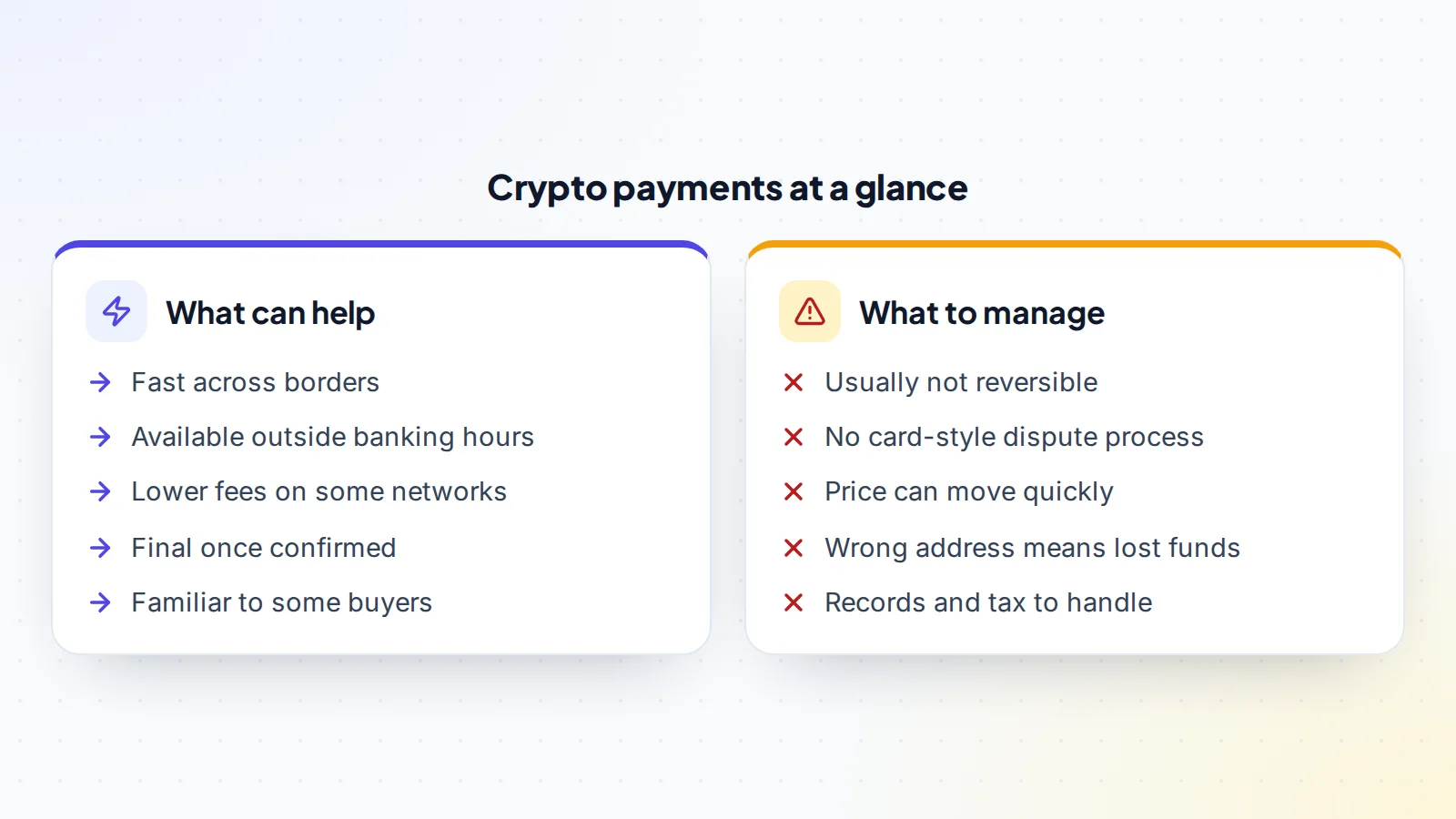
Payments are usually final. The US Federal Trade Commission explains that cryptocurrency payments typically are not reversible: once you pay, you can usually only get your money back if the person you paid sends it back. Credit and debit cards, by contrast, have legal protections and a dispute process. For a buyer, that means paying a stranger directly in crypto before receiving the business carries the full risk of non-delivery.
Scammers prefer it. The FTC warns that only scammers demand payment in cryptocurrency, and lists insistence on crypto among common warning signs. A legitimate seller may accept crypto, but one who refuses every other method, or pushes for payment before any checks, deserves caution. Our guide to digital asset scams covers the patterns.
Prices move. The value of many coins can change significantly between agreeing a deal and sending payment. Without a clear rate agreement, one side can end up with much less than expected.
Mistakes are permanent. Sending to a wrong address, or on the wrong network, can mean the funds are lost.
Records and tax. The IRS says digital assets are treated as property for US tax purposes, so using them to pay can itself be a taxable event for the buyer, and the seller needs to record the value received. Other countries have their own rules.
Pricing the deal
Agree the price in a national currency first, such as US dollars, then agree how it converts to crypto:
- Which coin and which network, written exactly.
- Which exchange rate source, such as a named exchange, and at what time.
- How long the rate holds, and what happens if payment arrives later.
- Who pays network fees.
Some parties use stable-value coins to reduce price movement during the deal, but these carry their own risks; understand any coin before you use it.
Structuring a safer crypto deal
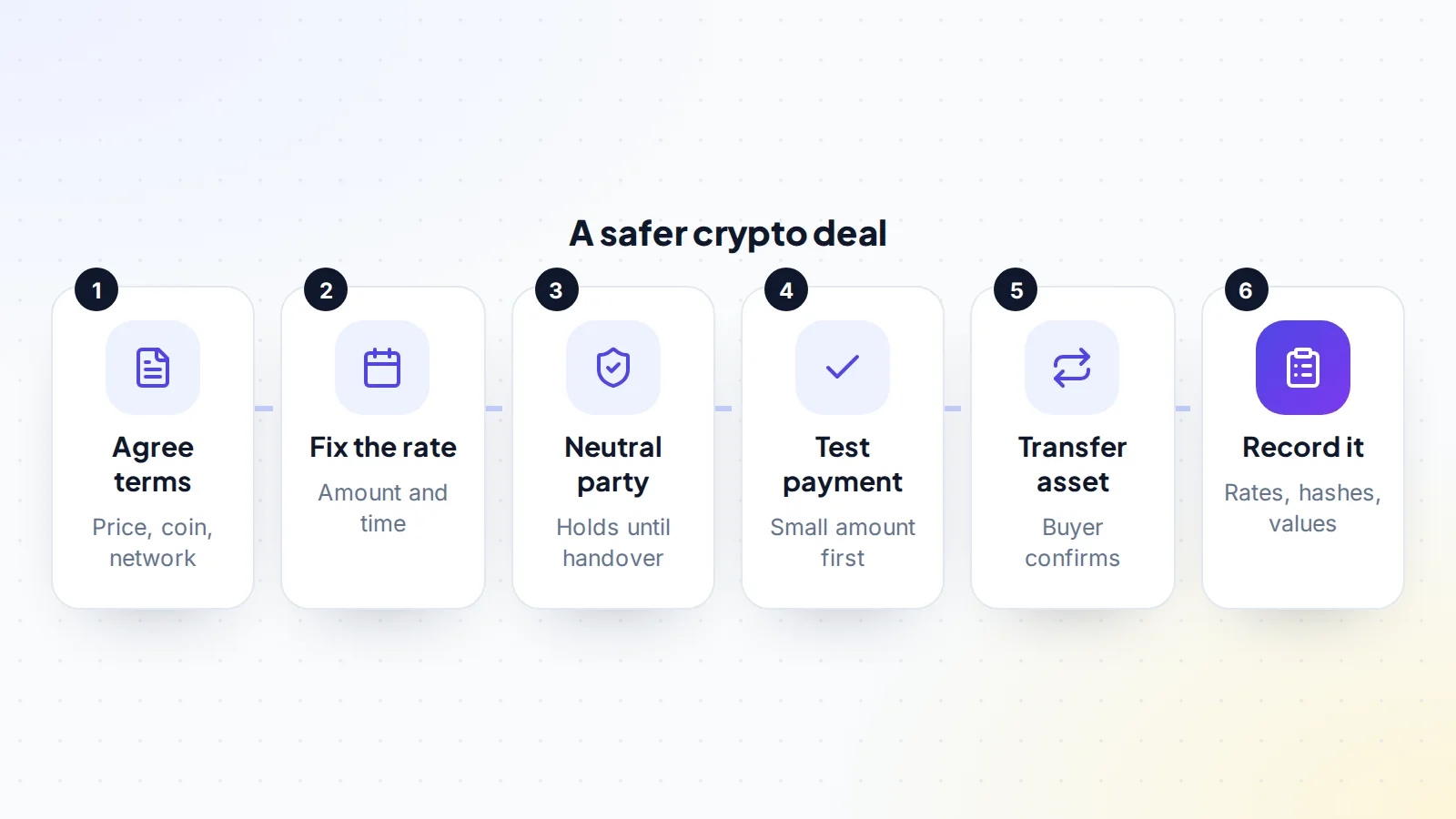
The safest structure is the same as for any payment: the money is held by a neutral party until the asset is transferred and confirmed. If you plan to pay with crypto for business assets, ask whether the escrow service or middleman you’re using accepts crypto, how they hold it and how they release it. If no neutral party is available, consider whether a different payment method would protect both sides better, or split the deal into stages so neither side carries the full risk at once.
Practical steps that prevent costly mistakes:
- Confirm the address on a call or through the platform, never only from an email or chat message that could be altered.
- Send a small test amount and confirm it arrived before sending the rest.
- Check the network matches on both sides.
- Record the transaction hash and the time for every payment.
Splitting the deal into stages
When no neutral party can hold crypto, some buyers and sellers reduce the risk by paying in stages tied to the handover. For example, a first payment when the domain moves, a second when the code and hosting move, and the final payment when the buyer confirms everything works. Each stage limits how much either side can lose if the deal stops. Write the stages, amounts and triggers into the agreement, and treat each payment with the same care: confirmed address, test amount, recorded hash. Staging is a fallback rather than a replacement for a neutral party, because someone still goes first at every step.
Wallet security
- Use a wallet you control, with its recovery phrase stored safely offline.
- Turn on two-step sign-in for any exchange account involved.
- Never share a recovery phrase or private key with anyone, including someone claiming to be support.
- Use address book entries or QR codes rather than typing addresses by hand.
- Check the first and last characters of every address before you send.
For sellers
Crypto’s finality removes chargeback risk, but you still need to be sure the funds are real and complete before handing over. Wait for the payment to reach the number of confirmations your wallet or exchange considers final. Check the full amount arrived, after fees. Don’t hand over anything based on a screenshot of a pending transaction. And record the value in your own currency at the time you received it.
For buyers
Your risk is non-delivery. Avoid paying a seller directly before the transfer unless a neutral party holds the funds. Verify the seller’s identity and history first, keep every message on the platform, and be wary of any seller who will only accept crypto or who pressures you to pay quickly. If you’re asked to pay outside the agreed process, stop and check.
What to agree before anyone sends
- The price in a national currency, and the crypto amount or formula.
- The exact coin and network, written out in full.
- The exchange rate source and the time it applies.
- Who holds the funds, and when they’re released.
- Who pays network and conversion fees.
- What happens if the payment is short, late or sent on the wrong network.
When another method is better
Crypto isn’t always the right tool. If neither side holds crypto already, converting to and from it adds cost, steps and price risk without much benefit. If no neutral party can hold the funds, a protected method such as escrow in a national currency usually serves both sides better. And if a seller will only accept crypto paid directly, before any checks, treat that as a warning sign rather than a preference.
Cross-border deals
Crypto is often suggested for international deals, where bank transfers can be slow and expensive. Cross-border deals have other considerations too: each side’s tax rules, any reporting requirements for large transfers, and how each side will convert crypto to their own currency afterwards. Exchanges usually verify customers’ identity and may ask about the source of large deposits, so keep the sale agreement and records ready to show. A little planning avoids funds being held while an exchange carries out checks.
Warning signs in a crypto deal
- The other side insists on crypto and refuses every other method.
- You’re pressed to pay quickly, before any checks.
- The wallet address changes in a late message or email.
- You’re offered a discount for paying directly instead of through a neutral party.
- The other side asks for your wallet recovery phrase or remote access to your device.
Any one of these is a reason to pause, check everything through the platform and, if needed, walk away.
On digiflippers.com
On digiflippers.com, the ways to pay in a deal are: directly to the seller, through escrow, and the platform never holds the money itself. Whatever method you agree, keep the terms and messages in the deal room, so there’s a clear record. Our guide to wire transfer safety covers a similar set of risks for bank transfers.
Keep good records
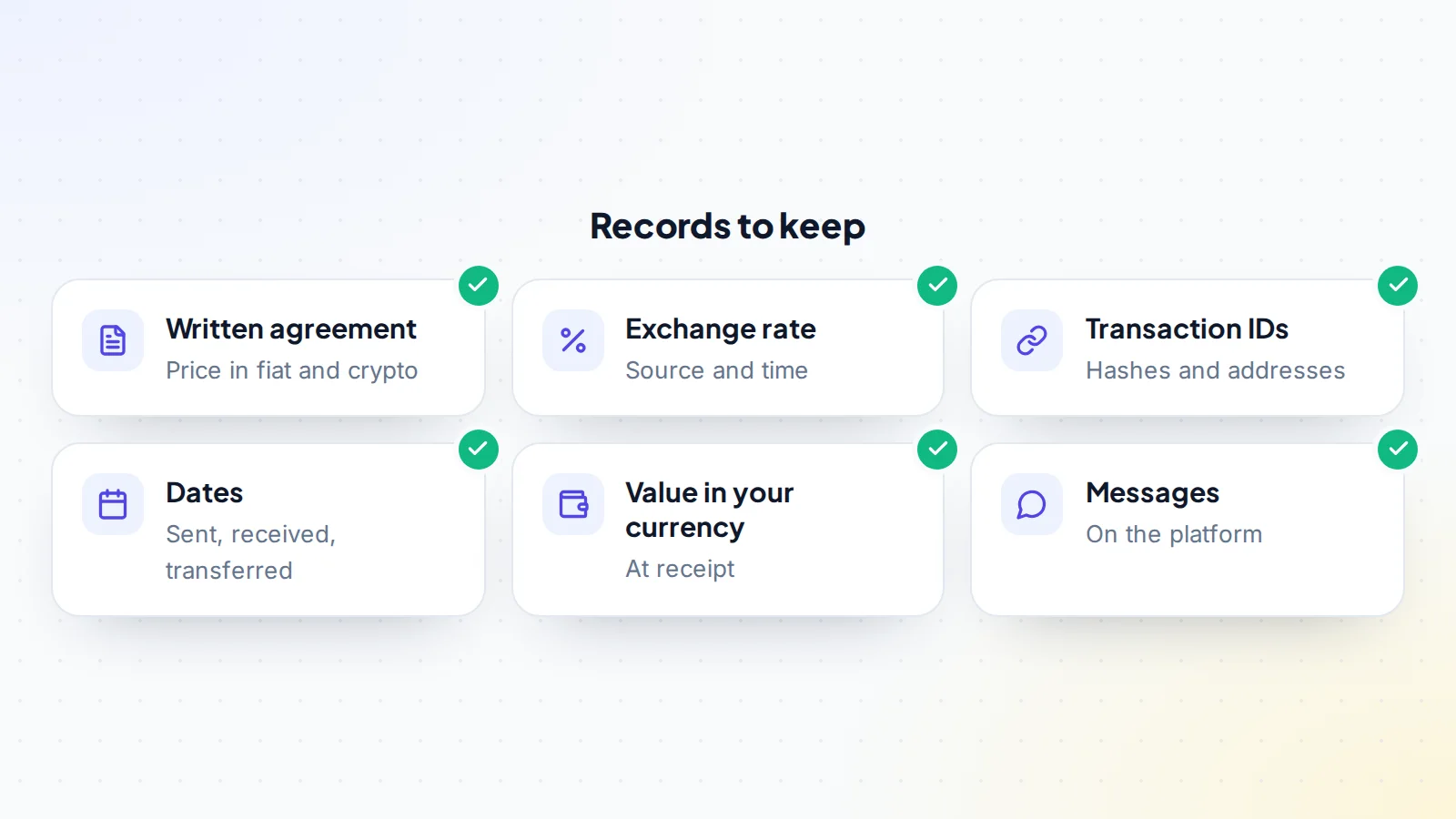
Records matter more with crypto than with most other payment methods. Keep the written agreement with the price in both currencies, the exchange rate source and time, every transaction hash and address, the dates of payment and transfer, and the value in your own currency when the payment was made or received. They help with tax returns and answer any later question about what was paid.
After the payment
Once the deal is complete, both sides should save the final records together: the agreement, the rate used, every transaction hash and the value in their own currency. Sellers converting to a national currency should note the conversion rate and any fees, because the difference between the value received and the value converted may matter for tax. Buyers should note the value of the crypto they gave up, since disposing of it may be a taxable event. If either side needs to prove the deal later, a clean, complete record makes it simple.
A worked example
The details below are made up to show the method.
Kai, a buyer abroad, wants to buy a small SaaS tool for $30,000 and would like to pay in crypto. The seller agrees, on condition that a middleman who accepts crypto holds the funds. They agree the price in dollars, the coin and network, an exchange rate from a named exchange at a fixed time, and that Kai pays network fees.
Kai sends a small test amount to the middleman’s address, confirmed on a call, then the rest. The middleman confirms receipt; the seller transfers the code, domain and accounts; Kai confirms; and the middleman releases the funds. Both sides record the rate, hashes and values for their taxes.
Pay with crypto for business: the checklist
- Price agreed in a national currency first.
- Coin, network, rate source, time and fees written down.
- Neutral party holding funds where possible.
- Address confirmed on a call or through the platform.
- Small test payment sent and confirmed.
- Full payment confirmed before the handover.
- Asset transferred and confirmed before release.
- Transaction hashes, rates and values recorded.
- Tax treatment checked with an adviser.
Ready to find your next asset?
Browse listings with verified numbers, ask sellers your questions before you offer, and agree every step in a free Deal Room.
Frequently asked questions
Can I buy an online business with crypto?
Yes, if the seller agrees. Agree the price, coin, network and rate in writing, and use a neutral party to hold funds where possible.
Can a crypto payment be reversed?
The FTC says crypto payments typically aren’t reversible; you can usually only get money back if the person you paid sends it back.
Is paying in crypto safer for sellers?
It removes chargeback risk, but sellers should still wait for full confirmation and check the full amount arrived before handing over.
How do I handle price changes during the deal?
Agree the price in a national currency, then fix the exchange rate source and time, and say what happens if payment arrives late.
Is a crypto payment taxable?
In the US, the IRS treats digital assets as property, so using them can be taxable. Rules differ by country; ask an accountant.
What’s the biggest mistake to avoid?
Paying a stranger directly before the asset is transferred. Use a neutral party or a payment structure that protects both sides.
Should I accept a screenshot as proof of payment?
No. Check the transaction yourself on the blockchain or in your wallet, and wait for the confirmations your wallet or exchange treats as final.