
How Much Is an Instagram Account Worth?
How much an Instagram account is worth: the two pricing methods, the numbers buyers check, the factors that raise or lower value, and a worked example.

Two Instagram accounts can have the same follower count and very different prices. What buyers pay for is attention: how many people see the posts, how they respond, who they are and whether the account earns money that will continue under a new owner. Working out Instagram account value means looking past the headline number to the things that make an audience worth having. This guide explains the two main pricing methods, the factors that move the price, and a worked example.
If you’re preparing to sell, read this alongside our guide on how to sell an Instagram account. If you’re buying, our buyer’s checklist covers the checks.
Key takeaways
- Earning accounts are usually priced as a multiple of average monthly net profit that will continue.
- Growing accounts are priced on reach, engagement, niche and audience, compared with similar sales.
- Reach and engagement in Insights matter more than the follower count.
- Income tied to the seller personally is usually discounted.
- Verified numbers and a clean handover support a higher price.
Two ways to price an account
Earning accounts. If the account makes money from brand partnerships, its own products or affiliate links, buyers usually start with average monthly net profit over the last 6 to 12 months, after costs such as editing help and tools. They multiply it by a figure that reflects how reliable and transferable the income is.
Growing accounts. If the account earns little or nothing yet, there’s no profit to multiply. Buyers look at reach, engagement, niche and audience instead, and compare with similar accounts that have sold. Our guide to pre-revenue valuation explains how assets without income are priced.
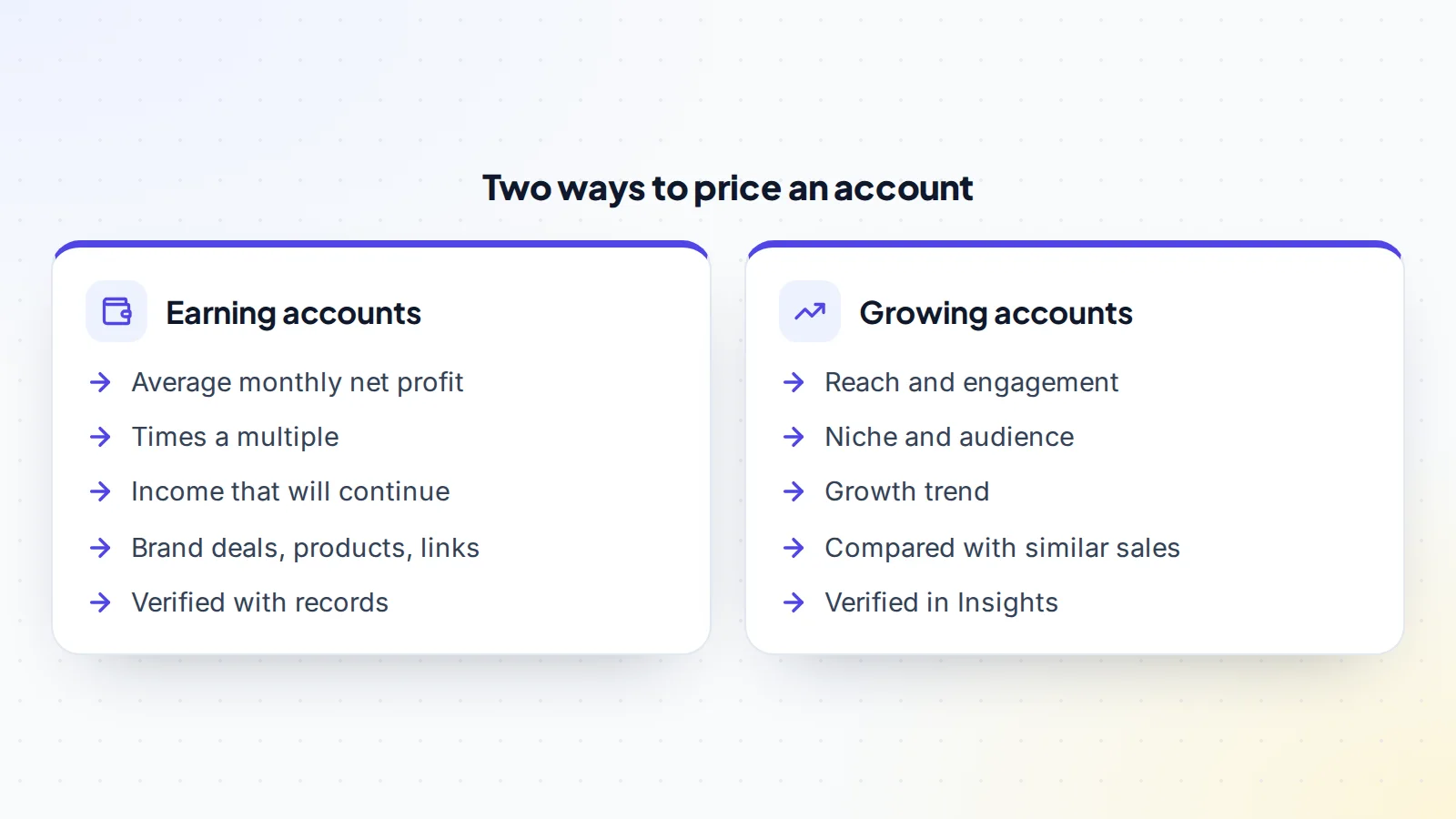
Many deals combine both: profit sets a floor, and a strong audience in a valuable niche adds to it. Whichever method you use, write down the numbers and reasons behind the price, so both sides can see how it was reached.
How the multiple is chosen
For earning accounts, the multiple turns monthly profit into a price. It’s not a fixed number; it reflects how confident a buyer can be that the profit will continue. Buyers move it up for steady income from several sources, strong engagement, a focused niche, consistent growth and content that a new owner can keep producing. They move it down for income tied to the seller, a recent dip, an audience in regions brands value less, or a single sponsor carrying most of the income. Our guide to valuation multiples explains the reasoning in more depth.
Because social accounts depend on a platform the owner doesn’t control, buyers often apply more caution than they would for a website with several traffic sources. An account that links to a website or email list has a home outside the app, which some buyers value.
Different kinds of accounts
- Creator accounts built around one person can have loyal audiences, but much of their value may leave with the creator. Buyers look for content and income that can continue without them.
- Brand and product accounts tied to a shop or product often transfer well, because followers came for the products.
- Theme and community pages built around a topic, such as recipes, quotes or local news, are usually the easiest to hand over, since the content style matters more than the person behind it.
Knowing which kind you’re dealing with is the first step in judging Instagram account value realistically.
Reach and engagement
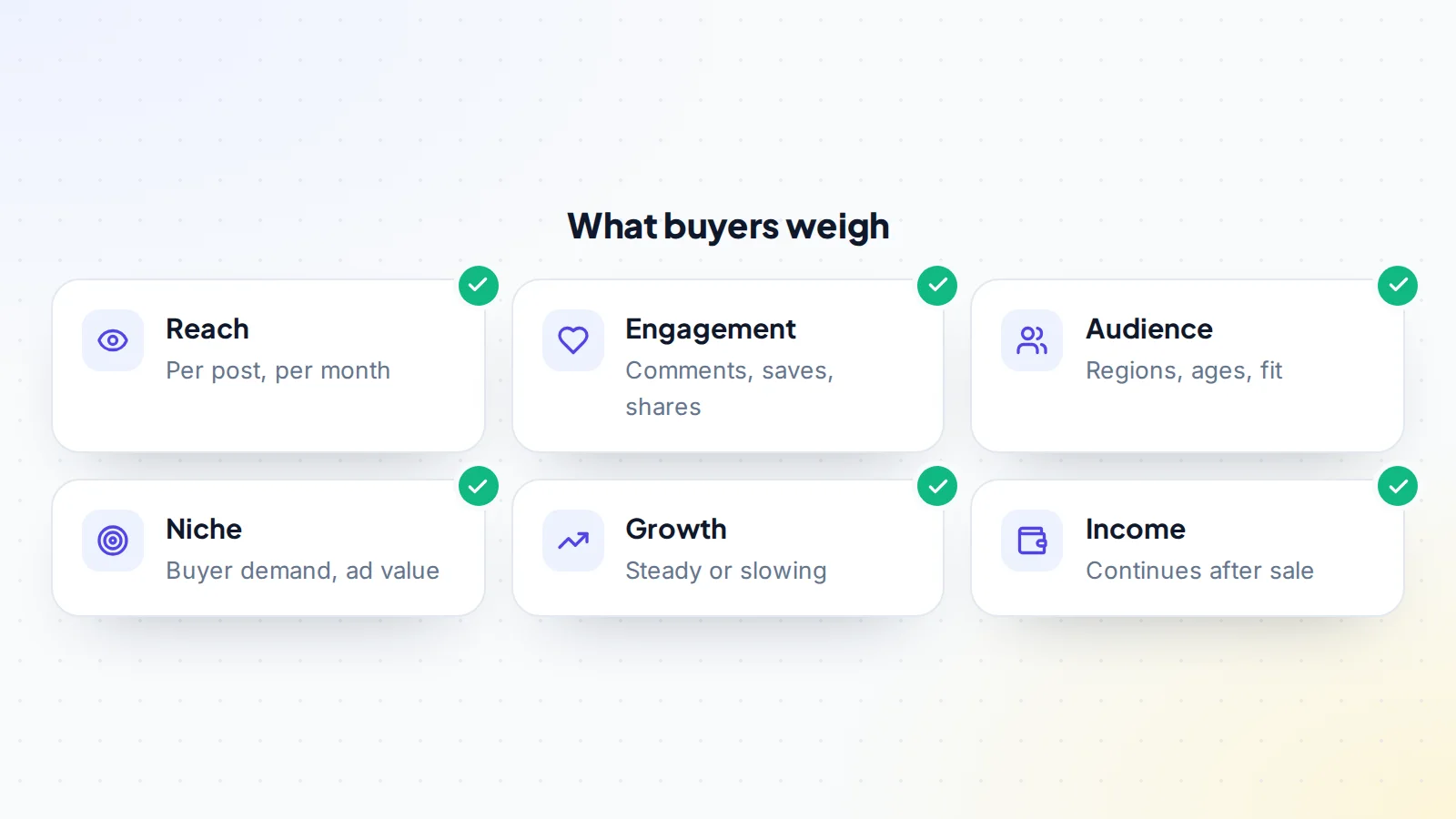
Instagram’s Insights, available on professional accounts, show accounts reached and accounts engaged, along with details for posts, Reels and Stories. These are the numbers buyers trust most, because they show how many followers actually see and respond to the content.
- Reach: average accounts reached per post and per month. Strong reach compared with the follower count is a sign of an active audience.
- Engagement: comments, saves and shares say more than likes. Comments that discuss the post and saves for later use show real interest.
- Consistency: typical posts that perform near the average are worth more than one viral post carrying the numbers.
Our guide to engagement rate explains how to calculate and compare it.
Audience and niche
Who follows the account matters as much as how many. Insights show top locations and age ranges. An audience concentrated in regions and age groups that brands want to reach, in a niche with buying intent, such as finance, fitness, travel or home, is usually worth more than a general audience. A clear, focused niche is also easier for a new owner to keep feeding with content.
Income and how it transfers
Buyers value income that will continue after the sale. Look at each source:
- Brand partnerships: recurring deals are worth more than one-offs. Partnerships built on the seller’s personal relationships or face may not continue, so buyers discount them.
- Products: a shop, presets, templates or courses that come with the account usually transfer well.
- Affiliate links: many affiliate accounts belong to a person and need replacing, but the audience’s buying habits carry over.
Verify each source with invoices, payout reports or dashboards shown live.
Growth and history
A steady growth curve over months suggests a healthy account. Sudden jumps in followers on days with nothing special posted deserve questions; our guide to spotting fake followers explains what to check. Instagram’s “About this account” screen shows when the account joined and its former usernames, which buyers use to confirm the story behind the account.
The content library
An account’s past posts keep working: they appear in searches, on profile visits and in shares long after they were published. A large library of evergreen posts, such as tutorials, guides and saved-worthy carousels, gives a new owner something to build on and reuse. Ask whether original files, templates and captions come with the account, because they make it much easier to keep the style consistent. Content that relies on music, images or clips the seller licensed personally may need to be replaced, so check what can be reused.
What raises the value
- Strong, steady reach and engagement for the follower count.
- A focused niche with an audience brands want.
- Several income sources that will continue.
- Content that doesn’t depend on the seller’s face or voice.
- A complete handover, including the account email and content files.
- Verified numbers shown live in Insights.
What lowers the value
- Low reach compared with the follower count.
- Recent sharp drops in reach or engagement.
- An audience far from the niche or the buyer’s market.
- Income tied to the seller personally.
- Unexplained follower spikes or many inactive followers.
- An email or two-factor setup that can’t be handed over.
Common valuation mistakes
- Pricing on followers rather than reach and engagement.
- Using a single best month of income instead of an average.
- Counting income that depends on the seller as if it will continue.
- Ignoring the time the account needs each week.
- Forgetting the costs of content, editing and tools.
Questions that test the value
- What do typical posts reach, compared with the best?
- How have reach and engagement changed over the last six months?
- Which income sources will continue with a new owner, and how do we know?
- How many hours a week does the account take, and on what?
- What would a new owner need to keep posting in the same style?
Honest answers to these questions narrow the range quickly. Sellers who can answer them with evidence usually get offers at the higher end of their Instagram account value range.
A worked example
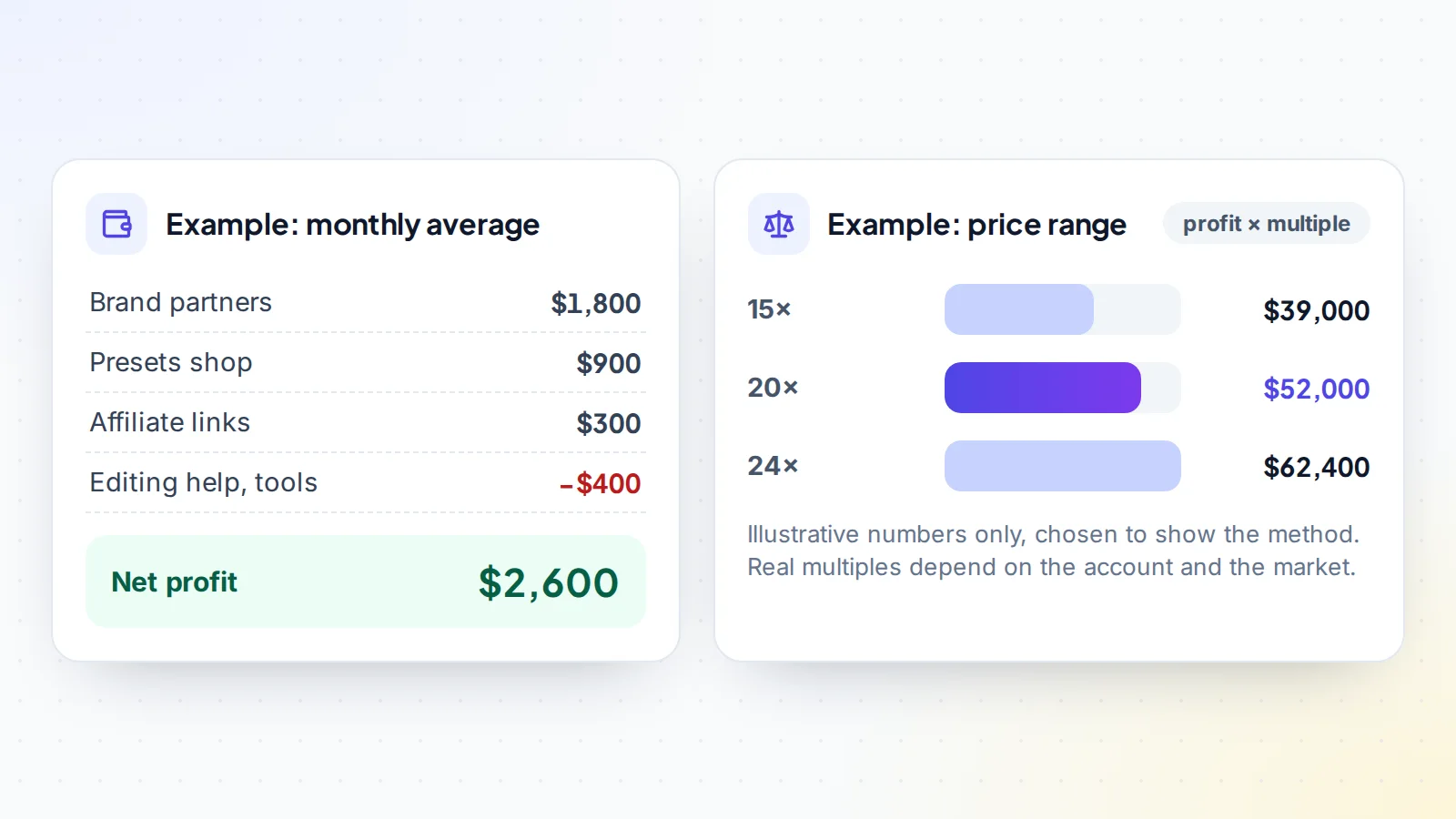
The numbers below are made up to show the method.
A travel photography account has 60,000 followers. Over the last 90 days, posts reached about 12,000 accounts each on average, and saves and shares are strong. The account earns $1,800 a month from two recurring brand partners, $900 from a presets shop and $300 from affiliate links, with $400 a month spent on editing help and tools, leaving $2,600 in net profit.
The buyer and seller agree that one brand partner is tied to the seller personally and may not continue, so they settle near the middle of the range rather than the top. The presets shop and the audience’s strong engagement support the rest of the price.
Time and running costs
Every account takes work: planning posts, creating or sourcing content, editing, captions, replying to comments and messages, and managing brand deals. Buyers price that time in. An account that needs ten hours a week from a skilled creator is worth less to most buyers than one that runs on a simple content system in three hours. List every regular cost too, such as editing software, stock content, scheduling tools and freelance help, and subtract them before you calculate profit. Our guide to owner hours shows how time affects the price.
Preparing your numbers as a seller
Before you ask anyone for an offer, put your numbers in one place: Insights for 30 and 90 days, monthly income by source for the last 6 to 12 months, monthly costs, hours per week and a list of what’s included. Note anything unusual, such as a viral post or a one-off sponsorship, so buyers don’t have to discover it themselves. Clear numbers make it easy for buyers to agree with your price, and they shorten the time to a deal.
How buyers avoid overpaying
Buyers protect themselves by checking numbers live, agreeing a checking period after the handover, and paying through escrow or a middleman so the money is only released once the account is fully theirs. For accounts where income depends on brand partners continuing, some buyers agree to pay part of the price later, once the partners confirm. These terms let both sides agree a fair price even when some value is uncertain.
Using a valuation tool
A quick estimate helps both sides start from the same place. The valuation tool on digiflippers.com gives a range from your numbers, and shows which factors move it most. Treat it as a starting point, then adjust for the risks and strengths above. Our guide to valuation calculators explains how to read the results.
Getting the price you deserve
Sellers who prepare get better offers: gather Insights for 30 and 90 days, income records and a clear list of what’s included, and show the numbers live to serious buyers. On digiflippers.com, you can list your account; selling comes with no success fee, so you keep 100% of the sale price. The ways to pay in a deal are: directly to the seller, through escrow, and the platform never holds the money itself. Buyers who pay through a protected method and see verified numbers are usually willing to pay more.
Instagram account value: the checklist
- Pricing method chosen: profit-based, reach-based or both.
- Net profit averaged over 6 to 12 months, after costs.
- Reach and engagement for 30 and 90 days from Insights.
- Audience regions, ages and niche fit reviewed.
- Each income source checked for continuity after the sale.
- Growth history and “About this account” checked.
- Strengths and risks listed and reflected in the multiple.
- Range compared with similar sales.
Ready to find your next asset?
Browse listings with verified numbers, ask sellers your questions before you offer, and agree every step in a free Deal Room.
Frequently asked questions
How much is an Instagram account worth?
Earning accounts are usually priced as a multiple of continuing monthly net profit. Growing accounts are priced on reach, engagement, niche and audience compared with similar sales.
Does the follower count set the price?
Not on its own. Reach and engagement show how many followers still see and respond to posts, which is what buyers pay for.
Which niches are worth more?
Niches where audiences buy things and brands advertise tend to attract more interest from buyers, but every account is judged on its own reach, engagement and income.
Do brand deals add to the value?
Recurring deals that will continue with a new owner do. Deals tied to the seller personally are usually discounted.
How do buyers verify the numbers?
By watching the seller open Insights live on a screen-share, and by checking income records and payouts.
Can I get a quick estimate?
Yes. A valuation tool gives a starting range from your numbers, which you then adjust for risks and strengths.
How many hours a week should I factor in?
Use the seller’s real figure. Buyers value an account that needs fewer hours more highly, and add the cost of help if they’ll hire someone.