
Digital Real Estate Explained: Owning Assets Online
What people mean by digital real estate, the main types of online assets, how they produce income, how they're valued and what makes them different from property.
“Digital real estate” is a popular way to describe online assets that can be owned, improved, rented out in a sense and sold: domains, websites, apps, audiences and digital products. The comparison with property is useful because it captures the idea of an asset that can produce income and change hands. It also hides important differences. This guide explains what digital real estate really means, the main types, how they earn and are valued, and what to understand before you buy.
If you’re new to the idea, our guide to what a digital asset is is a good companion.
Key takeaways
- Digital real estate means online assets that can be owned, earn income and be sold.
- Main types include domains, websites, SaaS and apps, audiences, digital products and game assets.
- Most earn by turning attention into income: ads, sales, subscriptions or partnerships.
- Profitable assets are usually valued as a multiple of monthly net profit.
- Platforms, registrars and search engines set many of the rules, which adds risks property doesn’t have.
What “digital real estate” means
The phrase borrows from property: you acquire an asset, improve it, earn from it and eventually sell it, often to someone who will improve it further. A domain is like a plot of land with a good address. A website built on it is like a building. Visitors are like footfall, and advertising, affiliate commissions or product sales are like rent. The analogy helps people new to online businesses see that these assets can be bought and sold like any other.
It’s an informal term, not a legal category. In US tax law, for example, the IRS uses “digital assets” to mean things recorded on a blockchain, such as cryptocurrencies and NFTs, which is a different thing from a website or domain. Our guide to the creator economy covers how audiences fit into the picture.
The main types
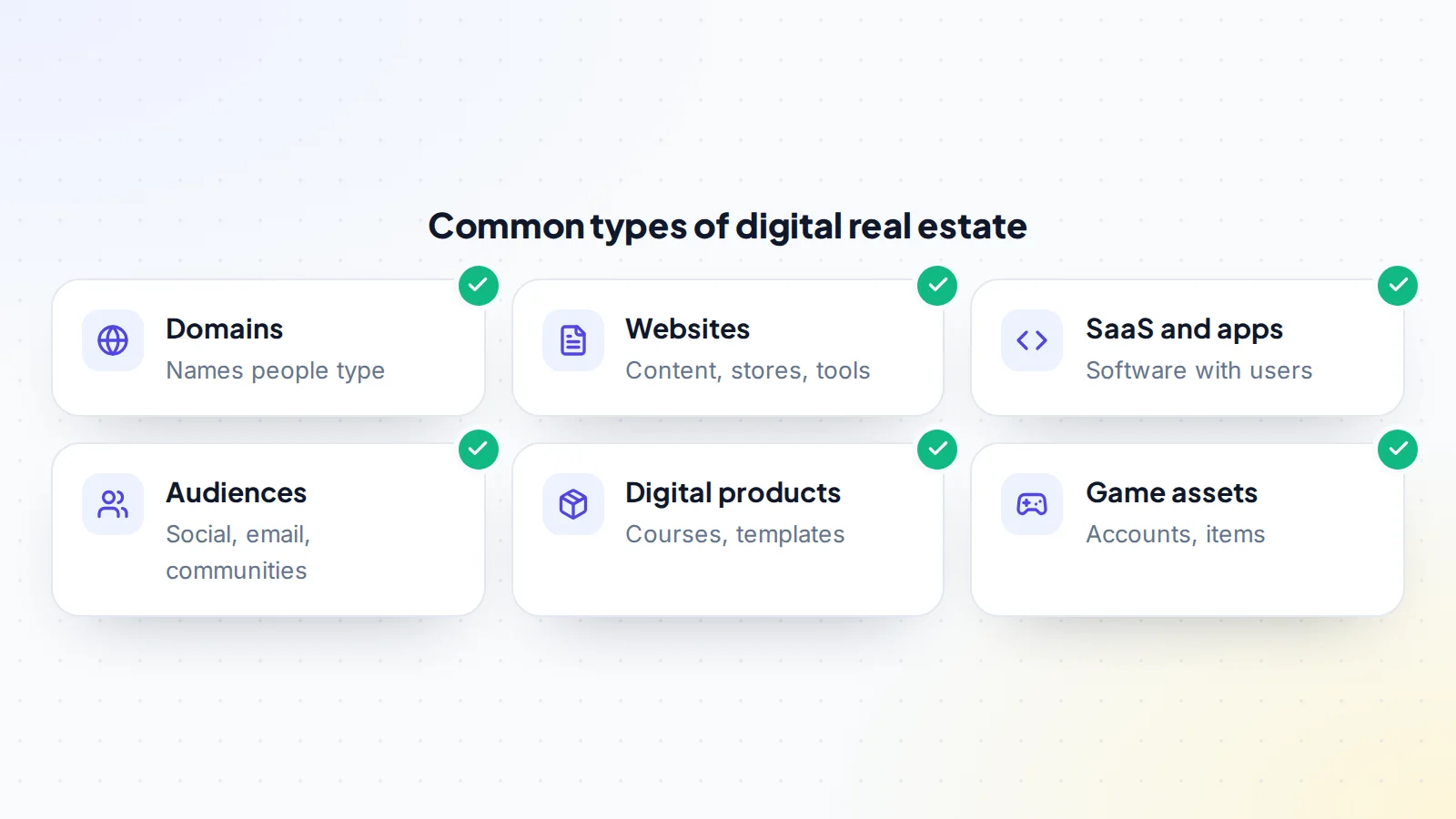
- Domains: names people type or remember. Valuable ones are short, clear and in demand. You register a domain through a registrar under ICANN’s rules rather than owning it outright, and you keep it by renewing it.
- Websites: content sites, e-commerce stores and online tools that earn from ads, affiliate links, product sales or leads.
- SaaS and apps: software with users and, often, subscriptions.
- Audiences: social media accounts, email lists, newsletters and communities.
- Digital products: courses, templates, ebooks and other files sold repeatedly.
- Game assets: accounts and items with value to players.
How digital real estate earns
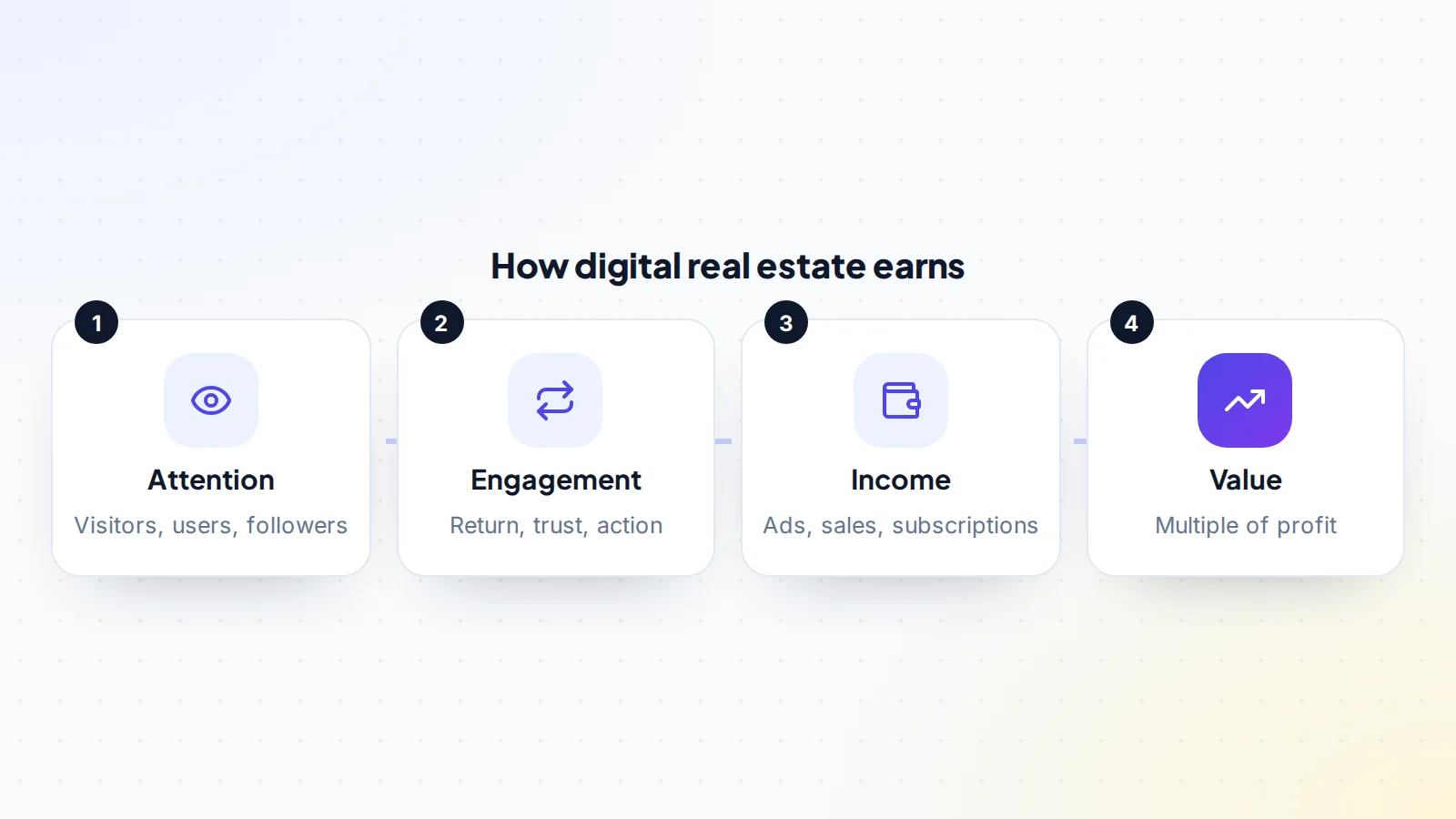
Most online assets earn by attracting attention and turning it into income. A content site attracts visitors through search and earns from ads and affiliate commissions. A store converts visitors into customers. A SaaS product turns users into subscribers. An audience earns from sponsorships and products. The stronger and more loyal the attention, the more reliable the income, and the more a buyer will pay for it later. Our guide to passive income from online businesses looks at how hands-off that income really is.
Four common strategies
- Build: register a name and create the asset yourself. Cheapest in money, most expensive in time, and slowest to earn.
- Buy and hold: buy an asset that already earns and keep it for the income, maintaining it as you go.
- Buy and improve: buy an asset with clear room to grow, improve content, conversion or products, and either keep it or sell at a higher value.
- Flip: buy, make quick improvements and resell. It can work, but small margins and transaction costs leave little room for mistakes.
Many owners combine these over time. Our guide to buying vs starting compares the first two in detail.
How it’s valued
Profitable online assets are usually valued as a multiple of average monthly net profit, adjusted for how steady, diverse and transferable that profit is. Assets without much income, such as domains or early-stage sites, are priced on comparable sales, demand and potential. Our guide to valuation calculators explains how estimates work, and you can try the valuation tool on digiflippers.com.
How it differs from property
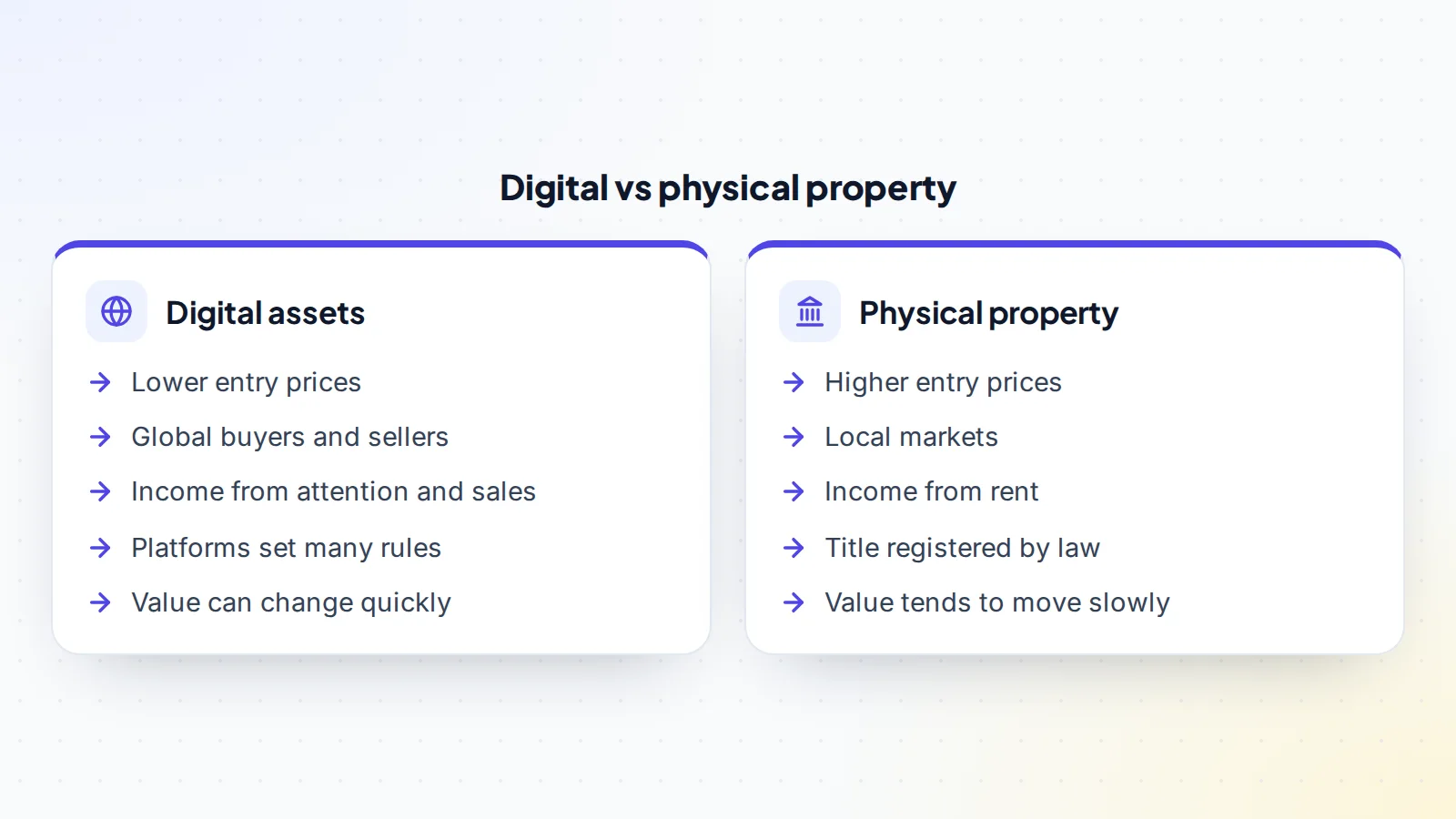
The property comparison breaks down in a few important places:
- Rules set by others: search engines, social platforms, app stores and registrars set rules that can change your traffic or access. A landlord’s building doesn’t lose half its tenants because a search engine changed.
- Speed of change: online assets can gain or lose value quickly.
- Maintenance is work, not repairs: content goes out of date, software needs updates and audiences need attention.
- Ownership is often a set of accounts: a business may be a domain, hosting, email list, payment accounts and social profiles, each with its own rules about transfer.
- Lower entry prices: small assets can be bought for far less than physical property, which makes it easier to start, learn and make mistakes on a small scale.
Time horizon
Physical property is often held for decades. Online assets usually move faster: many owners hold a site or app for a few years, grow it and sell, then buy something larger. Others keep a small portfolio for steady income. Decide early which approach suits you, because it shapes what you buy. If you plan to sell in two years, focus on assets where your improvements will show clearly in the numbers buyers check. If you plan to hold, focus on durable income and low maintenance.
Skills that help
Owners who do well with online assets usually bring at least one relevant skill: writing, marketing, search, product, development, design or operations. You don’t need all of them; you can hire for the rest. But matching the asset to your strengths makes it easier to improve, and easier to judge which listings have real potential and which only look good on paper.
Risks to understand
- Platform dependence: heavy reliance on one search engine, platform or partner. See our guide to concentration risk.
- Verification: numbers can be exaggerated; buyers must check them.
- Transfer rules: some platforms don’t allow accounts to change hands, or set conditions.
- Scams: fake listings, fake escrow and impersonation target buyers and sellers.
- Owner dependence: some assets rely heavily on the seller’s skills or identity.
How owners add value
Unlike most physical property, online assets can often be improved quickly and cheaply. Common improvements include refreshing and expanding content, improving page speed and design, adding an email list, testing better offers or prices, adding new income sources and reducing the time the asset needs to run. Each improvement that raises steady profit, or makes it more reliable, can raise the value by a multiple of that change. That’s why buyers with relevant skills often see more potential in an asset than its seller did.
Spreading risk
Because online assets can be affected by a single platform change, owners who hold several often spread them across types, niches and traffic sources: a content site, a newsletter and a small digital product business, for example, rather than three sites relying on the same search traffic. Diversifying doesn’t remove risk, but it means one change is less likely to affect everything at once.
Records and taxes
Treat online assets as a business from the start. Keep records of what you paid, what you spent on improvements, what you earned and what you sold for. Tax treatment depends on where you live and how you hold the assets, so speak to an accountant. Good records also make selling easier, because buyers want to see clear numbers.
Beginner mistakes
- Buying on a headline number without verifying traffic and income.
- Underestimating the time an asset needs.
- Putting all your money into one asset with no reserve.
- Relying on one platform for all traffic or income.
- Paying outside a protected payment method.
Domains: the land of the internet
Domains are the closest thing online to a plot of land. A short, memorable name can be valuable on its own, before anything is built on it. But a domain is registered, not owned outright: you hold it for as long as you renew it, under your registrar’s terms and ICANN’s policies. If a registration lapses, ICANN’s renewal and expiration rules describe grace periods in which the owner can usually still restore it, after which the name can become available to others. Owners of valuable names set them to renew automatically and keep their registrar account secure. Our guide to expired domains explains the cycle.
Audiences as an asset
An engaged audience, whether on a social platform, an email list or a community, can be one of the most valuable online assets, because it gives direct access to people who chose to listen. It’s also one of the most dependent on others: platforms control reach, and audiences follow people as much as brands. Owners who build audiences across more than one channel, especially an email list they control, usually have a more durable asset.
Where these assets are bought and sold
Online assets change hands on marketplaces, through brokers and in private deals. Marketplaces bring buyers and sellers together with listings, profiles and protected payment options. Our guide to selling an e-commerce business shows the selling side, and on digiflippers.com you can also list an asset when you’re ready to sell.
Questions to ask about any asset
- How does it earn, and how steady is that income?
- Where does its attention come from, and how concentrated is it?
- How much time does it need each week?
- What exactly would I own, and can every part transfer?
- What would I do to improve it?
Getting started
- Learn the types and choose one or two you understand.
- Set a budget, keeping money aside for running costs and surprises; our guide to the budget for a first purchase helps.
- Watch listings to learn normal prices.
- Do due diligence: verify traffic, income and ownership.
- Pay safely with escrow or a middleman.
- Plan to improve the asset, not just hold it.
Browse the marketplace on digiflippers.com to see the range of assets for sale. The ways to pay in a deal are: directly to the seller, through escrow, and the platform never holds the money itself.
A worked example
The details below are made up to show the method.
Omar buys a short, brandable domain for a modest sum and builds a small site about home coffee brewing. Over two years, Omar publishes helpful guides, grows an email list and earns from affiliate links and a simple digital product. When the site makes a steady monthly profit, it’s worth a multiple of that profit, far more than the domain alone. The site is sold on a marketplace with verified numbers and the proceeds go towards a larger site. That’s the digital real estate cycle: acquire, improve, earn and sell.
Digital real estate: the checklist
- Types of asset understood, with one or two chosen.
- Budget set, with reserves for running costs.
- Prices learned from current listings and sales.
- Platform rules and transfer terms checked.
- Traffic, income and ownership verified.
- Concentration and owner dependence assessed.
- Payment protected with escrow or a middleman.
- Plan in place to maintain and improve the asset.
Ready to find your next asset?
Browse listings with verified numbers, ask sellers your questions before you offer, and agree every step in a free Deal Room.
Frequently asked questions
What is digital real estate?
An informal term for online assets that can be owned, earn income and be sold, such as domains, websites, apps, audiences and digital products.
Is digital real estate a good investment?
It can be, for buyers who understand the asset, verify the numbers and are willing to maintain and improve it. Like any investment, it carries risks.
How is digital real estate valued?
Profitable assets are usually valued as a multiple of monthly net profit; others on comparable sales, demand and potential.
Do you really own a domain?
You register it through a registrar under ICANN’s rules and keep it by renewing. In practice, the registrant has control of the name for as long as registration continues.
What are the biggest risks?
Dependence on platforms or search engines, unverified numbers, transfer restrictions, scams and heavy reliance on the seller.
How much do I need to start?
Much less than physical property. Small domains and starter sites can be bought for modest amounts, though larger, profitable assets cost more.
Can I start with no money?
You can build an asset yourself with very little money, though it takes time. Buying an existing asset needs capital, but gives you a head start.