
15 Ways to Increase Your Online Business’s Value Before Selling
Fifteen practical steps sellers can take in the months before listing to raise their online business's value, from tidy accounts to documented processes.

The price of an online business is set by two things: how much it earns, and how confident a buyer can be that it will keep earning. Most sellers focus on the first. The second is often where the easier gains are. If you want to increase business value before sale, the months before you list are your best chance to make the business cleaner, steadier and easier to hand over. This guide gives you fifteen practical steps, grouped by what buyers reward.
For how the price itself is calculated, see our guide to online business valuation, and for the listing stage, our guide to preparing a website for sale.
Key takeaways
- Buyers price on profit and on confidence; preparation mostly improves confidence.
- Start 6 to 12 months ahead, because buyers look at the last 12 months.
- Clean books, verified numbers and documented processes are the quickest wins.
- More income sources and fewer owner hours usually lift the multiple.
- A clear, complete handover plan removes reasons for buyers to discount.
Why preparation pays
Most online businesses are valued as a multiple of average monthly net profit over the last 12 months. The multiple reflects risk: the more a buyer has to assume, check or fix, the lower it goes. Preparation removes reasons to discount. It can’t change your history overnight, which is why starting early matters: changes you make now show up in the twelve-month figures buyers will study.
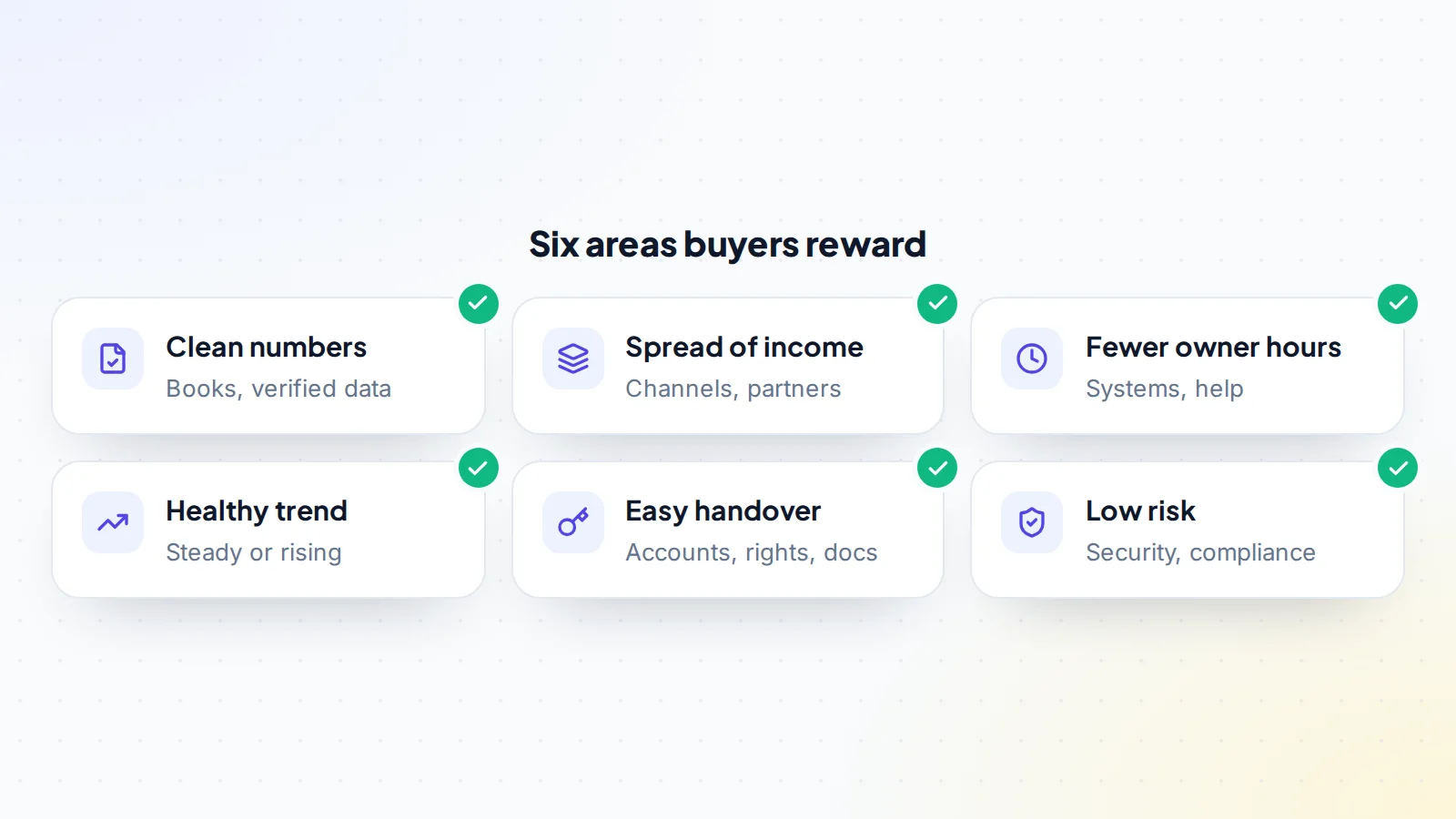
What buyers look at first
Before they ask a single question, most buyers scan a listing for a handful of things: twelve-month profit and its trend, where traffic and income come from, how many hours the business takes, how old it is and whether the numbers are verified. If those look solid, they dig deeper; if not, they move on or make a low offer. Every step below improves at least one of those first impressions, which is why they have such an effect on the final price.
Clean, provable numbers
1. Separate the business’s money
Run all income and costs through accounts used only for the business. Mixed personal and business spending makes profit hard to prove and invites discounts, because buyers can’t tell which costs they’ll inherit. Even if you’ve mixed them in the past, separating them now gives buyers clean months to look at.
2. Produce monthly profit and loss statements
Prepare a simple profit and loss statement for each of the last 24 months, matched to payouts and bank statements. Our guide to trailing twelve months profit shows how buyers will read it. Use the same categories every month, so trends are easy to spot.
3. Document add-backs honestly
Personal or one-off costs run through the business can be added back to profit, but only with evidence. Keep receipts and notes, and don’t add back costs a buyer will still have. Our guide to add-backs explains which ones buyers accept.
4. Make your data verifiable
Give buyers ways to check numbers without relying on screenshots: read-only analytics access, connected revenue sources, payout reports. Google Analytics, for example, lets you add users with a Viewer role. On digiflippers.com, sellers can verify key figures so buyers see which numbers are checked; our guide to verified metrics explains how.
A wider spread of income and traffic
5. Add a second income source
A business paid mostly by one affiliate programme, ad network or customer carries concentration risk. Adding a second partner, a product or a direct sponsor reduces it. Our guide to revenue diversification has ideas by business type.
6. Grow an owned audience
An email list, returning visitors and repeat customers are channels you control. Build the list with a useful sign-up offer and send to it regularly, so buyers can see it’s engaged. Keep a record of opens, clicks and the income it brings, and make sure subscribers agreed to hear from you, because buyers will check consent before they value a list.
7. Reduce dependence on one traffic source
Check the share of visits from your biggest channel in your analytics, such as the Traffic acquisition report in Google Analytics. If one search engine or social platform brings most of it, start building a second channel months before you sell. Our guide to traffic concentration risk explains how buyers price it.
8. Strengthen recurring revenue
For subscription businesses, buyers watch monthly recurring revenue and churn closely. Improving onboarding, offering annual plans and fixing the main reasons customers cancel all strengthen the numbers buyers care about most. Track churn monthly and keep a short note of what you changed and when, so buyers can see cause and effect.
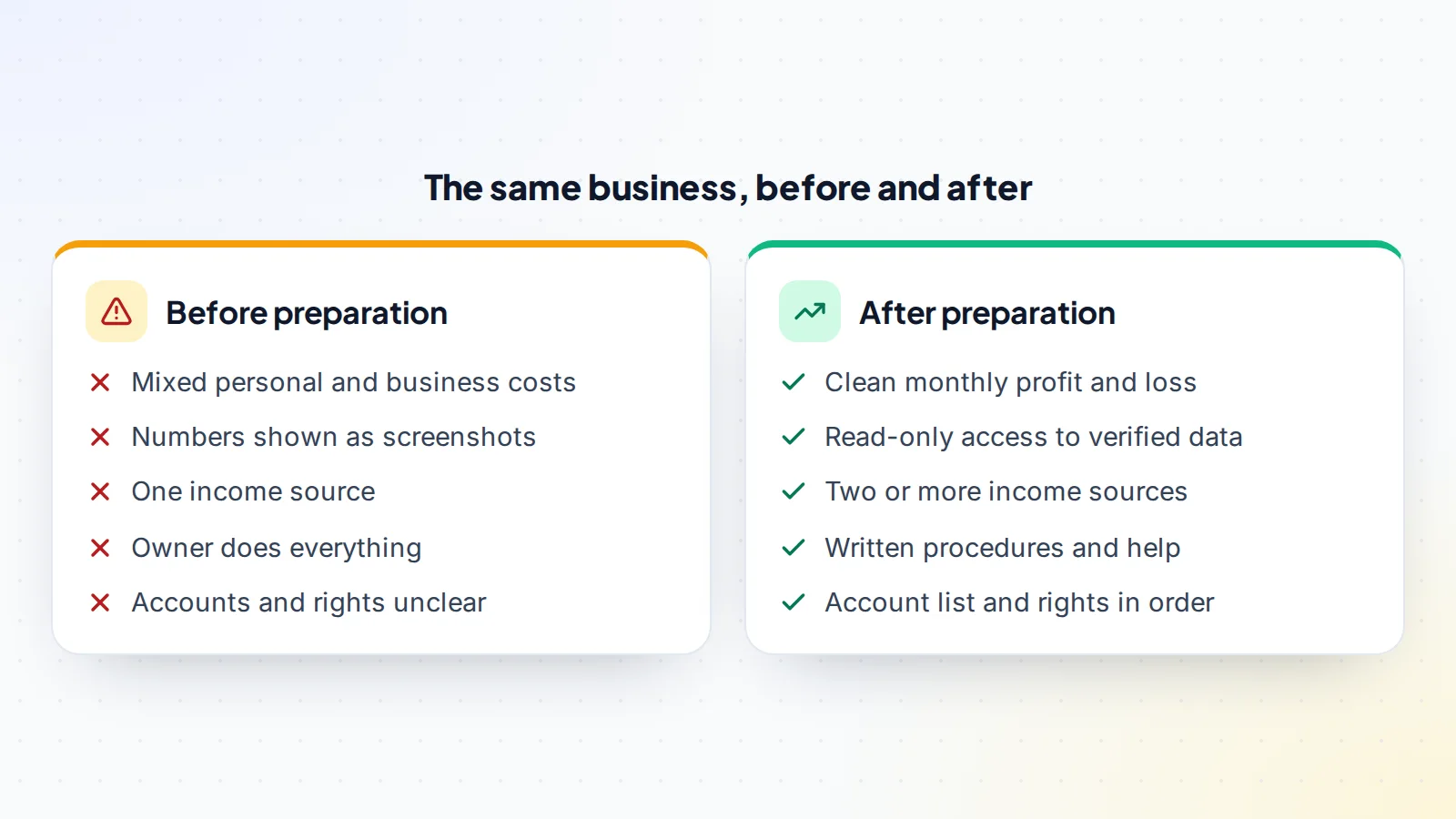
Less dependence on you
9. Write down how everything works
Standard operating procedures for publishing, customer support, fulfilment, ads and finances let a new owner run the business from day one. They also show you’ve built a system, not a job. Keep them short and practical: the steps, the tools, the logins needed (without the passwords themselves) and what good looks like. A simple shared folder of procedures is enough for most small businesses.
10. Reduce your hours
Buyers value the time the business needs. Automate repetitive tasks, use tools for scheduling and support, and delegate to freelancers where it makes sense. Record the new hours honestly. Our guide to owner hours explains why this matters.
11. Move relationships to the business
Suppliers, sponsors and partners who deal only with you personally are a risk to buyers. Introduce team members or a business email address into those relationships, so they’re less tied to you. Where you can, put arrangements in writing, so a buyer can see the terms they’d be taking over.
An easy, low-risk handover
12. Get rights and ownership in order
Make sure the business owns what it uses: written assignments from freelancers, licences for fonts and images, the domain in your name, and trademarks where relevant. Our guide to digital product IP covers the checks buyers will make.
13. Tidy accounts, access and security
List every account the business uses, with who holds it. Turn on two-step sign-in, remove old users and keep recovery details current. A clean account inventory makes the handover fast and reassures buyers. It also protects you while the business is listed, when it may attract more attention than usual.
14. Fix known problems
Broken pages, slow load times, outdated plugins, a cluttered email list or unanswered support tickets all give buyers reasons to negotiate. Fixing them before listing is usually cheaper than the discount they’d cause. Run through the business as a buyer would: visit the site on a phone, place a test order, send a support request and read your latest reviews.
15. Prepare the sale package
Gather everything a buyer will ask for: profit and loss statements, traffic data, a list of what’s included, your procedures, a summary of how the business grew and a short, honest reason for selling. Sellers who arrive prepared spend less time answering questions and give buyers fewer reasons to hesitate.
Priorities by type of business
- Content sites: traffic spread across many pages, a second income source, an email list and a clean content calendar.
- E-commerce stores: reliable suppliers with written terms, lower ad dependence, repeat customers and accurate stock records. Our guide to supplier checks shows what buyers will ask.
- SaaS and apps: lower churn, clean code and documentation, and billing that can move to a new owner. See our guide to selling a mobile app for app-specific steps.
- Social accounts and communities: steady reach and engagement, income that doesn’t depend on you personally, and moderators or editors who can stay.
Whatever the type, the aim is the same: to increase business value before sale by making results steadier and easier for someone else to continue.
Keep the business steady while it’s listed
Sales take time, and buyers watch the latest numbers. Keep publishing, answering customers and running campaigns at your usual rhythm while the business is listed. A dip during the sale process can undo months of preparation, and buyers may ask to renegotiate if results slip before closing.
Explaining the changes you made
Buyers will notice recent changes, such as a new income source or a freelancer taking on work. Explain them in your listing with dates and results, so buyers see a deliberate improvement rather than a puzzle. Be honest about anything still settling in: a second income source that has only run for three months is a positive sign, but buyers will give it less weight than a year-old one.
When to start
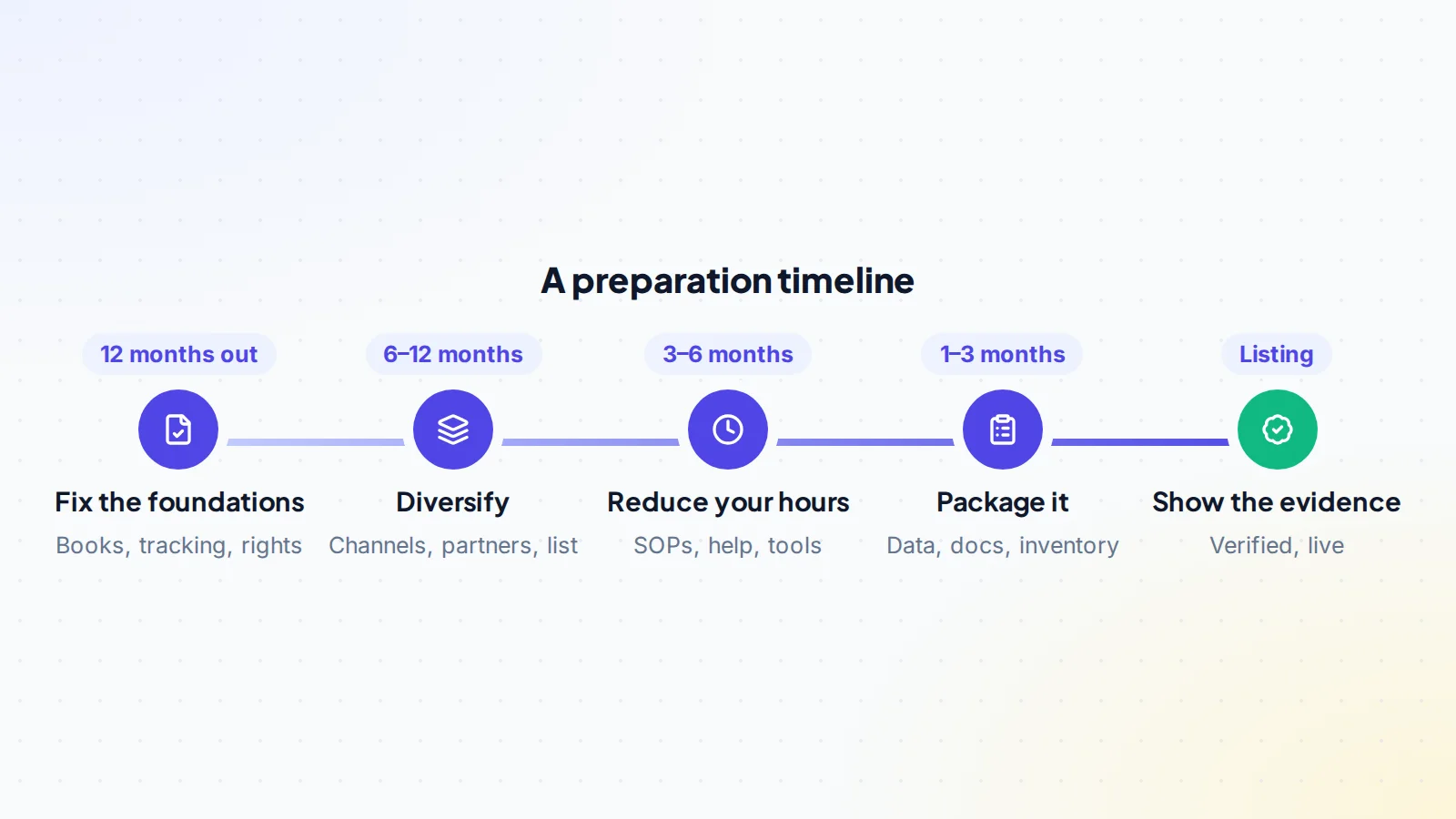
Ideally 12 months before you plan to sell, because buyers look at the last year of results. If you have less time, focus on the quick wins: clean numbers, verifiable data, documented processes, tidy accounts and fixed problems. Bigger changes, such as a second income source or fewer owner hours, take longer to show in the figures, but even a few months of evidence helps. If you’re already close to listing, it’s often better to list with an honest note about changes underway than to delay indefinitely.
Get a second opinion
Before you list, ask someone you trust, such as a fellow founder, an accountant or an experienced buyer, to look at your sale package as if they were buying. Ask them what would make them offer less. Their answers usually point straight at the last few things worth fixing.
What not to do
- Don’t cut essential costs just to inflate profit; buyers notice when content, ads or support stop.
- Don’t run unsustainable promotions that spike revenue before listing.
- Don’t hide problems; they come out in due diligence and damage trust.
- Don’t make big risky changes, such as a full redesign or platform move, right before selling.
A worked example
The numbers below are made up to show the method.
Ana runs a content site earning $4,000 a month in profit, with 85% of income from one affiliate programme and 15 hours a week of Ana’s time. A year before selling, Ana separates the business finances, writes procedures, hires a freelance editor and adds display ads and a second affiliate programme. Ana’s hours fall to six a week and the largest income source drops to 55%.
Profit stays about the same after the editor’s cost, but buyers see a steadier, easier business with verified numbers. Offers come in at a higher multiple than Ana had been quoted a year earlier, and the sale closes faster because the sale package answers most questions up front.
Increase business value before sale: the checklist
- Business finances separated from personal ones.
- Monthly profit and loss for 24 months, matched to payouts.
- Add-backs documented with evidence.
- Read-only access ready for analytics and revenue.
- Second income source and owned audience growing.
- Largest traffic channel’s share reduced or explained.
- Procedures written; owner hours reduced and recorded.
- Rights, licences and domain ownership in order.
- Account inventory and security tidied.
- Known problems fixed; sale package ready.
Ready to sell?
List it on digiflippers.com with verified numbers, answer buyers in one place and agree every step in a free Deal Room. No success fee.
Frequently asked questions
How can I increase my business’s value before selling?
Clean up your numbers and make them verifiable, add income sources, reduce your hours, document processes, sort out rights and accounts, and prepare a complete sale package.
How early should I start preparing?
Around 12 months ahead, because buyers look at the last year. Quick wins like clean numbers and documentation can be done in weeks.
What raises the multiple most?
Every buyer weighs things differently, but steady income from several sources, verified numbers and low owner hours are consistently valued.
Should I cut costs to boost profit?
Only costs that genuinely aren’t needed. Cutting content, support or ads that drive results tends to show up in the numbers and worries buyers.
Does verification really affect the price?
Buyers discount what they can’t check. Verified numbers remove that discount and make your asking price easier to defend.
Where should I list when I’m ready?
On digiflippers.com, you can list your business with no success fee, so you keep 100% of the sale price, and use the free valuation tool to check a price range.
Is it worth paying for help to prepare?
For larger businesses, an accountant to tidy the books and an adviser to review the sale package often pay for themselves. For small sites, most steps can be done yourself with the checklist here.