Operational Due Diligence: Processes, Tools and Contractors
How to review the day-to-day running of an online business before you buy: processes, tools and subscriptions, contractors, support, security and the handover plan.

Financial due diligence tells you what a business earned. Operational due diligence tells you whether it can keep earning once it’s yours. It looks at the day-to-day machinery: the processes, the tools, the people who do the work, the suppliers, customer support and security. Businesses that look identical on paper can be very different to run. This guide gives you a practical checklist for reviewing an online business’s operations before you buy.
It’s one part of a full review; see our guide to due diligence for online businesses for the whole process, and our red flags guide for warning signs.
Key takeaways
- Operational due diligence checks whether the business can run without the seller.
- Review processes, tools and subscriptions, contractors, suppliers, support and security.
- List every tool from bank statements, with its cost and whether the account can move.
- Talk to key contractors and suppliers before closing, with the seller’s introduction.
- Turn what you find into a written handover plan and deal terms.
Why operations matter
The profit figures in a listing assume the business keeps running the way it does today. That depends on the seller’s routines, the tools they pay for, the freelancers they rely on, the suppliers who ship, and the support that keeps customers happy. If any of these breaks during the handover, results can fall quickly. Operational checks find those dependencies in advance, so you can plan for them or price them in.
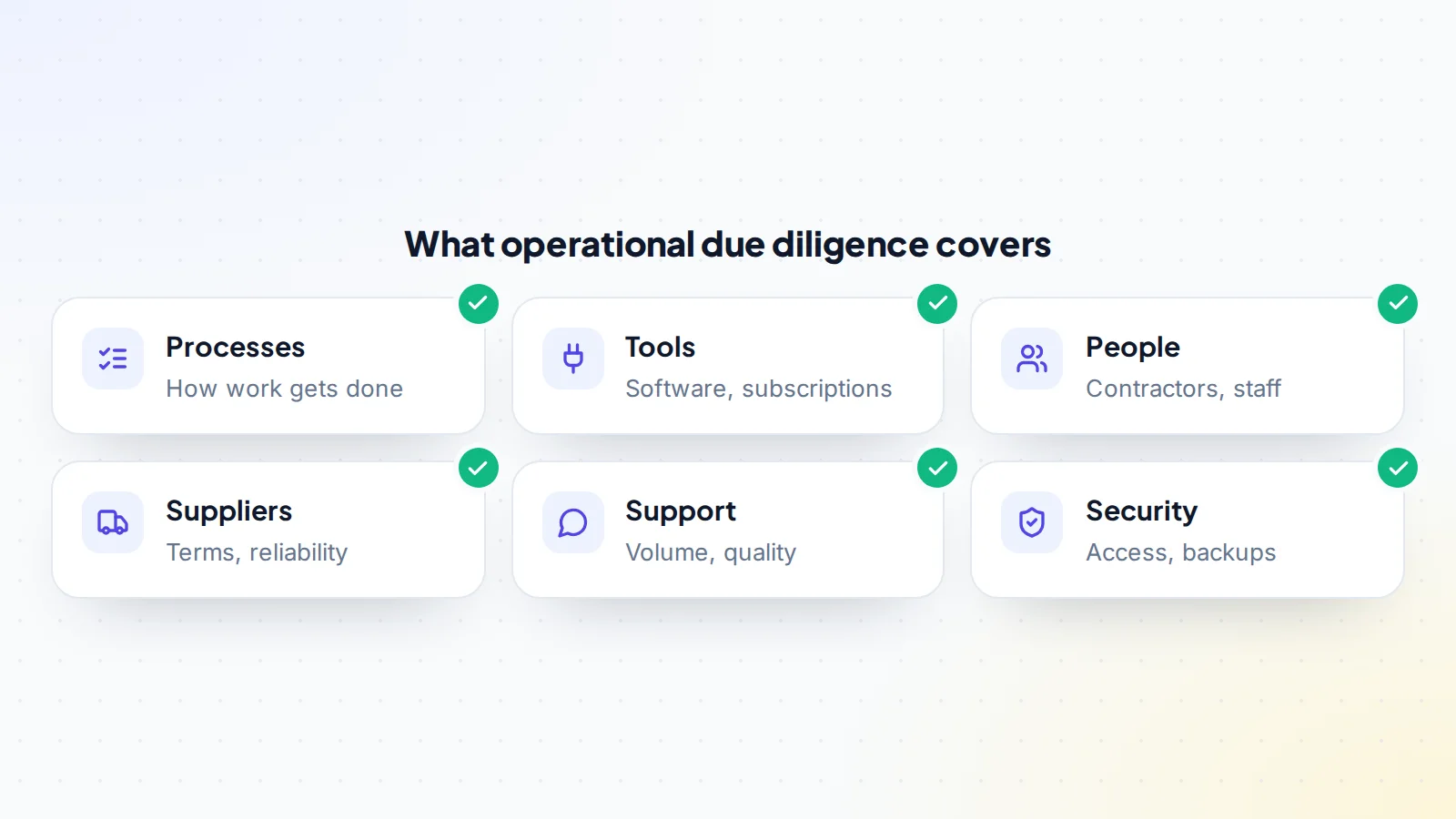
Processes: how the work gets done
Ask the seller to walk you through a typical week and month. For each recurring task, find out what’s done, by whom, how often and with which tools. Ask whether procedures are written down. A business with clear, written procedures is far easier to take over than one that runs on the owner’s memory. Look for tasks only the seller knows how to do, and plan how they’ll be documented or handed over during transition support.
Our guide to owner hours explains how the workload affects value.
Tools and subscriptions
Most online businesses rely on dozens of tools: hosting, email marketing, analytics, design, SEO, help desks, payment processors, plugins and more. Build a full list from bank and card statements, not from memory. For each tool, record:
- What it does and how essential it is.
- Monthly or yearly cost, and whether the seller is on a discounted or legacy plan.
- Whose name the account is in, and whether it can transfer.
- Data held in the tool, such as email lists, customer records or analytics history.
- Integrations with other tools that will break if it changes.
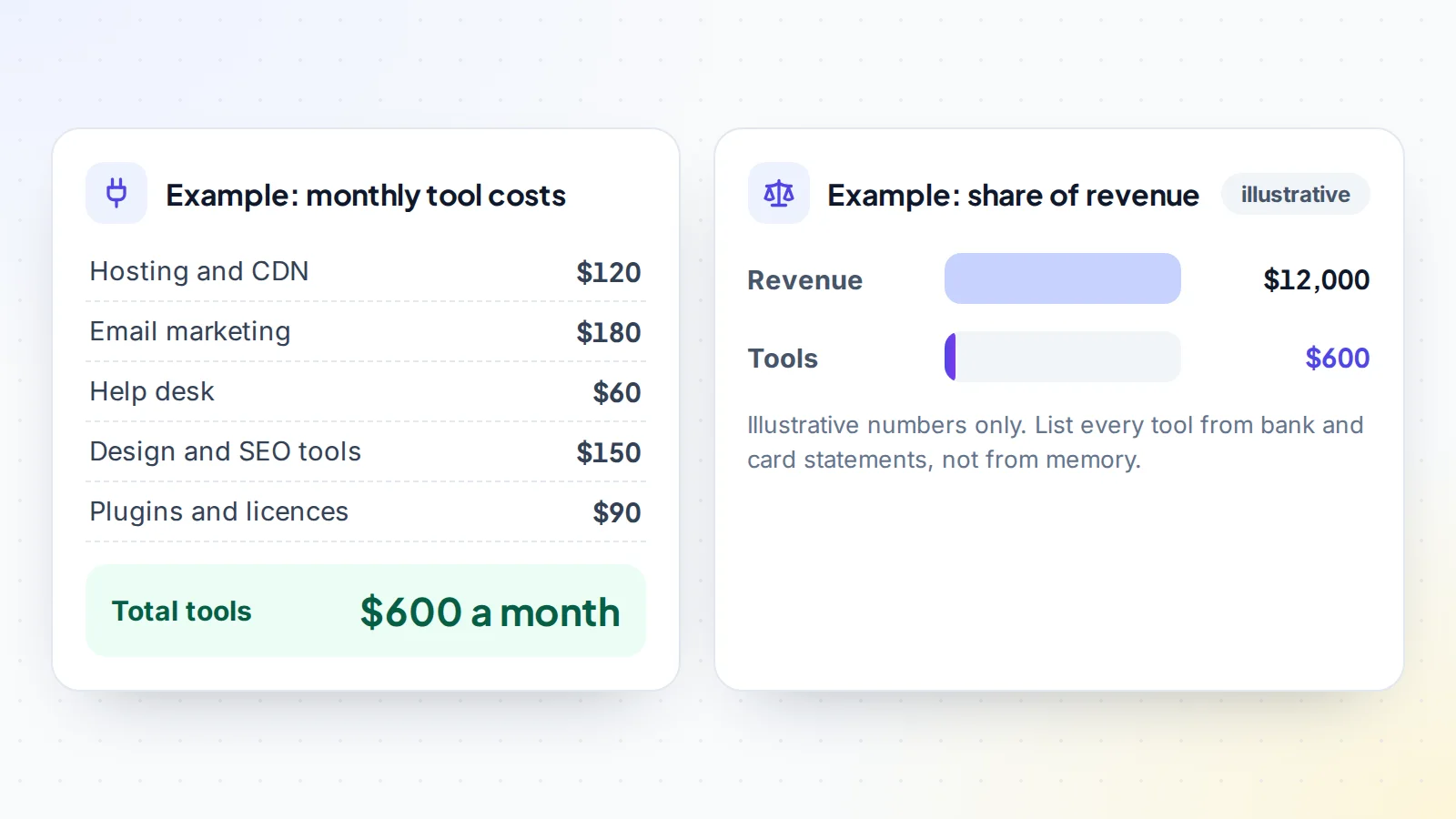
Check licences for plugins, themes, fonts and software, too. Some are tied to the seller’s account and need replacing.
Contractors and staff
Many online businesses rely on freelancers: writers, editors, developers, designers, virtual assistants and support agents. For each person, find out what they do, how they’re paid, whether there’s a written agreement and whether they’ll continue after the sale. Check that agreements assign the rights in their work to the business. If you’ll keep people on, consider how the relationship should be classified where you are; in the US, the IRS explains that whether someone is an employee or an independent contractor depends on behavioural control, financial control and the type of relationship.
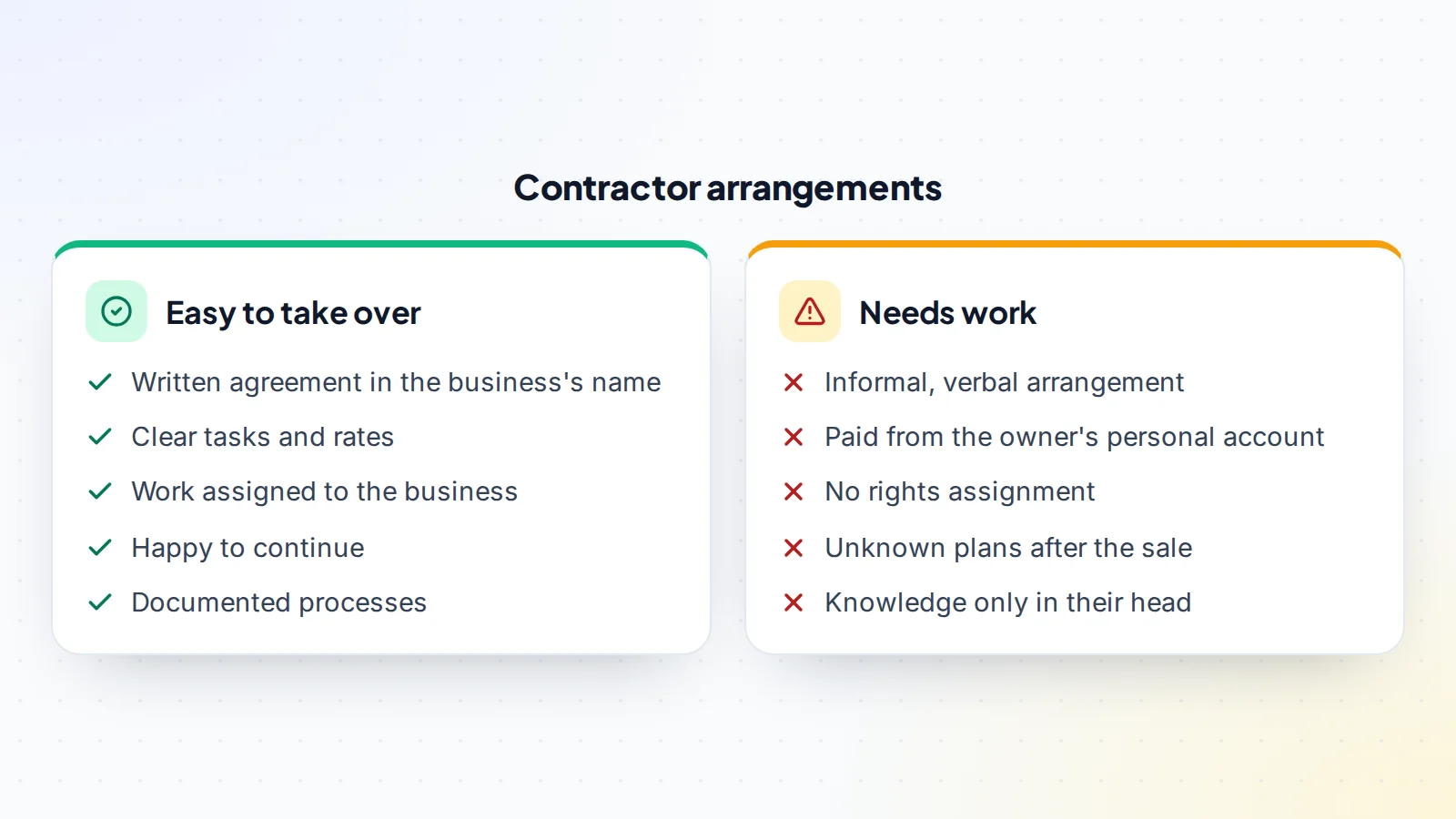
Ask the seller to introduce you to key contractors once terms are close. Their willingness to continue, and their view of how the business runs, is valuable information. Personal data about staff and contractors needs care too; the UK ICO, for example, advises telling workers about a change of ownership and reminding them of their rights.
Suppliers and partners
For e-commerce and product businesses, suppliers are central: pricing, lead times, quality and whether the relationship transfers. For content and affiliate businesses, the key partners are affiliate programmes, ad networks and sponsors. Check each one’s terms, especially rules about changing owner. Our guide to supplier due diligence covers this in depth.
Customer support
Support shows how customers feel and how much work the business really takes. Ask for:
- Monthly ticket or email volume for the last year.
- Average response and resolution times.
- The most common topics, which often point to product problems.
- Saved replies, help articles and any support tools.
- Who answers support today, and in which hours.
Read a sample of recent conversations. Rising volumes or repeated complaints are early warnings, while friendly, quick, helpful replies are a strength worth keeping.
Security and access
Find out who has access to what: hosting, domain registrar, email, payment accounts, analytics, social profiles and admin panels. Check that two-step sign-in is on for important accounts, that former contractors’ access has been removed, and that backups exist and have been tested. Ask about past security incidents and how they were handled. API keys and integrations should be listed so they can be rotated at handover. Our guide to handing over passwords and 2FA covers the transfer itself.
Technical health
For websites, check page speed, mobile layout, broken links, plugin and theme versions, and error logs. For SaaS and apps, review the code, dependencies and deployment process, or have a developer do it; our guide to technical due diligence has the checklist. Outdated systems aren’t necessarily a deal-breaker, but they cost time and money to fix.
Policies and compliance
Look at the policies the business publishes and follows: privacy notice, terms of service, refund policy and shipping times. Check that day-to-day practice matches them. A refund policy that’s promised but not followed, or shipping times that suppliers can’t meet, are operational problems with legal consequences. Our guide to legal due diligence covers the legal side.
Data, records and backups
Every business has data it can’t easily replace: customer records, order history, email lists, analytics history, content files and design assets. Find out where each lives, whether it’s backed up, and how it will move to you. Ask for exports where the tool allows them, and check they open and contain what you expect. Records also include bookkeeping, contracts and correspondence with partners. A business whose records are scattered across personal inboxes and drives takes longer to take over and is more likely to lose something important along the way.
Seasonal peaks and busy periods
Many businesses have busy seasons: holiday sales, back-to-school, tax season, a big annual launch. Operations that cope in a quiet month may struggle at the peak. Ask how the last peak went: stock levels, support response times, site performance and any problems. If you’re buying shortly before a busy period, plan the handover so it’s finished well before the rush, or ask the seller to support you through it.
Test the operations yourself
Where you can, try the business as a customer and as an operator. Buy a product and see how quickly it arrives. Send a support question and time the reply. Sign up for the email list and see what follows. With the seller’s help, watch a typical task being done start to finish, such as publishing an article, processing an order or deploying an update. These simple tests often reveal more than any document: slow replies, broken links, confusing steps or a process that only works because the seller knows its quirks.
Note what you find, good and bad, and add it to your handover plan. Small fixes can be agreed before closing; bigger ones belong in the price or the terms.
Questions to ask the seller
- What does a typical week look like, and who does each task?
- Which tasks only you can do today?
- Which tools would the business struggle without?
- Which contractors are essential, and will they stay?
- Which accounts are in your personal name?
- What has gone wrong operationally in the last year, and how was it fixed?
- What would you improve if you were keeping the business?
Our list of questions to ask when buying a business covers the general ones.
Operational red flags
- No written procedures, and the seller can’t explain how key tasks are done.
- Essential accounts in the seller’s personal name with no plan to move them.
- Contractors paid informally, with no agreements or rights assignments.
- Support backlogs, slow responses or repeated complaints about the same issue.
- Backups that have never been tested, or none at all.
- Former staff or contractors who still have access.
Each can be fixed, but each takes time and should be reflected in the terms.
For sellers: preparing an operations file
Sellers make operational due diligence quick by preparing a simple file before listing: a list of tools with costs and account owners, a list of contractors with their roles and agreements, written procedures for recurring tasks, a summary of support volumes and common questions, and a note of how backups work. It answers most questions before they’re asked, and it shows buyers a business that can run without you, which supports a better price.
Turning findings into a handover plan
Operational due diligence should end with a written plan: every account and tool, who holds it, how it moves and when; every contractor and supplier, and what happens to each; the procedures to hand over; and the support the seller will give afterwards. Put the essentials into the sale agreement, and hold part of the payment through escrow or a middleman until the key accounts and relationships are in your name. On digiflippers.com, the ways to pay in a deal are: directly to the seller, through escrow, and the platform never holds the money itself.
How findings affect price
Operational issues usually show up in the price or the terms rather than stopping a deal. Extra costs for tools on new accounts, contractors who’ll charge more, outdated systems or heavy owner dependence all reduce what a buyer will pay. Well-documented processes, reliable contractors and clean, secure accounts support a higher price, because they reduce the risk of the handover.
A worked example
The details below are made up to show the method.
Aiden is buying a content site. Bank statements reveal 14 tools costing $600 a month, two of them on the seller’s old discounted plans that will cost more for a new account. The site relies on three freelance writers paid from the seller’s personal PayPal, with no written agreements. Support is light, backups run daily but have never been restored, and an old developer still has admin access.
Aiden asks the seller to get written agreements assigning past work from the writers, remove the developer’s access and test a backup restore before closing. Aiden adjusts the offer for the higher tool costs, agrees a month of transition support, and keeps 10% of the price in escrow until the writers confirm they’ll continue.
Operational due diligence: the checklist
- Typical week and month walked through, task by task.
- Written procedures collected or planned.
- Every tool listed from bank statements, with cost and transferability.
- Licences for plugins, themes, fonts and software checked.
- Contractors listed, agreements and rights checked, key ones contacted.
- Suppliers and partners reviewed for terms and continuity.
- Support volume, topics and quality reviewed.
- Access, two-step sign-in, backups and past incidents checked.
- Policies compared with real practice.
- Handover plan written and reflected in the deal terms.
Ready to find your next asset?
Browse listings with verified numbers, ask sellers your questions before you offer, and agree every step in a free Deal Room.
Frequently asked questions
What is operational due diligence?
A review of how a business actually runs day to day: its processes, tools, people, suppliers, support and security, to check it can keep running after the sale.
How is it different from financial due diligence?
Financial checks confirm what the business earned. Operational checks confirm whether the systems and people that produced those results will still be there.
Should I talk to contractors before buying?
Yes, once terms are close and with the seller’s introduction. Their willingness to continue is important to the business’s results.
How do I find every tool the business uses?
Go through bank and card statements for the last year, not just the seller’s list, and ask about each recurring payment.
What operational issues are most common?
Undocumented processes, accounts in the owner’s personal name, informal contractor arrangements and old access that was never removed.
How long does operational due diligence take?
For a small online business, a few days to a couple of weeks, depending on how organised the seller is and how many tools and people are involved.