
Premium Domains: When They’re Worth the Price
Premium domains explained: registry-priced premiums vs aftermarket names, the hidden cost of premium renewals, when a high price makes sense and how to buy safely.

Search for a short, memorable domain and you’ll often see the word “premium” next to a price far above the usual registration fee. A premium domain can be worth every cent for the right business, or a costly mistake for the wrong one. Knowing which kind of premium you’re looking at, and what it will cost to keep, makes all the difference.
This guide explains what premium domains are, the two very different ways the word is used, the hidden cost of premium renewals, what makes a premium name worth its price, when it makes sense to pay and how to buy one safely. It’s useful for founders choosing a brand name and for investors weighing a purchase.
For the factors behind any domain’s value, see our guide to how much a domain name is worth.
Key takeaways
- “Premium” can mean a name priced high by the registry, or a name already owned by someone who’s asking a high price.
- Registry premium names can renew at premium prices every year; always check the renewal price before buying.
- Aftermarket premium names usually renew at the normal rate, but need a safe purchase and transfer.
- A premium price makes sense when the name is central to your brand and you’ll use it for years.
- Pay through escrow and confirm the transfer before releasing money.
What is a premium domain?
In everyday use, a premium domain is any domain priced well above the standard registration fee because it’s short, memorable, meaningful or in high demand. But behind that simple definition sit two quite different situations, and mixing them up is how buyers get surprised.
Registry premium domains
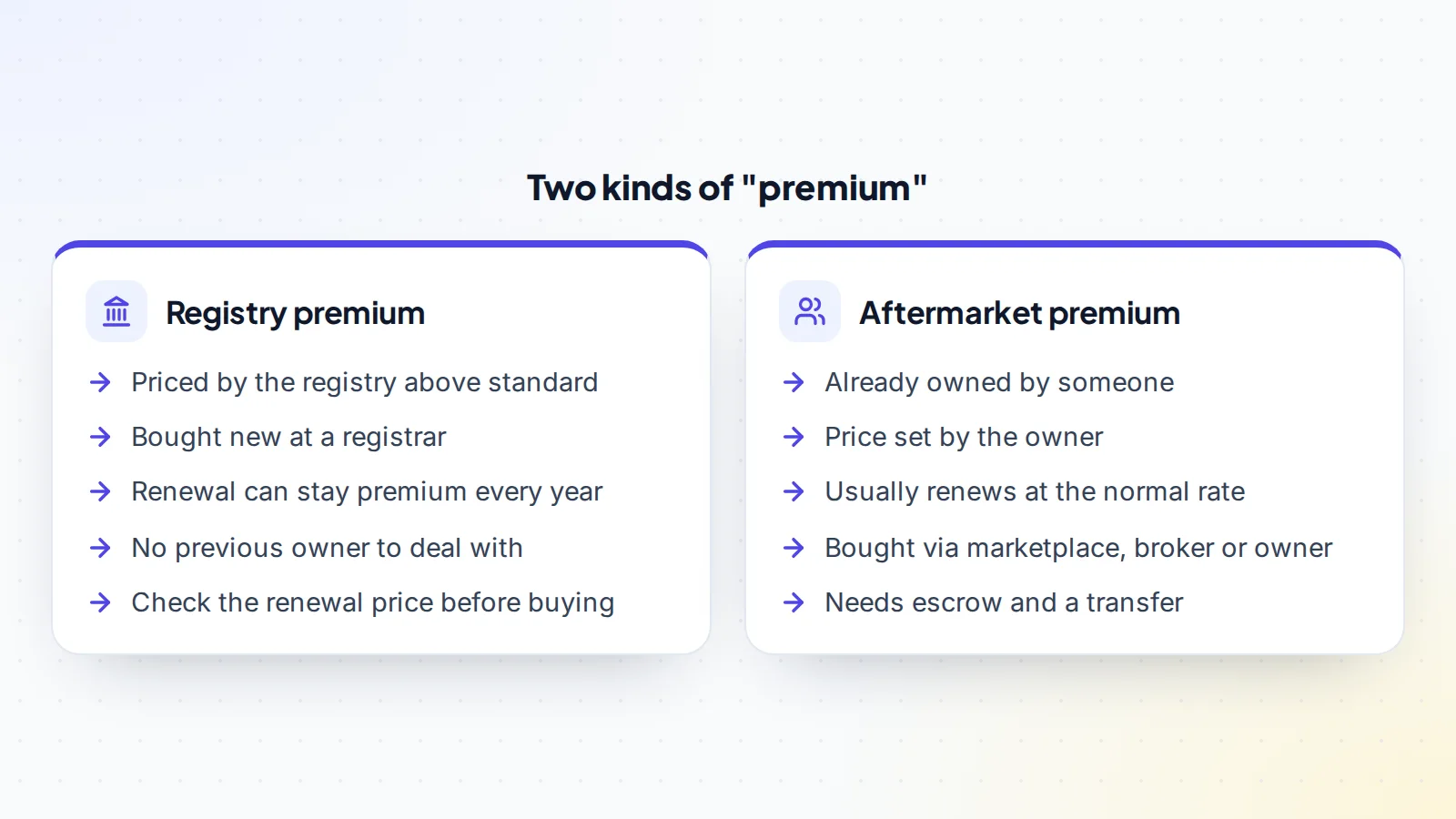
Many registries (the organisations that run extensions) set aside names they consider especially desirable and price them above the standard fee. These names have never been registered, or were released after expiry, and you buy them new through a registrar like any other name, just at a higher price.
The detail to watch is renewal. For some registry premium names, the higher price applies not just at registration but every year. A name that costs a few hundred dollars a year to keep is a very different commitment from one that renews at the normal rate. Registrars show the renewal price before checkout; read it carefully. It’s especially common in newer extensions, while many traditional extensions have fewer registry premiums.
Aftermarket premium domains
The other kind of premium is a name someone already owns and is offering for sale at a high price: an investor’s portfolio name, or a name a business no longer needs. You buy it from the owner (directly, through a marketplace or through a broker), and it moves to your account via a push or a registrar transfer. Once it’s yours, it usually renews at the extension’s normal rate.
Aftermarket prices are set by negotiation and by what similar names have sold for. Our guide to buying a domain that’s already taken covers finding owners and negotiating.
Why premium names cost so much
- Scarcity. There are only so many short, clear, meaningful names, especially in .com.
- Brand value. A name that’s easy to say, spell and remember makes every other marketing effort work harder.
- Trust. Customers often assume the business that owns the obvious name is the established one.
- Type-in traffic. Some names attract visitors who simply type them into a browser.
- Resale value. Good names tend to hold their value, so owners can wait for the right price.
When a premium name is worth it
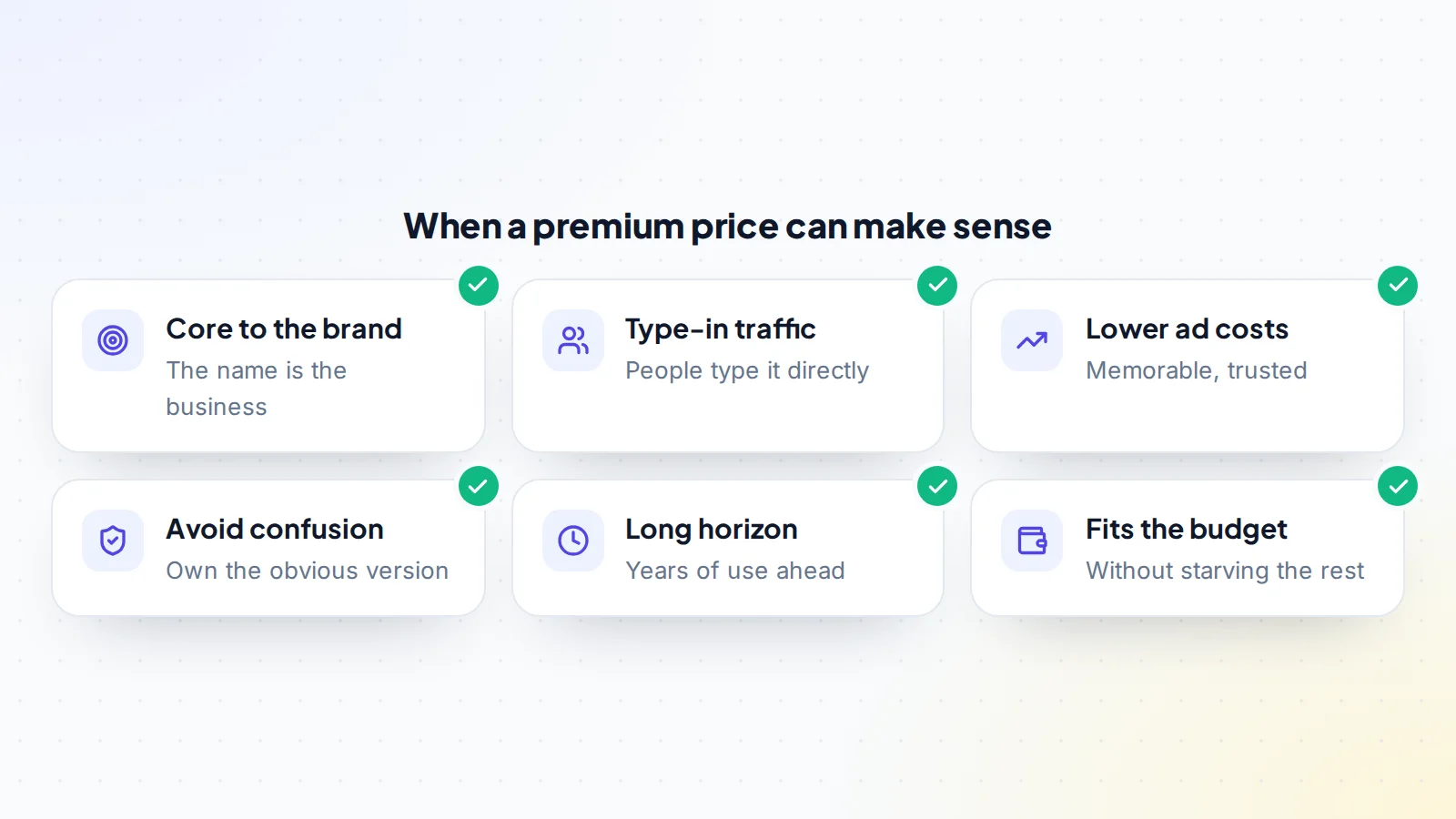
A premium price can make sense when the name will be central to a business you plan to run for years: your brand, your product, the address customers will remember. It can also make sense when owning the obvious name prevents customers from ending up at a competitor’s site, or when it noticeably reduces what you spend on marketing. And it makes sense only when it fits your budget without starving the rest of the business.
It usually isn’t worth it for a side project you might abandon, for a name you’re only buying in case it’s useful, or when a slightly different name would work almost as well for a fraction of the cost.
How to judge whether the price is fair
- Compare with real sales of similar names: length, extension, meaning, style.
- Score the name on length, clarity, extension, commercial meaning and brandability.
- Check the history on the Wayback Machine and the registration data with ICANN Lookup.
- Rule out trademark conflicts. A name that copies a brand is a liability under ICANN’s UDRP.
- Estimate what it saves you: rebranding later, confused customers, marketing costs.
Then decide your maximum price before you contact anyone. If the asking price is above it, a polite counter-offer with reasons often works better than walking away immediately. Our guide to the difference between revenue and profit in valuations is a useful reminder that a domain only pays for itself through what you build on it.
How to buy a premium name safely
- Verify the owner or the registrar’s premium listing. For aftermarket names, ask the seller to prove control, for example by adding a text record to the domain’s DNS.
- Agree everything in writing: price, who pays fees, transfer method and timeline.
- Pay through escrow so the seller is paid only once the domain is in your account. Be wary of escrow sites the seller suggests; fake escrow is a common scam. See how fake escrow scams work.
- Transfer the domain by push or registrar transfer. A registrar transfer needs the auth code, which ICANN’s rules say the registrar must provide within five calendar days. See the domain transfer process and auth codes.
- Secure it: confirm you’re the registrant, turn on two-factor authentication, enable the registrar lock and set auto-renew.
On digiflippers.com, you can browse domains for sale, ask owners questions and agree every step in a Deal Room. The ways to pay in a deal are: directly to the seller, through escrow.
Premium names across extensions
The extension changes the picture. In .com, premium names are mostly found on the aftermarket, because the best names were registered long ago; you’ll be dealing with an owner. In many newer extensions, registries price desirable names as premiums from the start, and renewal prices can stay high. Country-code extensions have their own registry rules, sometimes including residency requirements, which can limit who can own a name at all. Before comparing prices, compare the total cost of owning each option for the years you expect to use it, and how naturally your customers will type it.
Budgeting for a premium name
A useful rule is to treat the name as part of your launch budget, not a separate dream purchase. Ask what else the same money could buy: product development, design, marketing, a few months of runway. If the name takes most of the budget, the business behind it may not get the chance to succeed. Many successful companies started on a decent available name and bought their ideal one later, once revenue justified it. Others decided the ideal name was essential from day one. Both are reasonable; the mistake is deciding without comparing.
Questions to ask a seller
- How long have you owned the name, and how did you acquire it?
- Has it ever been used for a website, and for what?
- Is it registered in your name, at which registrar, and is anything blocking a transfer?
- Will you use escrow, and which provider?
- Are there any disputes, offers or agreements involving the name?
A worked example
A founder is choosing between three names for a new budgeting app. The first is a registry premium name in a newer extension, priced at a few hundred dollars and renewing at the same premium price every year. The second is a two-word .com offered by an investor for several thousand dollars, renewing at the normal .com rate once transferred. The third is a longer, available .com at the standard price.
Over ten years, the registry premium name’s renewals add up to a large total, for an extension many customers won’t type by default. The aftermarket .com costs more upfront but little after that, and it’s the version customers will assume. The third name is cheap but harder to remember. For a business planned for the long term, the aftermarket .com may well be the better investment, if the price is in line with comparable sales and the budget allows. For a quick experiment, the cheap name is fine. The right premium domain depends on the plan, not just the name.
Alternatives to paying a premium
If the ideal name is out of reach, there are good options. Add a short, natural word to the brand name (a verb like “get” or “try”, or a word describing what you do). Choose a different, well-known extension that suits your market. Invent a brandable name that’s available at the standard price. Or start on a solid available name and plan to buy the premium one later, once the business can afford it. Our guide to buying a domain that’s taken includes tips on finding strong alternatives, and you can always check what’s already listed by owners who are ready to sell.
For domain investors
Investors buy premium names expecting to resell them to end users. That works when the purchase price leaves room for profit after years of holding costs. Registry premiums with high annual renewals are harder to hold profitably for long periods. Our guide to domain investing covers portfolio strategy.
Common mistakes
- Ignoring premium renewal prices on registry premium names.
- Paying for a name that copies a trademark.
- Paying a seller directly instead of using escrow.
- Buying a premium name for a project that’s still an idea. Start smaller; upgrade later.
- Forgetting to secure the account after the transfer.
After you buy
Once the name is in your account, protect it like any important asset. Keep the registrar account on a dedicated email with two-factor authentication, set the name to auto-renew with a payment method that won’t expire unnoticed, and keep the transfer lock on. Point the name at your site quickly so it starts building a history under your ownership, and redirect any older addresses you used before. If you bought it as an investment, set up a clean “for sale” page so future buyers can reach you.
Premium domain checklist
- Registry premium or aftermarket? Know which you’re buying.
- Renewal price checked, especially for registry premiums.
- Comparable sales reviewed; name scored on the key factors.
- History and registration data checked.
- Trademark conflicts ruled out.
- Maximum price decided before negotiating.
- Owner’s control verified; terms in writing.
- Payment through escrow on a site you verified yourself.
- Transfer completed; you’re the registrant.
- 2FA, registrar lock and auto-renew set.
Ready to find your next asset?
Browse listings with verified numbers, ask sellers your questions before you offer, and agree every step in a free Deal Room.
Frequently asked questions
What makes a name premium?
Shortness, clarity, meaning, a strong extension and demand. Registries mark some names as premium; on the aftermarket, owners price names they believe are valuable.
Do premium names renew at premium prices?
Some registry premium names do, every year. Aftermarket names usually renew at the normal rate after transfer. Check before you buy.
Are premium domains worth it?
For a business you’ll build for years, where the name is central to the brand, they can be. For side projects or ideas, usually not.
Can I negotiate the price of a premium domain?
Aftermarket prices are often negotiable. Registry premium prices are usually fixed.
Can I lease a premium name instead of buying it?
Some owners offer leases or payment plans. They lower the upfront cost, but read the terms carefully: who controls the name during the lease, what happens if a payment is missed, and when ownership actually passes to you.
How long does buying a premium name take?
Registry premium names can be registered immediately. Aftermarket purchases usually take a few days to a couple of weeks, depending on negotiation, escrow and the transfer method.
How do I pay safely for a premium domain?
Through escrow, so the seller is paid only once the domain is in your account. Choose the escrow company yourself.
Does a premium name improve search rankings?
Not by itself. A good name helps people remember and trust you; rankings depend on the site’s content and quality.