Licences and IP: What You Actually Own When You Buy Digital Products
When you buy a digital product business, what do you actually own? Copyright, assignments, third-party licences, freelancer work and the checks that protect buyers.
When you buy a business that sells templates, courses, ebooks, presets, fonts, plugins or design assets, the product is intellectual property. The files are easy to copy; what you’re really paying for are the rights: to keep selling them, change them and build on them. Digital product intellectual property is often more layered than it looks, with work by freelancers, licensed stock and open-source code mixed in with the seller’s own. This guide explains what you actually own, what you only have permission to use, and how to check before you buy.
This is general information, not legal advice. For a significant purchase, have a lawyer review the rights and the agreement. For the wider buying process, see our guide to buying a digital product business.
Key takeaways
- Buying the files doesn’t give you the rights; the copyright must be transferred in writing.
- Work by freelancers may belong to them unless there’s a written agreement.
- Stock images, fonts, icons and code libraries are usually licensed, with their own terms.
- Check the brand, the domain and any trademarks separately from the product.
- Remember the licences already granted to customers; they come with the business.
Copyright basics for digital products
In the US, copyright protects original works of authorship, including text, images, software, audio and video, from the moment they’re created in a fixed form, according to the US Copyright Office. The creator owns the copyright unless the work was made for hire or the rights were transferred.
Transfers have a formal requirement. US copyright law says a transfer of copyright ownership isn’t valid unless it’s in writing and signed by the owner of the rights or their authorised agent. That means a handshake, a payment or a delivered zip file is not enough: the sale agreement must assign the rights in writing. Recording the transfer with the Copyright Office isn’t required for it to be valid between the parties, but it has legal advantages. Other countries have their own rules, but a written assignment is good practice everywhere.
The layers inside a digital product
Most digital products are built from several layers, each with its own owner:
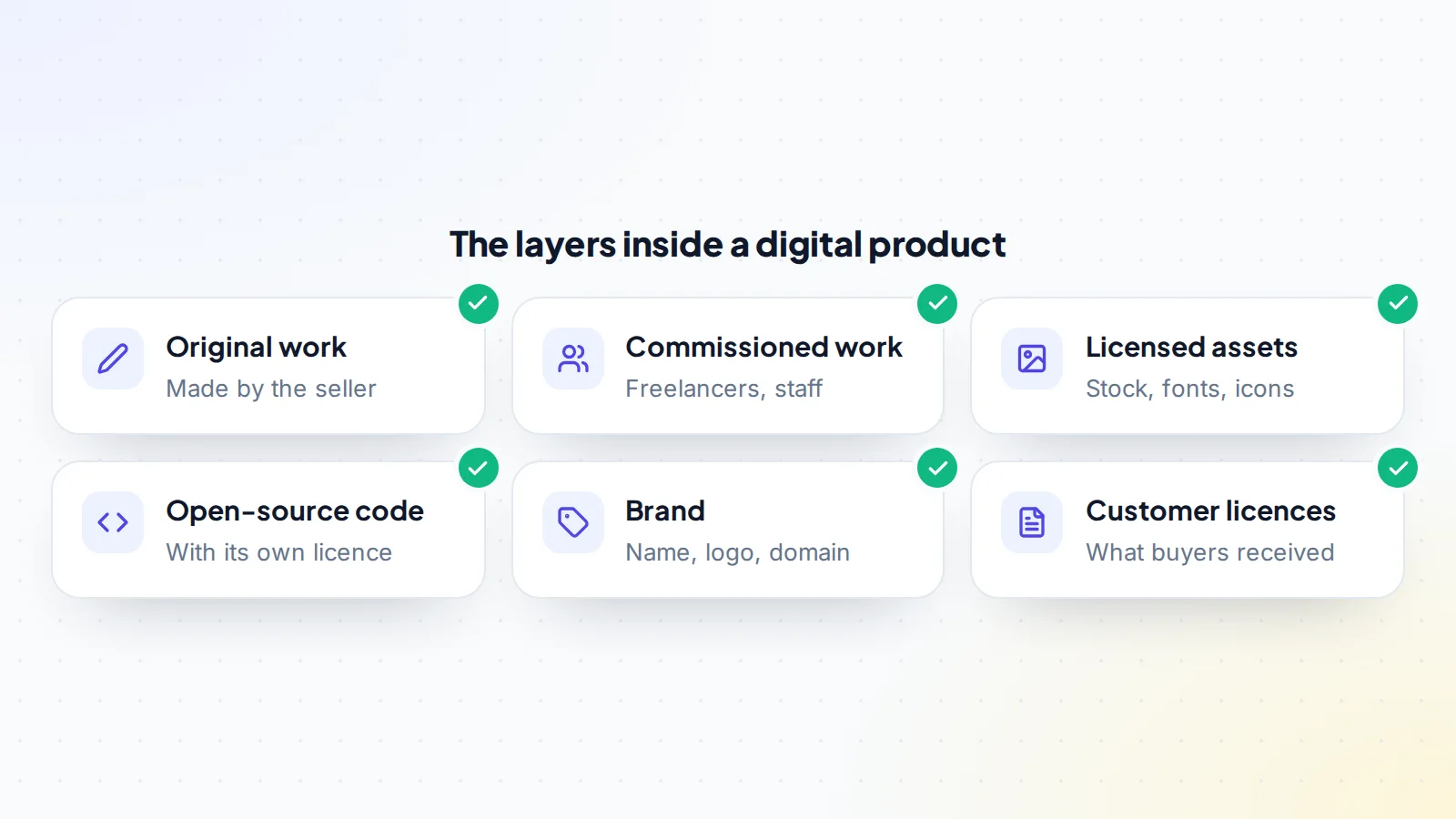
- The seller’s own work: what they created themselves, which they can assign to you.
- Commissioned work: designs, illustrations, code or writing by freelancers or staff.
- Licensed assets: stock photos, fonts, icons, music and templates bought under a licence.
- Open-source code: libraries with licences that set their own conditions.
- The brand: product names, logos, the domain and any registered trademarks.
- Customer licences: the rights already granted to people who bought the product.
Freelancer and staff work
A common surprise: if a freelancer designed the product’s graphics or wrote part of the code, the freelancer may own the copyright, even though the seller paid for it. The US Copyright Office explains that a “work made for hire” belongs to the employer when it’s made by an employee within their job, or, for certain kinds of commissioned work, when there’s a written agreement saying so. Outside those cases, the freelancer keeps the copyright unless they assigned it in writing.
Ask the seller for every freelancer and agency agreement, and check that each one assigns the rights or clearly grants what the business needs. If an agreement is missing, the seller may be able to get a written assignment from the freelancer before the sale. The same applies to co-founders and former partners who contributed to the product: their rights should be assigned to the business or the seller in writing before the business changes hands.
Licensed assets: stock, fonts, icons and music
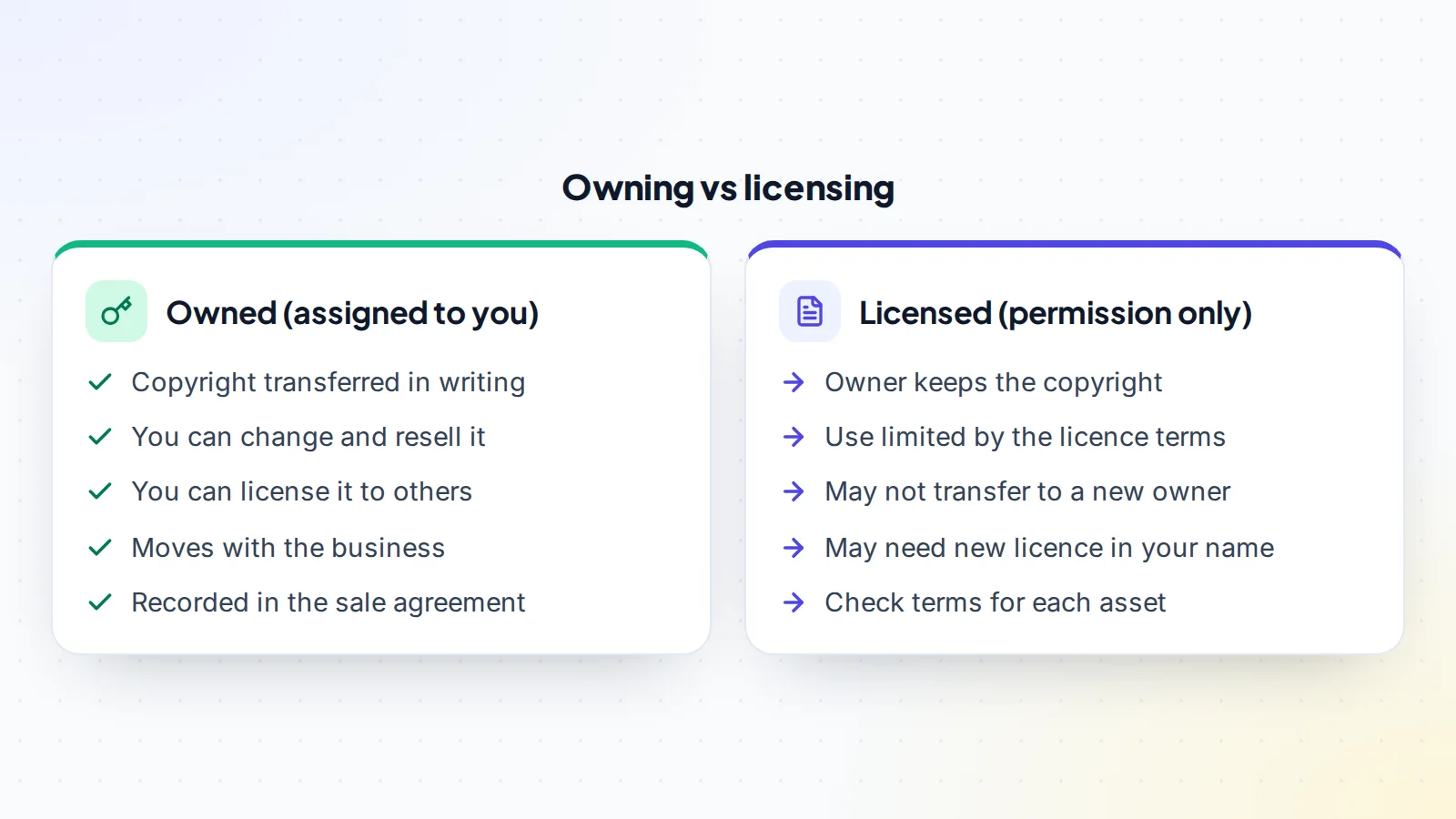
Licensed assets are used with permission, not owned. Their licences decide what’s allowed, and the details matter:
- Whether the asset can be included in a product that’s sold to others.
- Whether there’s a limit on copies sold or end users.
- Whether the licence can transfer to a new owner, or whether you need your own.
- Whether attribution is required.
Marketplaces have their own rules too. Envato’s help centre, for example, says it can’t transfer data such as licences between Envato accounts. Creative Commons licences are another common case: all require attribution, and some add conditions such as non-commercial use only (NC), no derivatives (ND) or share-alike (SA), which may not fit a commercial product. Make a list of every licensed asset, with its licence and whether it’s yours to keep using.
Open-source code
Software products often include open-source libraries. Each licence sets conditions: some are permissive, others require that changes or whole products be shared under the same licence. In the WordPress ecosystem, for example, the plugin directory’s guidelines require plugins to be compatible with the GNU General Public License, including bundled code and images. Ask for a list of dependencies and their licences, and make sure the way the product is sold fits them. Our guide to buying a theme or plugin business covers this in more detail.
Products sold through platforms
Many digital products are sold through a platform: a course host, a digital download store or a marketplace. The platform account, its customer list and its reviews follow the platform’s own rules, which are separate from the rights in the product itself. You might own the copyright in a course but still need to rebuild its sales page on your own account if the platform doesn’t allow accounts to change hands. Check each platform’s terms before agreeing a plan, and list in the agreement which accounts move and which you’ll recreate. Our guide to transferring a Gumroad store shows how this works on one platform.
The brand: names, logos, domains and trademarks
The product’s name and logo can be as valuable as the files, because they carry the reputation customers recognise and search for. Check whether the seller owns the domain, whether the name or logo is a registered trademark and in whose name, and whether anyone else uses a similar name in the same field. Trademarks and domains transfer separately from copyright, so list each in the agreement.
Licences already granted to customers
Every customer who bought the product received a licence, for example personal use, commercial use or an extended licence. Those licences continue after the sale. Read the current licence terms and any older versions, and make sure you can honour them, including promises such as lifetime updates. Changing terms for new customers is usually fine; changing them for existing customers is harder, and doing it suddenly can cost goodwill the business depends on.
IP checks before you buy
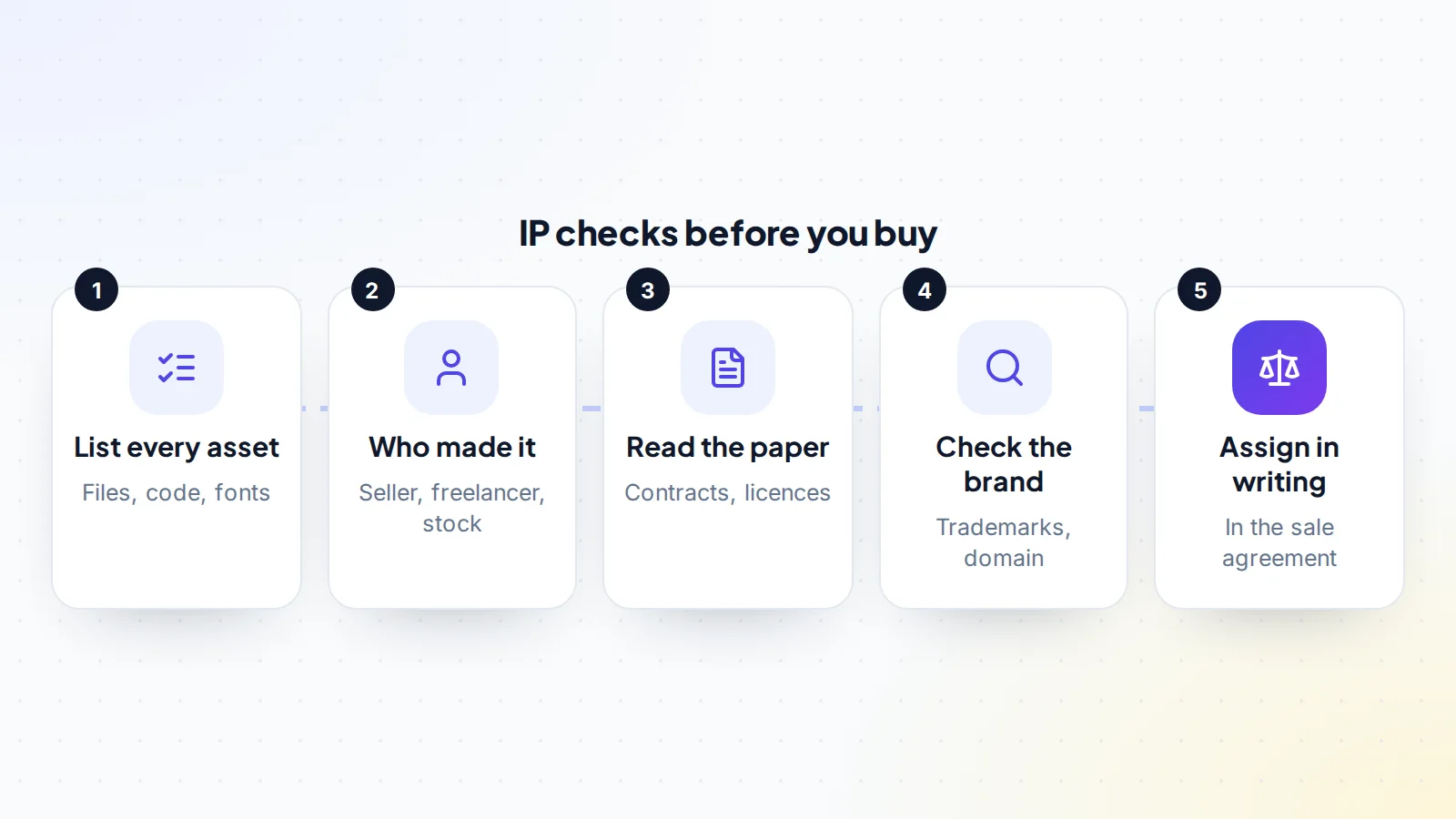
- List every asset: each product, file type, font, image set, code library and brand element.
- Record who made each one: the seller, a freelancer, an employee or a third party.
- Read the paperwork: freelancer agreements, licences, marketplace terms and customer licence terms.
- Check the brand: domain ownership and trademark searches.
- Agree the assignment: the sale agreement assigns the seller’s rights in writing, lists licensed assets, and includes promises from the seller that the work is theirs to sell.
What the sale agreement should say
- A clear assignment of copyright and other rights the seller owns, signed in writing.
- A schedule listing the products, files, code and brand assets included.
- A list of licensed assets, with which licences transfer and which you’ll need to replace.
- Statements from the seller that they own what they’re assigning and know of no claims against it.
- What happens if a rights problem appears later.
Holding part of the payment until the files, accounts and assignments are all delivered protects you. Our guide to the inspection period explains how to set a checking window.
Questions to ask the seller
- Which parts of each product did you create yourself?
- Who else contributed, and do you have written agreements with them?
- Which fonts, images, icons, music and code libraries are included, and under which licences?
- Have you ever received a copyright or trademark complaint?
- What licence terms have customers bought under, and have they changed over time?
- Which platform accounts hold the products, and can they move?
The answers shape your digital product intellectual property checks and the schedules in the sale agreement.
How IP gaps affect the price
Rights problems don’t always stop a deal, but they change its value. A missing freelancer assignment that the seller can fix before closing is a small issue. Licensed assets that need replacing cost time or money, which buyers often subtract from the price. Uncertainty about who owns a core part of the product, such as its main code or artwork, is serious, because it affects whether you can keep selling at all. Clear digital product intellectual property, documented and assigned, is part of what makes a business worth a full price, and sellers who prepare it in advance give buyers fewer reasons to negotiate.
For sellers: preparing your rights file
If you’re selling, a tidy rights file makes buyers confident and shortens the deal. Prepare a spreadsheet of every product and asset, with who made it and how you hold the rights: your own work, an assignment from a freelancer, or a licence with its terms. Save copies of freelancer agreements, licence receipts and your customer licence terms in one folder. Where something is missing, fix it before you list: ask freelancers for written assignments, buy licences that allow commercial use or replace assets you can’t document.
Buyers notice when this work has been done well and early. It’s one of the simplest ways to show that the business is what it appears to be.
A worked example
The details below are made up to show the method.
Priya is buying a business that sells social media templates. The seller designed most templates, but a freelancer created the illustration pack used in a third of them, and the templates use two commercial fonts and stock photos from a subscription service.
The seller has a written agreement assigning the freelancer’s copyright, which Priya’s lawyer checks. The font licences allow use in products sold to others but are tied to the seller’s account, so Priya buys new licences in Priya’s own name. The stock photo licence doesn’t transfer, so the seller replaces those photos with their own before the sale. The agreement assigns the seller’s rights, lists the fonts and the freelancer agreement, and Priya pays through escrow, with release after the files and assignment are delivered.
Digital product intellectual property: the checklist
- Every asset listed, with who created it.
- Seller’s own work assigned in writing in the sale agreement.
- Freelancer and staff agreements checked for assignment.
- Licensed assets listed, with transfer rules for each.
- Open-source dependencies and licences reviewed.
- Domain and trademarks checked and included.
- Customer licence terms read and honoured.
- Seller’s ownership statements included in the agreement.
- Payment held until files and assignments are delivered.
Ready to find your next asset?
Browse listings with verified numbers, ask sellers your questions before you offer, and agree every step in a free Deal Room.
Frequently asked questions
Do I own a digital product if I buy the files?
Not automatically. In the US, a transfer of copyright must be in writing and signed by the owner. Make sure the sale agreement assigns the rights.
Who owns work made by a freelancer?
Usually the freelancer, unless there’s a written agreement assigning the rights or the work qualifies as a work made for hire under a written agreement.
Do stock and font licences transfer with the business?
It depends on each licence. Some are tied to the original buyer’s account, so you may need your own.
Can I use Creative Commons content in a product I sell?
Only if the licence allows commercial use and you meet its conditions, such as attribution. Licences with the NC element don’t allow commercial use.
What happens to customers’ existing licences?
They continue. You need to honour the terms they bought under, including promises such as updates.
Do I need a lawyer?
For a significant purchase, a lawyer’s review of the rights and the agreement is worth it. This guide is general information, not legal advice.
Can I change the product after buying it?
If the copyright in the seller’s work has been assigned to you, yes. Licensed parts can only be changed as their licences allow.
Keep reading
Sources
- US Copyright Office: Copyright Act, Chapter 2 (ownership and transfer)
- US Copyright Office: Circular 1, Copyright basics
- US Copyright Office: Circular 30, Works made for hire
- Creative Commons: About CC licenses
- Envato Market Help: Can I transfer a license to another Envato account?
- WordPress Plugin Handbook: Detailed plugin guidelines