Earn-Outs Explained: When They Make Sense in Online Business Sales
An explainer on earn-outs: part of the price paid later if the business hits agreed targets. Choosing metrics, periods and caps, protecting both sides, reporting, tax questions and a worked example.

Buyers and sellers often agree on what a business has earned, but not on what it will earn. The seller sees growth continuing; the buyer sees risk. An earn-out bridges that gap: part of the price is paid at closing, and part is paid later only if the business reaches agreed targets. Used well, an earn-out lets both sides get a deal they’re comfortable with. Used carelessly, it becomes a source of disputes. This guide explains how an earn-out works, which targets and terms suit online businesses, how to protect both sides and how to avoid common problems.
These deals are common in software; see our guide to buying a SaaS business. For other ways to fund a purchase, read about SaaS acquisition financing.
This guide gives general information, not legal or tax advice. Contingent payments need careful drafting; use a lawyer and an accountant for your deal.
Key takeaways
- An earn-out pays part of the price later, if the business hits agreed targets.
- It helps when buyer and seller disagree about future growth.
- Good ones use clear, measurable metrics over a defined period.
- Sliding scales and caps reduce all-or-nothing disputes.
- Reporting, accounting rules and a dispute process should be written down.
What is an earn-out?
An earn-out is a way of structuring the price of a business so that part of it depends on future performance. The buyer pays an agreed amount at closing, and promises to pay more later if the business reaches agreed targets, such as revenue, profit or number of customers, over an agreed period. If the targets are missed, some or all of the extra payment isn’t made.
It’s different from seller financing. With a seller note, the buyer owes the money regardless of performance. Here, payment depends on results.
Why use one?
They’re most useful when there’s genuine uncertainty about the future. Common situations include:
- A fast-growing business where the seller’s price assumes growth will continue.
- A business recovering from a dip, where the seller believes the dip is temporary.
- A business that depends on the seller’s relationships, which may or may not transfer.
- A new product or contract that hasn’t yet shown up fully in the numbers.
In each case, the arrangement lets the seller be paid for the future they believe in, while protecting the buyer if it doesn’t happen.
Choosing the metric
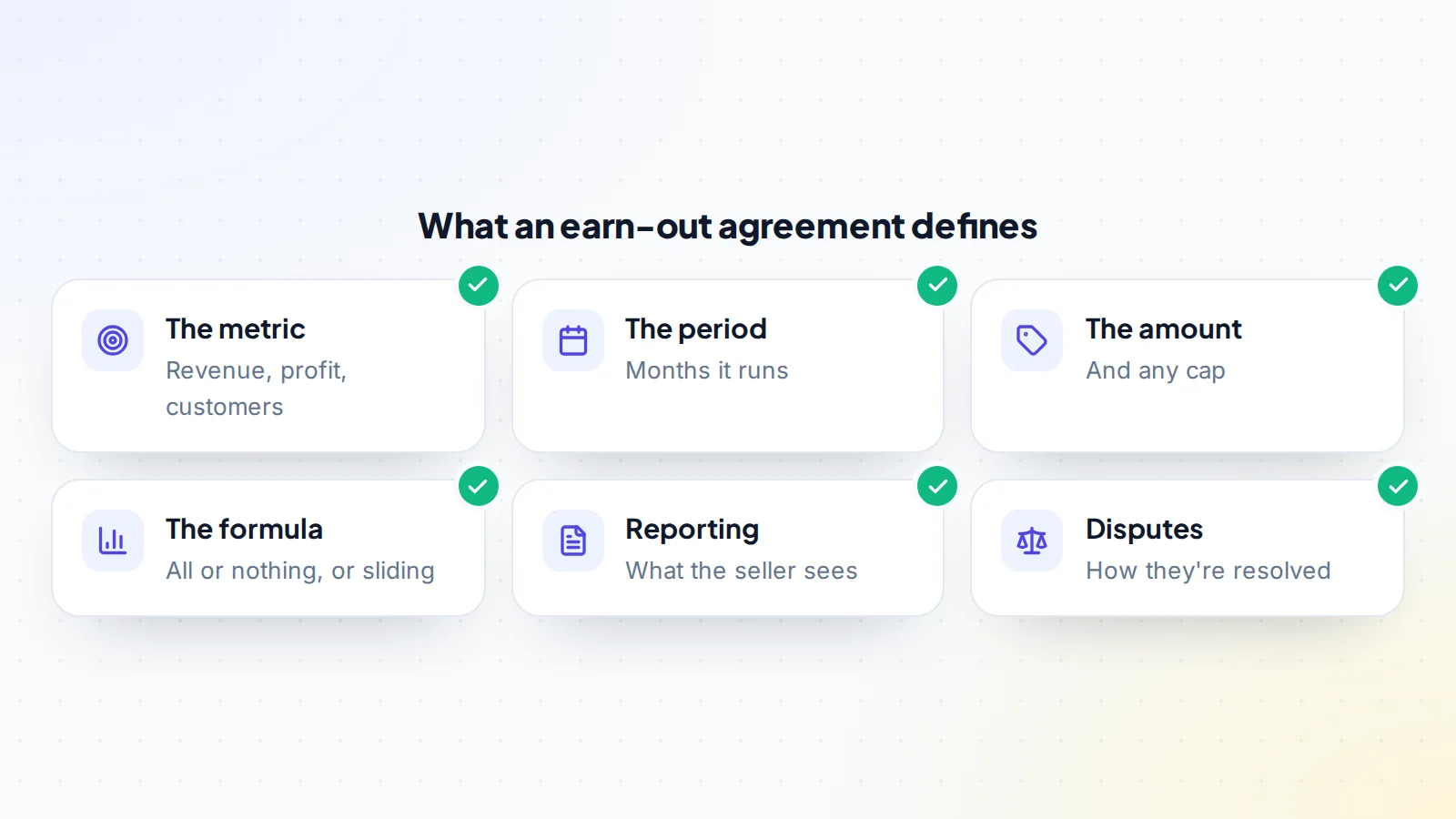
The metric is the measure that decides the payment. For online businesses, common choices are:
- Revenue: simple to measure and harder to manipulate through cost decisions, but it ignores profitability.
- Gross profit or net profit: closer to what the buyer values, but affected by spending decisions the buyer controls.
- Recurring revenue: common for SaaS, measured as monthly or annual recurring revenue.
- Customer or subscriber numbers: useful where revenue per customer is stable.
- A specific milestone: such as a contract renewal or a product launch.
Revenue-based metrics often cause fewer disputes, because the buyer’s later decisions about costs don’t affect them. Whatever you choose, define exactly how it’s measured: which accounts, which reports, which currency and which accounting rules.
The period and the amount
Periods for small online businesses are often short, measured in months or a year or two, because the further out the target, the more it depends on the new owner’s decisions. The amount is usually a share of the total price, and many agreements cap the total so the buyer knows the maximum they’ll pay.
Payments can be made once at the end of the period, or in stages, such as quarterly or yearly. Staged payments give the seller money sooner and reduce the stakes of each measurement.
All-or-nothing vs sliding scale
An all-or-nothing formula pays the full amount if the target is met and nothing if it’s missed, even by a little. That creates a cliff, and cliffs create disputes: a seller who misses by 1% has every reason to challenge the numbers. A sliding scale pays in proportion, for example nothing below 90% of target, rising to the full amount at 100%. It’s fairer and usually calmer for both sides. Some agreements also include a small bonus for beating the target, which rewards the seller’s help without making the structure complicated.
How much of the price to defer
There’s no standard share. The deferred part should reflect the genuine uncertainty: if the disagreement is about a modest amount of future growth, a small contingent payment is enough; if a large share of the asking price depends on results that haven’t happened yet, a larger one may make sense. Sellers should remember that a deferred amount is not guaranteed money, and value it accordingly. Buyers should remember that a very large contingent part can make the seller anxious about every decision the new owner makes, which isn’t good for anyone.
Measuring the numbers in practice
For online businesses, the metric usually comes from a platform: a billing system, a payment processor, an ad network or an app store console. Agree exactly which report will be used and how to treat things like refunds, chargebacks, discounts, currency conversion and annual plans paid up front. Decide whether figures are taken when money is charged or when it’s received. Small definitions like these can change the result by several per cent, which is often the whole difference between hitting a target and missing it.
Protecting the seller
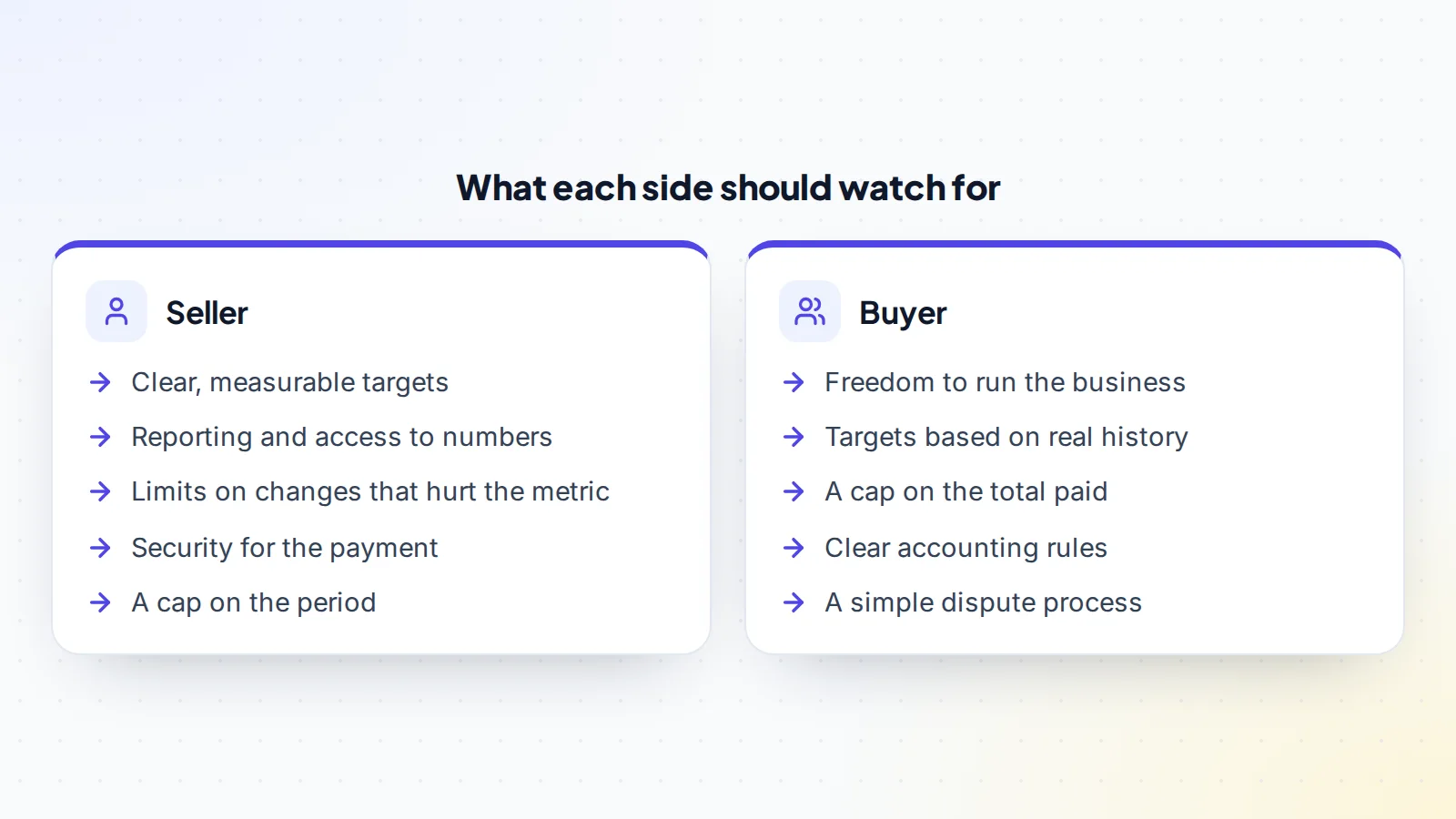
After closing, the buyer controls the business, and the buyer’s decisions affect whether targets are met. Sellers usually ask for:
- Regular reports showing the metric, and the right to check the underlying records.
- Limits on actions that would deliberately reduce the metric, such as shutting down a product line during the period.
- Clarity about what happens if the business is sold again or merged during the period.
- Some security for the payment, such as funds held in escrow, where possible.
Protecting the buyer
Buyers need to run the business as they see fit, including making changes the seller wouldn’t. They usually ask for:
- Targets based on the business’s actual history, not optimistic forecasts.
- A cap on the total deferred amount.
- Clear accounting rules, so there’s no argument about how the metric is calculated.
- Freedom to make normal business decisions without breaching the agreement.
Combining with other terms
Contingent payments often sit alongside other deal terms. A deal might combine cash at closing, a seller note paid over time and a performance-based amount on top. Sometimes part of the closing payment is held in escrow for a short period as a holdback, to cover any problems found after the handover. Each piece serves a different purpose, so be clear about which is which, and check that the total cost of all of them works for the buyer’s cash flow. Our guide to AI SaaS businesses for sale covers a type of deal where performance-based terms are especially common, because growth can be fast and unpredictable.
Questions to ask before agreeing
- What exactly is being measured, from which report, and over which months?
- What happens if the business is changed, merged or sold during the period?
- How often will the seller see the numbers, and can they check the source?
- Is there a cap, and is the formula a sliding scale?
- How will disagreements be settled, and by whom?
For larger deals, buyers often link these terms to the overall valuation multiple, offering a lower guaranteed multiple plus a performance-based top-up.
If the seller stays involved
Many run alongside a transition period in which the seller keeps helping, for example by keeping key relationships warm or supporting customers. That can help the targets be met, but it also blurs responsibility. Write down the seller’s role, hours and responsibilities during that time, and whether they’re paid separately for it. Our guide to the SaaS transition period explains how to plan this.
Avoiding disputes
Most earn-out disputes come from vague definitions. Prevent them by defining the metric precisely, agreeing the source of the numbers, setting a reporting schedule, using a sliding scale, and agreeing how disagreements will be resolved, such as review by an independent accountant before anything escalates. Keep all communication in writing, and send reports on the agreed schedule even when results are good, so trust builds over the period. On digiflippers.com, the deal record keeps messages and agreed terms in one place. Our guide to legal due diligence covers the documents to have in order.
Common mistakes
- Setting targets from the seller’s forecast instead of the business’s actual history.
- Using profit as the metric without agreeing how costs will be counted.
- An all-or-nothing target that turns a small miss into a big dispute.
- No agreed report or data source for measuring results.
- Forgetting what happens if the business is sold or merged during the period.
- Leaving the seller’s role during the period undefined.
Tax questions
Contingent payments can affect how and when tax is due, for both buyer and seller. In the US, the IRS covers sales with contingent payments in its publication on installment sales, which explains how gain may be reported when the total price isn’t fixed at the time of sale. Rules vary by country and by how the deal is structured, so take advice from an accountant before agreeing the terms.
When it isn’t a good idea
They add complexity, and they aren’t always worth it. They work poorly when the buyer plans to change the business heavily, merge it into another product or stop reporting its numbers separately, because the metric becomes hard to measure fairly. They’re also less useful for very small deals, where the cost of drafting and monitoring outweighs the amount at stake. In those cases, a simple price adjustment or a seller note may be better. A shorter inspection period with a clear holdback can also give the buyer comfort without tying the two sides together for months.
A worked example
The details below are made up to show the method.
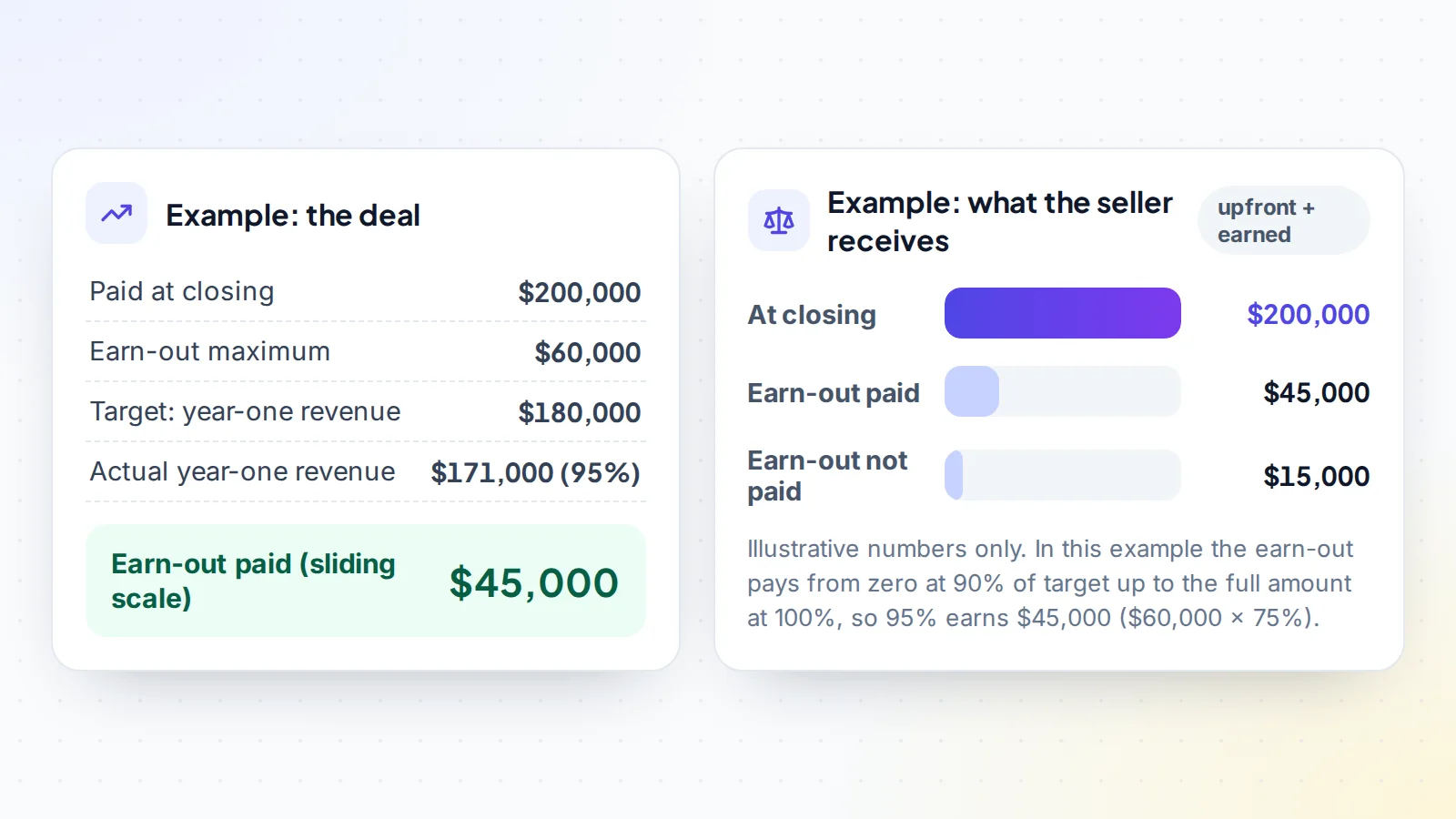
Riley is selling a scheduling tool with $160,000 in revenue over the last 12 months, growing quickly. Riley believes next year’s revenue will reach $180,000 and wants a price that reflects that. The buyer, Jamie, values the business on current results.
They agree $200,000 at closing and an earn-out of up to $60,000 based on revenue in the first year, measured from the billing platform’s reports. It pays nothing below 90% of the $180,000 target and rises in a straight line to the full amount at 100%. Jamie sends Riley quarterly revenue reports. At the end of the year, revenue is $171,000, which is 95% of target, so Riley receives $45,000. Both sides understood the formula from the start, so there’s nothing to argue about, and Riley stays on good terms with Jamie for questions in the years that follow.
Earn-out: the checklist
- Metric chosen and defined precisely.
- Source of the numbers and accounting rules agreed.
- Period and payment schedule set.
- Total deferred amount capped.
- Sliding scale considered instead of all-or-nothing.
- Reporting schedule and seller’s access to records agreed.
- Seller’s role during the period written down.
- Dispute process agreed.
- Legal and tax advice taken.
Selling software? List your SaaS or app with 0% success fee up to $10,000, then 5% (max $5,000), or browse SaaS businesses for sale. The free valuation tool gives a starting range.
Ready to find your next asset?
Browse listings with verified numbers, ask sellers your questions before you offer, and agree every step in a free Deal Room.
Frequently asked questions
What is an earn-out?
Part of a business’s price that’s paid later, only if the business reaches agreed targets over an agreed period.
When is it useful?
When buyer and seller disagree about future performance, such as fast growth, a recent dip or relationships that may or may not transfer.
What’s the best metric to use?
Revenue is often simplest and least affected by the buyer’s cost decisions. Whatever you choose, define it precisely.
How long should it last?
For small online businesses, usually months or a year or two. Longer periods depend more on the new owner’s decisions.
What is a sliding scale?
A formula that pays in proportion to how close the business gets to target, avoiding an all-or-nothing cliff.
How are disputes avoided?
Through precise definitions, agreed data sources, regular reporting, a sliding scale and an agreed dispute process.
How is it taxed?
It depends on the country and deal structure. In the US, the IRS covers contingent payment sales in its installment sales guidance. Take advice.