
How to Buy a SaaS Business: The Complete Guide
What to check before you buy a SaaS business: recurring revenue, churn, code, infrastructure, customers and data, plus how the price and handover work.

To buy a SaaS business is to buy a promise that customers will keep paying next month. That is why software businesses often sell for more than content sites with the same profit, and also why the checks are different: you are studying subscriptions, code and customer relationships, not just traffic.
This guide explains how to buy a SaaS business from start to finish. You will learn how to read recurring revenue properly, what to check in the product and infrastructure, how SaaS businesses are priced, and how to move payments, customers and data to you without breaking anything.
It focuses on small and medium SaaS products, the kind sold by founders and small teams, but the same questions apply at every size.
Key takeaways
- Study the movement inside MRR (new, expansion, churn, contraction), not just the headline figure.
- Churn is the number that decides value. Check it by month and by customer group, from the billing system itself.
- Have the code, infrastructure and security reviewed, ideally by someone who has run a product like it.
- Agree how payments, customers, data and the founder’s knowledge move to you before you sign.
- Plan a transition period with the seller. Most SaaS handovers take weeks, not days.
Why buy a SaaS business?
Software that people pay for every month is one of the most attractive digital assets you can own. Revenue is recurring, margins are often high once the product is built, and growth can come from improving the product and the marketing rather than producing endless new content.
Buying also removes the hardest part: finding product-market fit. Most new software products never reach a meaningful number of paying customers. An established SaaS has already proven that a group of people value it enough to pay, and you can measure exactly how many and for how long.
The trade-off is complexity. You inherit code, servers, integrations, customers who expect support and, often, personal data you are responsible for. A good purchase is one where you understand all of it before you pay.
Step 1: Decide what kind of SaaS fits you
“SaaS” covers everything from a one-person tool to a company with a sales team. Be clear about what you can run:
- Micro SaaS. Small products, often run by one person, with a focused feature set and a few hundred customers or fewer. Great first purchases if you can handle the tech or hire someone who can. See our guide to micro SaaS for sale.
- Self-serve B2B tools. Customers sign up and pay by card without talking to anyone. Usually easier to run than sales-led products.
- Sales-led B2B products. Bigger contracts, longer sales cycles and customers who expect a relationship. More stable revenue, but you need sales skills.
- Plugins, extensions and apps. Related models with their own marketplaces and rules: WordPress plugin businesses, browser extensions and mobile apps.
Ask yourself honestly whether you will develop the product, manage a developer, or neither. If the answer is neither, look for products with stable code, few integrations and documented processes, and budget for a developer anyway.
Step 2: Read the revenue properly
Recurring revenue is the heart of a SaaS business, and it hides a lot behind one number. Stripe’s own guide describes monthly recurring revenue (MRR) as the predictable recurring income from customers each month, and breaks it into parts: new MRR from new subscribers, expansion MRR from upgrades, and churned MRR lost to cancellations. Contraction from downgrades belongs in the picture too.
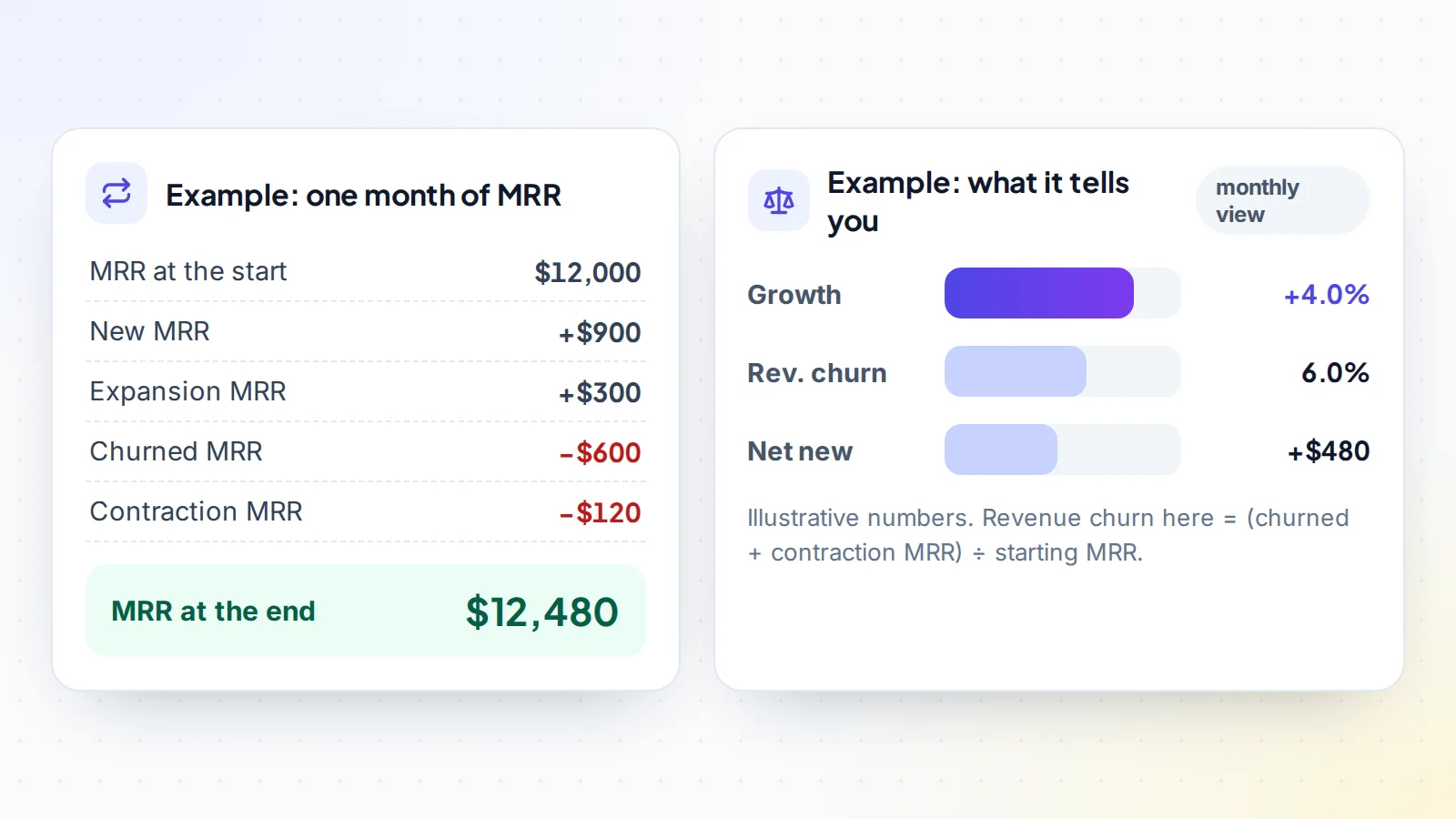
Ask for the figures month by month for at least 12 months, ideally straight from the billing system. Then look at:
- Revenue churn. Stripe defines gross revenue churn as churned MRR divided by MRR at the end of the previous month. A business adding new customers quickly can hide high churn for a long time; when growth slows, the churn shows.
- Customer churn. The share of customers who cancel each month. Compare it with revenue churn: if big customers stay and small ones leave, revenue churn will be lower.
- Annual plans. Annual subscriptions paid upfront are great, but they shouldn’t be counted as one month’s revenue. Make sure they are spread across the year.
- Refunds, failed payments and discounts. All of them reduce what actually reaches the bank.
- Concentration. If one customer pays a large share of MRR, losing them would change the business.
Our guides to SaaS metrics every buyer should check, MRR vs ARR and churn rate go deeper into each one.
Step 3: Check the product, code and infrastructure
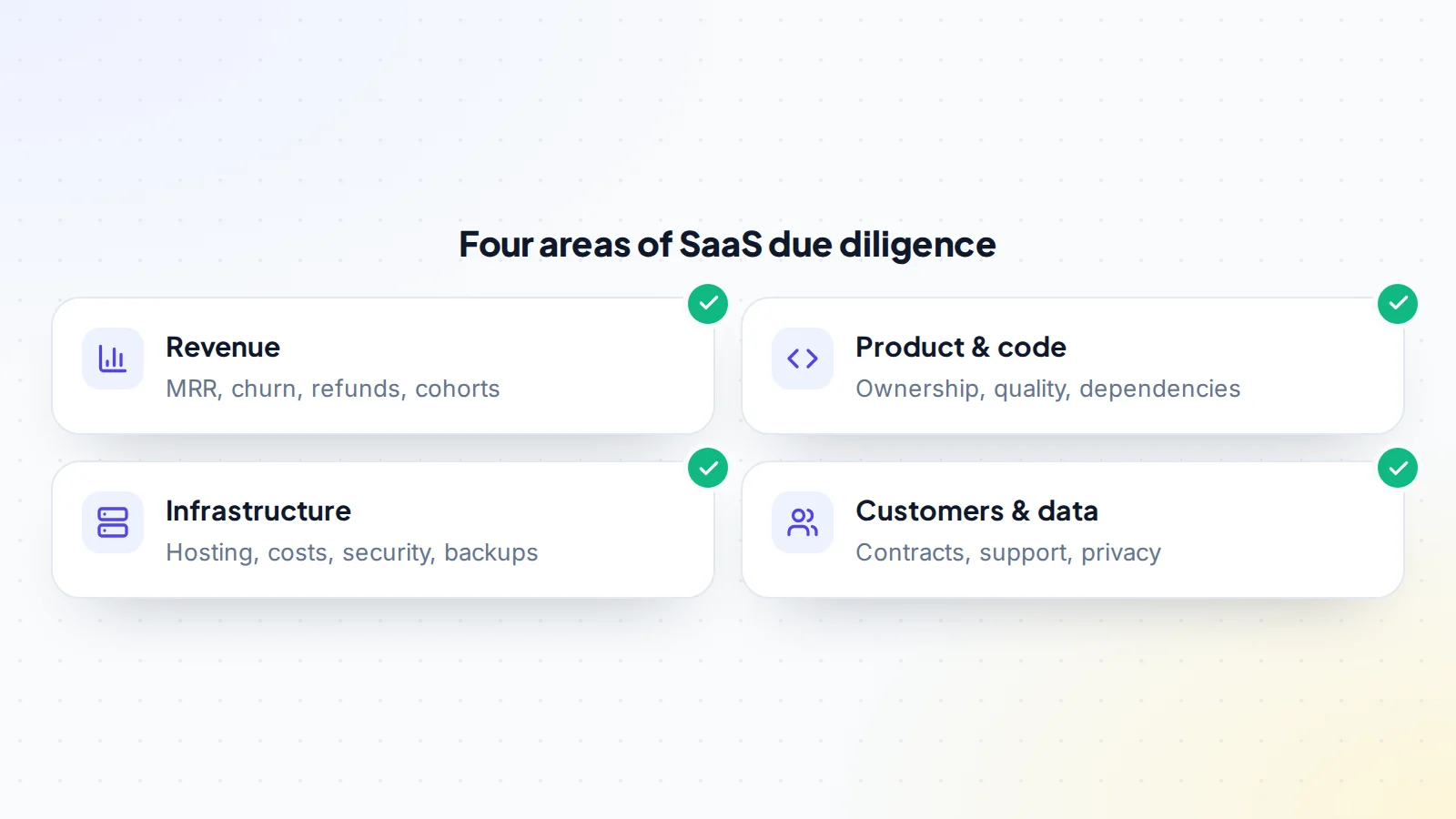
With a SaaS business, the product is the asset. You need to know that it works, that you can maintain it and that it legally belongs to the seller.
Ownership and licences
- Who wrote the code? If contractors did, check there are agreements assigning the work to the seller.
- Which open-source libraries are used, and under which licences?
- Are any paid components, themes or APIs licensed to the seller personally rather than to the business?
Code quality and maintainability
Ask for read access to the code repository and have a developer review it. They should look at how the code is organised, how outdated the dependencies are, whether there are tests, how deployments work and whether anything depends on the founder’s personal machine or accounts. Our technical due diligence guide lists the questions.
Infrastructure and costs
- Where is it hosted, and what does it cost each month?
- Which third-party services does it rely on (email delivery, payments, AI APIs, storage), and on what terms?
- Are there backups, and has anyone ever restored one?
- What security incidents or outages have happened, and how were they handled?
If the product relies on a third-party API, read that provider’s terms. A change in pricing or access can turn a profitable product into a loss-making one overnight.
Step 4: Understand the customers and their data
Talk to the seller about who the customers are, why they buy and why they leave. Look at support tickets from the last few months: they tell you what breaks, what confuses people and how much time support really takes.
Customer data needs special care. If the business has customers in the European Union, their personal data is covered by the General Data Protection Regulation (GDPR), and moving it to a new owner has to respect the privacy terms customers agreed to. Check the privacy policy and terms of service, and ask which processors handle the data. Our guide to GDPR when buying or selling a SaaS covers what to agree with the seller.
Step 5: Value the business
Small SaaS businesses are usually priced as a multiple of profit, often expressed as annual net profit (or seller’s discretionary earnings) rather than monthly figures. Larger, fast-growing companies are sometimes priced on revenue instead. Either way, the multiple reflects risk and growth.
Factors that push the multiple up:
- Low churn and a healthy share of annual plans.
- Steady, organic growth that doesn’t depend on paid ads.
- A product that needs little of the founder’s time.
- Clean, maintainable code and low infrastructure costs.
- Customers spread across many accounts rather than a few.
Factors that push it down include high or rising churn, dependence on one platform or API, a founder who is the product’s only salesperson or developer, and revenue you can’t verify. Read how SaaS valuation multiples work and use the free valuation tool for a quick range.
Step 6: Structure the deal
SaaS deals often have more moving parts than a simple website sale. Agree in writing:
- What is sold: code, domain, brand, customer contracts, accounts, documentation and any trademarks.
- How the price is paid: all upfront, or partly later. An earn-out ties part of the price to future performance and can bridge a gap between what you and the seller think the business is worth.
- The transition period: how long the seller helps, how many hours a week, and with what. See planning a SaaS transition period.
- A non-compete covering similar products for a reasonable period.
Larger deals are usually written as an asset purchase agreement, and it is worth having a lawyer read it. Our guide to the SaaS asset purchase agreement explains the main clauses.
Step 7: Pay safely
As with any digital asset, the safest structure is one where the money is secured before the handover starts and released once you have control. A licensed escrow company does exactly that. On digiflippers.com, the ways to pay in a deal are: directly to the seller, through escrow, and the platform never holds the money itself. Read how escrow works before you agree a payment method.
Step 8: Take over payments, code and customers
The handover is where SaaS deals differ most from other digital assets, because live customers are paying the whole time. Plan it in this order:
- Code and infrastructure. Transfer the repository, hosting, domain and DNS to your accounts. Rotate every secret, API key and password the seller knew.
- Payments. If the subscriptions run on Stripe, Stripe’s support pages say the owner should contact Stripe Support first to confirm which details change when a business is sold: the owner, bank account for payouts, legal name, statement descriptor and more. If the buyer is in a different country, a different process applies. Our guide to transferring Stripe subscriptions walks through the options.
- Third-party services. Email delivery, analytics, support desk, error tracking and any APIs, moved to your billing and your logins.
- Customers. Decide with the seller how and when customers are told. Many buyers keep the brand and support address the same, so customers notice nothing but continued service.
- Knowledge. Recorded walkthroughs, documentation and the seller’s time during the transition period.
Our general handover checklist covers the remaining steps.
Red flags in a SaaS listing
Some warning signs come up again and again when you look at SaaS for sale. None of them automatically rules a business out, but each one needs a clear answer before you go further:
- MRR shown only as a screenshot or a spreadsheet, with no read-only access to the billing system.
- A sudden jump in customers in the months before the sale, especially from heavy discounts or lifetime deals.
- Lifetime deals counted as recurring revenue. One-off payments are not MRR, and lifetime customers still cost money to support.
- No churn figures, or churn calculated in a way the seller can’t explain.
- Everything runs on the founder’s personal accounts, from the code host to the email provider.
- Unanswered support tickets or recent reviews complaining about bugs and slow replies.
Your first 90 days as the new owner
Resist the urge to change everything at once. Customers chose the product as it is, so keep it stable while you learn. In the first month, focus on support quality and on making sure billing, backups and deployments work under your control. In the second, fix the bugs customers complain about most. Only then start on pricing, new features or marketing, and measure each change against churn and MRR so you know what worked. Our guides to reducing churn and SaaS pricing are good next reads.
SaaS buying checklist
- 12+ months of MRR, broken into new, expansion, churned and contraction, from the billing system.
- Customer and revenue churn calculated by month, annual plans spread correctly.
- Refunds, failed payments and customer concentration checked.
- Code reviewed; ownership and open-source licences confirmed.
- Hosting, third-party services and monthly costs listed; backups tested.
- Support load and recent tickets reviewed.
- Privacy policy, terms and data processors checked.
- Price, payment terms, transition period and non-compete agreed in writing.
- Payment secured before the handover; released once code, payments and accounts are yours.
- All secrets and passwords rotated.
Ready to find your next asset?
Browse listings with verified numbers, ask sellers your questions before you offer, and agree every step in a free Deal Room.
Frequently asked questions
How much does it cost to buy a SaaS business?
Small SaaS products can sell for a few thousand dollars, established ones for millions. Price is usually a multiple of annual profit for smaller businesses, and the multiple depends on churn, growth, effort and risk.
Do I need to be a developer to buy a SaaS business?
No, but someone has to maintain the product. If you aren’t technical, budget for a developer from day one and choose a product with clean code, few integrations and good documentation.
What is a good churn rate when buying a SaaS?
There is no single right number: it depends on the price point and the customers. What matters is that churn is stable or falling, that you’ve calculated it from the billing data yourself, and that the price you pay reflects it.
How long does a SaaS acquisition take?
Small deals can close in a few weeks. The transition, when the seller helps you take over, often runs for several weeks more. Larger deals with lawyers and formal agreements take longer.
Can existing customers’ subscriptions continue after the sale?
Usually yes, if the payment account is handled correctly. With Stripe, the account itself can often be updated for the new owner after contacting Stripe Support, which avoids asking customers to re-enter card details. Plan this step with the seller early.