
How to Sell a SaaS Business: From Preparation to Closing
A founder's guide to selling a SaaS: getting the numbers and code ready, what drives the price, choosing a buyer, deal structures and a smooth transition.

Selling a SaaS business you built is a strange mix of relief and worry. You get rewarded for years of work, but you also have to trust someone else with customers who depend on your product every day. The best exits manage both: a fair price for you and a smooth hand-off for them.
This guide explains how to sell a SaaS business step by step. It covers when to sell, how to get your metrics and code ready, what drives the price buyers will pay, how to choose the right buyer, how deals are structured and how to hand over a live product without hurting it.
It is written for founders of small and medium SaaS products: the bootstrapped tools, plugins and niche B2B apps that change hands every day. If you’re still deciding whether to sell, the first two sections will help.
Key takeaways
- Start preparing six to twelve months before you want to sell. Buyers reward a clean record, and a record takes time.
- Have your MRR, churn and profit ready by month, straight from the billing system, with annual plans spread correctly.
- Reduce founder dependence: document the code, the infrastructure and your routines.
- Choose the buyer as carefully as the price. Ask how they plan to run the product and look after customers.
- Secure the payment before the handover, and agree a clear transition period in writing.
When to sell your SaaS
The best time to sell is when the business is healthy and you could keep running it, so you sell from strength rather than fatigue. Common good reasons include wanting to start something new, the product needing investment you’d rather not make, or simply wanting to turn recurring income into a lump sum.
Watch for timing traps:
- Selling right after a churn spike. Buyers will average your recent months. If you can fix the cause first, do.
- Selling in the middle of a migration, such as a new pricing model or a rewrite. Buyers discount unfinished work.
- Waiting until you’re burnt out. Support quality and growth usually slip first, and both show in the numbers.
Many founders find it useful to read the buyer’s side too. Our guide to buying a SaaS business shows exactly what they will check.
Step 1: Get your metrics in order
SaaS buyers think in recurring revenue, so your numbers need to tell that story clearly. Prepare a month-by-month view for at least the last 12 months, and longer if you have it:
- MRR and how it moved: new, expansion, churned and contraction MRR each month. Stripe’s guides define these parts the same way buyers use them.
- Churn: customer churn and revenue churn. Stripe describes gross revenue churn as churned MRR divided by the previous month’s MRR; use one method and stick to it.
- Annual plans spread across 12 months, not counted when they’re paid.
- Profit: revenue minus every cost the product needs, including hosting, tools, contractors and any salary for work a buyer would have to replace.
- Customer concentration: what share of MRR your largest customers represent.
If you use Stripe, Stripe Billing can show MRR and churn directly, which is a strong starting point for buyers. Read MRR vs ARR and how to calculate churn if you want to check your own figures first.
Step 2: Make the product transferable
Buyers pay more for a product they can run without you. Before you list, work through these:
Code and documentation
- A README that explains how to set up, run and deploy the product from scratch.
- Up-to-date dependencies, and a list of the ones that can’t be updated and why.
- Agreements showing that anyone who wrote code for you assigned it to you or your company.
- A list of open-source licences used.
Infrastructure and accounts
- Every service the product uses, what it costs and whose account it’s on. Move anything on your personal accounts into business accounts now.
- Backups that you’ve actually restored at least once.
- A short incident history: what went wrong and how you fixed it.
Routines
Write down what you do each week: support, releases, marketing, billing issues. A buyer who can see the work clearly can price it, and a business with predictable work is worth more than one that relies on your instincts.
Step 3: Understand what drives your price
Small SaaS businesses are usually valued as a multiple of annual profit, or of seller’s discretionary earnings when the owner’s salary is added back. Larger, fast-growing companies are sometimes valued on revenue. In both cases the multiple reflects how safe and how promising the business looks to a buyer.
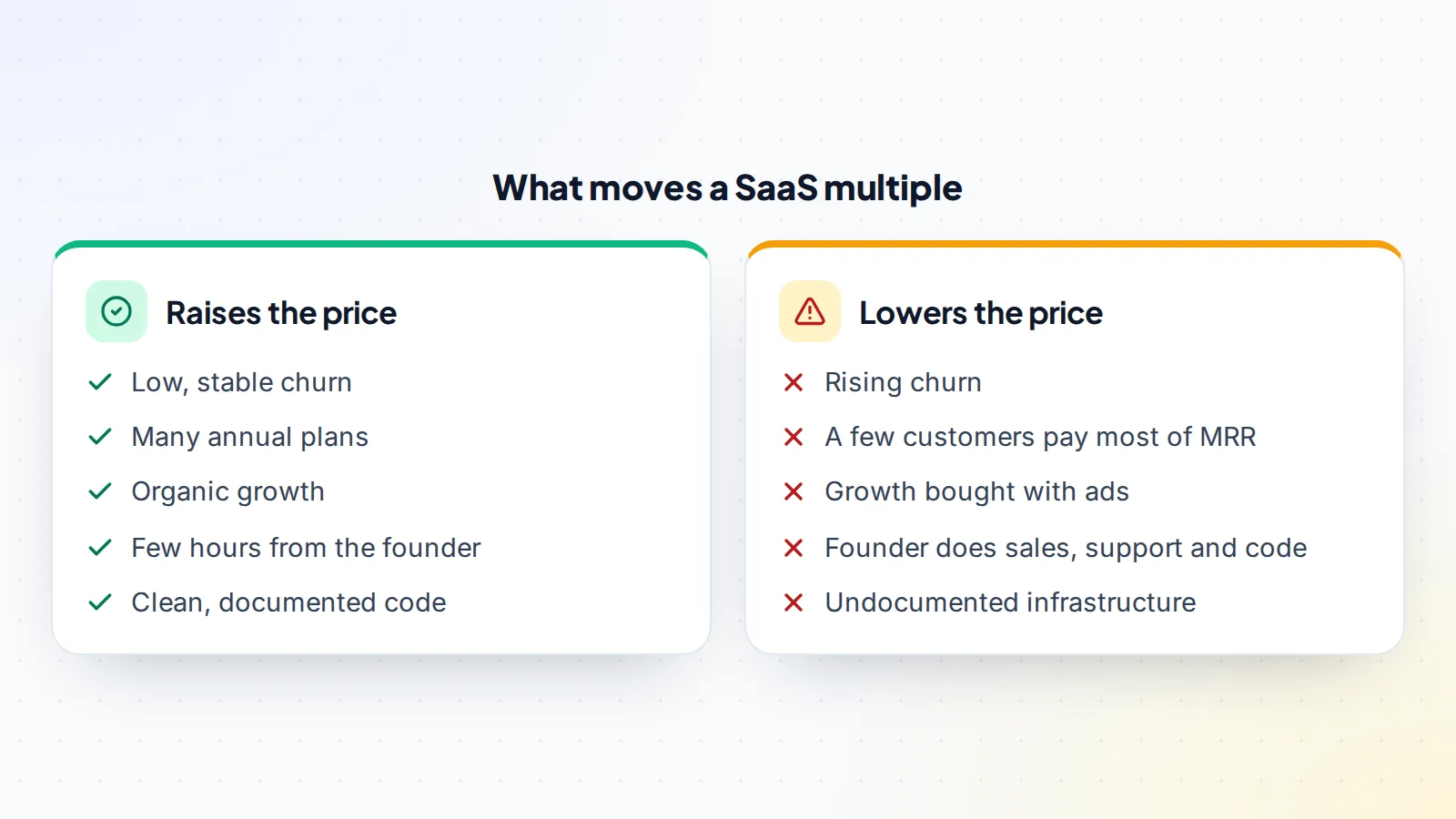
You can’t change your history before a sale, but you can often improve these in a few months:
- Move customers to annual plans with a fair discount. It reduces churn and looks good to buyers.
- Fix the top reasons people cancel. Your cancellation survey and support tickets will tell you what they are. See how to reduce SaaS churn.
- Review your pricing. Many small SaaS products are underpriced. A sensible increase for new customers can lift MRR quickly; read our SaaS pricing guide first.
- Cut costs you don’t need, such as unused tools and oversized servers.
For a quick range, try the free valuation tool, then read SaaS valuation multiples explained for the reasoning behind the numbers.
Step 4: Find the right buyer
Different buyers want different things, and the right one makes the sale easier and the product’s future safer.
- Individual operators want a product they can run themselves. They value low effort and clear documentation.
- Portfolio buyers own several products and want ones that fit their skills or customer base.
- Strategic buyers, such as a company in a related market, may pay more because your product fills a gap in theirs.
Ask every serious buyer how they plan to run the product: will they keep supporting customers, keep the pricing, keep developing it? Your reputation goes with the product, and customers will remember who sold them out.
You can sell through a marketplace, where you list and talk to buyers directly, or through a broker who runs the process for a commission. On digiflippers.com, you list for free, buyers see which of your numbers are verified, and it’s no success fee. Our guide to marketplace vs broker compares the two.
Step 5: Write a listing buyers trust
A strong SaaS listing answers the questions buyers would otherwise ask in their first call:
- What the product does, who it’s for and how customers find it.
- MRR, churn and profit over time, with a short explanation of any unusual months.
- The tech stack, hosting and main third-party services.
- How many hours a week the business takes, and on what.
- What’s included in the sale and what isn’t.
- Growth ideas you haven’t had time to try.
- Why you’re selling.
Be careful with sensitive details. Share the customer list, code and exact pricing experiments only with buyers who have shown serious intent, ideally after a written offer.
Step 6: Handle due diligence calmly
Expect buyers to ask for read-only access to billing data, a code walkthrough or repository access, and lots of questions. That’s normal. Answer in writing, keep everything in one place, and don’t take detailed questions as distrust: a buyer who checks carefully is a buyer who will close.
Protect yourself while you do it:
- Use read-only access or screen shares, never shared passwords.
- Give code access only after a written offer, and consider a confidentiality agreement.
- Don’t tell customers or staff about the sale until it’s agreed.
Step 7: Agree the deal structure
Most small SaaS sales are asset sales: the buyer purchases the product, code, domain, brand and customer relationships rather than your company. Agree:
- The price and payment: all upfront, or partly deferred. An earn-out pays part of the price later based on performance. It can close a gap in valuation, but it ties your money to how the buyer runs the product.
- The transition period: how many weeks you’ll help, how many hours a week, and what’s included. Our guide to the SaaS transition period has a template.
- A non-compete: usually limited to similar products for a set time.
- Customer data: how it moves and under which terms. If you have EU customers, the GDPR applies; read GDPR when selling a SaaS.
For larger deals, an asset purchase agreement drafted or reviewed by a lawyer is worth the cost.
Step 8: Get paid and hand over
Secure the payment first. With escrow, the buyer pays a licensed escrow company, you see the funds are held, you transfer the product, the buyer checks it, and the money is released to you. On digiflippers.com, the ways to pay in a deal are: directly to the seller, through escrow, and the platform never holds the money itself.
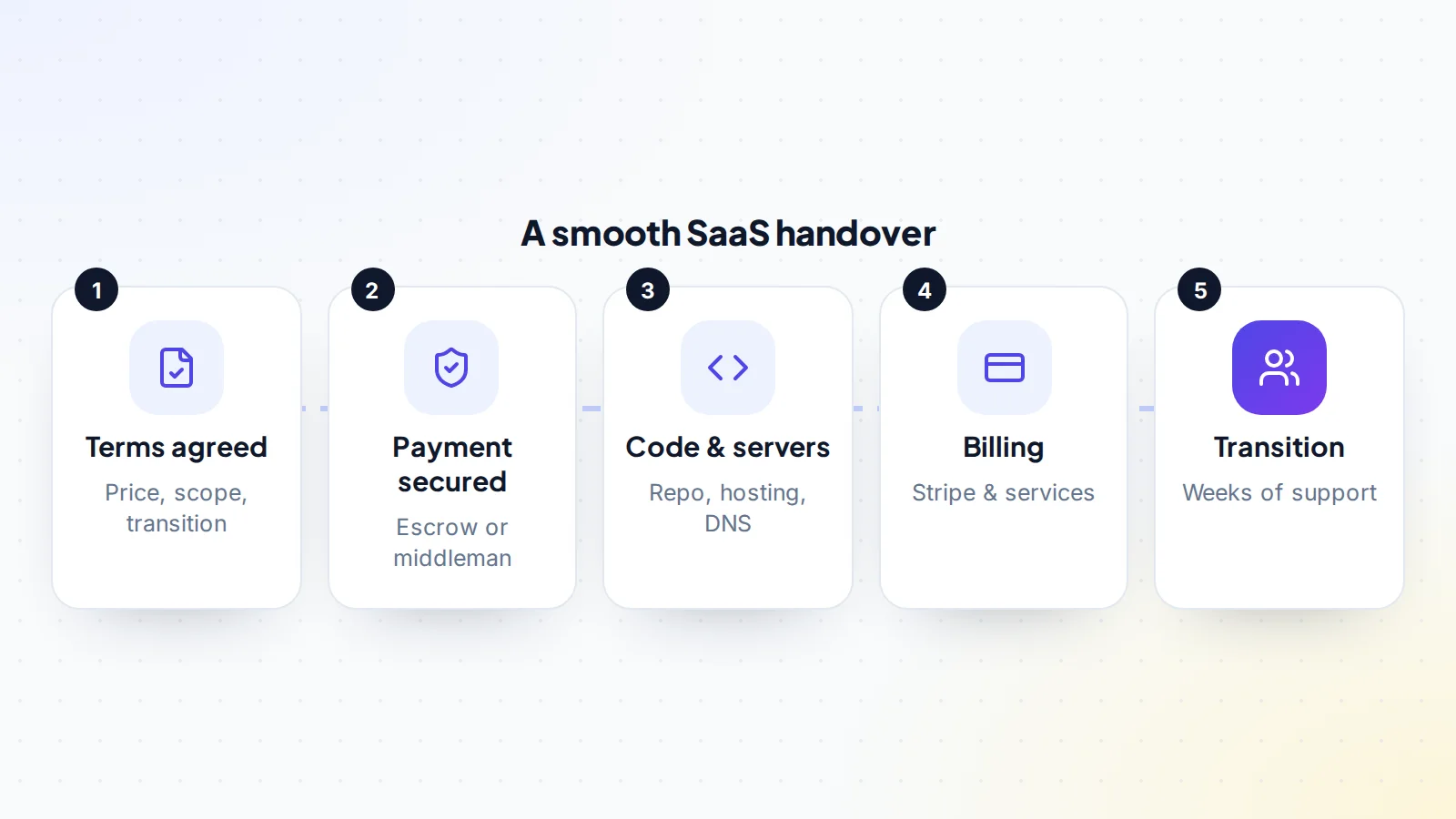
Then hand over in an order that keeps customers unaffected:
- Code, hosting, domain and DNS moved to the buyer’s accounts.
- Billing. With Stripe, the account owner should contact Stripe Support to confirm what changes when a business is sold, such as the owner, payout bank account, legal name and statement descriptor. A buyer in another country follows a different process. See transferring Stripe subscriptions.
- Third-party services such as email delivery, support desk and analytics.
- Knowledge transfer: walkthrough calls, recorded videos and your documentation.
- Your exit: once the buyer confirms everything works, remove your access and payment details everywhere.
The full sequence is in our handover checklist.
Mistakes founders make when selling
Knowing how to sell a SaaS business also means knowing where founders usually lose money or time. These come up in almost every sale that goes badly:
- Letting the product drift during the sale. Negotiations can take weeks. If support slows down or releases stop, churn rises and the buyer lowers the offer. Keep running the business as if you weren’t selling it.
- Counting the wrong revenue. Lifetime deals, one-off setup fees and annual plans counted in a single month all inflate MRR. Buyers find them, and then question every other number.
- Leaving yourself in the infrastructure. A domain on your personal registrar account, an API key tied to your credit card, a deploy script that only runs on your laptop. Each one slows the handover and worries the buyer.
- Agreeing to an open-ended transition. “Help as needed” can turn into months of unpaid work. Agree hours, duration and scope.
- Transferring before the money is secured. No matter how friendly the buyer is, the code and the billing account stay with you until the payment is safe.
After the sale
Once the transition period ends, step back fully. Remove your access from every account, cancel any subscriptions still on your card and keep a copy of the signed agreement and payment records for your accountant. Selling a business can have tax consequences that depend on where you live and how the business was owned, so speak to an accountant before the sale closes rather than after. Then enjoy it: selling a SaaS business you built is an achievement most founders never reach.
How to sell a SaaS business: the checklist
- 12+ months of MRR movements, churn and profit, from the billing system.
- Annual plans spread across the year; customer concentration known.
- Code documented, dependencies updated, code ownership agreements in place.
- Every service on business accounts, with costs listed; backups tested.
- Weekly routines written down.
- Quick wins done: churn fixes, pricing review, unused costs cut.
- A clear listing with metrics, tech stack, effort and reasons for selling.
- Sensitive data shared only with serious buyers, read-only.
- Price, payment, transition, non-compete and data handling agreed in writing.
- Payment secured before anything is transferred.
Ready to sell?
List it on digiflippers.com with verified numbers, answer buyers in one place and agree every step in a free Deal Room. No success fee.
Frequently asked questions
How much is my SaaS business worth?
Small SaaS businesses are usually priced as a multiple of annual profit. The multiple depends on churn, growth, how much of your time it needs, customer concentration and how easy the code and infrastructure are to take over.
How long does it take to sell a SaaS?
Preparation can take a few months. Once listed, a well-prepared small SaaS can find a buyer within weeks, and the transition period after the sale usually runs for several more weeks.
Should I tell my customers I’m selling?
Not before the deal is agreed. Afterwards, decide with the buyer how and when to tell them. Many products keep the same brand and support address, and customers mainly care that the service continues.
Is an earn-out a good idea?
It can be when you and the buyer disagree on value, because part of the price depends on future results. The risk is that those results depend on how the buyer runs the business, so keep earn-outs short, clearly defined and a minority of the total price.
Can I sell a SaaS that isn’t profitable yet?
Yes. Buyers will value it on its revenue, growth, product and customer base rather than on profit, and the price will reflect how much work and money it needs to become profitable. Clear churn data and a working product matter even more in that case.
Do I need a lawyer to sell my SaaS?
For small, simple deals many founders use a standard agreement. For larger sales, or when there are contracts, staff or data from many countries involved, a lawyer’s review is worth it.