How Much Is a Newsletter Worth?
How newsletters are valued: profit multiples for earning lists, engaged readers for the rest, and the factors that move the price up or down.

“How much is my newsletter worth?” sounds like a simple question, and most people answer it with a number: subscribers. But two newsletters with 20,000 readers can be worth wildly different amounts. Newsletter valuation is really about engaged attention, proven income and how safely both can pass to a new owner.
This guide explains how newsletters are valued in practice. You’ll learn the two main approaches (for earning newsletters and for those not earning yet), the factors that move the price, why subscriber count alone misleads, how consent and deliverability affect value, and how to apply all of it with worked examples. It’s written for buyers and sellers alike.
For the full buying and selling process, see our guides to buying a newsletter and selling one.
Key takeaways
- Earning newsletters are usually valued as a multiple of average monthly net profit.
- Newsletters without income are valued on engaged readers, niche, growth and potential.
- Clicks, replies and steady organic growth matter far more than total subscribers.
- Clean consent and healthy deliverability protect value; problems with either reduce it sharply.
- Income tied to the writer personally is worth less than income tied to the newsletter.
Why subscriber count misleads
A subscriber count tells you how many email addresses are on a list. It doesn’t tell you how many people read, click or buy. Lists grown through giveaways, co-registration or imports can be large and quiet. Lists grown slowly through a website and referrals are often smaller and far more engaged. Sponsors pay for attention, and buyers pay for what sponsors and readers will pay. That’s why experienced buyers ask about engagement first and size second.
Open rates used to be the go-to engagement figure, but they’ve become less reliable since some email apps load images automatically, which can register an open without anyone reading. Unique clicks, replies and growth trends are better signals today.
Valuing a newsletter that earns
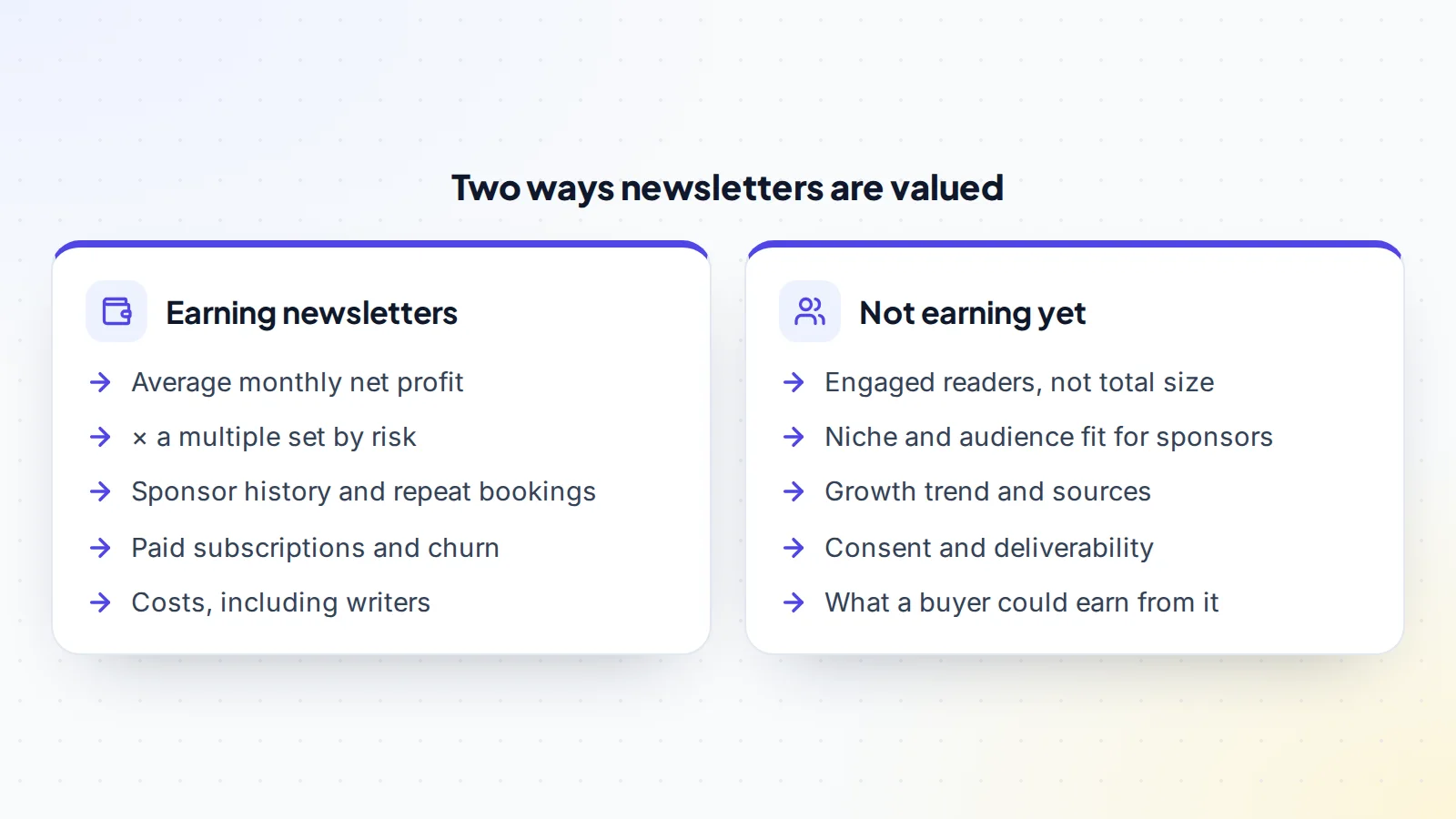
When a newsletter has a record of income, it’s usually valued like other online businesses: average monthly net profit over the last 6 to 12 months, multiplied by a multiple that reflects risk and growth. Net profit means revenue minus every cost needed to keep it running, including platform fees, tools, writers, editors and designers. If the seller writes it themselves, the cost of replacing their time matters to a buyer who won’t.
Income usually comes from some mix of:
- Sponsorships sold directly or through ad networks. Repeat sponsors who book month after month are worth more than one-offs. See newsletter sponsorship revenue.
- Paid subscriptions, valued like recurring revenue, with churn in mind.
- Affiliate income from recommended products.
- Products and services sold to readers.
Valuing a newsletter that doesn’t earn yet
Many newsletters for sale haven’t been monetised. Their value comes from what a buyer can do with the audience. Buyers look at:
- Engaged readers: how many people click and reply regularly.
- Niche: is the audience valuable to sponsors (professionals, buyers in a market, decision-makers)?
- Growth: steady organic growth from sources a new owner can keep using.
- Cost to build: what it would cost in time and money to grow a comparable engaged list.
These valuations are less precise than profit-based ones, and buyers price in the uncertainty. Our guide to pre-revenue valuation explains the methods.
What moves the price
Up
- Strong clicks per issue and a habit of replies.
- Steady organic growth through the website, referrals and recommendations.
- Repeat sponsors with invoices to prove it.
- Clean consent records for every subscriber.
- An authenticated sending domain with low bounces and complaints.
- A format that a new writer could continue.
Down
- A large list with low engagement.
- Growth driven mainly by giveaways or paid co-registration.
- Sponsors who book because they know the writer personally.
- Imported or unclear sources of subscribers.
- Deliverability problems, rising complaints or a shared sending domain.
- A personality-led format that depends on one writer.
Consent and deliverability: value protectors
Two technical factors can make or break newsletter value. The first is consent. Readers who chose to subscribe are an asset; contacts added without consent are a liability. In the United States, the FTC’s CAN-SPAM guidance requires commercial emails to include a postal address and a working opt-out, honoured within 10 business days. In the European Union, the GDPR governs how subscribers’ data can move to a new owner. Our guide to transferring subscribers under the GDPR covers it.
The second is deliverability. Google’s sender guidelines require senders of more than 5,000 messages a day to Gmail accounts to authenticate their domain with SPF, DKIM and DMARC and to offer one-click unsubscribe. A newsletter that reliably reaches inboxes is worth more; one with deliverability problems may need months of work to recover. See the email deliverability check.
A worked example
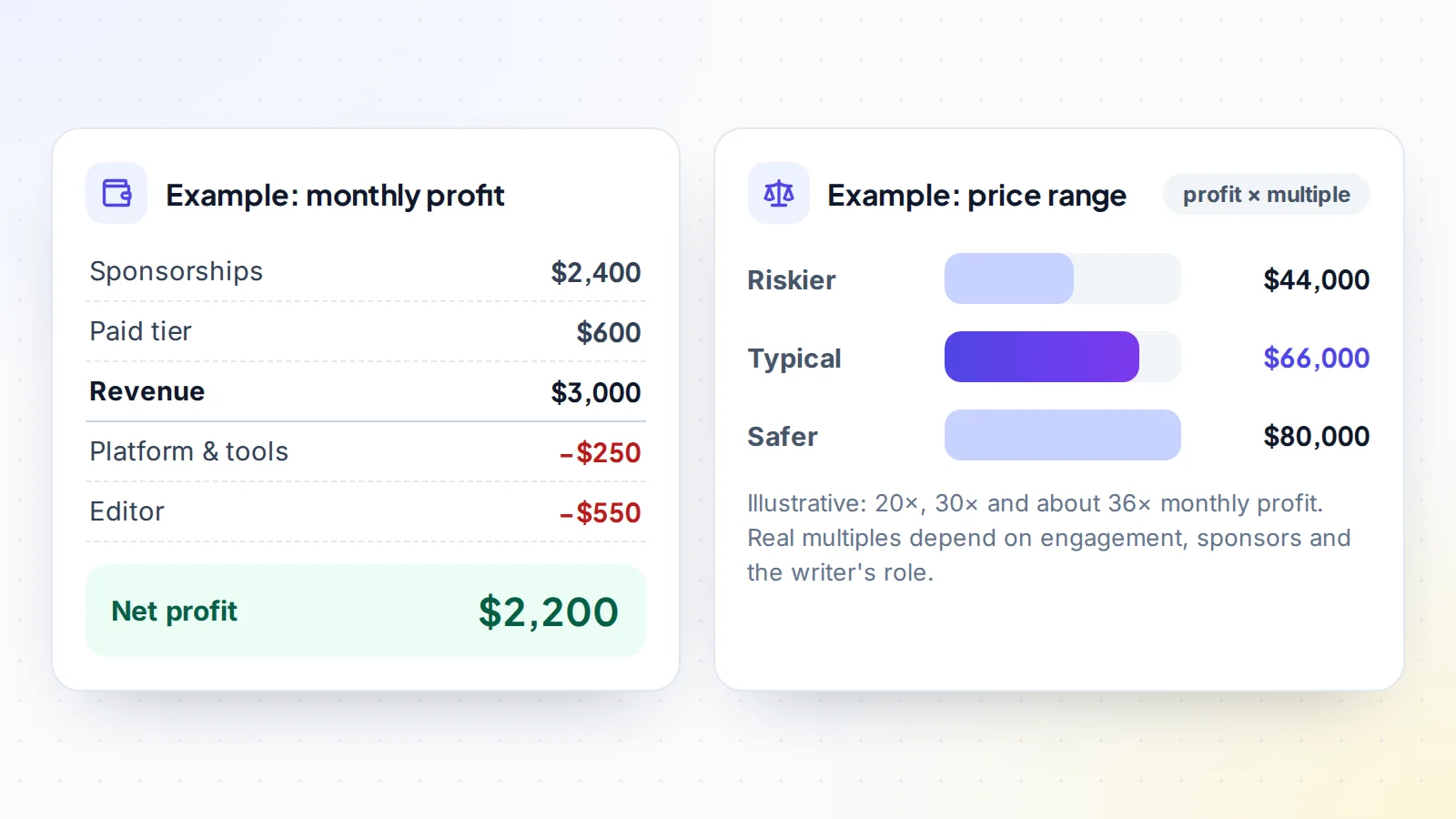
A weekly newsletter for product managers has 14,000 subscribers. It earns $2,400 a month from sponsors (three of whom have booked for over a year) and $600 from a paid tier, for $3,000 of revenue. An editor costs $550 a month and tools $250, so profit is $2,200 a month.
If the writer is central to the format, two of the three sponsors know them personally and growth has stalled, a buyer might apply a lower multiple. If the format runs on a clear template the editor already produces, sponsors book because of the audience, and the list grows steadily through referrals and recommendations, a higher multiple is justified. The figure shows how the same $2,200 can support very different prices.
How each income type is judged
Not all newsletter income is valued equally. Sponsorship income is judged on its history and spread: many sponsors booking repeatedly over a year is far stronger than one large sponsor or a few one-off bookings. Buyers also ask whether sponsors book through the newsletter’s own sales process or through the writer’s personal network. Paid subscription income is judged like recurring revenue: how many paid subscribers there are, how many cancel each month, how many are on annual plans and whether paid content depends on the writer. Affiliate income is judged on stability and on the programmes’ terms, which can change. Product income depends on whether the products come with the sale. A newsletter whose income is spread across several of these, each with a solid record, earns a higher multiple than one relying on a single stream.
Growth potential: what buyers will pay for
Buyers don’t only pay for today’s profit; they pay for what they believe they can do next. A newsletter with an engaged audience in a valuable niche and little monetisation can be attractive to a buyer who knows how to sell sponsorships. A newsletter with sponsors but a stagnant list may appeal to a buyer with a growth playbook. Sellers who can show credible, specific growth opportunities (sponsor categories not yet approached, a paid tier not yet launched, partners interested in cross-promotion) give buyers reasons to pay toward the upper end of a range. Vague promises of “huge potential” do the opposite.
What about “value per subscriber”?
You’ll sometimes hear newsletters priced as a dollar amount per subscriber. It’s a quick shorthand, but it ignores the factors that matter most: engagement, niche, income and consent. Two lists of the same size can be worth very different amounts per subscriber. If you use it at all, use it only to compare newsletters in the same niche with similar engagement, and always cross-check with profit or engaged readers.
A second example: no income yet
Now take a newsletter for independent bookshop owners with 6,000 subscribers and no income. It’s grown steadily for two years through the website and recommendations from related newsletters. Each issue gets around 1,500 unique clicks, readers reply often, and the sending domain is properly authenticated. There are no sponsors, but several publishers and software companies serve exactly this audience.
A buyer can’t use a profit multiple here, so they ask what it would cost to build a comparable engaged list in this niche, and what they could earn from it with a sponsorship programme. The answer won’t be as precise as a profit-based valuation, and the buyer will price in the risk that sponsors don’t materialise. But engagement, niche fit and clean growth make this newsletter far more valuable than a list three times its size grown through giveaways. Newsletter valuation always comes back to the same question: how much real attention is there, and who will pay for it?
For sellers: raising your newsletter’s value
- Clean the list of long-inactive readers; healthier engagement often outweighs a smaller count.
- Lock in sponsors with longer bookings where you can.
- Document the process so a new writer can continue the format.
- Fix deliverability before you list: authenticate your domain and reduce complaints.
- Add a growth channel that doesn’t depend on you, such as a referral programme or recommendations; see how channels like Telegram can complement a newsletter.
If the buyer asks you not to start a competing newsletter, agree the scope clearly; see non-competes.
For buyers: checking the numbers behind the value
Ask for a live view of the platform dashboard for 12 months of clicks, growth, unsubscribes and complaints; sponsor invoices matched to payments; paid subscriber numbers with churn; and the sources of every subscriber segment. Check the profit figure carefully, including any add-backs, and ask how the newsletter will move to you: our guide to newsletter transfers covers Substack, beehiiv and Kit.
Common valuation mistakes
- Pricing on total subscribers instead of engaged readers or profit.
- Counting the writer’s time as free, which overstates profit for any buyer who won’t write it themselves.
- Using a peak sponsorship month as the base rather than an average.
- Ignoring deliverability until after the sale, when fixing it costs time and income.
- Assuming every sponsor stays. Ask which are tied to the audience and which to the person.
Timing
Newsletter valuation reflects the last few months more than older history. A newsletter sold while engagement and sponsorships are strong will attract better offers than the same newsletter sold after a quiet period. Sellers who are tired of writing often wait too long; the drop in consistency shows in the numbers buyers study. If you’re considering a sale, keep publishing on schedule until the handover.
Newsletter valuation: the checklist
- 12 months of clicks per issue, growth, unsubscribes and complaints.
- Subscriber sources and consent documented.
- Deliverability checked: SPF, DKIM, DMARC, bounces, complaints.
- Income verified: sponsor invoices, paid subscriptions, affiliate reports.
- All costs listed, including the writer’s time.
- Writer dependence assessed.
- Valuation method chosen: profit multiple or engaged-reader based.
- Multiple justified with specific factors.
- Price range written down before negotiating.
Ready to find your next asset?
Browse listings with verified numbers, ask sellers your questions before you offer, and agree every step in a free Deal Room.
Browse newsletters & communities Sell your newsletter or community
Frequently asked questions
How much is a newsletter worth?
Earning newsletters are usually valued as a multiple of average monthly net profit. Newsletters without income are valued on engaged readers, niche, growth and potential.
Is subscriber count a good measure of value?
Not on its own. Clicks, replies, growth sources and income say far more about value than total subscribers.
Do open rates still matter?
Less than before, because automatic image loading in some email apps can inflate opens. Clicks and replies are more reliable.
Does the platform affect value?
Somewhat: buyers prefer platforms with clear ownership transfers and good deliverability. The audience and income matter much more than the tool.
How does the writer affect the price?
If readers and sponsors are loyal to the writer personally, buyers discount for the risk that they’ll leave after the sale.
Should I include the archive and social accounts in the price?
Yes, list them as part of the sale. The archive supports search traffic and new sign-ups, and social accounts linked to the newsletter help growth; buyers value both, even if they rarely change the multiple much on their own.
How long does a newsletter valuation take?
A first estimate takes minutes with the main numbers. A reliable valuation, after checking engagement, consent, deliverability and income at the source, usually takes a few days of due diligence.
Is a paid newsletter worth more than a sponsored one?
Not automatically. Paid subscriptions are recurring, but often depend more on the writer; sponsorships depend on audience quality. Buyers look at stability and transferability for both.
Can I value a newsletter with a free tool?
Tools give a quick range, but newsletter valuation depends on engagement and income details that only careful checks reveal.