
Micro-SaaS for Sale: How to Find and Judge a Good One
A practical guide to small software businesses for sale: where to find them, the metrics that matter, technical and transfer checks, pricing and the handover.

A micro SaaS is a small software business, often run by one person, that earns recurring revenue from a focused product: a browser extension with a paid plan, a plugin, a reporting tool for one platform, a niche scheduling app. When you find a good micro SaaS for sale, you’re buying a product that customers pay for every month, and with care it can keep doing that for years.
This guide explains how to find and judge small software businesses: where they’re listed, which numbers matter, how to check the code and the transfer, how they’re priced, and how to plan the handover and first 90 days. For the full process on larger deals, see our guide on how to buy a SaaS business.
Key takeaways
- Look for steady or growing recurring revenue, low churn, customers spread across many accounts and maintainable code.
- Verify revenue and churn in the payment processor yourself, ideally through read-only access.
- Have the code reviewed, and check that every service, key and account can be transferred.
- Micro SaaS businesses are usually priced on profit, adjusted for growth, churn and how much work they need.
- Start the payment processor and app store transfer questions early; they take the longest.
What counts as a micro SaaS
There’s no official definition, but a micro SaaS usually has a small team (often one founder), a narrow product for a specific group of customers, recurring subscription revenue, and low running costs. Many are built on top of a bigger platform: a plugin for an online store builder, an add-on for a design tool, an integration between two popular apps. That focus is their strength, and also their main risk.
Why people buy them
- Recurring revenue: customers pay automatically each month or year. Stripe describes monthly recurring revenue as the predictable revenue a business expects every month, which is exactly what makes these businesses attractive.
- High margins: once built, software costs relatively little to run.
- Manageable size: one person can often run and improve it.
- Growth room: many founders sell when they’ve built the product but haven’t had time to market it.
Where to find micro SaaS for sale
Small software businesses are listed on online business marketplaces, sold through brokers for larger deals, and sometimes offered privately in founder communities. Buyers can also post what they’re looking for and let founders come to them. You can browse software listings on digiflippers.com’s SaaS and apps marketplace, or post a request describing the product you want.
What makes a good one
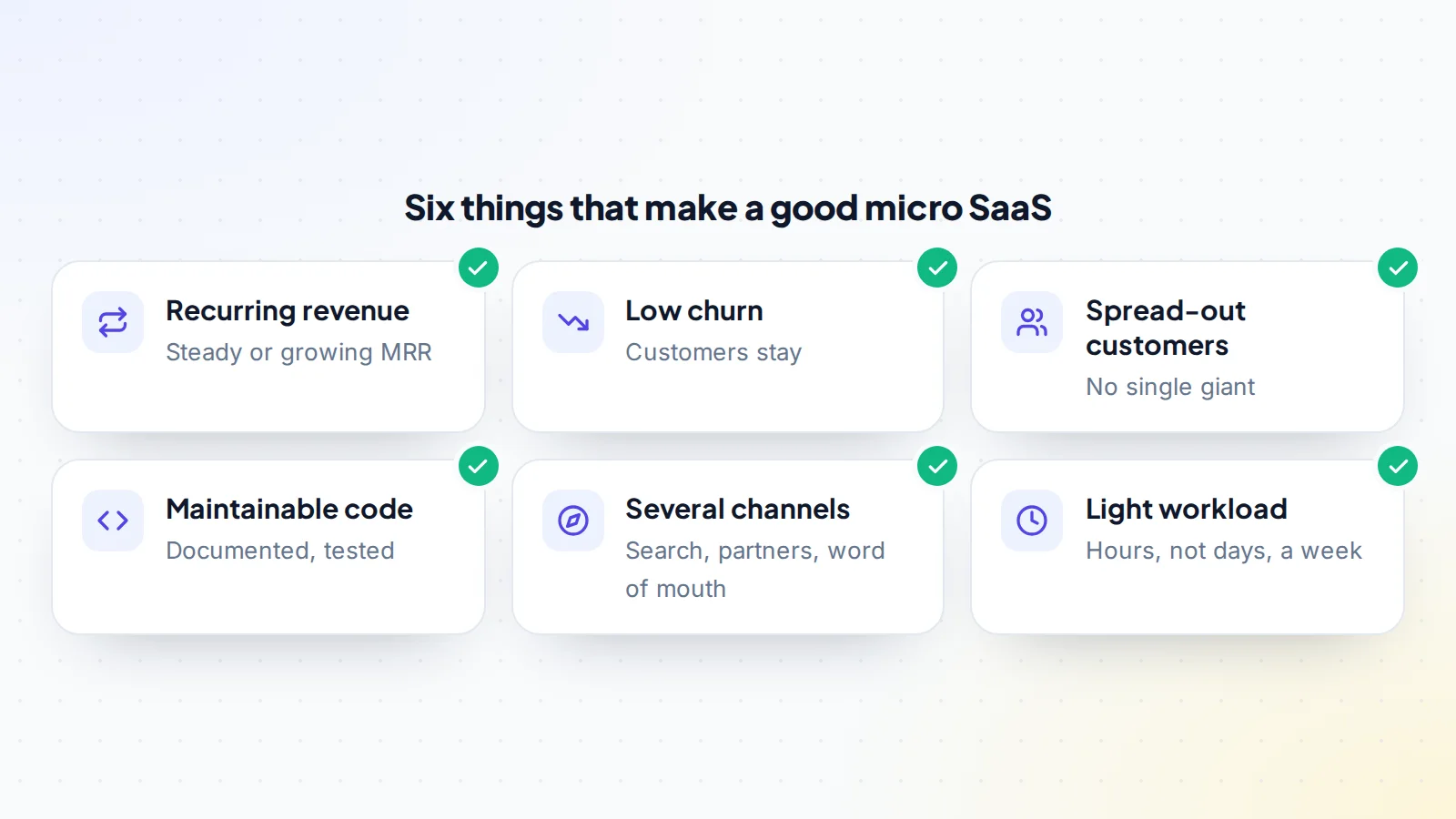
Recurring revenue that’s steady or growing
Look at monthly recurring revenue over at least 12 months, split into new, expansion, contraction and churned revenue. A gently rising line built from many customers is healthy. See MRR vs ARR.
Low, stable churn
Churn decides how long revenue lasts. Recalculate it yourself from the payment data, by customer and by revenue, and look at cohorts. Our guide to SaaS churn rate explains how.
Customers spread out
If one customer pays a large share of revenue, losing them changes everything. Check the revenue share of the top five customers.
Maintainable code
Readable, documented code with tests, current dependencies and a clear deployment process is far easier to own. See SaaS technical due diligence.
Several ways customers find it
Search, an app marketplace listing, partner referrals and word of mouth together are stronger than one channel. Read about traffic concentration risk.
A workload you can carry
Ask exactly how the founder spends each week: support, bug fixes, updates, marketing. Some products need an hour a day; others need a developer on call.
Platform dependence
Many micro SaaS products depend on another company’s platform: an app store, an API, a marketplace for plugins. That dependence brings customers, but it also brings risk: the platform can change its rules, its API or its fees, or build a competing feature. Check the platform’s developer terms, how often its API has changed, and how much of the product’s revenue comes through the platform’s own marketplace. A product that would survive a platform change, perhaps because it also sells directly, is worth more.
Verifying the numbers
- Read-only access to the payment processor: Stripe, for example, offers restricted API keys that can be limited to read access. Use the raw data to recalculate MRR, churn and refunds.
- Product analytics: active users, sign-ups and feature use, compared with paying customers.
- Costs: hosting, third-party services, support tools, contractors and payment fees, with invoices.
- Support history: ticket volume and common issues show where the product struggles.
Our guide to SaaS due diligence covers the full list, and operational due diligence covers processes and workload.
Checking what can transfer
Software businesses have more moving parts than most. Before agreeing a price, confirm how each will move:
- Code: GitHub’s documentation explains that a repository can be transferred to a new owner, keeping its issues, pull requests and commit history, with the new owner accepting by email.
- Cloud infrastructure: servers, databases, storage and their billing accounts.
- Payment processor: Stripe’s support says that when a business is sold, the account holder should contact Stripe first, because what can change depends on the situation. Subscriptions need careful handling so customers keep paying.
- App stores: Apple’s App Store Connect help explains app transfer criteria, such as the app having at least one released version and not being in review, and that the recipient has a limited time to accept. Other stores have their own processes.
- Third-party services: email sending, error monitoring, analytics and any APIs with keys tied to the founder.
- Domain and email.
Questions to ask the founder
- Why are you selling, and what would you build next if you kept it?
- Where do new customers come from, month by month?
- Why do customers cancel? Do you have cancellation feedback?
- What breaks most often, and how long does it take to fix?
- Which services, keys and accounts are tied to you personally?
- Have you changed prices? What happened to sign-ups and churn?
- Are there any customer contracts, special discounts or promises outside the standard plans?
The answers often reveal more than the numbers: a founder who knows exactly why customers leave usually runs a healthier product than one who doesn’t.
Legal and data points
- Terms of service and privacy policy: check they cover how customer data is used and that they allow a change of owner.
- Customer data: if customers are in the European Union or other regions with data protection laws, the GDPR or similar rules apply to how data is handled and transferred.
- Open-source licences: make sure the libraries used allow commercial use in the way the product uses them.
- Intellectual property: code written by contractors should be assigned to the business in writing.
- Platform agreements: developer terms for app stores and APIs the product relies on.
Where the upside usually is
Many founders sell micro SaaS products because they love building but not marketing. That’s often where a buyer adds value: improving onboarding to reduce early churn, adding an annual plan, reviewing pricing, writing helpful content for search, listing the product on more marketplaces, or building integrations customers have asked for. Price the business on what it earns now, then treat these as your plan, not the seller’s promise.
How micro SaaS businesses are priced
Small software businesses are usually priced as a multiple of profit (for the smallest, often monthly net profit or seller discretionary earnings), and sometimes, for faster-growing ones, as a multiple of recurring revenue. The multiple rises with growth, low churn, many customers, clean code, several channels and a light workload. It falls with platform dependence, concentration, rising churn, technical debt and heavy founder involvement.
Read about the online business valuation multiple and try the free valuation tool for a quick range.
A worked example
The numbers below are made up to show the method, not market data.
Robin finds a micro SaaS for sale: a reporting add-on for an online store platform with 340 paying customers and $5,100 of monthly recurring revenue. Costs are about $900 a month, so profit is around $4,200 a month. The founder spends five hours a week on support and fixes.
Robin checks the data through a read-only key. Revenue has grown steadily for 18 months; monthly revenue churn averages 2.5%; no customer pays more than 3% of revenue. A developer friend reviews the code: it’s tidy, with tests, but one library is several versions behind. The risk Robin notes is platform dependence: 80% of customers came through the store platform’s app marketplace.
Robin offers a price based on profit, with a multiple adjusted down slightly for the platform dependence and the library update, and asks the founder for 60 days of support to help with the payment processor move and the app listing transfer. The founder agrees, and both sides plan the handover in writing before signing.
The handover
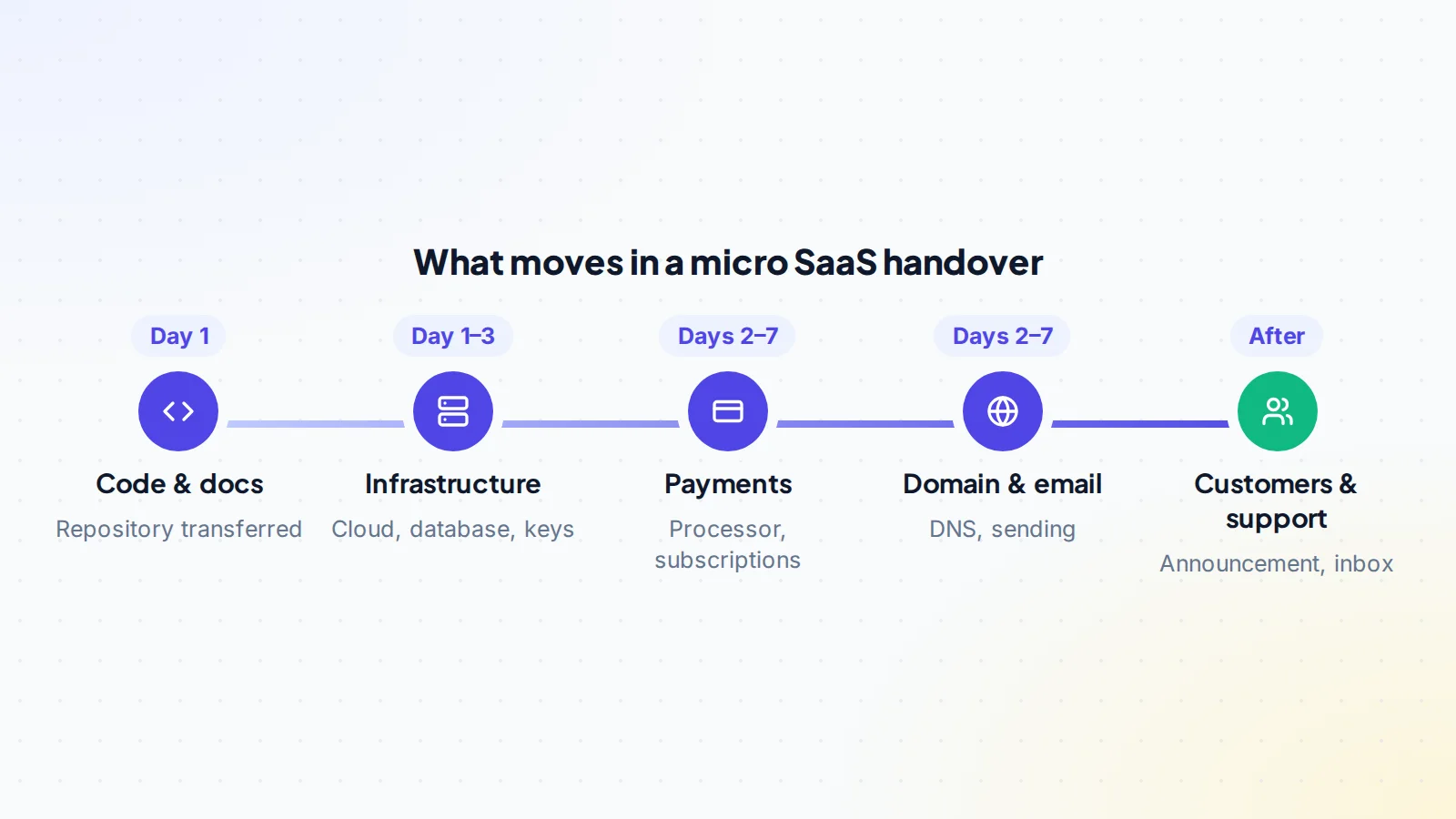
- Payment secured by escrow or a trusted middleman. On digiflippers.com, the ways to pay in a deal are: directly to the seller, through escrow, and the platform never holds the money itself.
- Code and documentation transferred, with deployment tested on the buyer’s accounts.
- Infrastructure moved, with keys and secrets rotated.
- Payments and subscriptions moved following the processor’s guidance.
- App store or marketplace listings transferred through their own processes.
- Domain, email and support inbox moved.
- Customers informed with an agreed announcement.
Our asset transfer checklist covers every item.
The first 90 days
- Keep it running: respond to support quickly; customers notice changes in response time first.
- Fix the risky things: update outdated dependencies, rotate credentials, set up monitoring and backups.
- Talk to customers: ask what they’d pay more for.
- Reduce dependence: add a direct sales channel or a second platform.
- Improve retention before chasing new customers; lower churn is usually the fastest way to grow.
Support after the sale
Agree a support period with the founder, often 30 to 90 days, covering questions about the code, infrastructure, customers and partners. Write down what’s included (for example, a set number of hours or a response time), whether it’s part of the price, and how to contact them. Knowledge transfer is often the most valuable part of the handover, because the founder knows the quirks no documentation covers.
Red flags
- Revenue shown only in screenshots; see fake revenue screenshots.
- Rising churn the seller can’t explain.
- One customer or one platform providing most of the revenue.
- Code the seller won’t let anyone review.
- Services or keys tied to the founder’s personal accounts with no transfer plan.
- A product built on an API the platform has announced it will change or close.
Micro SaaS for sale: the checklist
- 12+ months of MRR, split into new, expansion, contraction and churn.
- Churn recalculated from raw payment data, with cohorts.
- Customer concentration checked.
- Code reviewed by someone you trust.
- Platform dependence assessed.
- Transfer method confirmed for code, infrastructure, payments, app stores and services.
- Workload understood in hours per week.
- Price based on verified profit and adjusted for risks.
- Payment secured before the handover.
Ready to find your next asset?
Browse listings with verified numbers, ask sellers your questions before you offer, and agree every step in a free Deal Room.
Frequently asked questions
What is a micro SaaS?
A small software business, often run by one person, that sells a focused product on a subscription.
Do I need to code to buy one?
It helps a lot. If you don’t code, budget for a trusted developer to review the product before you buy and to maintain and update it afterwards, and include that cost in your profit figure.
How are micro SaaS businesses valued?
Usually on profit, sometimes on recurring revenue for fast growers, with the multiple adjusted for growth, churn, concentration, code quality and workload.
Can Stripe subscriptions move to a new owner?
Stripe’s support says to contact them first when a business is sold, because what can change depends on the situation. Plan this early.
How long does a handover take?
Often one to three weeks, mostly because payment processors, app stores and domains each have their own processes and timelines.
What’s the biggest risk with a micro SaaS for sale?
Usually dependence: on one platform, one channel, one large customer or the founder’s knowledge. Check each, and reflect it in the price.