The Most Common Scams When Buying Digital Assets
Fake escrow, fake listings, edited screenshots, payment reversals and account recovery tricks: how digital asset scams work and the simple habits that stop them.
Buying and selling websites, domains, apps and accounts is mostly done between strangers, often across borders and usually in a hurry. That combination attracts scammers. The good news is that digital asset scams follow a small number of patterns, and a handful of simple habits stop almost all of them. Knowing the patterns makes you a much harder target, whether you’re buying or selling.
This guide describes the eight most common scams, how each one works, the warning signs and how to protect yourself. It ends with five habits that cover nearly every case.
Key takeaways
- Most scams target the moment money or access changes hands.
- Fake escrow, fake sellers and edited screenshots are the most common tricks.
- Sellers face their own risks: payment reversals after handover and fake payment confirmations.
- The FTC warns that scammers pressure people to act fast and insist on payment by wire, crypto, payment apps or gift cards.
- Prove ownership live, verify numbers at the source, stay on the platform, use protected payment you choose, and secure the handover.
Eight common scams
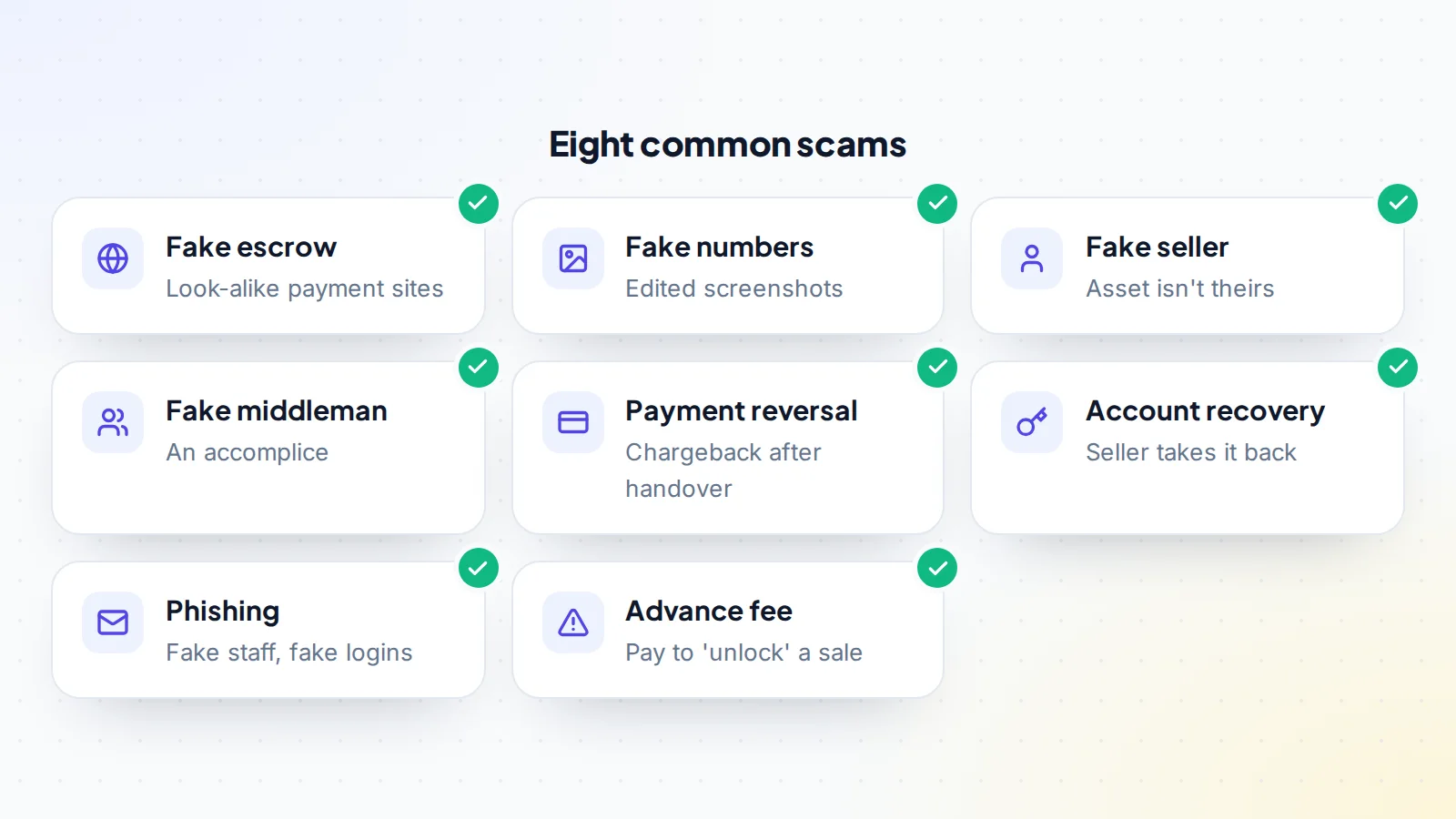
Each of the scams below exploits a gap in a deal: trust in a website, trust in an image, trust in a person, or trust that a payment is final. Close the gap with a simple check and the scam fails. Many scammers combine two or three of these tricks in the same conversation, so spotting one is a reason to look for the others.
1. Fake escrow
The other side suggests an escrow service you don’t know. It looks professional and soon sends a “funds received” email, so you hand over the asset. The site was fake and no money existed. Escrow.com’s fraud guidance describes this pattern, and California’s DFPI has warned about fake escrow sites using fictitious or copied licence numbers.
Protection: choose the escrow company yourself or use the marketplace’s own options, check its licence with the regulator, and confirm funds by signing in yourself. See how fake escrow scams work.
2. Fake numbers
A listing shows impressive revenue or traffic in screenshots that have been edited, cropped or borrowed from another account. The buyer pays for income that doesn’t exist.
Protection: verify numbers at the source through a live screen share where you choose the dates, or read-only access, and match revenue to payouts. See fake revenue screenshots.
3. The fake seller
Someone lists a website, domain or account that isn’t theirs, copying its content and story. They take payment and disappear, because they never controlled the asset.
Protection: ask for live proof of ownership with a code you choose, placed on the site, profile or DNS. Check public records such as domain registration data. See how to check an online seller.
4. The fake middleman
In account and domain trades, the other side recommends a “trusted middleman” who is really an accomplice or a second account they control. Payment sent to the middleman never comes back.
Protection: use the marketplace’s own middleman service, or confirm a middleman’s identity through an official channel. Never accept one introduced in a private message. See middleman service.
5. Payment reversal after handover
This targets sellers. A buyer pays with a method that can be reversed, receives the asset, then disputes the payment, sometimes claiming they never received anything. The seller loses both the money and the asset.
Protection: use escrow or a middleman, so payment is confirmed by a third party before handover. Keep records of every step. See chargeback risk when selling online.
6. Account recovery by the seller
In account sales, a dishonest seller hands over the login but keeps a way back in: the original email, a recovery phone or backup codes. Weeks later, they recover the account.
Protection: change the email first, then the password, two-factor and recovery details, and remove the seller’s devices, all while payment is still held. See securing a game account and transferring accounts with two-factor authentication.
7. Phishing and fake staff
Messages claim to come from the marketplace, a registrar or a platform’s support team, asking you to “verify” an account, confirm a transfer or enter a code on a link. The link leads to a fake login page.
Protection: real staff work through the platform itself. Type addresses yourself, never share codes and turn on two-factor authentication everywhere.
8. Advance fee tricks
A “buyer” offers a great price but says a fee must be paid first: for “verification”, “escrow activation” or “international transfer”. Once paid, the buyer vanishes. Real buyers and escrow services don’t ask sellers to pay to receive money.
Protection: treat any request to pay before receiving as a warning sign, and check fees with the provider directly.
Scams by type of asset
- Domains: unsolicited “buyers” who insist you get a paid appraisal from a specific service before they can make an offer; fake escrow; requests for the auth code before payment. See the domain auth code guide.
- Websites and online businesses: edited revenue screenshots, traffic inflated by bots, and listings copied from real businesses.
- Social media and video channels: inflated follower counts, accounts sold with the original email kept by the seller, and fake middlemen.
- Game accounts: account recovery by the seller after the handover, and payment reversals.
- Newsletters and communities: subscriber or member counts padded with inactive or fake accounts. See the email deliverability check.
- SaaS and apps: recurring revenue that includes one-off payments, or customers who are friends of the seller.
Why digital asset scams work
Digital asset scams succeed because of three features of these deals. First, assets move instantly and are hard to take back: a domain, a login or a file can’t easily be recovered once handed over. Second, the parties rarely know each other and may be in different countries, so trust has to come from process rather than relationships. Third, deals often feel urgent: a good price, an eager buyer, a deadline. Scammers use all three. The habits in this guide replace trust and urgency with simple checks that a real counterpart will happily accept.
Warning signs across all scams
- Pressure to act fast. The FTC notes that scammers want you to act before you have time to think, while honest businesses give you time.
- Insistence on a specific payment method, especially wire transfers, crypto, payment apps or gift cards, which the FTC says scammers prefer because money is hard to recover.
- Moving the conversation off the platform to a chat app.
- Unfamiliar services recommended by the other side.
- Prices that seem too good, or offers that agree to everything immediately.
- Stories that change between messages.
Red flags in the listing itself
- A price far below similar assets, with no clear reason.
- Vague descriptions that avoid naming the domain, channel or site.
- Screenshots only, tightly cropped, with no offer of live access.
- A brand-new seller account listing several high-value assets at once.
- The same asset listed elsewhere by a different seller.
- Instructions to contact the seller off the platform written into the listing.
Any one of these deserves a question. Several together are a reason to report the listing and move on.
Five habits that stop most scams
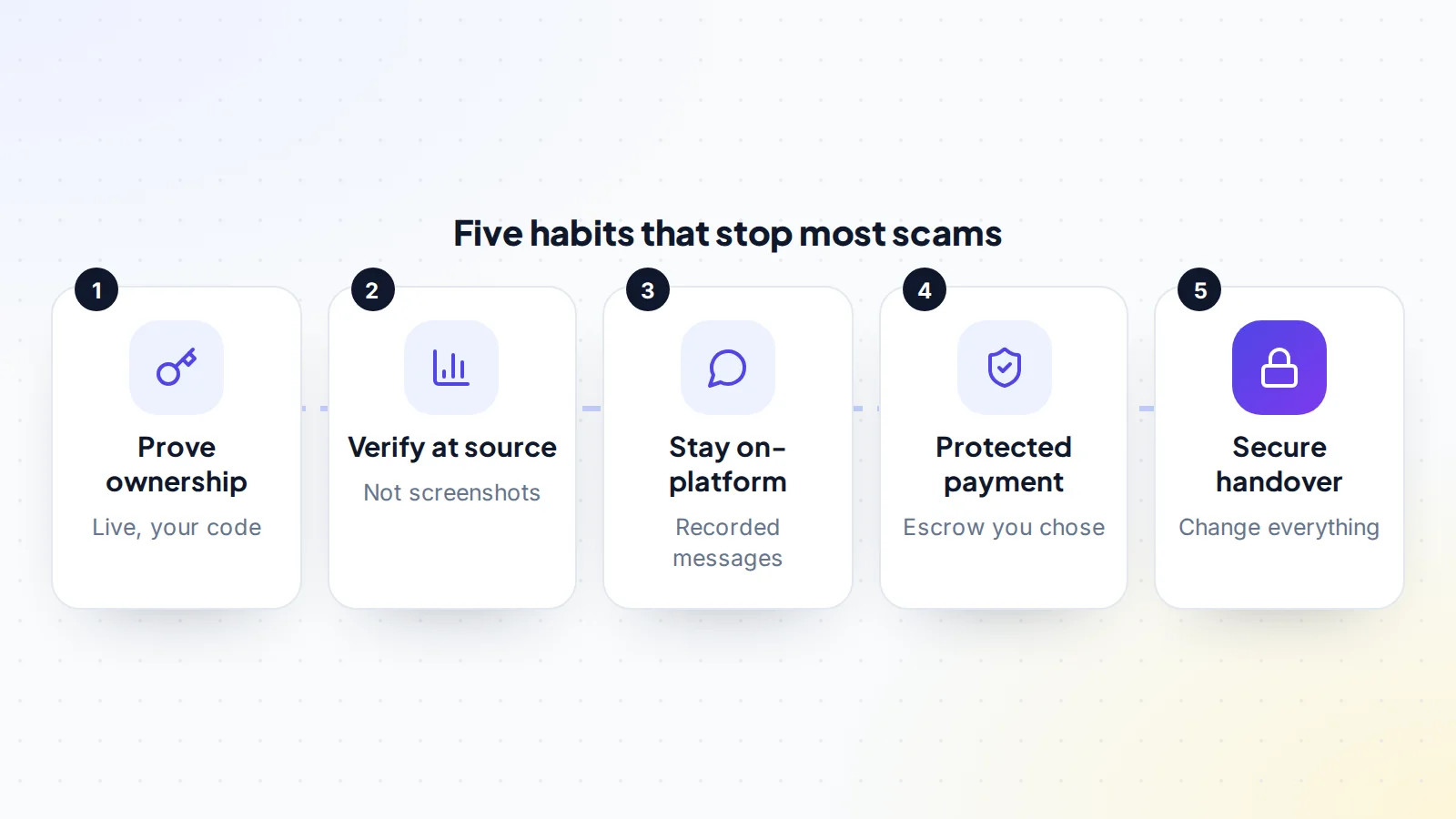
- Prove ownership live with a code or change you choose.
- Verify numbers at the source, not in images.
- Stay on the platform, where messages are recorded and staff can help.
- Use protected payment you chose: escrow or a middleman you found yourself or the marketplace provides. On digiflippers.com, the ways to pay in a deal are: directly to the seller, through escrow, and the platform never holds the money itself.
- Secure the handover: change every access detail before confirming, while payment is still held.
Protecting a team or business
If several people in a business buy or sell assets, write the rules down: approved payment methods and escrow providers, a requirement that a second person confirms funds before any handover, a ban on moving deals to private chat apps, and two-factor authentication on every registrar, platform and email account. Share examples of scam messages so everyone learns to spot them. Clear rules protect people from making a rushed decision under pressure, which is exactly what scammers count on.
How marketplaces help
A good marketplace builds many of these habits into the process: verifying identities and phone numbers, checking ownership with codes, flagging duplicate listings, keeping messages in a recorded deal space and offering protected payment options. On digiflippers.com, deals happen in a deal room with recorded messages, and the payment options are shown before anyone agrees. These features don’t replace your own judgement, but they make digital asset scams much harder to pull off.
A worked example
The details below are made up to show how the habits work together.
A buyer finds a listing for a gaming community with a great price. The seller wants to move to a chat app “to speed things up”, sends screenshots of member statistics and suggests a middleman they “always use”. The buyer applies the five habits: asks to stay on the platform (refused), asks for a code to be posted in the community’s announcement channel (delayed), and proposes the marketplace’s own payment options (rejected in favour of the seller’s middleman).
Three habits, three refusals. The buyer stops and reports the listing. It later turns out the seller wasn’t the community’s owner at all. None of the checks took more than a few minutes, and together they made the scam impossible to complete.
For sellers: scams aimed at you
- Fake payment confirmations: screenshots or emails saying money was sent. Confirm in your own account or with the escrow provider.
- Overpayment tricks: a buyer “accidentally” pays too much and asks for the difference back before the original payment bounces.
- Requests for codes or logins “to check” the asset before payment.
- Fake escrow suggested by the buyer.
If you’ve been targeted
- Stop any handover or payment in progress.
- Secure your accounts: change passwords, reset two-factor, re-lock domains.
- Report it to the marketplace and the platforms involved.
- Contact your bank or payment provider immediately if money was sent.
- Report fraud, in the United States at ReportFraud.ftc.gov.
- Keep evidence: messages, listings, emails and website addresses.
Help others stay safe
Scammers reuse the same scripts on many people. If you spot a fake listing, a look-alike escrow site or a suspicious “middleman”, report it to the marketplace so it can be removed, and tell people in communities where you buy and sell. Keeping screenshots of the messages and the addresses involved makes reports far more useful. A few minutes of reporting can stop the same trick reaching the next buyer or seller.
Digital asset scams: the checklist
- Ownership proven live with a code you chose.
- Numbers verified at the source.
- Conversation kept on the platform.
- Payment method chosen by you; escrow or middleman verified independently.
- No payment by wire, crypto, payment app or gift card to a stranger.
- Every access detail changed before confirming the handover.
- No codes or logins shared with anyone.
Ready to find your next asset?
Browse listings with verified numbers, ask sellers your questions before you offer, and agree every step in a free Deal Room.
Frequently asked questions
What’s the most common scam when buying a website?
Fake numbers and fake sellers, often combined with fake escrow. Live ownership proof, verified data and protected payment stop them.
How do scammers target sellers?
With fake payment confirmations, payment reversals after handover, fake escrow and requests for codes or logins before payment.
Is escrow always safe?
Genuine escrow is. Fake escrow sites are a common scam, so choose the provider yourself and verify it.
Why do scammers want to move off the platform?
Because messages there are recorded and the platform can act on them. Private chats leave no shared record and no one to step in.
What should I do if I’ve sent money to a scammer?
Contact your bank or payment provider immediately, report it to the marketplace and, in the United States, at ReportFraud.ftc.gov.
Are low prices always a warning sign?
Not always, since some sellers need a quick sale. But a price far below similar assets, with pressure to pay fast by an irreversible method, is a classic sign of a scam.