How Escrow Works When You Buy an Online Business
A plain-English guide to escrow for websites, SaaS, domains and accounts: the steps, the costs, the protections and how to avoid fake escrow scams.
Buying or selling an online business means moving two valuable things at once: money one way and an asset the other. Without protection, someone has to go first, and whoever goes first takes the whole risk. Online business escrow solves that by putting the money with a neutral, licensed company until the asset has changed hands and been checked.
This guide explains how escrow works for websites, SaaS products, domains, social media accounts, newsletters and other digital assets. You’ll learn each step from agreement to release, who pays the fees, what the inspection period is for, what happens in a dispute, when paying directly can be reasonable and, importantly, how to recognise fake escrow sites, one of the most common scams in this market.
It’s written for both sides. Escrow protects buyers and sellers equally, which is why serious people on both sides prefer it.
Key takeaways
- Escrow holds the buyer’s payment with a neutral third party until the seller has transferred the asset and the buyer has checked it.
- Agree the details first: what’s being transferred, how, and how long the buyer has to inspect.
- Sellers transfer only after confirming, in their own escrow account, that the funds are held.
- Escrow fees are usually a percentage of the price; agree who pays them before you start.
- Use only escrow companies you’ve checked yourself. Fake escrow websites are a common scam.
What escrow is
Escrow is an arrangement in which a neutral third party holds money (and sometimes documents) on behalf of two people who are doing a deal, and releases it only when agreed conditions are met. It’s been used for property sales for a long time; online, it has become the standard way to buy and sell digital assets between people who don’t know each other.
Escrow companies are regulated. In California, for example, the Department of Financial Protection and Innovation (DFPI) licenses escrow agents and internet escrow agents, and its guidance says companies providing escrow services over the internet to Californians must be licensed under the state’s Escrow Law. The DFPI publishes a list of licensed online escrow companies. Other places have their own rules, but the principle is the same: real escrow is a regulated service.
Why escrow matters for digital assets
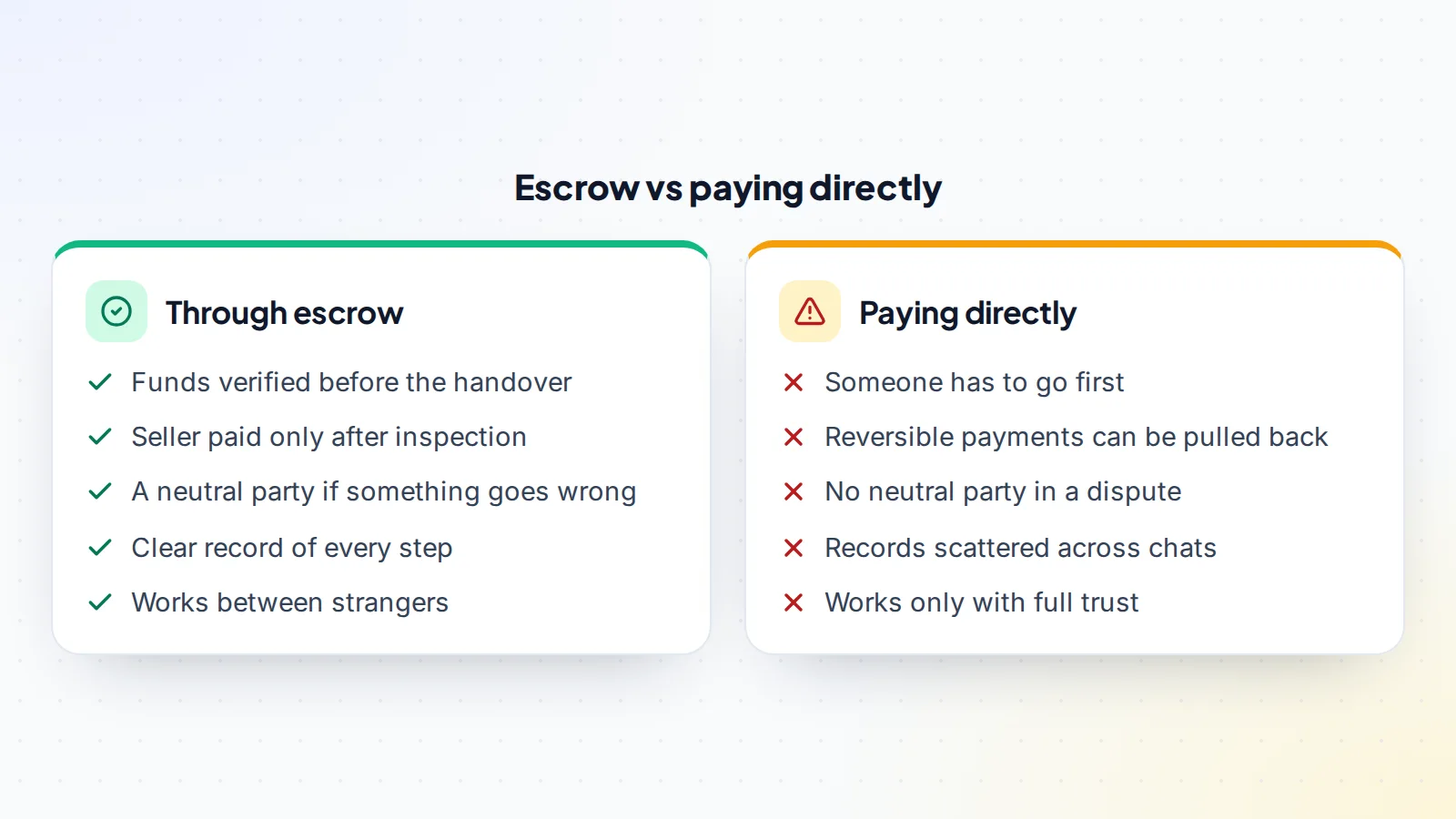
Digital assets have a feature that makes direct payment risky: they can’t easily be “returned”. Once a domain is transferred, an account’s email is changed or a database is copied, the seller can’t take it back if the buyer doesn’t pay. And once a buyer sends money, especially by a reversible method, a dishonest seller can disappear or reclaim the asset later.
Escrow removes the need for either side to go first with everything. The buyer’s money is real and committed; the seller’s asset moves while the money is safe; and the release happens only when both sides’ conditions are met.
How escrow works, step by step
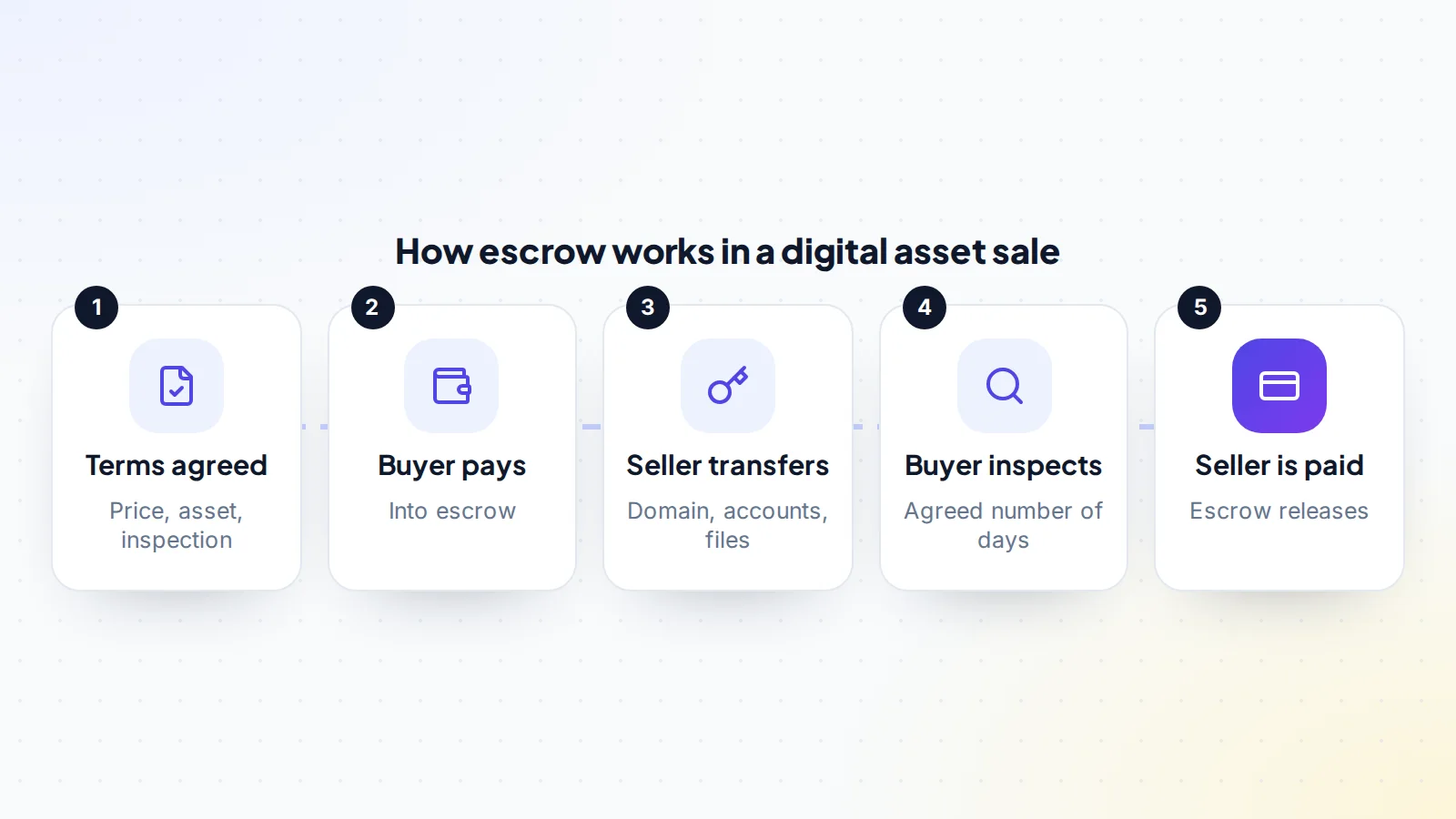
1. Agree the terms
Before anything moves, write down the price, exactly what’s included, how each part will be transferred, how many days the buyer has to inspect after the transfer, and who pays the escrow fee. Clear terms make the rest of the process straightforward, and they’re what the escrow company and both sides will refer to if questions come up.
2. Open the escrow transaction
One side opens a transaction with the escrow company, entering the agreed terms. The other side reviews and accepts them. Both sides check the details carefully, especially the amount, the description of the asset and the inspection period.
3. The buyer pays into escrow
The buyer sends the payment to the escrow company using the methods it accepts. The escrow company confirms when the funds have arrived and are secured.
4. The seller transfers the asset
Only once the seller sees, by logging in to the escrow account themselves, that the funds are held, do they start the transfer: pushing the domain, changing account ownership, moving files and hosting, adding the buyer as owner. Each step should match the agreed terms. Our handover checklist covers the order.
5. The buyer inspects
The buyer checks that everything arrived and works as described: the domain is in their account, they’re the owner of the accounts, the site loads, revenue sources point to them. The inspection period is limited (agreed in step 1), so buyers should be ready to check promptly. Read what the inspection period is for.
6. Release
When the buyer confirms everything is in order, or the inspection period ends without an objection, the escrow company releases the money to the seller. The deal is done.
Escrow fees: what they cost and who pays
Escrow companies charge for the service, usually as a percentage of the transaction amount, often with a minimum fee. Rates depend on the company, the amount and the payment method. Who pays is negotiable: the buyer, the seller, or half each. On digiflippers.com, our escrow partner is Escrow.com, a licensed escrow company, and the fee is paid by the seller unless you agree otherwise. Our guide to escrow fees explains how to compare them.
Compared with the risk escrow removes, the fee is usually small, especially for deals in the thousands of dollars or more.
What happens if something goes wrong
If the buyer finds a problem during inspection, they raise it with the escrow company before the period ends, and the money stays where it is while the two sides try to resolve it. Common outcomes are that the seller fixes the problem, the parties agree a price adjustment, or the transaction is cancelled and the asset returned. Escrow companies have their own dispute procedures, so read them before you start. Keeping all messages and agreed terms in one place helps enormously; see handling disputes in an online business sale.
Escrow vs paying directly vs a middleman
Escrow isn’t the only option. Paying directly can be reasonable when both sides already trust each other, the amount is small, or the asset can be checked and transferred instantly. A middleman, a trusted person or service who holds the asset or the payment during the handover, is common for social media and game accounts. Each option suits different deals. Our comparisons of escrow vs direct payment and middleman services explain when each fits.
On digiflippers.com, the ways to pay in a deal are: directly to the seller, through escrow. The platform never holds the money itself; the Deal Room keeps the agreed terms, every step and every message in one place, whichever method you choose.
How to choose an escrow company
Not every escrow service suits every deal. When you compare options, look at:
- Licensing and track record: who regulates it, how long it has operated and whether it handles digital assets regularly.
- Payment methods: bank transfer, card, or others, and how long each takes to clear.
- Fees: the percentage, the minimum and any extra charges for currency conversion or particular payment methods.
- Inspection periods: whether you can set the length that suits the asset.
- Dispute process: how disagreements are handled and how long it takes.
- Support: a phone line and real people who answer.
Using the escrow partner your marketplace already works with saves time, because the terms and process are familiar to both sides.
A worked example
A buyer agrees to purchase a content website for $40,000. The terms say the sale includes the domain, the WordPress site and database, the email list and two social profiles, with a five-day inspection period after the transfer and the escrow fee split equally. The seller opens the escrow transaction; the buyer reviews and accepts it, then pays by bank transfer.
Two days later, the escrow company confirms the funds are secured. The seller logs in to the escrow account to see it, then pushes the domain to the buyer’s registrar account, migrates the site to the buyer’s hosting, adds the buyer as owner in analytics and hands over the list and profiles. The buyer checks each item, confirms ad and affiliate codes now point to their accounts and that traffic continues normally. On day four of the inspection, the buyer confirms, and the escrow company releases the $40,000 to the seller, minus the seller’s half of the fee. Neither side ever had to trust the other with the whole amount. That’s online business escrow working as intended.
How to spot fake escrow
Fake escrow websites are one of the most common scams in online business and domain sales. The scammer suggests an escrow service, usually one you haven’t heard of, with a professional-looking website they control. You pay; the money is gone. Protect yourself:
- Choose the escrow company yourself, or use the one built into the marketplace. Be very cautious when the other side insists on a service you don’t know.
- Type the address yourself. Don’t follow links in emails or chats.
- Check licensing. Look the company up with the regulator; in California, the DFPI publishes the licensed online escrow companies.
- Check the website’s age and details. Brand-new sites, no phone line, poor HTTPS or vague company details are warning signs.
- Never accept “payment confirmations” by email. Log in to the escrow account yourself.
Read how fake escrow scams work and common digital asset scams. If you’ve been targeted in the United States, you can report it at the FTC’s ReportFraud.ftc.gov.
Escrow for different digital assets
- Domains: the simplest case. The domain is pushed or transferred to the buyer’s account, the buyer confirms, and funds are released. See domain escrow.
- Websites: the domain, files, hosting and accounts move; the inspection period lets the buyer check traffic and income sources point to them.
- SaaS: code, infrastructure and billing move; longer inspection periods are common.
- Social media and game accounts: the email, password, recovery options and two-factor authentication move; the buyer secures the account before confirming.
- Newsletters: the publication or list moves through the platform’s process, along with the domain.
For buyers: getting the most from escrow
Escrow protects you only if you use the inspection period well. Before you pay, make a list of exactly what you’ll check once the asset arrives: the domain in your registrar account with you as registrant, owner access to every account, the site loading from your hosting, analytics and income sources connected to you, files and backups in your storage. When the transfer happens, work through the list straight away rather than waiting for the last day. If something’s missing, raise it with the seller and the escrow company in writing, inside the period. And don’t confirm early as a courtesy: the inspection period exists so you can be sure, and a good seller will understand. Read buyer protection for digital assets for more.
For sellers: why escrow helps you too
Sellers sometimes see escrow as a buyer’s tool. It’s just as much yours. You never transfer anything until you’ve seen the funds secured, you avoid reversible payments that can be pulled back weeks later, and you have a neutral party and a clear record if a buyer later claims something was missing. Serious buyers are also more willing to make strong offers when they know their money is protected. Read about seller protection.
Online business escrow: the checklist
- Terms written down: price, what’s included, transfer steps, inspection days, fee payer.
- Escrow company chosen by you or the marketplace, and its licence checked.
- Escrow website address typed by hand; no links from the other side.
- Transaction details checked by both sides before payment.
- Seller confirms funds are held by logging in to the escrow account.
- Asset transferred in the agreed order.
- Buyer inspects promptly within the agreed period.
- Problems raised with the escrow company before the period ends.
- All messages and terms kept in one place.
- Release confirmed; passwords and access cleaned up on both sides.
Ready to find your next asset?
Browse listings with verified numbers, ask sellers your questions before you offer, and agree every step in a free Deal Room.
Frequently asked questions
How does escrow work when buying a website?
You pay a licensed escrow company, the seller transfers the domain, files and accounts, you inspect everything within the agreed period, and then the escrow company releases the money to the seller.
Who pays the escrow fee?
Whoever the parties agree: the buyer, the seller, or half each. Agree it before opening the transaction.
How long does escrow take?
It depends on the payment method, the transfer and the inspection period. Simple domain deals can finish in days; complex businesses take longer.
Is escrow safe?
Real, licensed escrow is designed to protect both sides. The main risk is fake escrow websites, so check the company yourself and type its address by hand.
Can I use escrow for social media accounts?
Yes, or a trusted middleman. The buyer should secure the account fully (email, password, recovery details and two-factor authentication) before confirming.
Does the marketplace hold my money?
On digiflippers.com, no. The platform never holds buyer funds. Payment goes directly to the seller or through a licensed escrow partner or middleman, depending on what you agree in the Deal Room.
What if the seller never transfers?
The money stays in escrow and is returned to the buyer according to the escrow company’s terms. That’s the point: the seller is only paid for a transfer that actually happens.