
Buying an Etsy Digital Download Shop: Transfers and Risks
Etsy says accounts can't be transferred, so buying an Etsy digital download business means buying the products, rights and brand, then rebuilding the shop.

Digital download shops on Etsy (planners, printables, templates, patterns, wall art) can be appealing businesses: low costs, no shipping and sales around the clock. So it’s natural to search for an Etsy digital shop for sale. But there’s an important rule to understand first: Etsy says accounts can’t be transferred to a new owner. What a buyer can acquire is the business behind the shop, and that changes how it should be valued and moved.
This guide explains what can and can’t move, what a buyer is really paying for, how to check the numbers, how to value it, and how to rebuild the shop under new ownership with as little lost as possible. For the wider category, see our guide to buying a digital product business.
Key takeaways
- Etsy’s help says that if you sell the business you run on Etsy, you can’t transfer your Etsy account; the new owner opens their own account and shop.
- What a buyer acquires is the products, the rights to them, the brand and any off-Etsy assets, not the account’s reviews or ranking.
- Because reviews and search history stay behind, expect a rebuild period and price it in.
- Get a written assignment of rights to every design and file.
- Off-Etsy assets, such as an email list, a website and social accounts, are often what make the deal worthwhile.
The rule to know first
Etsy’s help centre addresses this directly: if you’ve sold the business you run on Etsy to someone else, you can’t transfer your Etsy account to them, and the new owner must open their own Etsy account and shop. That matters for anyone buying or selling an Etsy-based business, because it means the shop page, with its reviews, sales count and search position, isn’t part of what can be handed over.
So when you see an Etsy digital shop for sale, read it as “a digital product business that currently sells on Etsy”. Everything that follows is about buying that business properly.
What moves and what stays
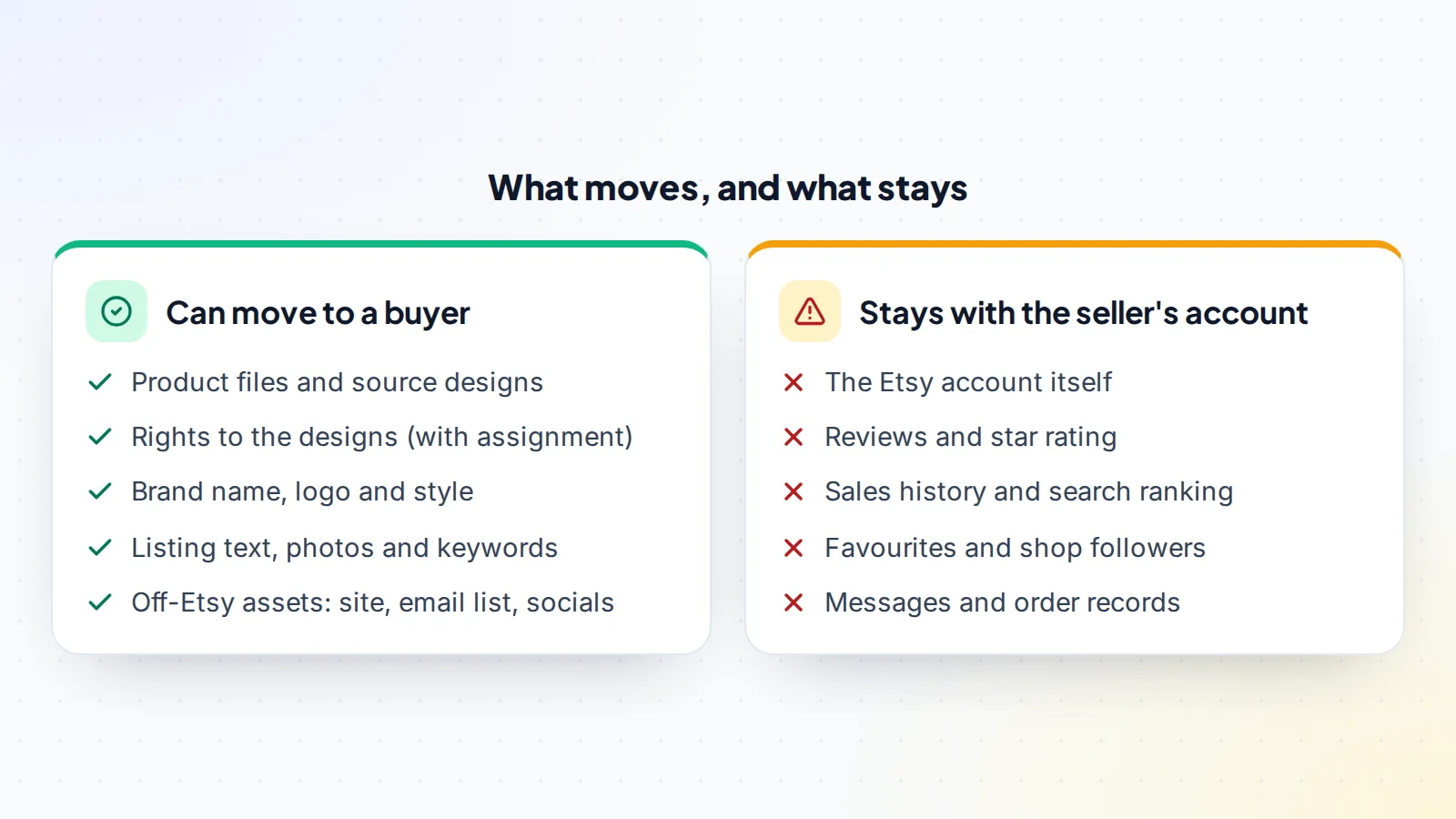
Can move to the buyer: the product files and their editable source designs; the rights to those designs, through a written assignment; the brand name, logo and visual style; the listing text, photos and keyword research, which the buyer can reuse in their own listings; and off-Etsy assets such as a website, email list, social accounts and product mock-up templates.
Stays with the seller’s account: the Etsy account itself, its reviews and star rating, its sales history and search ranking, its favourites and followers, and its messages and order history.
What you’re really paying for
Without the account, the value lies in four things:
- Proven products: designs with a record of selling, which removes the guesswork about what customers want.
- Know-how: keyword research, pricing, mock-up style, bundling and the process for creating new products.
- Rights: the legal right to sell the designs, so nobody else can claim them.
- Owned channels: an email list, a website or social accounts that can send customers to the new shop.
A business with strong owned channels can move much of its sales to a new shop quickly. One that relies entirely on Etsy search starts closer to zero, with proven products but no reviews.
Checking the numbers
- Sales by product for at least 12 months, from the shop’s own reports, shown live in a screen share.
- Revenue after Etsy fees, advertising and refunds, matched to payouts in bank records.
- Traffic sources: how much comes from Etsy search, Etsy ads, social media and external links.
- Concentration: how much of revenue comes from the top few products; see traffic concentration risk.
- Off-Etsy channels: email list size and engagement, website traffic, social followers and how much they drive sales.
Checking the rights
Digital products often include fonts, images, graphics and templates from other sources. Each must be licensed for commercial use in products for sale, and the licence must allow a new owner to keep selling. Ask for the licences, check that original designs were made by the seller or assigned by any designers who helped, and get a written assignment of all rights in the sale agreement. Our guide to intellectual property in digital products explains what to look for.
How to value it
Digital product businesses are usually priced as a multiple of average monthly net profit. For an Etsy-based business that can’t transfer its account, buyers adjust for the rebuild:
- Lower the multiple to reflect lost reviews and ranking.
- Or value expected profit after the move, based on how much sales the off-Etsy channels can bring and how quickly new listings are likely to gain traction.
- Add value for strong owned channels, a large and well-documented product range, and clear rights.
- Consider an earn-out: part of the price paid later, based on sales in the new shop, which shares the rebuild risk fairly.
Try the free valuation tool for a starting range, then adjust for the move.
A worked example
The numbers below are made up to show the method, not market data.
Morgan is interested in a planner and printable business selling on Etsy, with 180 products and average net profit of $2,200 a month after Etsy fees and ads. About 70% of sales come from Etsy search; 30% from a 9,000-person email list and a Pinterest account that link to the shop.
Because the account can’t transfer, Morgan expects the 30% from owned channels to follow quickly once the links point to a new shop, and the 70% from Etsy search to rebuild more slowly as new listings gather sales and reviews. Morgan offers a price based on a lower multiple of current profit, plus an earn-out: an extra payment if the new shop reaches an agreed sales level within six months. The seller agrees, assigns all design rights, hands over the source files, email list and Pinterest account, and helps relist products. Both sides share the rebuild risk instead of arguing about it.
Moving the business
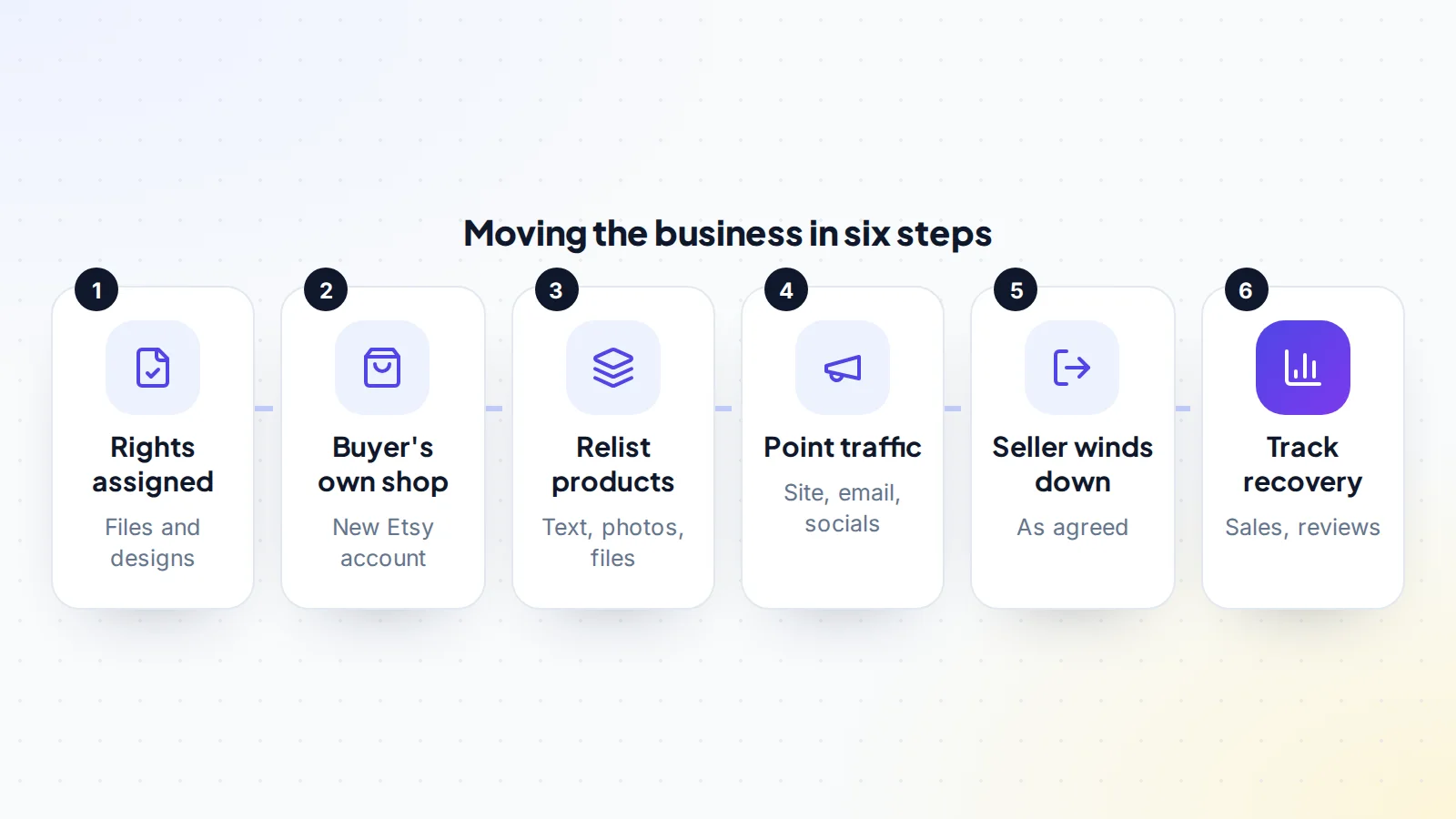
- Payment secured by escrow or a trusted middleman. On digiflippers.com, the ways to pay in a deal are: directly to the seller, through escrow, and the platform never holds the money itself.
- Rights assigned in writing, with source files and licences delivered.
- The buyer opens their own Etsy shop and creates new listings using the transferred text, photos and files.
- Owned channels point to the new shop: website links, email announcements and social profiles.
- The seller winds down their listings as agreed, so the two shops don’t compete for the same products.
- Track recovery: sales, conversion and new reviews in the new shop.
Our asset transfer checklist covers the off-Etsy assets.
Questions to ask the seller
- Which products sell best, and how has that changed over the last year?
- Where do sales come from: Etsy search, Etsy ads, social media or your own list?
- Who created the designs, and do you have the licences for every font, image and graphic?
- How did you build your email list, and did subscribers agree to receive marketing?
- How long does it take to create and list a new product?
- Will you help relist products and promote the new shop?
- Will you stop selling the same or similar designs after the sale?
A note on customer data
Customer details that come through Etsy orders belong to the marketplace relationship, and an email list is only an asset if subscribers agreed to hear from the business, for example through a sign-up form on its own website. Ask how the list was built, and keep consent records with it. Contacting people who never opted in can harm deliverability and may break privacy rules in some countries.
For sellers: preparing an Etsy-based business for sale
- Be upfront that the Etsy account itself won’t transfer, and explain what will.
- Organise source files and licences, so the buyer gets everything needed to keep creating.
- Build owned channels in the months before selling: an email list with clear consent, a simple website and social profiles. They make the business far more valuable to a buyer.
- Document your process: product research, design, mock-ups, keywords, pricing and promotion.
- Offer help with the move, such as relisting support or an announcement to your list.
When you’re ready, you can list the business on digiflippers.com with no success fee. For the full seller’s process, see how to sell a digital product business.
Alternatives worth considering
- Buy a digital product business with its own store, where the store, customers and reviews can move with the business.
- Buy only the product catalogue and rights at a lower price, and sell them through your existing shop or store.
- Buy a business on another platform whose rules allow a change of owner; see our guides to the template business and the theme business for sale.
Timing the move
When the move happens matters. Many digital products, such as planners, calendars and seasonal printables, sell much more at certain times of year. Moving just before the busiest season means the new shop starts with few reviews at the moment demand peaks; moving in a quieter period gives the new listings time to settle. Agree the timing in the deal, and if the busy season is close, consider having the seller keep selling until it ends, with profits shared as agreed, before the buyer takes over fully.
Making the most of the listing content
The seller’s listing titles, tags, descriptions and photos are some of the most useful things in an Etsy digital shop for sale, because they reflect what has already worked. Ask for an export of every listing, with the search terms each one targeted and its sales. Rewrite descriptions in your own words where needed, keep the best-performing titles and tags, and relist the strongest products first, so early sales build momentum in the new shop.
Red flags
- A seller offering to “transfer the Etsy account” or hand over the login. Etsy’s help says accounts can’t be transferred.
- Designs using fonts, images or graphics without licences that allow resale.
- Sales figures shown only as screenshots.
- One product producing most of the income.
- No owned channels, with a price that ignores the rebuild.
Running it after the purchase
The first months are about rebuilding: publishing listings consistently, using the transferred keyword research, asking happy customers for reviews, and using the email list to bring early sales. Keep adding products on the schedule that worked for the seller. Our guide to operational due diligence helps you understand the workload before you commit.
Etsy digital shop for sale: the checklist
- Understand that the Etsy account itself can’t transfer.
- 12 months of sales by product, after fees and refunds, verified.
- Traffic sources and owned channels measured.
- Licences for every font, image and graphic checked.
- Written assignment of all design rights agreed.
- Price adjusted for the rebuild, or an earn-out agreed.
- Plan for relisting and pointing traffic to the new shop.
- Payment secured before the handover.
Ready to find your next asset?
Browse listings with verified numbers, ask sellers your questions before you offer, and agree every step in a free Deal Room.
Frequently asked questions
Can I buy an Etsy shop and keep its reviews?
No. Etsy’s help says accounts can’t be transferred to a new owner, so reviews, sales history and ranking stay with the original account.
What do I actually get when I buy an Etsy digital business?
The product files and source designs, the rights to them, the brand, listing content and any off-Etsy assets such as an email list, website and social accounts.
How long does it take to rebuild sales?
It varies. Sales from owned channels can return quickly; sales from Etsy search usually take longer as new listings gather sales and reviews.
Is an earn-out a good idea here?
Often, yes. It shares the uncertainty of the rebuild fairly between buyer and seller, and rewards the seller for helping the move succeed.
Can I sell the same designs on other platforms?
If you own the rights and the licences allow it, yes. Many buyers add their own store or other marketplaces to reduce dependence on one platform.
Should the seller close their shop after the sale?
Usually they stop selling the transferred designs, as agreed in the contract, so the two shops don’t compete. Whether they keep the account open for other products is up to them.