Paid Communities for Sale (Skool, Circle, Patreon): What Transfers
A buyer's guide to paid communities on Discord, Skool, Patreon and similar platforms: membership revenue, churn, engagement, platform transfer rules, valuation and keeping members through the handover.

A paid community is a group of people who pay every month to learn, connect or get access to something they value. It might be a Discord server with subscriptions, a Skool group, a Patreon membership or a private community on its own platform. For a buyer, a healthy paid community offers recurring revenue and an engaged audience in one place. But communities are built on relationships, and each platform has its own rules about who can own them. This guide explains how to judge a paid community for sale, what to check, how platforms handle ownership, and how to keep members through the handover.
Communities often sit alongside newsletters; see our guide to buying a newsletter. To measure activity, read our guide to community engagement metrics.
Key takeaways
- Value comes from paying members who stay, not just the member count.
- Check churn, engagement and how much members depend on the current host.
- Each platform handles ownership differently; some changes need approval or aren’t possible.
- Plan billing, payouts and member communication before the handover.
- Pay through escrow and agree a transition period with the seller.
What is a paid community?
A paid community charges members for access, usually monthly or yearly. Members might get discussions with peers, expert advice, courses, live sessions, job boards, deal alerts or simply a place to belong. Communities live on platforms built for them, on chat apps with paid features, or on membership tools connected to a website.
What makes a paid community valuable is the combination of recurring revenue and genuine connection. Members who find real value stay for months or years and bring friends. That makes a well-run paid community for sale an appealing purchase, especially for someone who knows the topic and enjoys running groups.
Why buy instead of building
Building a community from zero is slow. The early months, when there are few members and little conversation, are the hardest, and many communities never get past them. Buying an established one skips that stage: there are already members, conversations, routines and revenue. For a business, a community can also be a direct line to customers, a source of product ideas and a home for existing products like courses or newsletters.
Not every paid community for sale is a good fit, though. The best purchases match a topic you know and care about, because members quickly notice whether a new owner understands their world. If you would happily take part in the conversations yourself, you are far more likely to keep members engaged and to grow the community over time.
What to check
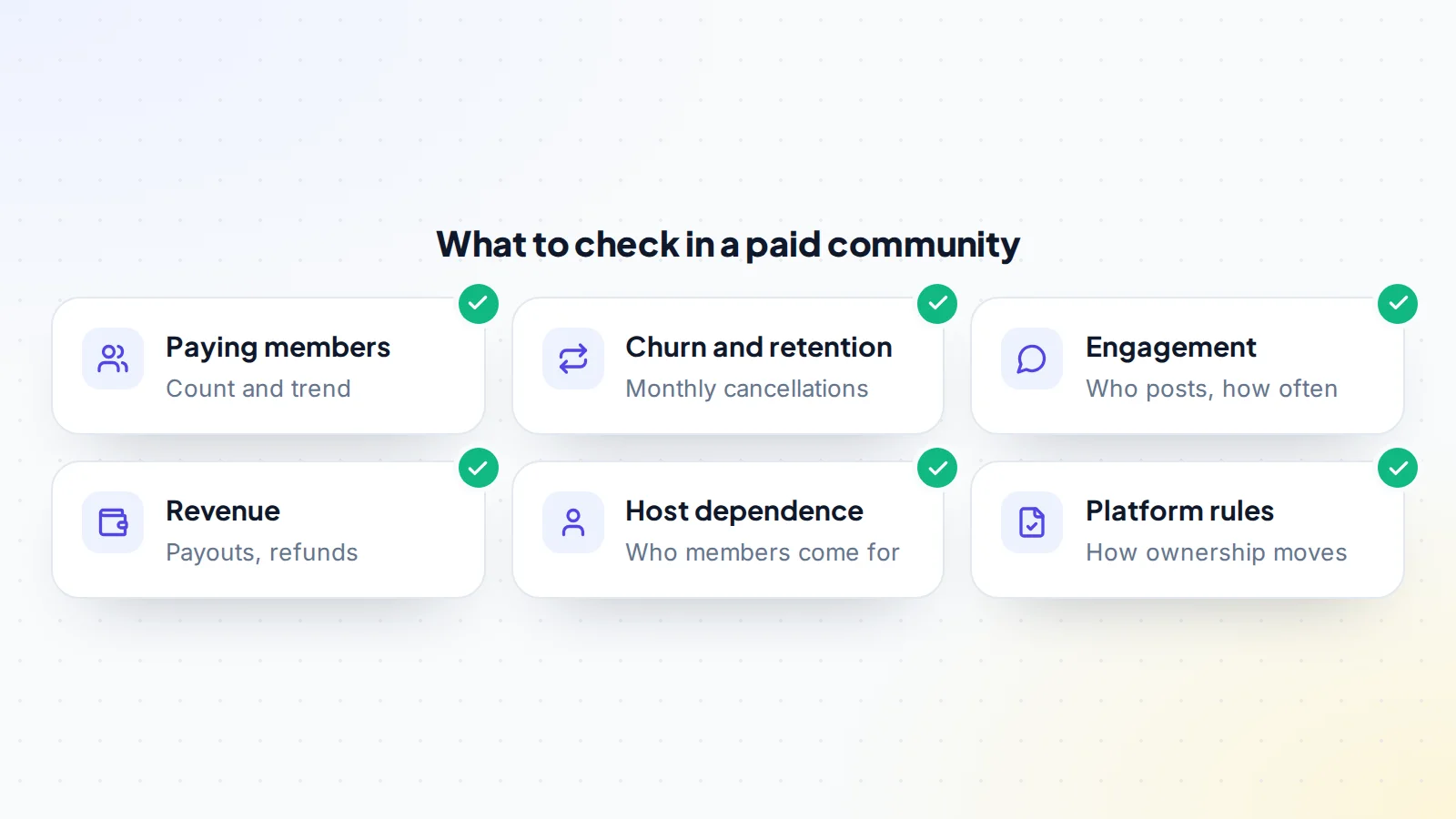
Ask the seller to show the community’s numbers live, in the platform’s own dashboards and billing tools. Look at:
- Paying members: the count by month over the last 12 months, and the trend.
- Churn: how many members cancel each month, and how long members stay on average.
- New members: how many join each month and where they come from.
- Engagement: how many members post, react or attend events, and whether a few people do most of the talking.
- Revenue: payouts from the platform or payment processor, refunds and any failed payments.
Our guide to community engagement metrics explains which measures matter and how to compare communities fairly.
How much depends on the host?
Many paid communities are built around one person: a creator, an expert or a well-known name in the field. Members may have joined to learn from that person or to be close to them. If so, a change of owner is a bigger change for members. Ask what members come for. Is it the host’s advice and presence, the peer discussions, the resources or the events? The less a community depends on one personality, the easier it is to hand over.
If the host is central, discuss a transition: perhaps the host stays as a guest or contributor for a period, introduces the new owner, or helps run events while members get used to the change. Our guide to transition support after a sale covers how to agree this.
Platform rules for ownership
Before you agree a price, check exactly how the platform handles a change of owner. Rules differ widely, and some limit what’s possible. State these limits plainly in the deal so nobody is surprised.
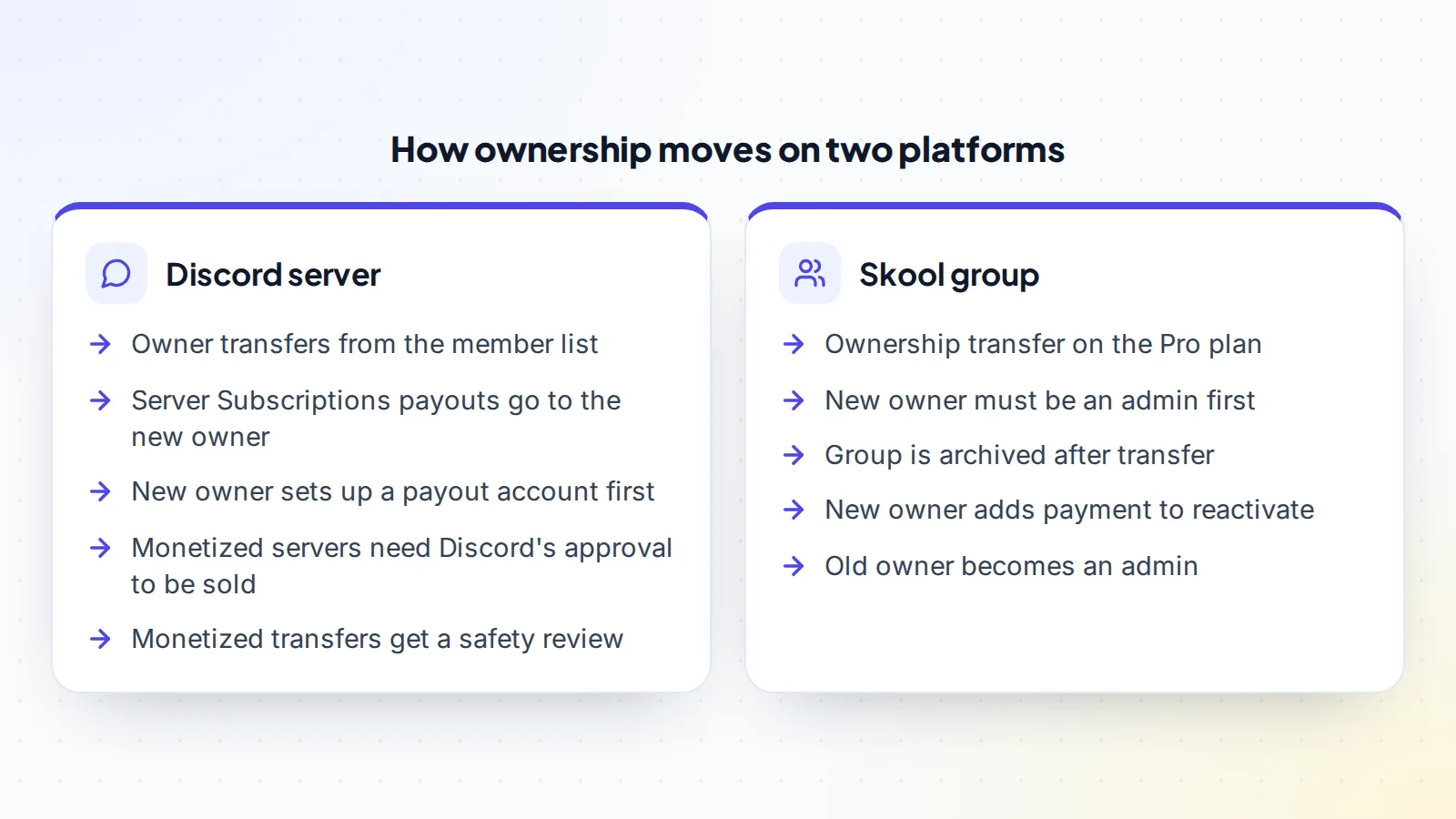
Discord servers with subscriptions
Discord lets a server owner transfer ownership to another member from the server’s member list. For servers that earn through Server Subscriptions, Discord’s creator support explains that after a transfer, payouts go to the new owner, who needs to set up a payout account first. Discord’s monetization policy also says that monetized servers must not be bought or sold without Discord’s approval, and that ownership transfers of monetized servers go through a safety review. So for a monetized Discord server, the seller should contact Discord about the sale before anything changes hands, and the deal should depend on that approval.
Skool groups
Skool’s help centre explains that group ownership transfer is supported on its Pro plan. The person taking over must first be a member, then an admin, and can then be made owner from the membership settings. After the transfer, Skool says the group is archived until the new owner adds their payment information to reactivate it, and the previous owner becomes an admin. Skool also suggests timing the transfer near the end of a billing cycle to keep charges down. Plan the reactivation for a quiet moment and tell members in advance.
Patreon and similar membership platforms
Patreon’s help centre says the Team Lead role, which belongs to the account that signed up and has sole access to financial data, can’t be transferred to another account. Login details can be changed, but the Team Lead stays tied to the original account. That means a Patreon page doesn’t move to a new owner in the way a Discord server or Skool group can. A buyer would need another route, such as building a new home for the community and inviting members to join it, which should be reflected in the price and the plan.
Other membership tools each have their own rules. Some let you add a new owner or change the account email; others require a support request. Ask the seller to confirm the current process with the platform in writing before you sign.
Billing and member payments
Revenue is only as safe as the billing behind it. Find out how members pay: through the platform, through a payment processor connected to it, or through a separate membership tool. Then work out what happens to existing subscriptions when ownership changes. On some platforms, billing continues automatically under the new owner. On others, payment details or payout accounts need updating, or members need to subscribe again.
If members must take any action, expect some to drop off. Build that into the price, and plan clear, friendly messages explaining what’s changing and why.
Member data and privacy
Paid communities hold personal information: names, emails, payment records and sometimes private conversations. Ask what data the community stores, where, and what members agreed to. If you’ll move member emails to a new tool, check that this fits what members were told and any privacy laws that apply. Our guide to transferring email subscribers under GDPR explains the rules in Europe and the UK.
How paid communities are valued
Paid communities with steady revenue are usually priced as a multiple of monthly or annual net profit, after platform fees, payment fees, tools and any paid moderators or guests. The multiple moves with:
- Churn: lower churn means more predictable revenue and a higher multiple.
- Growth: a rising member count supports value.
- Host dependence: communities built around one person are discounted.
- Platform risk: if ownership can’t move cleanly, value is lower.
- Engagement: active members renew; quiet ones cancel.
Communities without much revenue yet are valued on engagement, growth and potential. Our guide to pre-revenue valuation explains how. For a quick starting range, the free valuation tool can help.
Questions to ask the seller
- Why are you selling, and will you stay involved in any way?
- What do members value most: you, each other, the content or the events?
- How many hours a week does the community take, and on what?
- Who moderates, and will they continue?
- How does billing work, and what happens to it when ownership changes?
- Have you confirmed the ownership process with the platform?
- Have members ever been told about a possible sale?
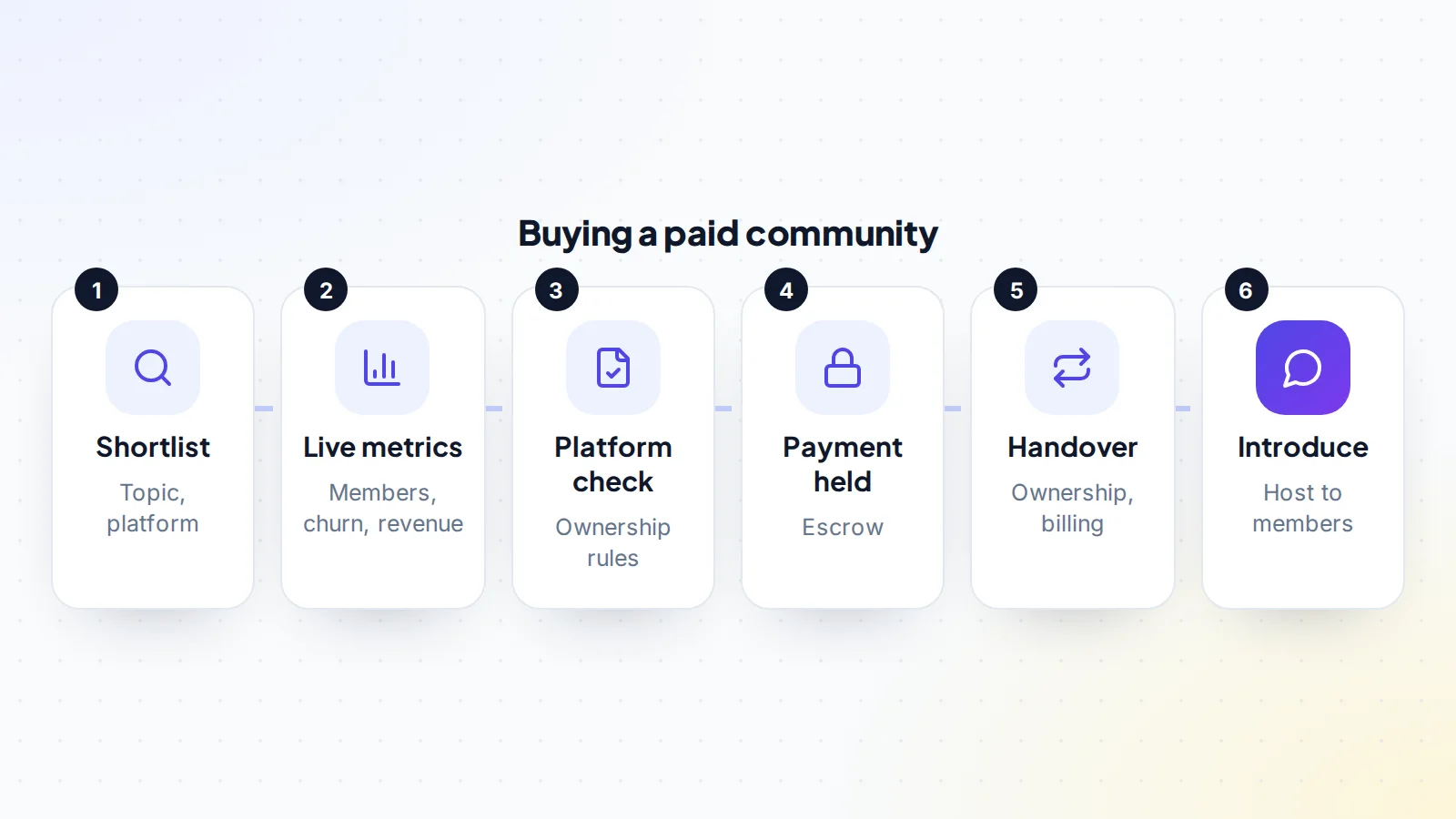
Planning the handover
Agree the handover in writing, step by step: the platform ownership change, billing and payouts, moderator roles, content and resources, social accounts and email lists, and any events already scheduled. Use escrow so the payment is held until ownership and billing are confirmed. On digiflippers.com, the ways to pay in a deal are: directly to the seller, through escrow, and the platform never holds the money itself.
Then plan the people side. A short, warm message from the current host introducing the new owner goes a long way. Explain what will stay the same, what might improve and how members can share their thoughts. Keep the community’s rhythm, such as weekly threads or monthly calls, steady through the change.
Your first months as owner
Listen before you change anything. Join conversations, ask members what they value and what they’d like to see, and keep the routines they’re used to. Watch churn closely in the first two or three months; a small rise is normal after a change of owner, but a large one is a signal to act. Thank active members and moderators, and add value gradually, such as a new event series or resource, once members know you.
A worked example
The details below are made up to show the method.
Tom is looking at a paid community for freelance designers on Skool, with 420 paying members at $25 a month. Churn has averaged about 5% a month over the last year, and new members roughly match cancellations. Platform and payment costs plus a part-time moderator come to about $2,100 a month, leaving around $8,400 a month in profit.
Members say they come mainly for portfolio reviews and job leads, which the moderator and members provide, rather than the founder personally. Tom confirms the Skool ownership process, including the archive and reactivation step, and plans the transfer for a quiet weekend near the billing date. They agree a price, the payment goes into escrow, and the founder posts a warm introduction a week before the change. Ownership moves, Tom reactivates the group with new payment details, and the founder stays as an admin for a month to help. Once billing is confirmed, the funds are released.
Paid community for sale: the checklist
- Paying members, churn and new members reviewed for 12 months.
- Engagement measured beyond a few active voices.
- Host dependence understood and a transition agreed.
- Platform’s ownership process confirmed in writing.
- Any approval the platform requires obtained first.
- Billing and payouts plan agreed.
- Member data and privacy checked.
- Payment held in escrow until ownership and billing are confirmed.
- Introduction message and first-month routine planned.
Looking for one? Browse communities for sale, and see how verification works on digiflippers.com.
Ready to find your next asset?
Browse listings with verified numbers, ask sellers your questions before you offer, and agree every step in a free Deal Room.
Browse newsletters & communities Sell your newsletter or community
Frequently asked questions
What makes a paid community valuable?
Paying members who stay, active engagement, steady growth and a community that doesn’t rely entirely on one person.
Can a Discord server with subscriptions change owners?
Discord lets owners transfer servers, and payouts go to the new owner after they set up a payout account. Discord’s monetization policy says monetized servers must not be bought or sold without its approval, so get that first.
Can a Skool group be transferred?
Yes, on the Pro plan. The new owner must be an admin first, and the group is archived until the new owner adds payment details.
Can a Patreon page change owners?
Patreon says the Team Lead role can’t be transferred to another account, so a buyer needs another route, such as moving members to a new home.
How are paid communities valued?
Usually on net profit, adjusted for churn, growth, host dependence, platform risk and engagement.
Will members leave after a sale?
Some may. A warm introduction, steady routines and a transition period with the old host help keep most of them.
How should I pay?
Through escrow, released once ownership and billing have moved.