
How to Sell a Newsletter: Valuation and Handover
From preparing your engagement data to transferring the publication: how to sell a newsletter for a fair price while keeping readers and sponsors happy.

Building a newsletter that people actually read is hard work, and that work has real value. Whether you want to move on to a new project, cash out after years of writing, or hand your audience to someone with more time for it, you can sell a newsletter like any other online business, and well-run ones attract serious buyers.
This guide explains how. You’ll learn what buyers look for, how to prepare your engagement, consent and income data, how newsletters are valued, how to find and vet a buyer, how to get paid safely and how to transfer the publication without losing readers or sponsors along the way.
It applies whether you publish on Substack, beehiiv, Kit or another platform, and whether you earn from sponsors, paid subscriptions, affiliate links or not at all yet.
Key takeaways
- Buyers value engaged readers, not raw subscriber counts. Show clicks, replies and growth sources.
- Be ready to explain how every subscriber joined; clean consent is a selling point.
- Show deliverability is healthy: authenticated sending domain, low bounces and complaints.
- Prove income with invoices and payment records, and say which sponsors are likely to stay.
- Use your platform’s transfer process, and start it only once the payment is held in escrow.
Who buys newsletters, and why
Understanding buyers helps you prepare for their questions and pick the right one. Common buyers include:
- Media companies and newsletter groups adding titles in related niches. They care about audience quality, sponsor fit and how easily the format can be run by their team.
- Companies that want a direct line to a specific audience: a software company buying a newsletter its customers read, for example.
- Creators and individual operators who want an engaged audience without the years of growth. They care most about workload and whether they can keep the voice.
All of them ask the same core question: will readers keep opening and clicking after the sale? Everything you prepare should help answer it.
What makes a newsletter easy to sell
Some newsletters sell within weeks and others sit for months. The ones that sell quickly usually share a few traits. They cover a clear topic for a clear reader, so buyers and sponsors immediately understand the audience. They publish on a reliable schedule, which shows the format is sustainable. Their readers came through channels the buyer can keep using, such as search, referrals and recommendations, rather than through one-off promotions. And their owners can show the numbers behind all of it without hesitation. None of these depend on size: a focused newsletter with a few thousand engaged readers can be easier to sell than a broad one with ten times as many.
When to sell
Sell while engagement and growth are healthy. Buyers study the last few months carefully, and a recent drop in clicks or a spike in unsubscribes lowers offers even when the long-term record is strong. If you’re burning out, it’s usually better to sell sooner than to let the newsletter slowly fade. And avoid selling in the middle of a big change, such as moving platforms or switching from free to paid. Finish the change, let the numbers settle, then list.
Step 1: Prepare your engagement data
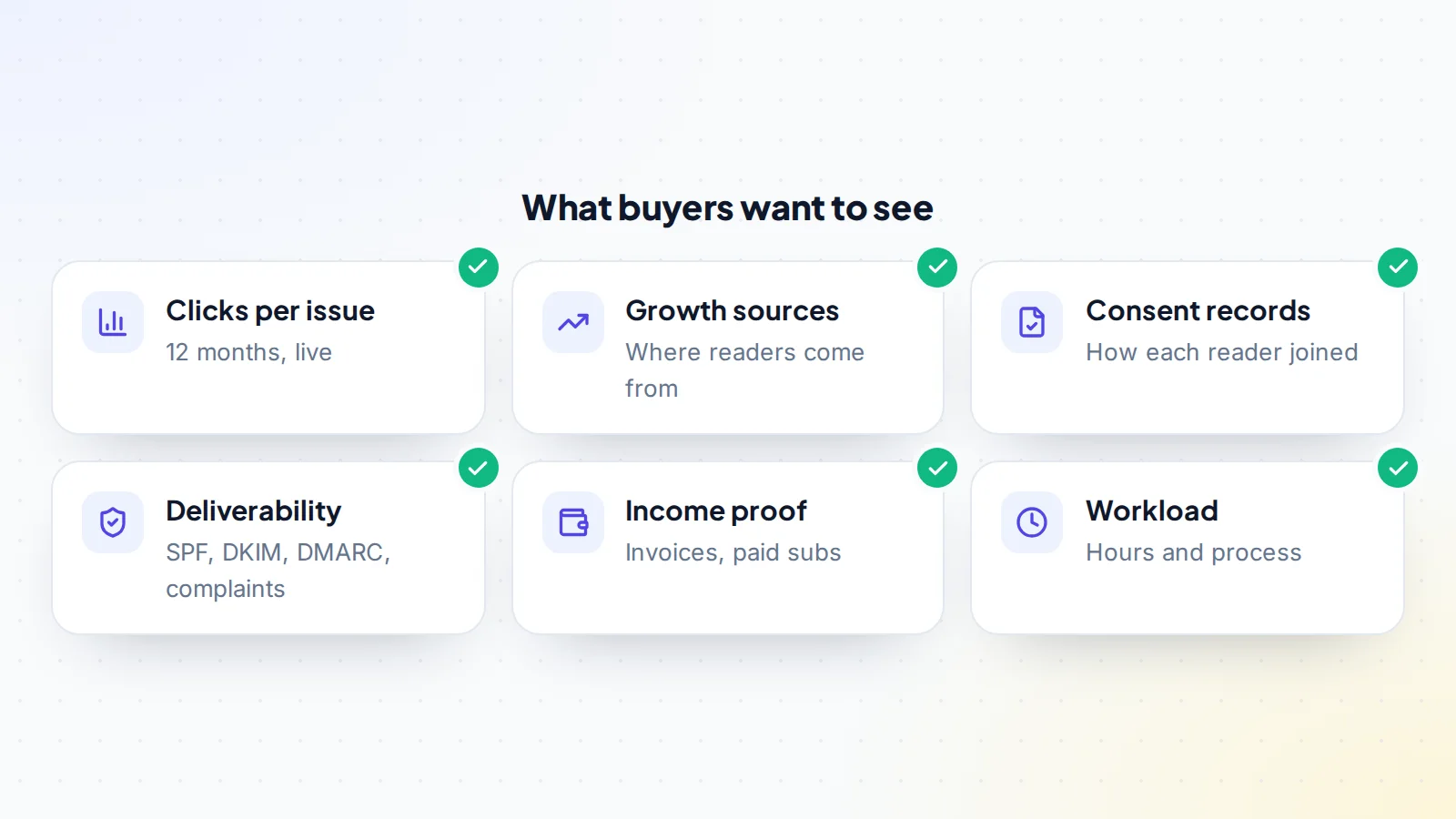
Buyers want to see the numbers you see. Prepare at least 12 months of:
- Unique clicks per issue, the most trusted sign of attention now that open rates are inflated by automatic image loading in some email apps.
- Subscriber growth by source: website sign-ups, referrals, recommendations, social, paid growth tools, giveaways.
- Unsubscribes, bounces and spam complaints per issue.
- Replies and shares, if you track them.
- Top-performing issues and what they had in common.
Our guides to engagement metrics and newsletter valuation explain which numbers buyers weigh most.
Step 2: Show clean consent
Serious buyers will ask how your subscribers joined, because a list built on consent is an asset and one built on imported contacts is a risk. Document every source, including any imports from older tools, and keep your platform’s records of sign-up dates and forms.
If you have readers in the European Union, their personal data is protected by the GDPR, which affects how the list can pass to a new owner; our guide to transferring subscribers under the GDPR covers what to agree. In the United States, the FTC’s CAN-SPAM guidance requires commercial emails to include a valid postal address and a working opt-out, with opt-outs honoured within 10 business days. Make sure your newsletter already meets these basics before you sell.
Step 3: Check deliverability
Google’s sender guidelines require anyone sending more than 5,000 messages a day to Gmail accounts to authenticate their domain with SPF, DKIM and DMARC and to support one-click unsubscribe. Even if you send fewer, having this in place shows buyers the newsletter will keep reaching inboxes. Check your bounce and complaint rates, remove long-inactive readers if you haven’t recently, and note any past deliverability problems and how you fixed them. Our deliverability check lists what buyers will look at.
Step 4: Prove the income
Gather invoices and payment records for every sponsor over the last 12 months, and your paid subscriber numbers by month with churn and refunds. Then be honest about which income is likely to continue: some sponsors book because they like the audience, others because they know you. Buyers will value income that’s tied to the newsletter far more than income tied to you personally. Our guide to newsletter sponsorship revenue explains how buyers look at it.
Step 5: Document the workload
Write down how an issue gets made: how you choose topics, how long writing and editing take, which tools you use, whether freelancers contribute and how sponsors are booked and invoiced. A buyer who can see the process can price it, and a newsletter that runs on a clear system is worth more than one that depends on your instincts. If your format relies heavily on your personal voice, think about how a new writer could continue it, and say so in the listing.
Step 6: Work out what it’s worth
Earning newsletters are usually valued as a multiple of average monthly net profit over the last 6 to 12 months. Newsletters without income are valued on engaged readers, niche and growth trend.
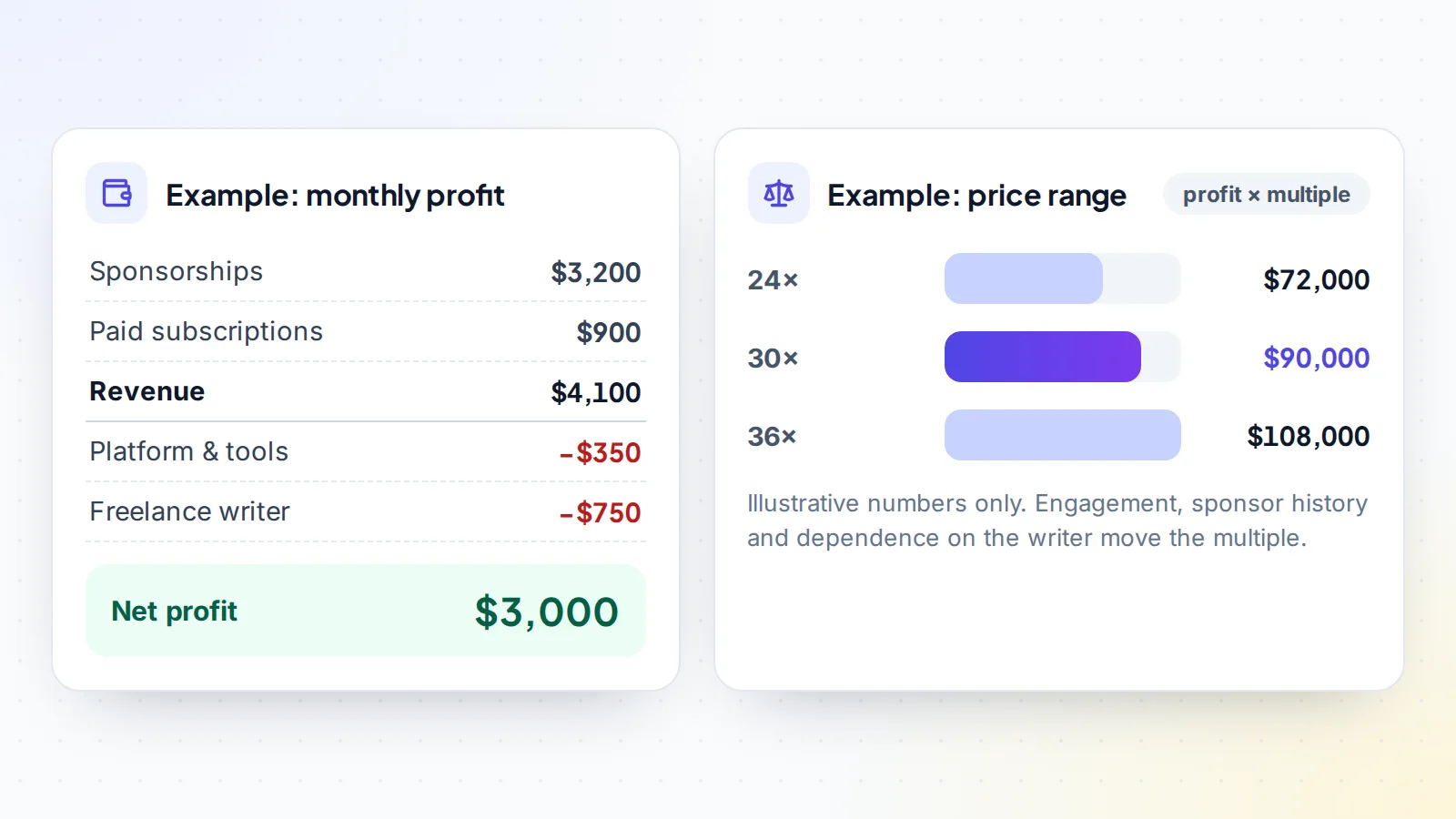
The multiple rises with strong clicks, steady organic growth, repeat sponsors, clean consent, healthy deliverability and a format someone else can run. It falls with weak engagement, giveaway-driven growth, deliverability issues and income tied to you. Use the free valuation tool for a quick range, and our guide to valuing an online business for the method.
Step 7: Raise the value before you list
- Clean the list of long-inactive readers. A smaller, engaged list often looks better than a large, quiet one.
- Book repeat sponsors on longer terms where you can; contracted income reassures buyers.
- Add a growth channel that doesn’t depend on you, such as a referral programme or recommendations.
- Write a style guide for the format so a new writer can pick it up.
Our guides to monetising a community and growing a channel have ideas if your newsletter has a community alongside it.
Step 8: List the newsletter
Include the niche and format, the publishing schedule, subscribers and clicks per issue, growth sources, income by type, workload, the platform, what’s included and why you’re selling. Be honest about weaknesses. When you’re ready, you can list your newsletter on digiflippers.com for free, with 0% success fee up to $10,000, then 5% (max $5,000), and show buyers which numbers are verified.
Step 9: Talk to buyers
Share dashboards through a live screen share or read-only access, never your login. Hold the subscriber export until the payment is secured; the list is the asset. Ask each buyer how they plan to run the newsletter. Readers trusted you with their inbox, and handing them to someone who will spam them reflects on you.
Step 10: Get paid and transfer
Start the transfer only once the payment is held by escrow or a trusted middleman. On digiflippers.com, the ways to pay in a deal are: directly to the seller, through escrow, and the platform never holds the money itself. Read how escrow works.
Then follow your platform’s process. On Substack, the owner can transfer the publication from its settings, and both people must confirm. On beehiiv, ownership changes go through its support team, which collects written confirmation from both sides. On other platforms you may export subscribers with their consent records and the buyer imports them. Our guide to newsletter transfers covers the details.
- Transfer the publication, or export the list for the buyer to import.
- Move the domain, keeping SPF, DKIM and DMARC records working.
- Hand over sponsor contacts and introduce the buyer; move paid subscriptions to their payment account.
- Pass on templates, the style guide, social accounts and the content calendar.
- Send or help write a short note introducing the new owner to readers.
Our handover checklist covers the rest.
A worked example
Imagine a weekly newsletter about remote work, with 22,000 subscribers after four years. It averages around 3,000 unique clicks per issue, most new readers come from the website and a referral programme, and complaints are low. Three sponsors book regularly; invoices match the payments. A freelance writer drafts half of each issue from a style guide, and the owner spends about four hours a week editing and booking sponsors.
Before listing, the owner removes readers who haven’t opened or clicked in a year, which shrinks the list but lifts every engagement rate. They ask two regular sponsors for three-month bookings, giving buyers contracted income to look at. They write down the sponsor process and the issue template. When the listing goes live with this evidence, buyers spend their time on price and timing rather than on doubts, which is exactly where you want them when you sell a newsletter.
Selling a newsletter with a community
Many newsletters have a community attached: a Discord server, a Telegram channel or a paid membership. Decide whether you’re selling them together or separately. Together, they’re often worth more, because the community deepens engagement and gives sponsors more to buy. Separately, each needs its own handover. Our guides to selling a Discord server and selling a Telegram channel cover those transfers.
After the sale
Help the buyer through the first few issues if you agreed to, introduce them to sponsors personally, and answer readers who reply to your farewell note with kindness. Then step away cleanly: remove your access from the platform, tools and social accounts, and keep the agreement and payment records. Depending on where you live, the sale can have tax consequences, so speak to an accountant before the money arrives.
Mistakes that cost newsletter sellers money
- Leading with subscriber count instead of engagement.
- Hiding imported contacts that a buyer later finds.
- Letting the schedule slip during the sale, which drops clicks right when buyers are watching.
- Sharing the subscriber export before the payment is held.
- Disappearing after the sale without introducing the new owner to readers and sponsors.
Checklist: how to sell a newsletter
- 12 months of clicks, growth sources, unsubscribes and complaints ready.
- Every subscriber source documented; no bought contacts.
- Sending domain authenticated; deliverability healthy.
- Sponsor invoices and paid subscription records matched to payments.
- Workload and process documented; style guide written.
- Price based on profit or engaged readers.
- Honest listing with what’s included and why you’re selling.
- Dashboards shared read-only; subscriber export held until payment.
- Payment secured before the transfer starts.
- Publication transferred with the platform’s process; readers and sponsors introduced.
Ready to sell?
List it on digiflippers.com with verified numbers, answer buyers in one place and agree every step in a free Deal Room. 0% success fee up to $10,000, then 5% (max $5,000).
Sell your newsletter or community Browse newsletters & communities
Frequently asked questions
How much can I sell my newsletter for?
Earning newsletters usually sell for a multiple of average monthly profit. Without income, price depends on engaged readers, niche and growth. Engagement matters far more than size.
Can I sell a newsletter on Substack?
Yes. Substack’s help centre explains how the owner can transfer a publication to a new owner, with both sides confirming.
Do I need to tell my readers?
It’s good practice to introduce the new owner after the sale. Honesty keeps more readers than silence.
What if my newsletter is built around my personality?
You can still sell it, but expect buyers to discount for it. A gradual transition, with you contributing for a while, can help readers stay.
How long does it take to sell a newsletter?
Preparation takes a few weeks. Finding the right buyer can take weeks or months; the transfer itself usually takes days, depending on the platform.
What if a buyer wants the subscriber list to check it?
Offer a live view of the platform dashboard instead, or aggregated figures. The list itself is the asset, so share the export only once the payment is held by escrow or a middleman.
Should I clean my list before selling?
Usually yes. Removing readers who haven’t engaged in a long time makes the list smaller but healthier, improves deliverability and gives buyers more accurate engagement figures. Mention that you did it, and when.
Can I keep writing about the same topic afterwards?
Only if your agreement allows it. Many buyers ask for a non-compete for a set period, so agree its scope before you sign.