
How to Value an Online Business: Methods, Multiples and Examples
How online businesses are really valued: earnings, add-backs, multiples and risk, with worked examples for websites, SaaS, newsletters and accounts.

Every online business sale comes down to one question: what is it worth? Buyers want to avoid overpaying, sellers want to be paid for years of work, and both need a way to talk about value that isn’t just a feeling. That’s what online business valuation is for.
This guide explains how valuation really works for websites, SaaS products, newsletters, digital product shops, domains and social media accounts. You’ll learn which earnings figure to start from, how add-backs work, what a multiple is and what moves it, how to handle businesses with no profit yet, and how to turn all of it into a price range you can defend in a negotiation.
It’s written for buyers and sellers alike. The method is the same; only the side of the table changes.
Key takeaways
- Most established online businesses are valued as earnings × multiple.
- Earnings are usually net profit or seller’s discretionary earnings (SDE), averaged over the last 6 to 12 months and verified at the source.
- Add-backs adjust earnings for the owner’s pay and one-off costs. They’re legitimate only when they’re real and documented.
- The multiple reflects risk and growth: age, stability, diversity of income, effort needed, transferability and trend.
- Assets without profit are valued on what a buyer can do with them, using comparable sales and the cost of building them.
Why valuation matters
A clear valuation helps both sides. Sellers who price on evidence attract serious buyers and sell faster; sellers who price on hope get ignored. Buyers who understand valuation can spot a bargain, avoid an overpriced listing and negotiate with reasons rather than guesses.
Valuation also tells you where to focus. If you’re a seller, it shows which improvements raise the price most. If you’re a buyer, it shows which risks to investigate in due diligence. That’s why valuation and due diligence go hand in hand: the valuation is a hypothesis, and due diligence tests it.
The main valuation methods
The U.S. Small Business Administration’s guide to buying an existing business lists several common approaches, including a capitalised earnings approach (based on the return an investor expects), an excess earnings method, a cash flow method, valuing tangible assets, and valuing specific intangible assets by comparing the cost of buying them with the cost of creating them.
For most online businesses, the practical version of the earnings approach dominates: earnings multiplied by a multiple. Online businesses have few tangible assets, so asset-based methods rarely capture their value. The intangible-asset approach is still useful, though, for things like domains, content libraries and audiences that don’t earn yet: what would it cost, in time and money, to build this from scratch?
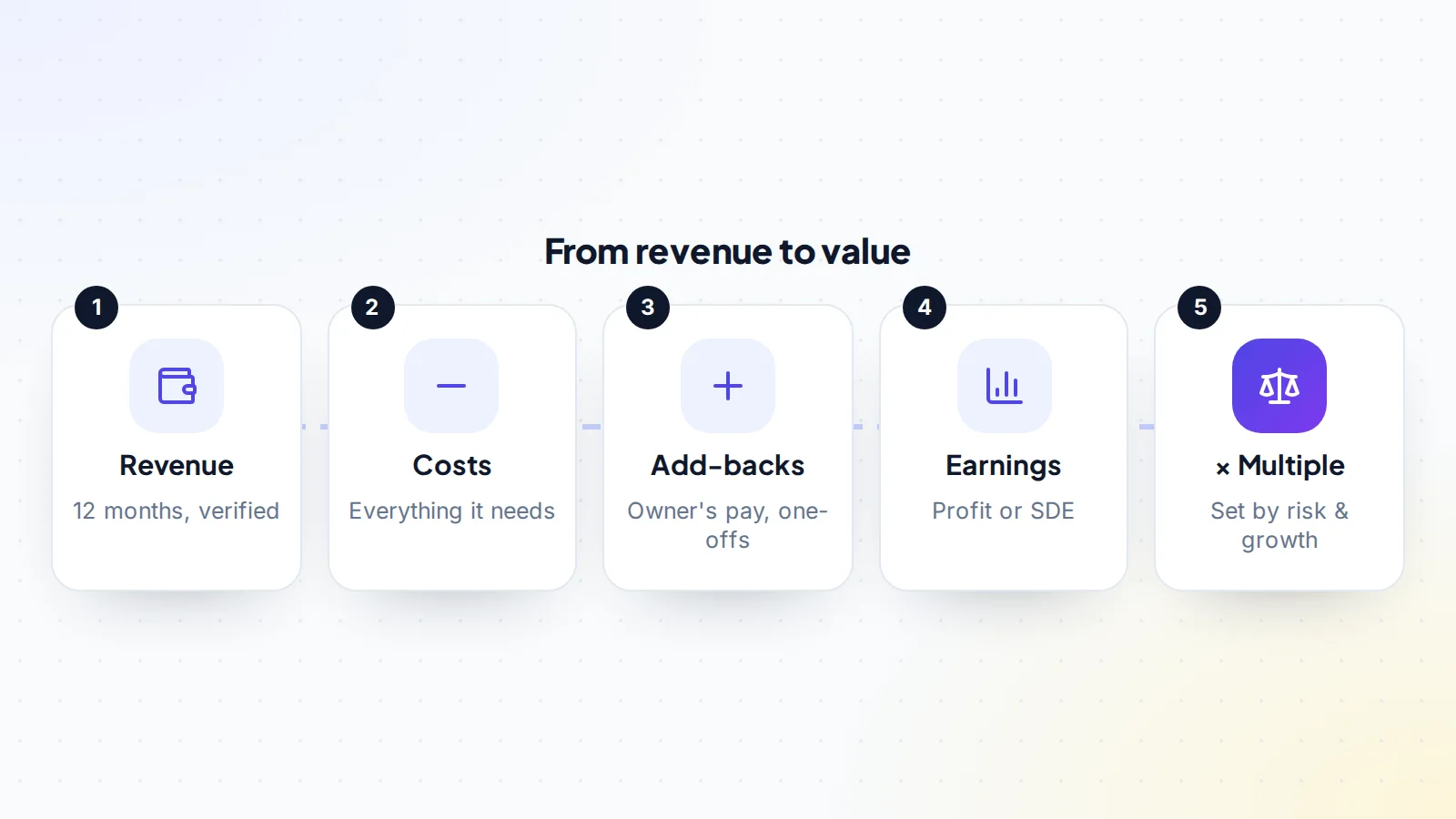
Step 1: Choose the right earnings figure
Start with what the business actually earns, verified at the source rather than taken from a spreadsheet. Two figures are common:
- Net profit: revenue minus every cost the business needs to keep running, including paid help. Common for content sites, newsletters, digital products and social accounts.
- Seller’s discretionary earnings (SDE): net profit plus the owner’s own pay and personal benefits run through the business, plus one-off costs. It shows what one owner-operator can take out of the business. See SDE explained.
Then decide on a period. Most valuations use the trailing twelve months (TTM), or an average of the last 6 to 12 months, to smooth out lucky or unlucky months. Read why trailing twelve months matter. If the business is clearly growing or shrinking, look at the trend too: a business whose last three months are well below its twelve-month average deserves a closer look.
Revenue-based valuations exist as well, mostly for fast-growing software companies. For small, profitable online businesses, profit is the better anchor. Our guide to revenue vs profit valuation explains when each one fits.
Step 2: Apply add-backs carefully
Add-backs adjust earnings for costs that a new owner wouldn’t have. Legitimate examples include a one-off redesign, a legal fee for a dispute that’s settled, or the seller’s personal expenses run through the business. The seller’s salary is added back in an SDE calculation.
Add-backs are also where valuations get inflated. Be wary of “one-off” costs that happen every year, freelancer costs added back even though someone will still need to do the work, and add-backs with no documents behind them. A buyer should accept an add-back only when it’s real, documented and genuinely won’t recur. Read add-backs explained for examples of both kinds.
Step 3: Understand the multiple
The multiple turns earnings into a price. It’s a compact way of expressing how many months (or years) of earnings a buyer is willing to pay for, given the risk they’re taking and the growth they expect. For small online businesses, multiples are often quoted on monthly profit; for larger ones, on annual profit or SDE. Always check which one someone means.
There’s no single “correct” multiple. It depends on the type of asset, its quality and the market at the time. What you can do is understand the factors that push it up or down, and price accordingly. Our guide to valuation multiples goes deeper.
Step 4: What moves the multiple
Factors that raise it
- Age and stability: a long record of steady earnings has survived more changes.
- Growth: a healthy upward trend, organic rather than bought. See growth trend and valuation.
- Diversity: several income sources and traffic channels. Read revenue diversification.
- Low effort: a business that needs few hours a week, or runs on documented processes. See owner hours and valuation.
- Verified numbers: figures a buyer can check at the source.
- Easy transfer: accounts, platforms and rights that move cleanly to a new owner.
Factors that lower it
- Concentration: most traffic from a few pages or one channel, or most revenue from one customer or programme. Read traffic concentration risk.
- A declining trend or recent drop.
- Dependence on the owner: their face, voice, contacts or skills.
- Platform risk: rules or algorithms that could change the business overnight.
- Unverifiable or messy numbers.
A worked example
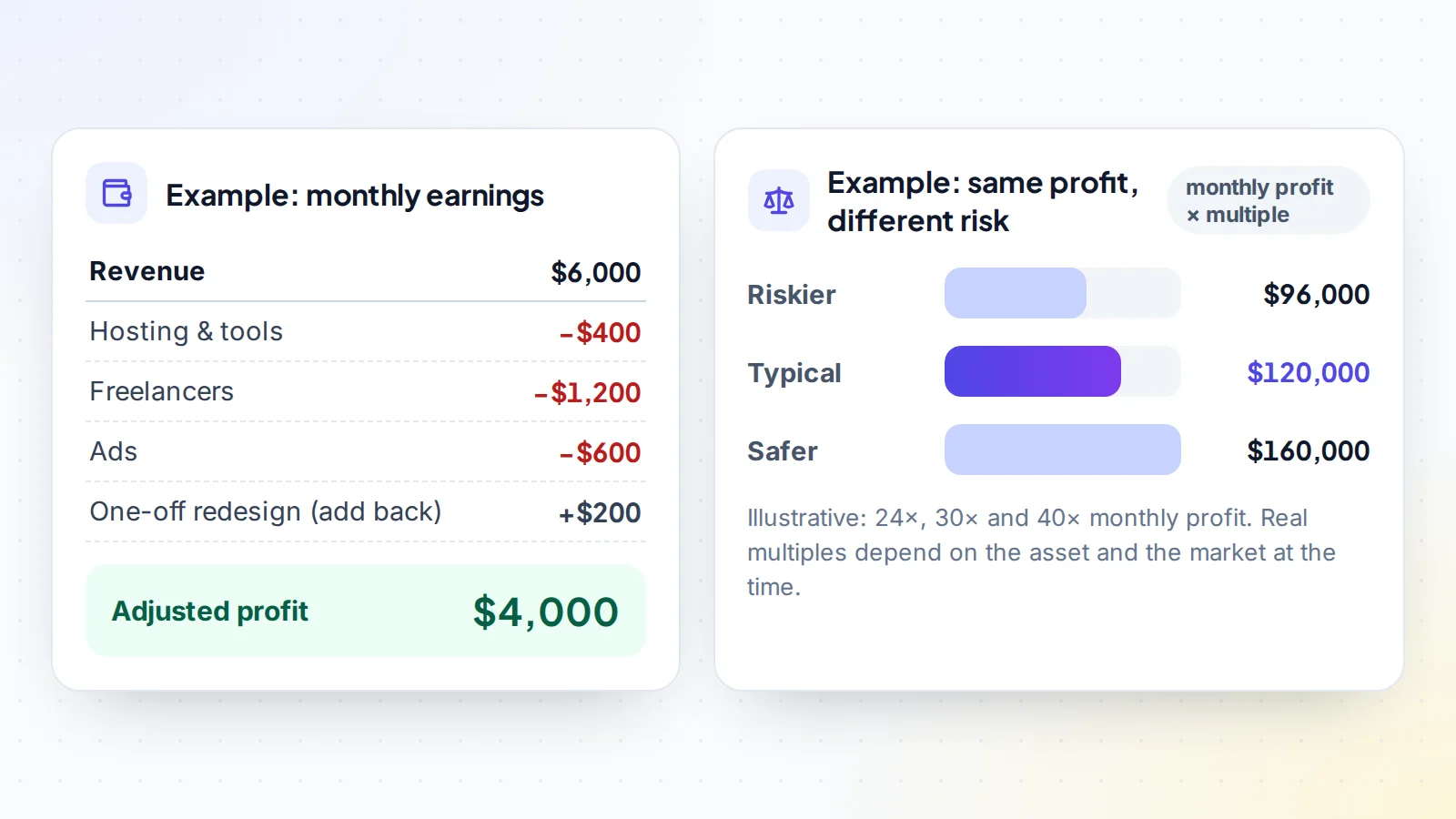
A content site earns $6,000 a month in revenue. Costs are $2,200 a month: hosting and tools, freelance writers and some advertising. Last year the owner paid for a one-off redesign, averaging $200 a month, which a new owner won’t repeat. Adjusted profit is therefore $4,000 a month.
If due diligence shows a young site with most traffic from a handful of pages, a buyer might apply a lower multiple. If it shows an older site with traffic spread across hundreds of pages, several income sources and verified numbers, a higher multiple is justified. The figure above shows how the same $4,000 can support quite different prices. The point isn’t the exact numbers; it’s that you can explain why you chose your multiple.
How different assets are valued
- Websites and content sites: monthly net profit × multiple. Search health and traffic spread matter most. See buying a website.
- SaaS: often annual profit or SDE × multiple for small products; revenue multiples for fast-growing ones. Churn is the key risk. See buying a SaaS business.
- Newsletters and communities: profit × multiple when they earn; engaged audience and niche when they don’t.
- Digital product shops: profit × multiple, adjusted for refunds, product age and platform transferability.
- Social media accounts: profit × multiple for earning accounts; audience quality and engagement for the rest.
- Domains: no earnings in most cases, so value comes from length, extension, meaning and comparable sales.
Valuing assets with no profit yet
Starter sites, new apps and audiences that don’t earn yet can’t be valued on earnings. Instead, buyers ask two questions: what would it cost to build this myself (time, content, design, audience), and what could it earn in my hands? Comparable sales of similar assets help anchor the answer. Expect these valuations to be lower and more debatable than earnings-based ones, because the risk is higher. Our guide to pre-revenue valuation covers the methods.
Common valuation mistakes
Most disagreements about price come from a handful of mistakes, made by buyers and sellers alike. Knowing them makes any online business valuation more reliable:
- Using the best month instead of an average. A single strong month, a launch or a viral post isn’t a fair base for the whole price.
- Forgetting the owner’s time. If the seller works 20 hours a week and the buyer will pay someone to do that work, the cost belongs in the calculation.
- Accepting every add-back. Only real, documented, non-recurring costs should be added back.
- Treating revenue as profit. Platform fees, refunds, payment fees and tools all come out before earnings.
- Ignoring transferability. Income that can’t move to the new owner (a sponsor who only works with the seller, an account tied to one person) shouldn’t be valued as if it can.
- Anchoring on someone else’s multiple without checking that the assets are really comparable.
Valuation and due diligence work together
A valuation is only as good as the numbers behind it. Before any price is final, the buyer checks the revenue, costs, traffic and accounts at the source, and every finding either confirms the multiple or changes it. A manual action in Search Console, a sponsor who won’t continue, or refunds that weren’t mentioned can each move the price. That’s why experienced buyers make offers “subject to due diligence”, and why sellers who prepare verified numbers before listing keep more of their asking price. Read our due diligence checklist for the full process.
Valuation tools and reports
Online valuation tools give you a fast, rough range from a few inputs. They’re useful as a starting point and a sense check, not as a final answer, because they can’t see the risks that due diligence uncovers. Try the free valuation tool, then read how valuation calculators work and what a valuation report should include.
For sellers: how to raise your valuation
Most of the multiple is about risk, so reducing risk is the fastest way to raise the price. Separate business and personal costs, document your processes, add a second income source or traffic channel, fix technical and legal loose ends, and connect your accounts so buyers can verify your numbers. Our guide to increasing business value before a sale lists the improvements that pay back most, and how to price a business listing covers the asking price itself.
For buyers: using valuation in negotiation
Use the valuation to explain your offer. Point to the specific risks you found in due diligence and show how they affect the multiple. Sellers respond far better to “the traffic depends on three pages, so I’m offering at the lower end” than to a bare number. And remember that price isn’t the only lever: payment terms, support after the sale and an earn-out can bridge gaps when you and the seller see value differently.
Online business valuation: the checklist
- Revenue and costs verified at the source for at least 12 months.
- Earnings figure chosen: net profit or SDE, averaged over 6–12 months.
- Add-backs checked: real, documented and non-recurring.
- Trend reviewed: recent months compared with the average.
- Risk factors listed: concentration, owner dependence, platform risk, transferability.
- Growth factors listed: diversity, verified numbers, documented processes.
- Multiple chosen with reasons you can explain.
- Comparable sales checked where available.
- For no-profit assets: cost to build and potential earnings considered.
- Final price range written down before negotiating.
Ready to find your next asset?
Browse listings with verified numbers, ask sellers your questions before you offer, and agree every step in a free Deal Room.
Frequently asked questions
How do you value an online business?
Most established online businesses are valued as earnings (net profit or SDE, averaged over 6 to 12 months) multiplied by a multiple that reflects risk and growth.
What is a good multiple for an online business?
There’s no single answer. It depends on the asset type, its age and stability, its growth, how much work it needs, how diverse its income is and how easily it transfers. Understand the factors and you can judge whether a multiple is fair.
What is SDE?
Seller’s discretionary earnings: net profit plus the owner’s pay, personal expenses run through the business and one-off costs. It shows what a single owner-operator can take out of the business.
Should I value on revenue or profit?
For small, profitable online businesses, profit is usually the better anchor. Revenue multiples are more common for fast-growing software companies.
Are online valuation calculators accurate?
They’re useful for a quick range, but they can’t see the risks due diligence reveals. Use them as a starting point, not a final price.
Does the market affect valuations?
Yes. Interest rates, the number of active buyers and recent changes on big platforms all affect what buyers are willing to pay. That’s why comparable sales from the recent past are more useful than old ones.
Who should do the online business valuation, the buyer or the seller?
Both. Sellers need a realistic asking price; buyers need their own view before making an offer. When both sides use the same method, negotiations focus on facts rather than feelings.
How do I value a business that doesn’t make money?
Look at what it would cost to build, what it could earn with a new owner and what similar assets have sold for. Expect a lower, less certain value than for a profitable business.