
How to Sell a Digital Product Business
Selling a template shop, course or ebook business? How to prepare, prove ownership, price it fairly, choose a buyer and hand over the store and customers.

A catalogue of templates, courses or ebooks that sells every day is a business someone else will happily pay for. If you’ve decided to move on, the question is how to get a fair price and hand it over cleanly, without months of back-and-forth or a buyer who discovers problems at the last minute.
This guide explains how to sell a digital product business step by step. You’ll learn how to prepare your numbers, prove you own every product, work out what the business is worth, find a serious buyer, get paid safely and move the store, files and customers to the new owner.
It applies to template shops, course businesses, ebook catalogues, theme and plugin shops, and stock libraries, whether you sell on your own website or through a creator platform or marketplace.
Key takeaways
- Prepare 12+ months of sales by product, refunds, payouts and costs, straight from your platforms.
- Document who created every product, with written assignments for freelance work and licences for fonts, images and code.
- Know exactly how your platform handles a change of owner before you list.
- Price on average monthly profit; reduce risk before the sale to raise the multiple.
- Secure the payment first, then hand over files, store, domain, email list and payouts in order.
When to sell
The best time is when sales are steady or growing and you could keep going. Buyers average your recent months, so a business sold during a dip sells for less, even if the long-term record is good. Common healthy reasons to sell include moving to a bigger project, wanting to turn a side business into a lump sum, or knowing the catalogue needs fresh energy you don’t have.
Avoid selling in the middle of a big change (a platform move, a relaunch, a price overhaul). Finish it, let the numbers settle, then list.
What kind of digital product business do you have?
Buyers think about different digital businesses in different ways, so it helps to know how yours will be seen:
- Template and design shops are valued for steady, low-support sales. Buyers look closely at search traffic and product age. See the template business.
- Course businesses are valued for higher prices per sale, but buyers worry about how much of the value depends on you as the teacher. Read selling an online course business.
- Ebook catalogues are valued for evergreen topics and marketplace rankings. See selling an ebook business.
- Stock libraries are valued for the size and quality of the collection and recurring licensing income. Read digital asset libraries.
If your business mixes several types, describe each part separately in your listing so buyers can value them properly.
Step 1: Prepare clean numbers
Buyers want to see the business the way you see it in your dashboards. Prepare:
- Monthly revenue by product for at least 12 months, ideally 24.
- Refunds and chargebacks, shown openly. Every business has some; hiding them destroys trust.
- Payouts that match your bank or payment account.
- All costs: platform and payment fees, tools, hosting, ads, freelancers and affiliate commissions.
- Traffic sources: search queries from Google Search Console, marketplace search, email, social and ads.
- Launches and discounts, marked on the timeline so buyers can see normal months too.
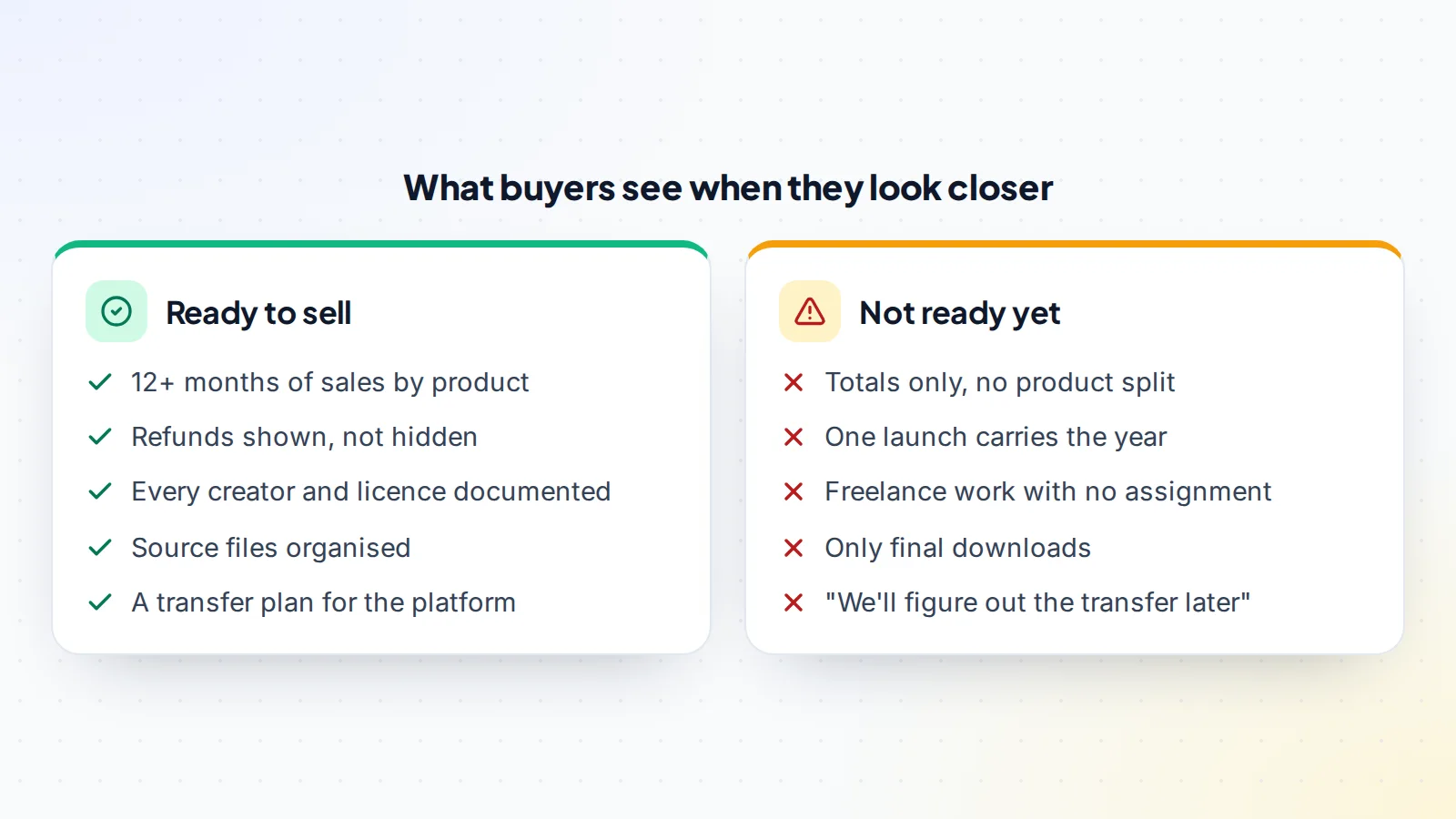
Read how buyers value digital product businesses to see which numbers they’ll focus on.
Step 2: Prove you own what you’re selling
Buyers of digital products are buying rights, and serious buyers will ask for proof. Make a simple list of every product with its creator and creation date, and gather:
- Assignments for freelance work. In the United States, the Copyright Office explains that a contractor’s work counts as “work made for hire” only in certain categories and with a written agreement; otherwise the creator generally owns the copyright unless it was assigned in writing. If you’re missing an assignment, ask the freelancer to sign one now.
- Licences for third-party assets: fonts, stock photos, icons, music and code. Check they allow use in products for sale and can pass to a new owner.
- Trademark details, if you registered the brand.
Our guide to intellectual property in digital products covers what to collect.
Step 3: Plan the transfer before you list
Every platform handles a change of owner differently, and buyers will ask. Find out now:
- Can the account or store move? Gumroad’s help centre, for example, says products and customers can’t be moved between accounts, but ownership of a whole account can move by changing its email address to the buyer’s. See transferring a Gumroad store.
- Will past customers keep access to what they bought?
- Does the platform need to approve the change, or does it require new tax and payout details?
- What happens to reviews and ranking on marketplaces?
If your store can’t move, plan an export and import with the buyer, and price that work in.
Step 4: Increase the value before you sell
A few months of focused work often raises the price more than it costs:
- Update your bestsellers so they don’t look dated.
- Fix the reasons for refunds. Clearer descriptions and previews usually reduce them.
- Build the email list with consent, so the buyer gets a channel they control. See email list value.
- Add a second traffic channel if you rely on one. Our guide to marketing digital products has ideas.
- Review your prices. Many creators underprice; read how to price digital products.
- Organise source files so the buyer can update products without you.
Step 5: Work out what it’s worth
Most established digital product businesses sell for a multiple of average monthly net profit over the last 6 to 12 months. The multiple rises with a long, steady record, low refunds, several traffic channels, products that age slowly, clean ownership and an easy transfer. It falls with dependence on one product, one channel or your personal brand, dated products and a difficult transfer.
For a quick range, use the free valuation tool. Our guide to valuing an online business explains the method in depth.
A worked example
Take a shop selling spreadsheet templates for freelancers: 22 products, three years of history, sold on a creator platform and through the owner’s website. Revenue has averaged $4,200 a month over the last year; after platform fees, tools and a small advertising budget, profit is $3,100. Four templates bring in half the revenue. Refunds run low and steady. One product was designed by a freelancer two years ago, with no written assignment.
Before listing, the owner does three things. They ask the freelancer to sign an assignment, which takes a week. They refresh the two oldest bestsellers with updated designs. And they confirm with the platform how a change of owner works, writing the steps into a one-page transfer plan. When the listing goes live, it shows sales by product, refunds, traffic sources and the transfer plan. Buyers have fewer questions, and the offers that arrive are closer to the asking price because the obvious risks have already been removed. That’s the practical difference preparation makes when you sell a digital product business.
Choosing the right buyer
The highest offer isn’t always the best one. Ask each serious buyer how they plan to run the business. Will they keep supporting customers? Will they keep the products updated? Do they understand the platform? A buyer who runs it well protects your reputation, and if part of the price is paid later, your money too.
Different buyers value different things. A creator in the same niche might pay more because your products complement theirs. A portfolio buyer might value the systems and the email list. An individual buying their first online business might value your support most. Knowing what each buyer wants helps you negotiate.
Step 6: List the business
A good listing helps the right buyer recognise the business quickly:
- What you sell, to whom, and on which platforms.
- Revenue and profit over 12+ months, with the product split.
- Traffic sources and the size of the email list.
- How many hours a week it takes, and on what.
- What’s included: products, source files, store, domain, list, social accounts, templates and documents.
- How the transfer works on your platform.
- Growth ideas you haven’t had time for.
- Why you’re selling.
You can list your digital product business on digiflippers.com for free, with 0% success fee up to $10,000, then 5% (max $5,000), and show buyers which numbers have been verified.
Step 7: Talk to buyers
Answer questions in writing and keep the conversation in one place. Share sales data through a live screen share or read-only access, never your password. Hold back the most sensitive material (full customer lists, source files, exact supplier rates) until a buyer has made a written offer.
Be cautious with buyers who want to see everything before showing any intent, push for a decision within hours, or suggest payment methods you can’t verify.
Step 8: Agree the terms
Write down the price, the payment method, exactly what’s included, the handover order, an inspection period for the buyer and the support you’ll give afterwards (for example, four weeks of answering questions). If you could easily create competing products, buyers will often ask for a non-compete for a set period.
Step 9: Get paid and hand over
Start the handover only once the payment is held by escrow or a trusted middleman. On digiflippers.com, the ways to pay in a deal are: directly to the seller, through escrow, and the platform never holds the money itself. Read how escrow works.
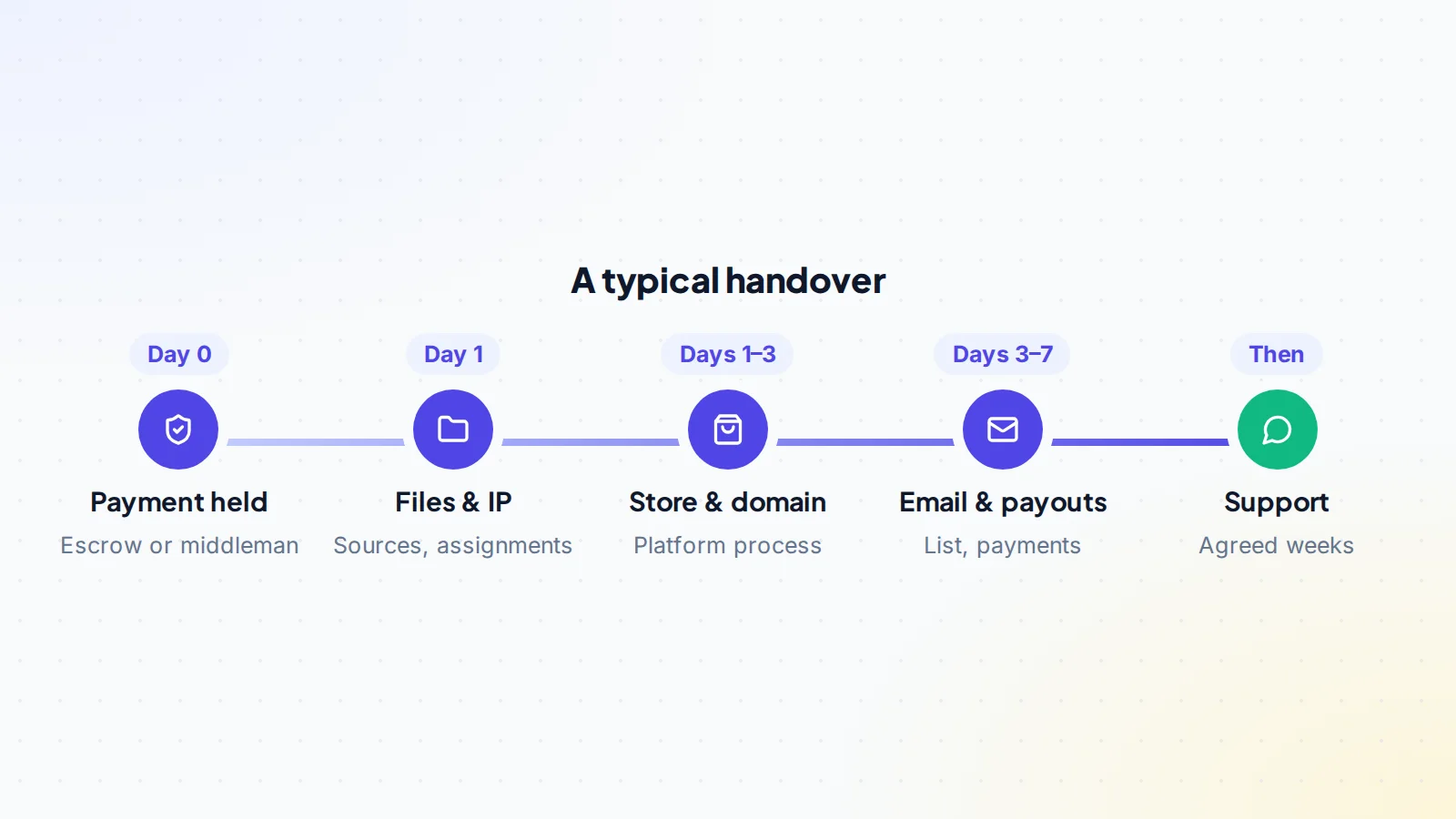
- Files and rights: final and source files for every product, plus assignments and licences.
- Store and domain: follow your platform’s process, then move the domain and hosting.
- Payouts: the buyer connects their own payout account; check the next sale reaches them.
- Email list: move it in line with the consent subscribers gave. Many sellers send a short note introducing the new owner.
- Everything else: social accounts, design tools, course platforms and affiliate programmes.
When the buyer confirms everything works, the payment is released. Our handover checklist has the full list.
After the sale
Keep the promises you made: answer the buyer’s questions during the support period and make any introductions you agreed. Remove your access from the store, tools and accounts once the buyer confirms they’re set up, and cancel any subscriptions still on your card. Keep the signed agreement and payment records; depending on where you live, the sale may have tax consequences, so speak to an accountant early rather than after the money arrives.
Mistakes that cost sellers money
- Hiding refunds or launches in the totals. Buyers find them, and then doubt everything else.
- No assignments for freelance work. It can delay or even stop a sale.
- Not checking the platform’s transfer rules until a buyer asks.
- Letting the business slip during the sale. Keep marketing and support going until the handover.
- Handing over files before the money is held. Digital files can’t be “returned”.
Checklist: how to sell a digital product business
- 12+ months of sales by product, refunds, payouts and costs ready.
- Traffic sources and email list size documented.
- Creator of every product listed; assignments and licences gathered.
- Platform transfer process confirmed, including customer access.
- Bestsellers updated, refunds reduced, source files organised.
- Realistic price based on average monthly profit.
- Clear listing with what’s included and how the transfer works.
- Sensitive material shared only after a written offer.
- Terms agreed in writing; payment secured before handover.
- Files, store, domain, payouts and list handed over in order.
Ready to sell?
List it on digiflippers.com with verified numbers, answer buyers in one place and agree every step in a free Deal Room. 0% success fee up to $10,000, then 5% (max $5,000).
Frequently asked questions
How much is my digital product business worth?
Usually a multiple of average monthly net profit. The multiple depends on how steady sales are, refunds, traffic channels, product age, ownership and how easily the business can move to a new owner.
Can I sell my Gumroad or Etsy store?
It depends on the platform’s rules. Gumroad’s help centre says account ownership can move by changing the account email, while products can’t move between accounts. Etsy’s help centre says accounts can’t be transferred to a new owner, so the buyer opens their own shop and you hand over the products, rights and brand; see buying an Etsy digital shop. Check your platform’s terms before you list.
Do I have to include source files?
Buyers expect them, because without them they can’t update products. Including them raises the price and speeds up the sale.
What if a freelancer made some of my products?
Ask them to sign a written assignment of their rights to you before you sell. Buyers will want to see it.
How long does it take to sell?
Preparing usually takes a few weeks. Finding a buyer can take weeks to a few months depending on price and niche, and the handover itself typically takes days.
Do I need a lawyer?
For small, simple sales many sellers use a standard written agreement. For larger sales, or when there are contracts with freelancers, partners or affiliates, a lawyer’s review of the agreement is worth the cost.
Can I keep selling similar products after the sale?
Only if the agreement allows it. Many buyers ask for a non-compete covering similar products for a set period, so agree the scope clearly before you sign.
Should I tell customers?
After the sale, a short, friendly note introducing the new owner helps. Before the sale, there’s no need.