Buying an Instagram Account: A Buyer’s Checklist
What to check before you buy an Instagram account, how to read Insights and account history, how to pay safely, and the order for a clean handover.
An Instagram account with a loyal audience can be a real business: a channel to sell products, earn from brand partnerships and send traffic wherever you need it. When you buy an Instagram account, you’re buying that attention, and the work is checking that the audience is real, engaged and transferable. This checklist walks you through every check, the questions to ask and the order for a clean, safe handover.
It’s written for buyers, from creators adding a page in their niche to brands buying an established audience. If you’re still comparing platforms, start with our overview of buying social media accounts.
Key takeaways
- Value comes from reach and engagement, not the follower count on its own.
- Check Insights live on a call, and read the account’s history in “About this account”.
- Agree exactly what is included: the account, its email, content, partnerships and any linked pages.
- Keep the payment held by escrow or a middleman until the handover is complete.
- Hand over in order: email, password, two-factor, then sign out every other device.
Why buy an Instagram account
Building an audience from zero takes months or years of consistent posting. An established page gives you a head start: followers who already like the topic, a content style that works, and often existing relationships with brands. For a business, it can be a faster way to reach customers in a niche. For a creator, it can be a second page that fits alongside what they already do.
The opportunity is real, and so is the need to check it properly. Two accounts with the same follower count can be worth very different amounts, depending on how many people actually see and respond to the posts.
Start with the niche. An account that fits something you already know, sell or care about is easier to run well, because you can keep posting content the audience expects. Think about the time you can give it each week, the kind of posts it needs (photos, Reels, Stories or carousels), and how it connects to the rest of your business. Before you buy an Instagram account, a clear plan for the first three months makes it easier to judge which accounts suit you.
What you’re actually buying
Write down what the deal includes before you talk about price. A typical sale can include:
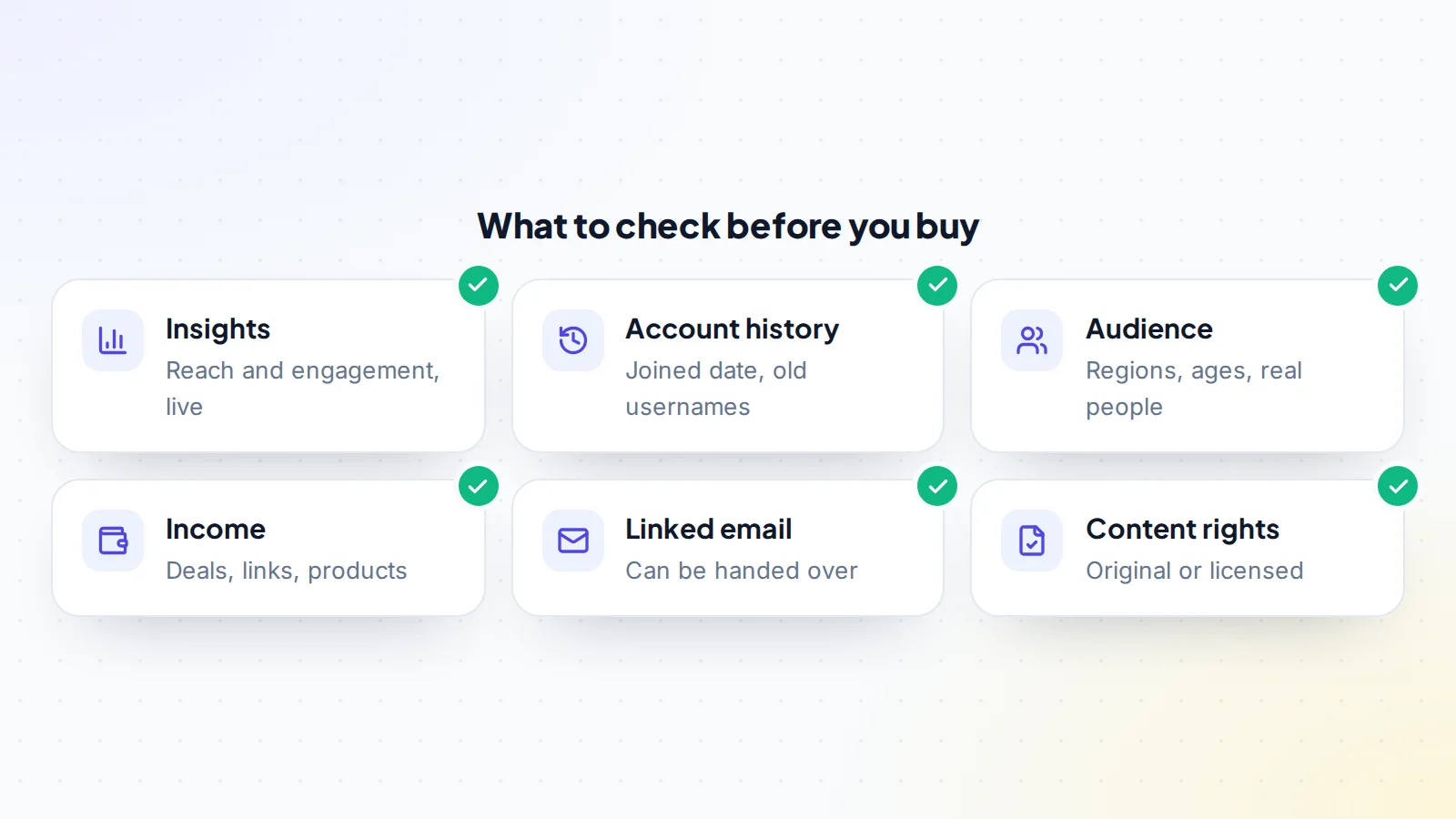
- The account itself: username, profile, posts, Reels and highlights.
- The email address linked to the account, or a change of email to yours during the handover.
- Content and rights: photos, videos and templates, ideally with original files.
- Income sources: brand partners, affiliate links, products or a link-in-bio page.
- Related assets: a website, email list, other social pages or a shop.
- Know-how: posting schedule, content ideas, best times and tools used.
Anything not on the list should be assumed not included. Clear terms prevent most disagreements later.
Check Insights live, not screenshots
Professional accounts (business or creator) have Insights, which Instagram describes as a way to learn about trends across your followers and how your content performs. Insights show figures such as accounts reached and accounts engaged, plus details for individual posts, Reels and Stories.
Screenshots are easy to edit, so ask the seller to share their screen on a video call and open Insights inside the app while you watch. Look at:
- Accounts reached over the last 30 and 90 days, and how that compares with the follower count.
- Accounts engaged and interactions: likes, comments, saves and shares.
- Audience: top locations, age ranges and gender split, and whether they match the niche and any buyers you want to reach.
- Recent posts and Reels: do typical posts perform near the average, or does one viral post carry the numbers?
Our guide to verified metrics explains how to confirm numbers you can’t see yourself.
Read the account’s history
Instagram’s “About this account” screen, available to logged-in users in the app, shows when an account joined Instagram, the country it’s based in and its former usernames. It’s one of the most useful checks you can do in a minute:
- Date joined should fit the story the seller tells about how the page grew.
- Former usernames show whether the account has changed topic or name. A change isn’t a problem in itself, but it should be explained.
- Country should make sense for the seller and the audience.
Scroll back through older posts too. A steady posting history in the same niche is a good sign. Gaps, deleted periods or a sudden change of topic deserve questions.
Judge the audience quality
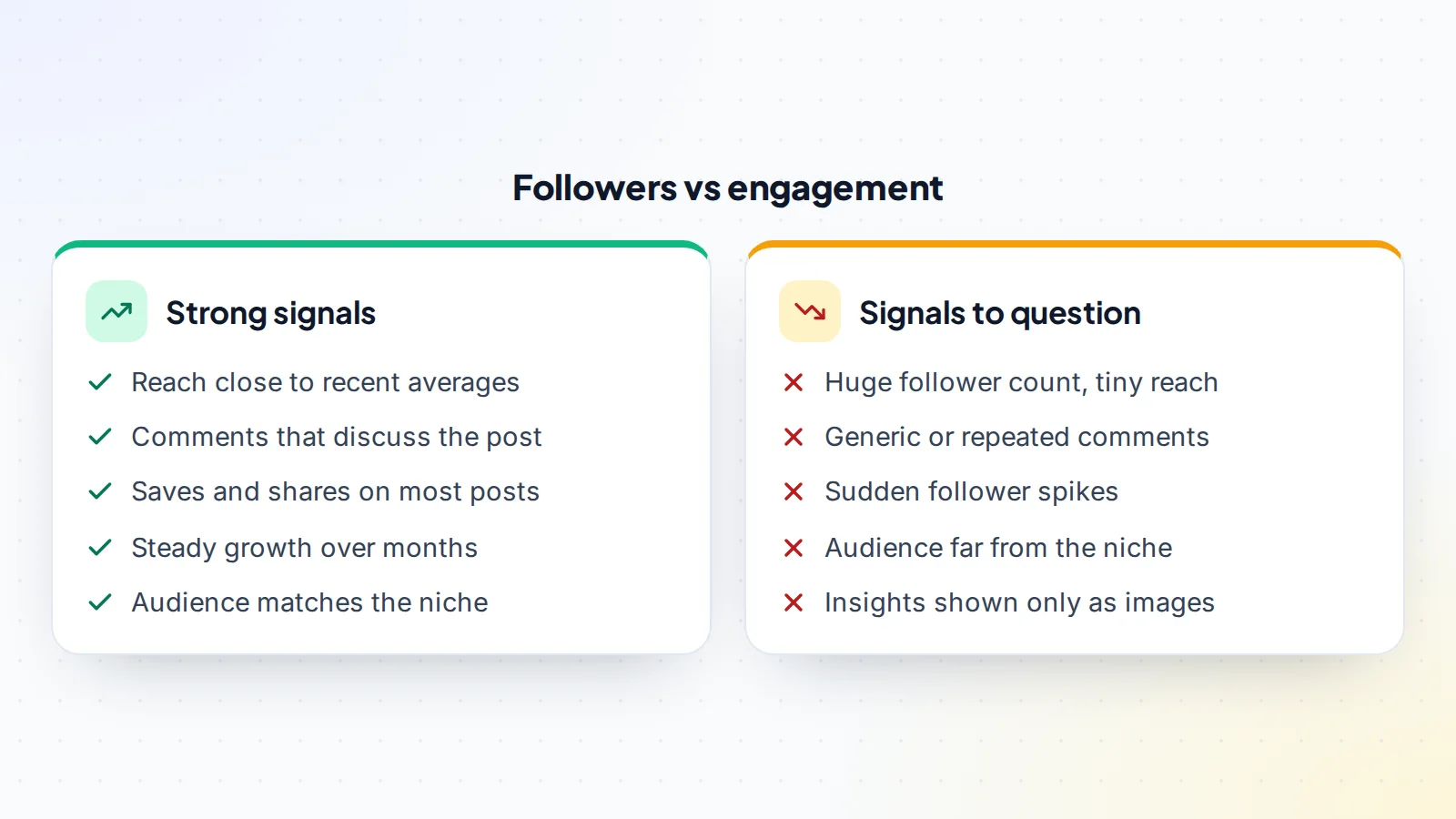
The best audiences are people who chose to follow because they enjoy the content. Look for comments that respond to what was posted, followers who return across many posts, and saves and shares, which suggest people found the content useful. Growth should look like a curve that follows good content, not sudden jumps on days with nothing special posted.
Open a sample of follower profiles. Real followers tend to have their own photos, posts and varied names. If many look empty or similar, ask the seller about the account’s growth history. A smaller, engaged audience is usually worth more than a larger, quiet one.
Check income and partnerships
If the account earns, ask how, and verify each source:
- Brand partnerships: past invoices, the brands’ names and whether contacts will transfer to you.
- Affiliate links: dashboards shown live; many affiliate accounts belong to a person and need to be replaced with your own.
- Products or a shop: sales records and who owns the store.
Income tied to the seller personally, such as a face on camera or a personal relationship with a brand, may not continue after the sale. Price that risk in. For accounts with income, valuation usually starts from average monthly profit; for growing accounts, from reach, engagement and niche compared with similar sales. Our Instagram account value guide covers the method, and you can try the valuation tool on digiflippers.com.
Questions to ask the seller
Good sellers are happy to answer clear questions, and their answers help you set a fair price. Ask:
- Why are you selling, and what will you do next?
- How did the account grow, and which posts or formats brought the most followers?
- Have you ever run giveaways, paid promotions or shout-outs? When, and what happened to reach afterwards?
- How many hours a week do you spend on the page, and on what?
- Which content is original, and which uses licensed images, music or templates?
- Which brands have you worked with, and will you introduce me?
- Are there any open agreements, unpaid invoices or promised posts I would take on?
- Will you stay available for questions for a few weeks after the sale?
Write the key answers into the deal terms. If an answer changes later, the written record makes the conversation simple.
Agree terms and payment
Before any money moves, agree in writing: the price, what’s included, the handover steps, who holds two-factor during the handover, how long you have to check everything, and what happens if something isn’t as described.
Use a payment method that protects both sides. On digiflippers.com, the ways to pay in a deal are: directly to the seller, through escrow, and the platform never holds the money itself. With escrow or a middleman, the money is held until you confirm the account is fully yours, so the seller knows the funds are real and you know you won’t pay for an account you can’t control. Avoid wire transfers, gift cards or crypto sent straight to a stranger; our guide to wire transfer safety explains why.
The handover, step by step
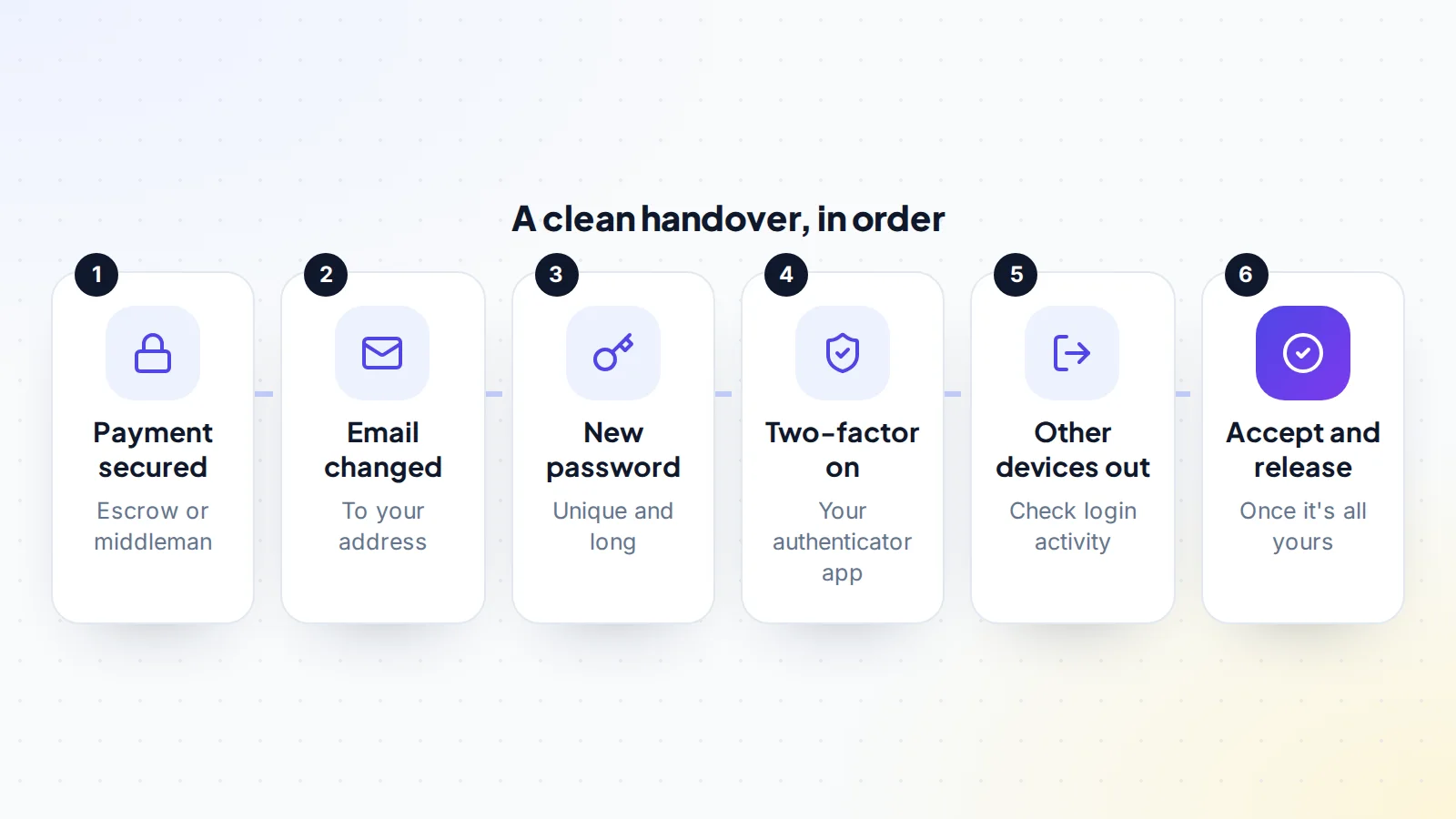
Do the handover on a call with the seller, while the payment is still held. The order matters, because the email controls password resets and recovery.
- Change the email on the account to an address only you control, and confirm it.
- Set a new password that’s long and unique.
- Turn on two-factor authentication. Instagram offers an authentication app (which it recommends), text message, and WhatsApp once text message is set up. You’ll find it under Settings, then Accounts Center, then Password and security.
- Update the phone number to yours or remove the seller’s.
- Check login activity, which lists devices that have recently logged in, and log out any you don’t recognise.
- Review Accounts Center: the account should not stay connected to the seller’s other profiles. Moving an account out of an Accounts Center removes shared login access.
- Accept in escrow once everything above is done, so the funds are released to the seller.
A worked example
The numbers below are made up to show the method.
Sam wants to buy an Instagram account in the home-cooking niche with 40,000 followers. On a screen-share, the seller opens Insights: over the last 30 days, posts reached an average of 9,000 accounts each, and typical posts gathered around 450 interactions, about 5% of reach. Most of the audience is in the regions Sam sells to. “About this account” shows the page joined four years ago, with one former username from when it was renamed to match the niche, which the seller explains.
The account earns from two recurring brand partners and an affiliate link. The seller shows invoices for the last 12 months; one brand agrees to continue with Sam. They agree a price based on the profit that will transfer, use escrow, and set a five-day period to check everything. On the handover call, they change the email, password and two-factor in order, Sam checks login activity, and then accepts in escrow.
After you buy
Keep things familiar for the audience at first. Post in the same style and rhythm for a few weeks before making changes, and introduce new formats gradually. Reply to comments and messages; early engagement helps you learn what your new followers like.
- Save backup codes for two-factor somewhere safe and offline.
- Replace the seller’s affiliate links and link-in-bio page with your own.
- Reconnect any shop, website or ad accounts you bought with the page.
- Record the starting numbers, so you can measure your own growth.
Our guide to owner hours and valuation helps you plan the time the page needs each week.
Buying an Instagram account: the checklist
- Deal contents written down: account, email, content, income, related assets.
- Insights reviewed live: reach, engagement and audience for 30 and 90 days.
- “About this account” checked: date joined, country, former usernames.
- Follower sample reviewed and growth history explained.
- Income verified with invoices or live dashboards.
- Terms agreed: price, handover steps, checking period.
- Payment held by escrow or a middleman.
- Email, password, two-factor and phone changed, in that order.
- Login activity checked and unknown devices logged out.
- Escrow accepted only once the account is fully yours.
Ready to find your next asset?
Browse listings with verified numbers, ask sellers your questions before you offer, and agree every step in a free Deal Room.
Frequently asked questions
What should I check before I buy an Instagram account?
Live Insights for reach, engagement and audience; the account’s history in “About this account”; a sample of followers; any income with proof; and exactly what the deal includes.
Are follower numbers a good measure of value?
On their own, no. Reach and engagement show how many followers actually see and respond to posts. Two accounts with the same follower count can be worth very different amounts.
How do I pay safely?
Use escrow or a middleman, so the payment is held until the account is fully yours. On digiflippers.com, the ways to pay in a deal are: directly to the seller, through escrow.
Which two-factor method should I use after buying?
Instagram recommends an authentication app, such as Google Authenticator or Duo Mobile. Set it up on your own device during the handover and save the backup codes.
Will the audience notice a new owner?
Usually only if the content changes suddenly. Keep the style and rhythm familiar at first, then evolve the page gradually.
Can brand partnerships transfer?
Sometimes. Partnerships belong to the relationship between the brand and the seller, so ask the seller to introduce you and get each brand’s agreement before you count that income in the price.
How long should I have to check the account?
Long enough to complete the handover and confirm you control the email, password and two-factor without the seller’s help. A few days is a reasonable starting point for most accounts; agree the period in writing before you pay.
Keep reading
Sources
- Instagram Help Center: Securing your account with two-factor authentication
- Instagram Help Center: View your recent login activity
- Instagram Help Center: What is “About this account” on Instagram and Threads
- Instagram Help Center: About Instagram Insights
- Instagram Help Center: Set up a professional account
- Instagram Help Center: Logging in across accounts in the same Accounts Center