Ranked Accounts Explained: How Rank and History Affect Price
What makes a ranked account worth more, how League of Legends and VALORANT ranks work, why decay and history matter, and how to check a ranked account before a deal.

A high rank is a record of hundreds of games, good decisions and steady improvement, and many players love an account that shows it. Ranked account value depends on more than the badge on the profile, though: past seasons, how active the account is, the collection that comes with it and how cleanly it can be handed over all shape the price. This guide explains how rank and history affect what a ranked account is worth, with examples from League of Legends and VALORANT.
It’s written for both sides: players selling an account they’ve built, and players looking for one that matches the way they play. If you’re new to account deals, start with our guide to selling a game account.
Key takeaways
- Current rank sets the headline, but peak rank, past seasons and ranked rewards add value.
- Activity matters: in League of Legends, Diamond and above lose points when inactive.
- Skins, agents and champions often make up a large part of the price.
- A handover with the original email and full security control is worth more to buyers.
- Check everything live in the game client, and keep the payment held until the account is yours.
Why ranked accounts have value
Rank is the most visible achievement in a competitive game. It reflects time, skill and consistency, and higher ranks are reached by a smaller share of players. Ranked play also often unlocks rewards at the end of a season, so an account with years of ranked history can carry cosmetics that can’t be earned any more.
Buyers look for ranked accounts for many reasons: a collection they love, a history they enjoy showing, a second account for a different role or region, or a fresh start with a strong set of unlocked content. Sellers have built something real. Understanding what drives value helps both sides agree a fair price quickly.
How ranks work in two popular games
Every game has its own system, so always check the game’s own support pages. Two examples:
League of Legends. Riot lists ten tiers, from lowest to highest: Iron, Bronze, Silver, Gold, Platinum, Emerald, Diamond, Master, Grandmaster and Challenger. Iron to Diamond each have four divisions, from IV up to I. Master, Grandmaster and Challenger are the apex tiers, which form a leaderboard instead of divisions. Progress is measured in League Points (LP).
VALORANT. Riot lists the ranks as Iron, Bronze, Silver, Gold, Platinum, Diamond, Ascendant, Immortal and Radiant. Every rank except Radiant has three tiers. Players earn Rank Rating (RR); from Iron through Ascendant, reaching 100 RR moves you up a tier, while Immortal and Radiant keep earning RR on a leaderboard. VALORANT also has an Act Rank, which reflects your best performance across an Act, based on your highest ranked wins.
What shapes ranked account value
These are the factors buyers and sellers weigh most often.
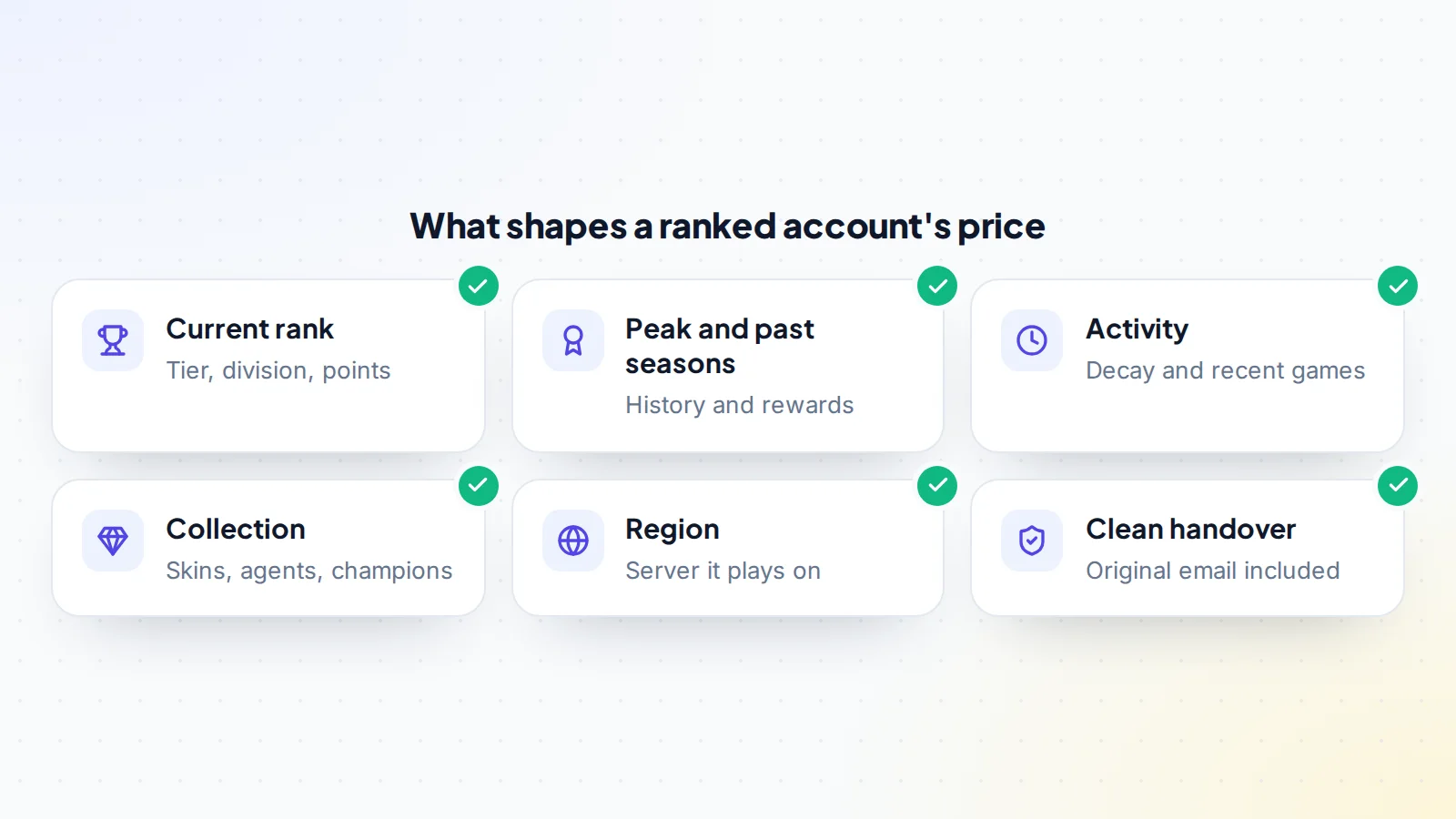
- Current rank: tier, division and points. A higher rank and more points within it usually mean a higher price.
- Peak rank and season history: strong past seasons, and the rewards that came with them, add to an account’s story and collection.
- Activity: recent games show the rank is current. In games with decay, an account close to losing points needs attention.
- Collection: skins, champions, agents, emotes and other cosmetics, especially limited or legacy items.
- Region or server: buyers generally want an account on the server they play on.
- Account level and age: a long, steady history fits naturally with a high rank.
- Handover quality: the original email, full control of security settings and a clear history all make buyers more confident.
Current rank vs peak rank
Current rank is what a new owner sees when they log in today. Peak rank and past seasons show what the account has achieved over time. Both have value, in different ways. A buyer who wants to play at a high level right away cares most about the current rank. A buyer who loves collecting cares about the rewards and history that past seasons left behind.
When you describe an account for sale, state both clearly, with the season for each. When you buy, ask to see both live in the client rather than relying on a listing. Ranks reset or adjust between seasons in many games, so the season matters as much as the badge.
Activity and decay
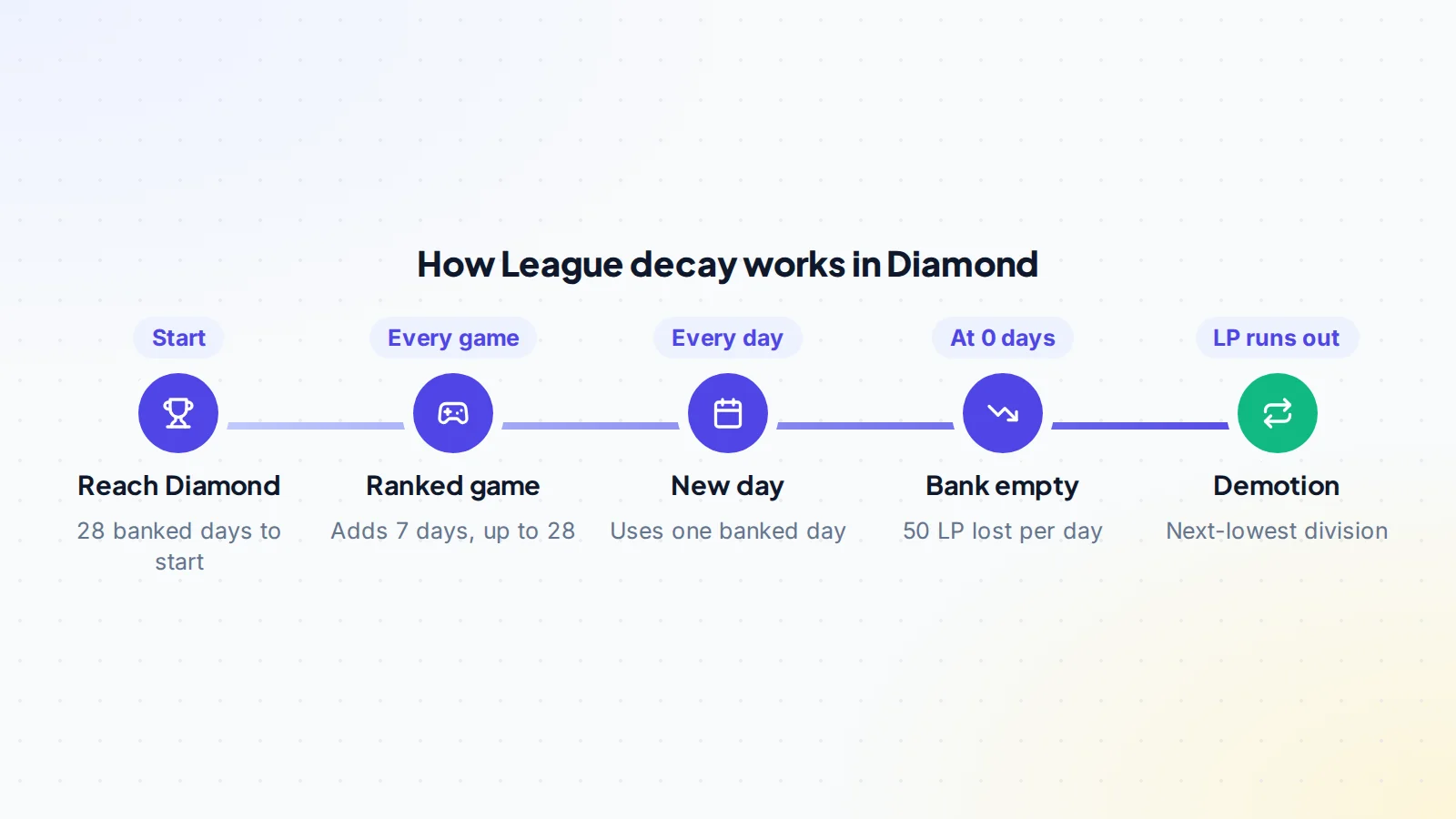
Some games reduce rank when an account stops playing. In League of Legends, Riot’s support article explains that decay applies in Diamond and above. When you enter Diamond, you get a bank of days; each ranked game adds more, and each day uses one. For Diamond, Riot lists 7 banked days per match, a maximum of 28, and 50 LP lost per day once the bank is empty. If decay takes the account below 0 LP, it moves to the next-lowest division.
For a deal, this means timing matters. Sellers should keep a high-rank account active until the handover, and both sides should note the remaining banked days in the terms. Buyers should plan to play ranked soon after the handover, so the rank they paid for stays in place.
Rank and the new owner’s skill
Ranked systems are designed to match players of similar skill, and rank moves with results. A ranked account is most enjoyable when its rank sits close to how the new owner plays: games feel competitive, and the rank grows with them. Buyers who want a higher rank than they play at today may find the rank adjusts over the following games. That’s worth knowing before you choose, and it’s one reason many buyers value the collection and history as much as the rank itself.
The collection behind the rank
For many accounts, cosmetics are a large share of what buyers pay for. Make a clear list: the number of skins, champions or agents, any limited or legacy items, and ranked rewards from past seasons. Screenshots of the collection help a listing, and a live screen-share confirms it before payment. Our guide to Steam inventory value explains how collections are priced on another platform, and the same thinking applies: rarity, demand and condition of the account as a whole.
How to check a ranked account before a deal
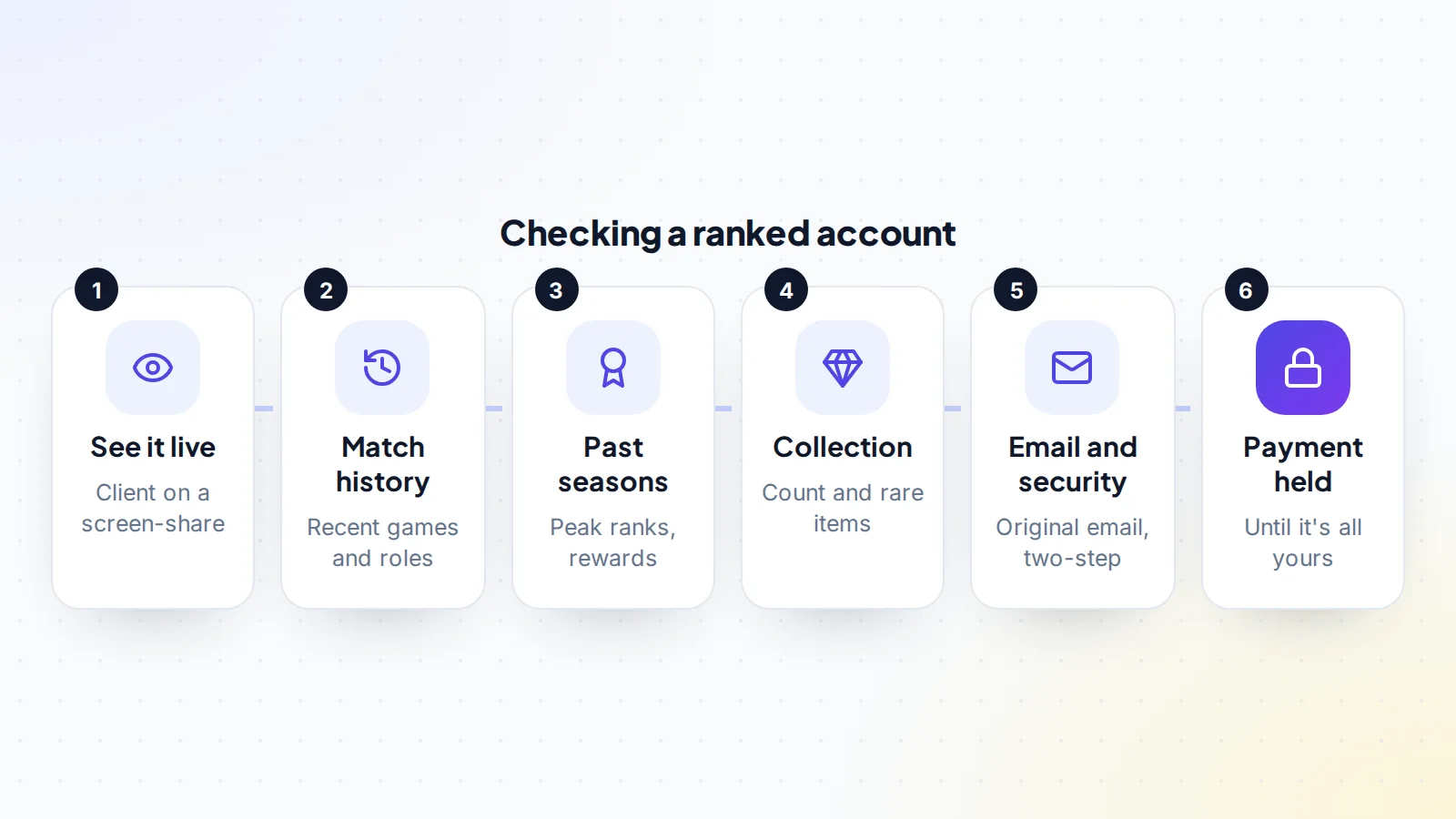
- See it live. Ask the seller to log in on a screen-share and open the profile, ranked page and collection.
- Review match history: recent ranked games, roles or agents played, and when the last games were.
- Check past seasons for peak ranks and rewards.
- Count the collection and note rare items.
- Confirm the email and security: which email is linked, whether it’s included, and how two-step verification will move to you.
- Agree payment protection: escrow or a middleman holds the money until the handover is complete.
Pricing a ranked account
There’s no fixed formula, but a clear method helps. Start from what similar accounts have sold for: same game, region, rank band and similar collection. Then adjust for the account’s strengths, such as a rare collection or strong season history, and for anything a buyer would need to work on, such as decay that’s close or an email that can’t be handed over.
Sellers get the best result with a clear, honest listing: rank and season, peak rank, collection list, region, recent activity and exactly what the handover includes. Buyers do best by comparing a few similar listings and asking the same questions of each. The valuation tool on digiflippers.com helps you think through the factors.
Writing a strong listing
For sellers, the listing is where most of the price is won. Buyers compare many accounts quickly, so make the important facts easy to find:
- Headline: game, region, current rank and the season it was reached.
- Rank history: peak rank and the seasons with the best results.
- Collection: total counts and a short list of the rarest items, with screenshots.
- Activity: how often the account is played, and for League of Legends in Diamond or above, the banked days remaining.
- Handover: whether the original email is included and how two-step verification will move.
- Availability: when you can do a screen-share and the handover call.
Honest, specific listings make a buyer’s decision easier. Clear photos of the ranked page and collection, plus an offer to show everything live, answer most questions before they’re asked. Listing on digiflippers.com lets you add these details in one place and keep every message with buyers on the platform.
A worked example
The details below are made up to show the method.
Jordan sells a League of Legends account in Diamond II on the server most of their friends play on. The account reached Diamond in two earlier seasons, has a large skin collection with several older skins, and is played most days. Jordan lists the current rank, past seasons, a skin count and the region, and notes that the original email comes with the account.
A buyer asks for a screen-share. Jordan shows the ranked page, match history from the last week and the collection. They agree a price close to similar Diamond accounts with comparable collections, use a middleman, and set the handover for the next day so banked days stay healthy. On the handover call, Jordan changes the email to the buyer’s, the buyer sets a new password and two-step verification, and the middleman releases the payment.
Paying and handing over safely
On digiflippers.com, the ways to pay in a deal are: directly to the seller, through escrow, and the platform never holds the money itself. With escrow or a middleman, the buyer’s payment is held until the account is fully theirs, which protects both sides. Our guide to using a game account middleman explains how that works, and closing a digital asset deal covers the final steps. Keep all messages on the platform and avoid sending payment straight to someone you don’t know; see wire transfer safety.
For the handover itself, change the email first, then the password, then two-step verification on the buyer’s own device, and sign out other sessions. Sellers can also verify their profile to give buyers more confidence.
Ranked account value: the checklist
- Current rank, division and points confirmed live, with the season.
- Peak rank and past seasons checked, with rewards noted.
- Recent match history and activity reviewed.
- Decay rules for the game checked and remaining days noted.
- Collection counted, with rare and legacy items listed.
- Region or server confirmed.
- Email and security handover agreed in writing.
- Price compared with similar accounts.
- Payment held by escrow or a middleman until the handover is complete.
Ready to find your next asset?
Browse listings with verified numbers, ask sellers your questions before you offer, and agree every step in a free Deal Room.
Frequently asked questions
What decides ranked account value?
Current rank, peak rank and season history, recent activity, the collection, the region and how cleanly the account can be handed over. Prices are best judged against similar accounts that have sold.
Does peak rank matter if the current rank is lower?
Yes, to many buyers. Past seasons can bring rewards and show what the account achieved, though buyers who want to play at a high level right away focus on the current rank.
What is rank decay?
A rule in some games that lowers rank when an account stops playing. In League of Legends, it applies in Diamond and above, using a bank of days that ranked games top up.
Which ranks does VALORANT have?
Iron, Bronze, Silver, Gold, Platinum, Diamond, Ascendant, Immortal and Radiant. Every rank except Radiant has three tiers.
How do I check a ranked account before paying?
Ask for a live screen-share of the profile, ranked page, match history and collection, confirm the email and security handover, and keep the payment held by escrow or a middleman.
Do skins add to the price?
Often a great deal. Rare, limited and legacy cosmetics can be a large part of what buyers pay, so list them clearly when selling.
Should I keep playing while my account is listed?
Yes, if the game has decay at your rank. Keeping the account active protects the rank buyers see in the listing. Avoid long losing streaks right before a handover, and update the listing if the rank changes.
Keep reading
Sources
- League of Legends Support: Ranked tiers, divisions and queues
- League of Legends Support: Placements, promotions, demotions and decay
- League of Legends Support: Master, Grandmaster and Challenger, the apex tiers
- VALORANT Support: Rank Rating for Iron through Ascendant
- VALORANT Support: Rank Rating for Immortal and Radiant
- VALORANT Support: Act Ranks and rewards