
How to Sell a Game Account Safely
Moving on from a game? How to value your account, show proof buyers trust, set a fair price, get paid through a middleman and hand over without problems.
Every player eventually moves on from a game. When you do, the account you built (the rare skins from early seasons, the rank you climbed, the library you collected) can be worth real money to someone who is just getting started. Knowing how to sell a game account well means you get a fair price for that time and effort without exposing yourself to the scams that target sellers.
This guide covers the whole process: working out what your account is worth, preparing proof that buyers trust, writing a listing that sells, choosing a payment method that protects you, and handing over the account cleanly so the deal is finished for good.
It applies to accounts in most popular games and platforms. Where a game has its own quirks, we link to a dedicated guide.
Key takeaways
- Value is in the details: rare items, rank, inventory, progress, account age and whether the email is included.
- Prepare a full item list and fresh proof before you list. It sells accounts faster and at better prices.
- Price against similar listings, and give extra weight to items that can never be obtained again.
- Use a middleman or escrow: the buyer’s money is held before you hand anything over.
- Hand over the email with the account, remove your own recovery details and keep the deal record.
What is your game account worth?
Buyers pay for what they can’t easily get themselves. Make a list of everything on the account and look at it the way a buyer would:
- Rare and limited items. Cosmetics from early seasons, one-off events, collaborations and battle passes that won’t return. These are usually the biggest part of the price. See what makes rare skins valuable.
- Rank and stats. Current-season rank, peak rank and match history. Recent high ranks are worth more than old ones. Read ranked account value.
- Inventory and library. Tradeable items, unspent currency and owned games or DLC. For platform accounts, see Steam inventory and library value.
- Progress. Unlocked characters, levels, achievements and anything that takes months to earn.
- Account age and history. An older account you created yourself, with a clean history, is more attractive.
- Full access. An account sold with its original email is worth considerably more than one without.
Game-specific guides help with pricing: Fortnite account value, Roblox account value and our overview of how game accounts are valued. For a quick starting point, try the free valuation tool.
Should you sell items or the whole account?
If your game lets you trade or sell items individually, selling a few valuable items can sometimes bring more than selling the whole account. On the other hand, selling the account is a single deal, and it’s the only option when most of the value is in progress, rank or items that can’t be traded. Our comparison of selling in-game items vs whole accounts walks through the trade-offs.
Step 1: Prepare the account and your proof
Preparation is what separates accounts that sell in days from those that sit for months.
- Make a complete item list, with the rarest items at the top. Include the season or event they came from where you can.
- Record fresh proof. A short video in which you log in, open the locker or inventory, show the rank screen and the account settings (with the email partly hidden) is far more convincing than screenshots. Our guide to game account proof lists what buyers look for in each game.
- Check linked platforms. Note which PC, console and mobile accounts are linked, and whether they can be unlinked.
- Secure the email account. Make sure you can hand over the email cleanly, or change the game account’s email during the sale.
- Remove what you’ll keep: saved payment methods, personal details and links to your other accounts.
Step 2: Set a fair price
Look at several listings with similar items, ranks or libraries, and note what they’re priced at and how long they’ve been listed. Then adjust:
- Up for items that can never return, a recent high rank, a large library or an included original email.
- Down for missing email access, platforms that can’t be unlinked, or an account you didn’t create yourself.
Leave a little room to negotiate, but don’t price far above comparable accounts: listings that are clearly overpriced get ignored, and buyers start to wonder why the account hasn’t sold. Our guide to game account market trends shows which games and items are in demand right now.
A worked pricing example
Say you’re selling an account for a popular battle royale. It has around 120 cosmetics, including six from the first two seasons that have never returned to the shop, plus a few hundred units of unspent currency. You created it yourself years ago, and you can hand over the original email.
You find four similar accounts listed. Two have a similar number of cosmetics but none of the early-season items, and they’re priced well below the others. One has a couple of the early items but no email access. The last is close to yours, with the email included, and it’s priced highest. That tells you two things: the early items carry most of the value, and email access adds a premium.
A sensible asking price sits near the closest comparable, slightly above it if your rare items are rarer, and leaves room for a modest negotiation. You list it with a full item list, the six rare items first, a fresh proof video and a clear note that the email is included. Then you wait for a buyer who values exactly what you have, rather than dropping the price after the first low offer.
Platforms, regions and linked accounts
Many game accounts are linked to other services, and buyers will ask about them. Before you list, check which console, PC store or mobile accounts are linked, whether the game allows you to unlink them, and whether there’s a waiting period after unlinking. Note the account’s region too: servers, store prices and some items can differ between regions, and a buyer elsewhere will want to know. Being clear about these details up front avoids disputes later and makes it easier for the right buyer to say yes. Anyone learning how to sell a game account for the first time is often surprised how many questions come down to these links.
Step 3: Write a listing that sells
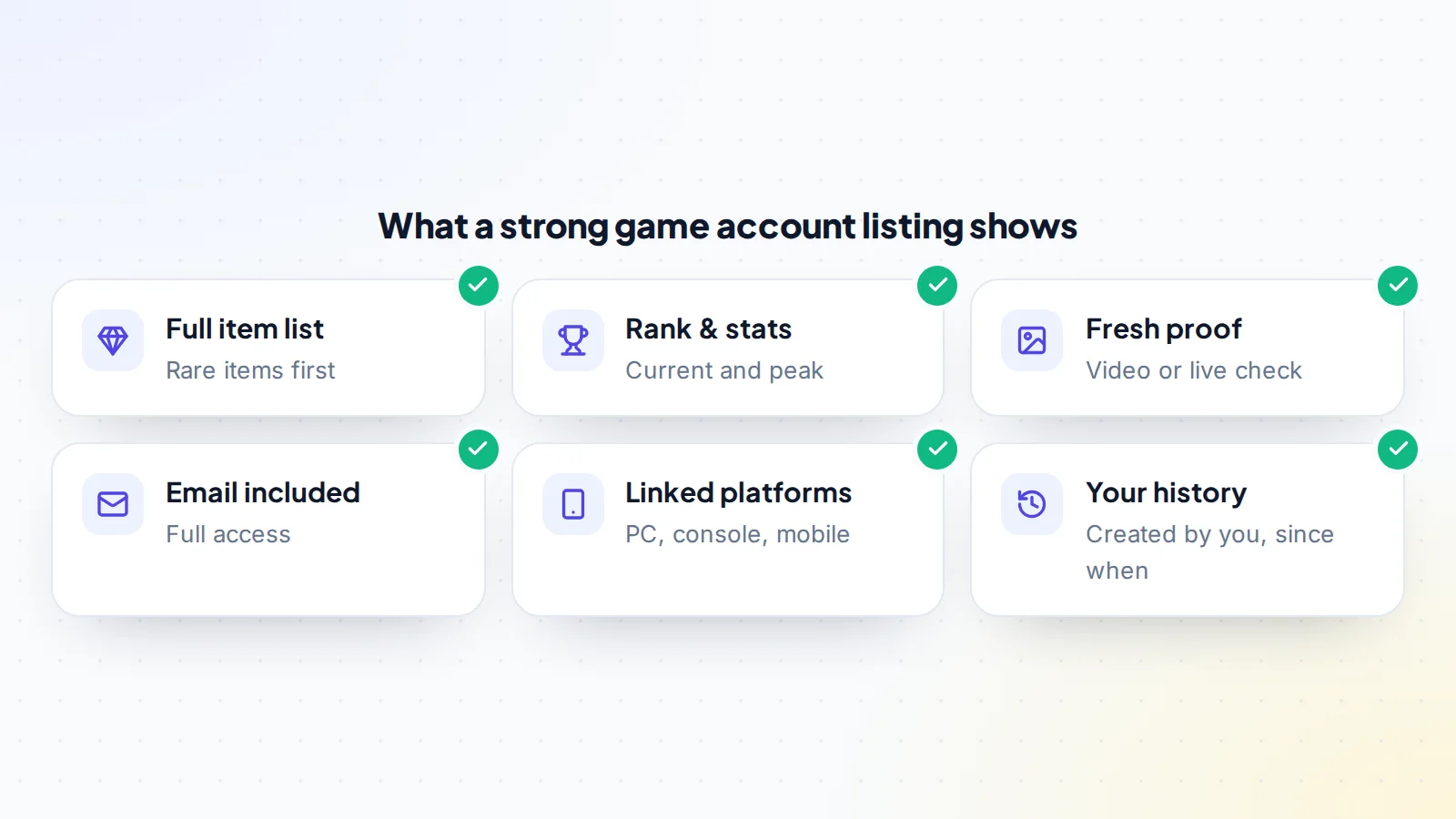
A strong listing answers buyers’ questions before they ask them:
- The game, platform and region.
- The headline items, then the full list.
- Rank and key stats.
- Account age, and that you created it.
- Whether the original email is included.
- Linked platforms and whether they can be changed.
- Your proof video or an offer of a live check.
Write it honestly. If something is missing or a link can’t be changed, say so. Buyers forgive limitations they were told about; they don’t forgive surprises. Our guide to writing a game account listing has examples. When you’re ready, you can list your game account on digiflippers.com, with no success fee.
Step 4: Deal with buyers
Answer questions clearly and keep the conversation on the marketplace, so there’s a record if you ever need one. Offer a live check to serious buyers: a quick screen share where you show the account and type a word they choose in chat. It builds trust quickly.
Be careful with buyers who:
- Ask for your login “just to check” before paying.
- Want you to hand over first and pay later.
- Suggest a middleman or payment site you can’t verify, or contact you pretending to be a middleman.
- Send screenshots of a payment instead of a payment you can see in your own account.
- Offer to pay more than the price if you hand over right now.
Step 5: Get paid through a middleman or escrow
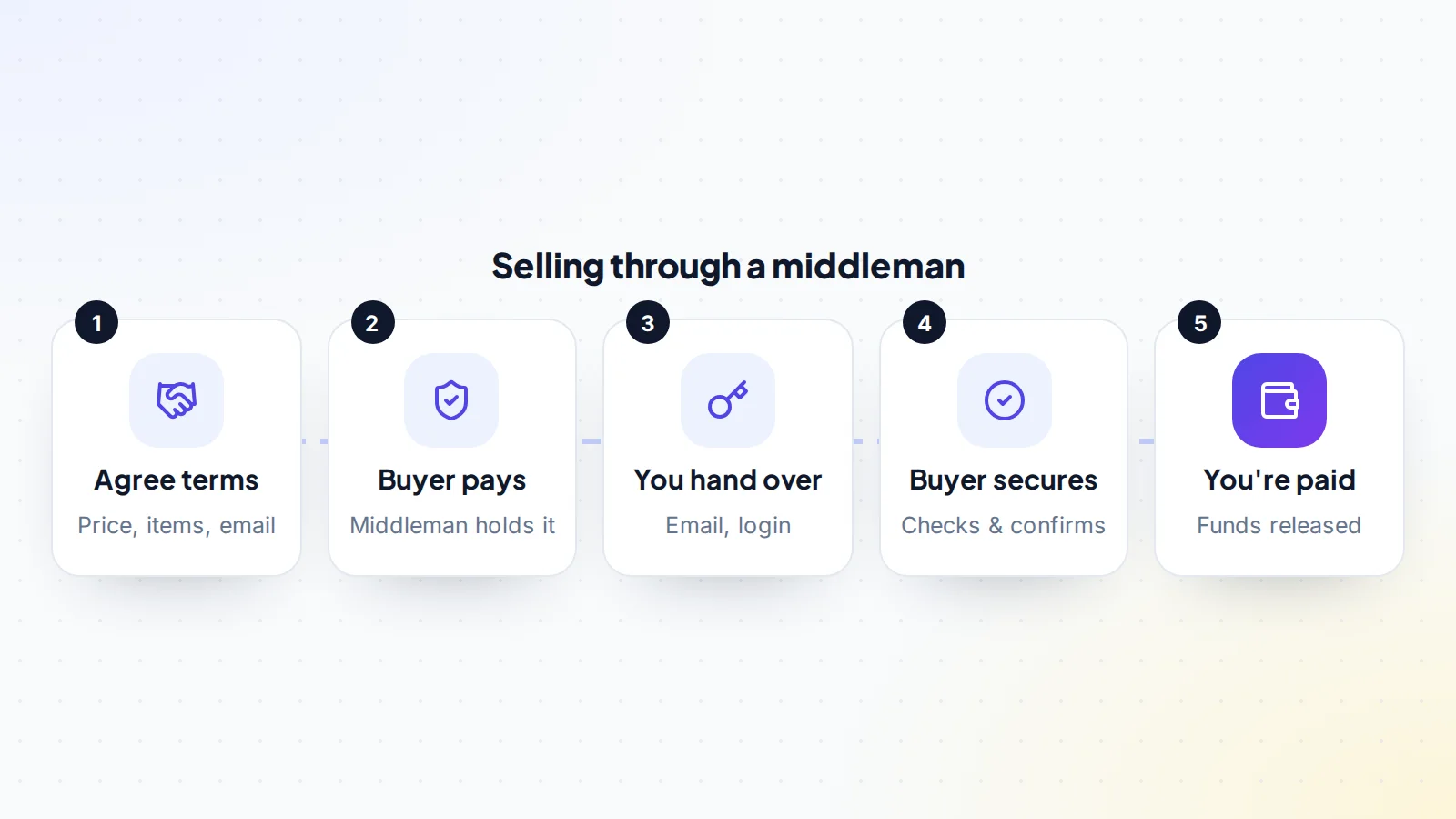
A middleman or escrow protects you as much as the buyer. The buyer pays a trusted third party, you see that the money is held, you hand over the account, the buyer checks and secures it, and the money is released to you. Read how game account middlemen work and how escrow works.
On digiflippers.com, the ways to pay in a deal are: directly to the seller, through escrow. The middleman service fee is not offered, paid by the buyer. The platform never holds the money itself.
Step 6: Hand over the account
Once the payment is held, hand over in this order, ideally while the buyer is online:
- The email. Either give the buyer the original email account (and help them change its password and recovery options) or change the game account’s email to theirs.
- The login. Share the password and any codes needed to sign in, then let the buyer set their own password.
- Two-factor authentication. Help the buyer move 2FA to their own app or phone. Epic Games, for example, supports authenticator apps, email and SMS codes, and Steam offers the Steam Guard Mobile Authenticator.
- Linked platforms. Unlink your consoles or other accounts where the game allows it.
- Your details. Make sure your phone number, payment methods and personal information are gone.
Then let the buyer confirm. Our guide to game account transfers has platform-specific steps.
After the sale
Once the payment is released, the account belongs to the buyer. Don’t log in again, and don’t use any recovery option you may still have: a clean finish protects your reputation and your future sales. Keep the deal record, including the agreed terms and messages, in case questions come up later. If you sell regularly, good reviews from smooth handovers are the most valuable thing you can build.
When to sell
Timing affects price more than many sellers expect. Demand for an account tends to rise when a game is growing, when a new season brings players back, or when items on your account become talked about again. It tends to fall when a game’s player base is shrinking or when a major update changes what’s valuable. If you’re thinking of moving on, it’s usually better to sell while the game is still popular than to wait. And keep the account in good shape while it’s listed: play normally, don’t spend the currency buyers are paying for, and avoid changes that would make your proof out of date.
Mistakes sellers make
- Handing over before the money is held, because the buyer seemed friendly or promised a bonus.
- Using a middleman someone suggested in private chat without checking it’s real.
- Listing without proof, then losing serious buyers to sellers who had it ready.
- Forgetting personal details such as a saved card or a phone number on the account.
- Keeping the email, which makes buyers pay less and creates doubts about the deal.
How to sell a game account: the checklist
- Full item list, rank and stats ready, rarest items first.
- Fresh proof video recorded; live check offered to serious buyers.
- Email ready to hand over; linked platforms noted.
- Saved payment methods and personal details removed.
- Price compared with similar listings and adjusted for rare items and email access.
- Honest listing with everything a buyer needs to decide.
- Conversation kept on the marketplace; no login shared before payment.
- Payment held by a middleman or escrow before the handover.
- Email, login, 2FA and linked platforms handed over; your details removed.
- Deal record kept after the payment is released.
Ready to sell?
List it on digiflippers.com with verified numbers, answer buyers in one place and agree every step in a free Deal Room. No success fee.
Frequently asked questions
How much can I sell my game account for?
It depends on the game, the rarity of your items, your rank, your inventory or library and whether the email is included. Compare similar listings and give extra weight to items that can’t be obtained any more.
What’s the safest way to sell a game account?
Through a marketplace, with a middleman or escrow holding the buyer’s payment before you hand anything over, and with every message kept in one place.
Should I include the email?
Yes, if you can. Accounts sold with full email access are worth more and sell faster, because the buyer knows nobody else can recover the account.
How do I prove the account is mine?
Record a fresh video showing you log in, the inventory, the rank and the account settings, or offer a live screen share where you type a word the buyer chooses.
How long does it take to sell?
Well-priced accounts with clear proof often sell within days or a few weeks. Rare or very expensive accounts can take longer to find the right buyer.
Do I have to answer every buyer?
It’s good practice to reply to genuine questions, even with a short answer. Quick, clear replies build trust and often turn a casual enquiry into a sale. You don’t need to engage with buyers who ignore your terms or push you to skip the middleman.
Can I sell an account I bought from someone else?
It’s possible, but buyers value accounts created by the seller more, and you’ll need to be honest about the history. Make sure you control the email and every recovery option before you list it.
What if a buyer asks for my password to check the account?
Decline politely and offer a live check instead. Share login details only after the payment is held by the middleman or escrow.