Rare Skins, Ranks and Items: What Makes a Game Account Valuable
Retired items, limited events, high ranks and low supply: what really makes a game account valuable, how to prove rarity, and how to price it fairly.

In many games, the most valuable thing on an account isn’t the hours played. It’s a handful of items that few other players own and nobody can get any more: a skin from the first season, a reward from a limited event, a rank badge from a competitive year. Understanding rare skins value helps you see what your account is really worth, whether you’re keeping it, selling it or buying one.
This guide explains where rarity comes from, why some rare items are worth a lot while others are worth little, how to prove rarity to a buyer, and how rare items fit into the price of a whole account. It covers skins, ranks, titles, emotes, weapon finishes and other collectibles across different kinds of games.
For the broader picture of account pricing, read our guide to game account value, and for one popular title see Fortnite account value.
Key takeaways
- Rarity comes from limited supply: retired items, limited events, earned rewards, promo codes, low drop rates and early seasons.
- Rare isn’t the same as valuable. An item is valuable when it is rare and players want it.
- Where a game has a public market, price history is the best evidence of value. Where it doesn’t, comparable accounts are.
- Show rare items live, with their season and source, rather than in screenshots.
- Rare items set the floor and the headline of an account’s price, but access, security and the rest of the inventory decide the final number.
What makes an item rare
An item is rare when few players own it and new copies can’t easily be created. Game studios decide supply, so rarity almost always comes from a design decision: an item was only offered for a short time, only given to a small group, or only drops with a very low chance.
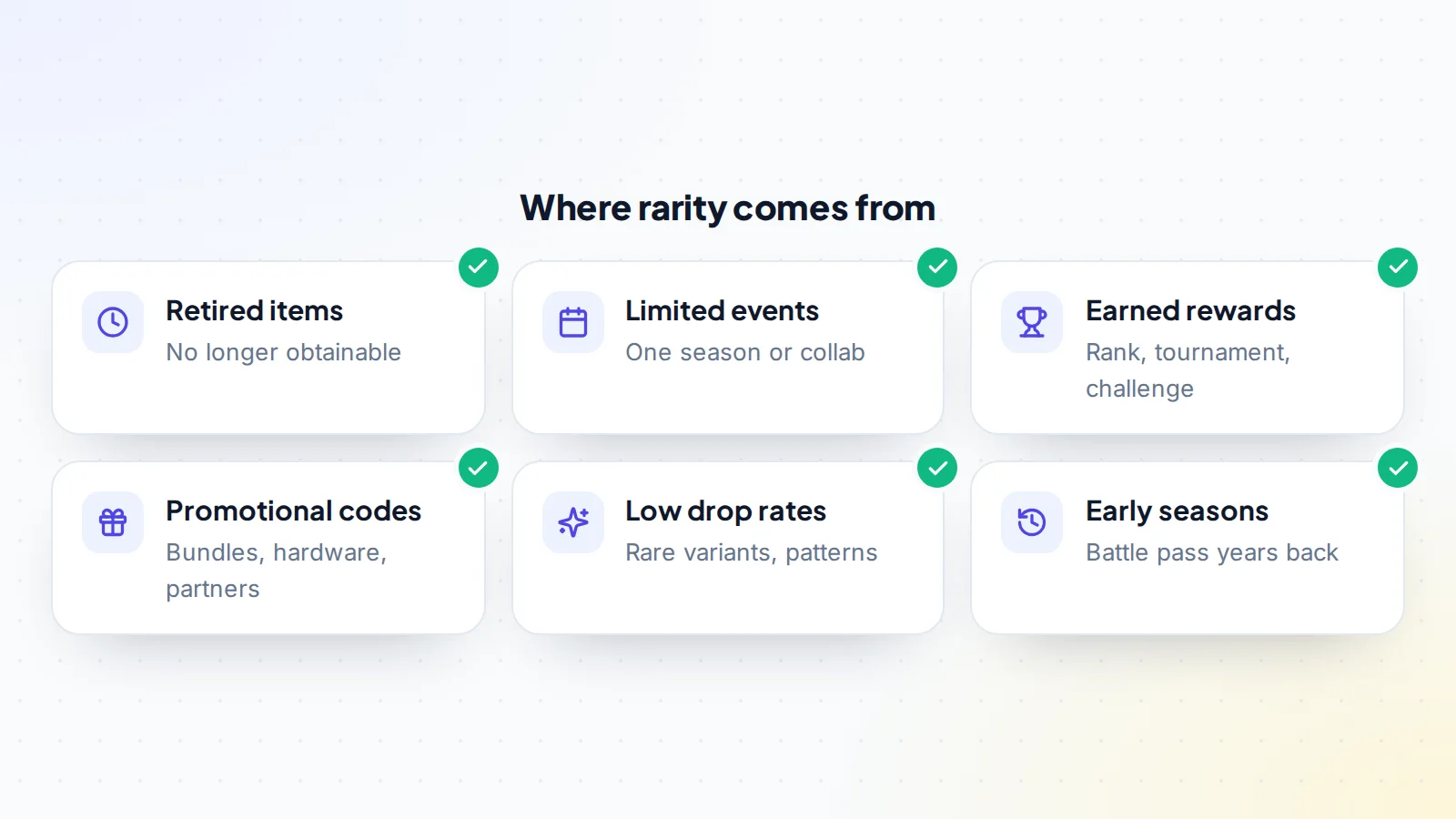
- Retired items were once available and have been permanently removed. Nobody new can get them, so supply only shrinks as accounts go inactive.
- Limited events include one-time seasons, collaborations with films, music artists or brands, and holiday events that never returned.
- Earned rewards are given for achievement: reaching a high rank in a particular season, placing in a tournament or finishing a difficult challenge. They show skill as well as ownership.
- Promotional codes came with hardware, subscriptions, partner bundles or real-world events. Many were available only in certain regions or for a short window.
- Low drop rates make some variants scarce from the start: a rare colourway, a special pattern or a finish that only appears by chance.
- Early seasons matter because the player base was smaller. A battle pass item from a game’s first year can be owned by far fewer players than one from a later, more popular season.
Rare isn’t always valuable
Rarity is only half of the equation. Rare skins value depends just as much on demand: how many players want the item, and how much they care about it. A retired skin that few people liked when it was available may still attract little interest. A popular item that returns to the shop every few months may hold value because so many players want it, even though it isn’t rare.
The items that command the highest prices tend to combine three things:
- Scarcity: few copies exist and no more will be made.
- Desirability: the item looks good, is tied to a popular character or collaboration, or carries prestige in the community.
- Recognition: other players can see it in the game, so owning it means something socially.
When you look at your own inventory, ask all three questions about each item. It will quickly show which items carry the price and which are simply nice extras.
Ranks, titles and badges
In competitive games, rank often matters more than cosmetics. A high current rank tells a buyer the account can play at that level straight away. Season-end rewards (badges, borders, titles or exclusive skins given only to players who reached a certain tier) are a special kind of rare item: they can’t be bought, so they prove a history of high-level play.
Buyers usually separate the two. Current rank is valuable for what the account can do now, and it can rise or fall with every season reset. Past-season rewards are permanent collectibles, and their value tends to grow as that season gets older and the number of active owners falls.
Games with markets and games without
How you measure the value of a rare item depends on whether the game has a public market for it.
Games with a public market
Some games let players trade items through an official marketplace. On Steam, for example, the Steam Community Market shows a chart of each item’s past sale prices, with the dates, prices and number sold. That history is the strongest evidence of value you can get: it shows what real buyers actually paid, not what someone hopes to receive. When an account’s inventory is made up of tradable items, its value is often close to the total of current market prices, adjusted for how easily those items could be sold.
Games without a market
In many games, items are tied to the account and can’t be traded separately. There, the value of rare items only shows up in the price of whole accounts. The best evidence is comparable accounts: recent listings or sales of accounts with similar rare items, rank and inventory. The fewer comparables there are, the more a seller has to explain why an item is special, with evidence of when it was available and how it was obtained.
How to prove rarity
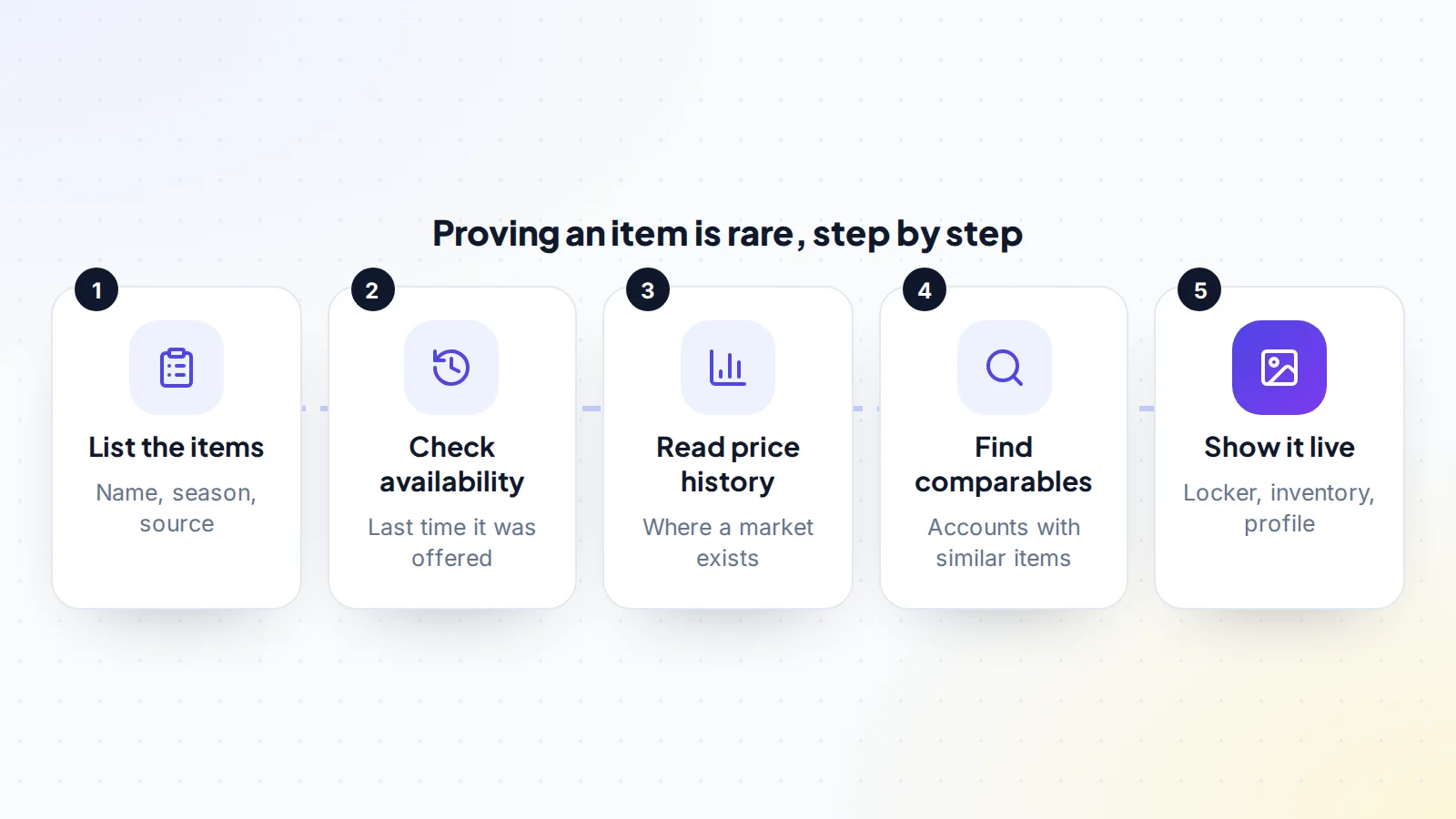
Buyers have seen plenty of exaggerated listings, so they discount claims they can’t check. Good evidence includes:
- A full item list with each rare item’s name, the season or event it came from, and how it was obtained.
- Availability history: when the item was last offered, and whether the studio has said it won’t return. Community-maintained item databases and patch notes help here.
- Price history from an official market, where the game has one.
- Comparable listings of accounts with similar items.
- A live walkthrough of the locker, inventory or profile on a video call, so the buyer sees the items on the actual account.
Screenshots are easy to edit and easy to copy from other accounts. A live view, where the buyer can ask you to open a specific screen, is far more convincing.
How rare items fit into an account’s price
Rare items usually set the headline of an account’s price. They are what attracts a buyer, and often what the listing title highlights. But the final number also depends on:
- The rest of the inventory: common skins, in-game currency, unlocked characters and owned games add value, though usually less per item.
- Access: whether the original email can be handed over, whether the account is linked to consoles or other platforms, and whether the buyer can secure it fully after the sale.
- Security: two-factor authentication turned on and working, with a clean history. Epic Games and Steam both offer authenticator-based protection, which buyers expect to move to their own devices after a sale.
- Region and platform: some items and accounts are tied to a region, server or platform, which narrows the buyer pool.
A useful way to think about it: rare items decide how high the price can go, and access and security decide how much of that potential a buyer will actually pay.
A worked example
The numbers below are made up to show the method, not market data.
Jordan has an account in a popular cosmetic-driven game, played since its first year. The locker holds 140 skins. Three of them came from the first two seasons and have not returned since; one came from a limited collaboration event; one is a reward for reaching the top tier in an early competitive season. The rest are common items that still appear in the shop from time to time.
Jordan follows five steps:
- List and source every rare item: name, season, how it was obtained, and when it was last available.
- Check demand: two of the early-season skins are well known and often requested in listings; the third is obscure.
- Find comparables: six recent listings of accounts with at least one of the same well-known skins, noting their other items and access details.
- Adjust for access: Jordan can hand over the original email and has two-factor authentication on, which puts the account at the top end of the comparables.
- Set a range: an asking price, the lowest acceptable offer, and a short note explaining the evidence for each rare item.
The obscure early-season skin turns out to add little to the price, despite being the rarest item on the account. The collaboration skin and the competitive reward, which players recognise instantly, carry most of it. That’s rare skins value in practice: scarcity opens the door, demand decides the price.
How rarity changes over time
Rarity isn’t fixed. A studio can bring an item back, release a near-identical version, or start a new event that makes older rewards feel less special. It can also work the other way: when a game’s player base grows, items from its early days become more sought after, because there are many more players who’d like to own them and no new supply.
For that reason, value claims should always be dated. “Not offered since season two” is a fact that stays true. “Will never come back” is a prediction, unless the studio has said so publicly.
Protecting rare items while you own them
- Turn on two-factor authentication and keep your recovery details current. Both Epic Games and Steam explain how to set up authenticator-based protection on their support pages.
- Use a unique password for the account and its email, and keep the email account secure too.
- Keep records of when and how you got each rare item: receipts, event screenshots with dates, and code redemption emails.
- Be cautious with trade offers and links from people you don’t know, especially ones that ask you to sign in on another page.
If you decide to sell
Lead your listing with the rare items, shown with their season and source, then list everything else and describe exactly what access is included. Share evidence live, never your login, and only hand over the account once the payment is held by escrow or a trusted middleman. Our guide on how to sell a game account walks through the whole process, and securing a game account covers the handover of email and two-factor authentication. You can list your account on digiflippers.com with 0% success fee up to $10,000, then 5% (max $5,000).
If you’re buying
Ask for the item list with seasons and sources, check them against item databases and price history, and ask for a live walkthrough. Compare the asking price with similar accounts, and weigh access as heavily as the items: an account full of rare skins is worth much less if you can’t fully secure it. Pay through escrow or a trusted middleman, and be wary of anyone who suggests an unfamiliar escrow site; read how fake escrow scams work.
Common mistakes
- Pricing on rarity alone. An obscure item can be rare and still add little. Check demand.
- Counting every item at full value. Common items add something, but rarely what they cost in the shop.
- Ignoring access. Buyers pay far less for an account they can’t fully secure.
- Undated claims. Say when an item was last available rather than promising it will never return.
- Relying on screenshots. Live evidence earns a better price.
Rare skins value: the checklist
- Every rare item listed with name, season, source and last availability.
- Each rare item checked for scarcity, desirability and recognition.
- Price history gathered where the game has a public market.
- Comparable accounts found and noted.
- Access and security details confirmed: email, linked platforms, two-factor authentication.
- Price range set: asking price, lowest offer, evidence note.
- Items shown live, never through a shared login.
- Payment held by escrow or a middleman before any handover.
Ready to find your next asset?
Browse listings with verified numbers, ask sellers your questions before you offer, and agree every step in a free Deal Room.
Frequently asked questions
What makes a skin rare?
Limited supply. Most rare skins were only available for a short time, given to a small group (for example through an event, a tournament or a promotion), or drop with a very low chance. If nobody can obtain new copies, the supply only shrinks over time.
Are retired skins always valuable?
No. A retired skin is rare, but its value depends on how many players want it. Well-known, good-looking or prestigious items hold value; obscure ones may add little.
How can I check what a rare item is worth?
If the game has an official market, read the item’s price history. Otherwise, look at recent listings of accounts with similar items, rank and access, and compare.
Do ranks count as rare items?
Past-season rewards for reaching a high rank are collectibles that can’t be bought, so they work like rare items. Current rank is valuable too, but it can change every season.
Should I show rare items in screenshots?
Screenshots are a start, but buyers trust a live walkthrough far more, because they can ask to see specific screens on the actual account.
Can an item lose its rarity?
Yes. A studio can bring an item back or release something very similar. That’s why it’s best to state facts, such as when an item was last available, rather than predictions.