Selling In-Game Items vs Whole Accounts
Compare selling in-game items with selling a whole game account: official trading and markets, pricing items, account value, and safe ways to complete each kind of deal.
If you’ve built up a great collection in a game, there are two ways to turn it into value: sell the items one by one, or sell the whole account with everything on it. Both can work well, and the right choice depends on the game, what you own and whether you want to keep playing. This guide compares selling in-game items with selling a whole account, explains how official trading systems and markets work, how items and accounts are priced, and how to complete each kind of deal safely.
For the account route in depth, see our guide to selling a game account. This one focuses on the choice between the two.
Key takeaways
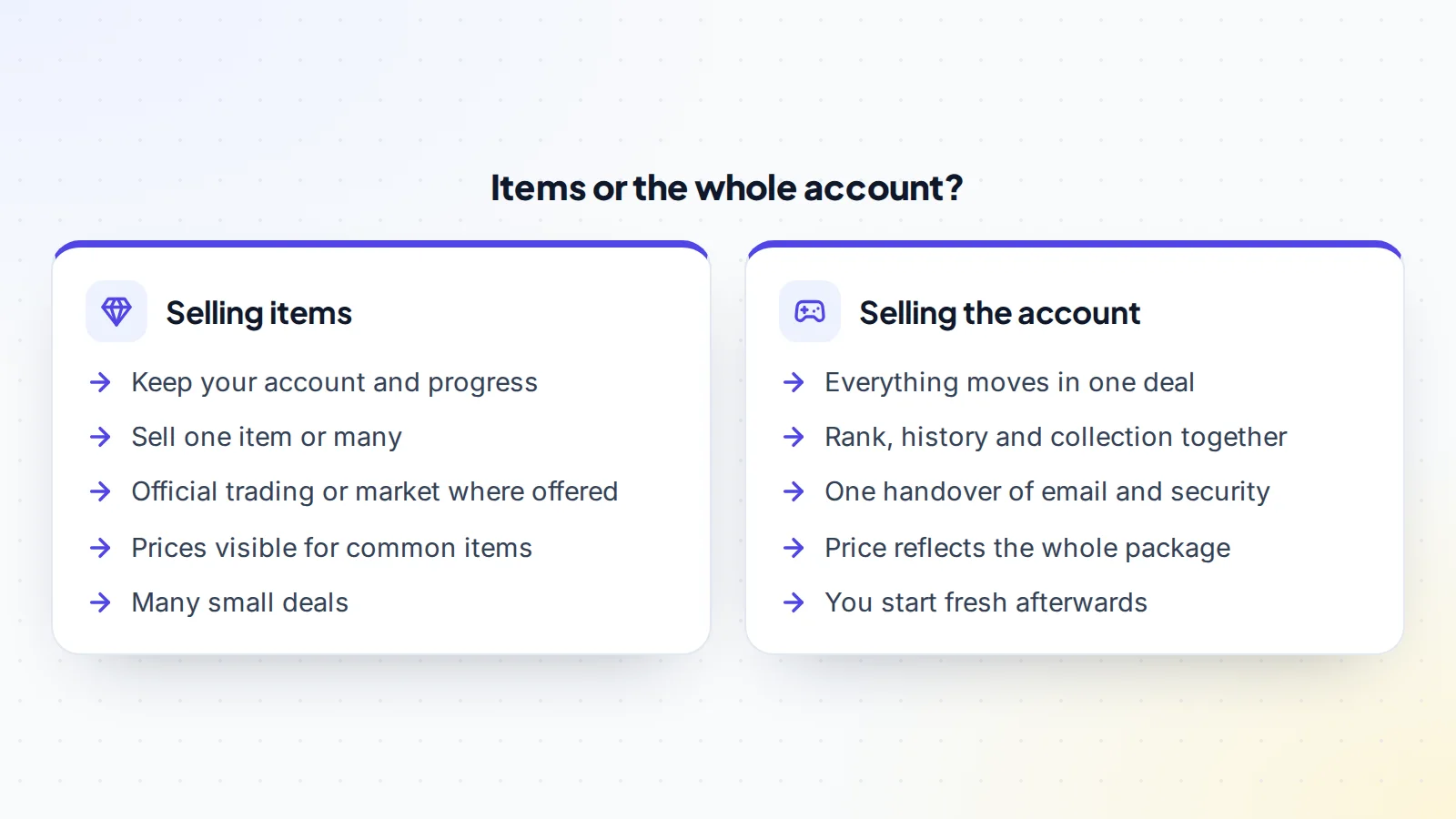
- Selling items lets you keep your account; selling the account moves everything in one deal.
- Where a game has an official trading system or market, it’s the safest way to move items.
- Item prices follow rarity, demand, condition and recent sales.
- Accounts are priced on the whole package: collection, rank, history and a clean handover.
- Whatever you sell, agree terms first and secure the payment before anything moves.
Items or the whole account?
Think about three questions. Do you want to keep playing? If yes, selling items lets you keep your account, progress and friends list. Is most of the value in a few items or in the whole collection? A handful of rare items may sell well individually, while a large collection with rank and history is often worth more as a package. And how much time do you have? Selling items can mean many small deals; selling an account is one larger deal with one handover.
Official trading systems and markets
Many games and platforms have their own ways to move items between players. Where they exist, they’re the safest route, because the platform records the transfer and applies its own protections.
Steam. Valve’s Steam platform supports trading items between accounts and selling eligible items on the Steam Community Market, where each item’s page shows a price history chart with recent sale prices and volumes. Steam also uses the Steam Guard Mobile Authenticator to protect trades; accounts without it, or that added it recently, may see trades and listings held for a period. Our guide to Steam inventory value explains how prices work there.
Roblox. Roblox’s help centre explains that players can trade Limited items, collectible avatar items that went off sale, through its official trading system. Both players need an active Premium or Plus subscription and trading turned on in their settings. Robux can be added to a trade within limits, and Roblox takes a fee on Robux included in trades. Roblox also explains that it can’t return items lost in deals made outside its official system, which is a good reason to use the official tools.
Other games have their own systems, from auction houses to gifting. Read the game’s own help pages to see how items move and what protections apply. Some systems have limits, such as how often you can trade, how much currency can be included or how long a new item must be held, so check those before you promise a buyer a delivery date.
How it differs by kind of game
- Shooters and skin-based games: cosmetics such as weapon skins, knives and characters are often the main value. Where official trading exists, selling in-game items one at a time can work well for rare pieces.
- Battle royale and live-service games: many cosmetics are tied to the account and can’t be traded, so the account itself carries the value.
- Collectible and avatar platforms: limited items with official trading, such as Roblox Limiteds, have active markets of their own.
- MMOs and RPGs: characters, progression and gear often matter as much as cosmetics, which usually points to selling the account.
- Mobile games: progress is often linked to a platform login, so check how the account is connected before you plan either route.
Read each game’s help pages to see what can be traded and how. That one check often decides the choice for you.
How in-game items are priced
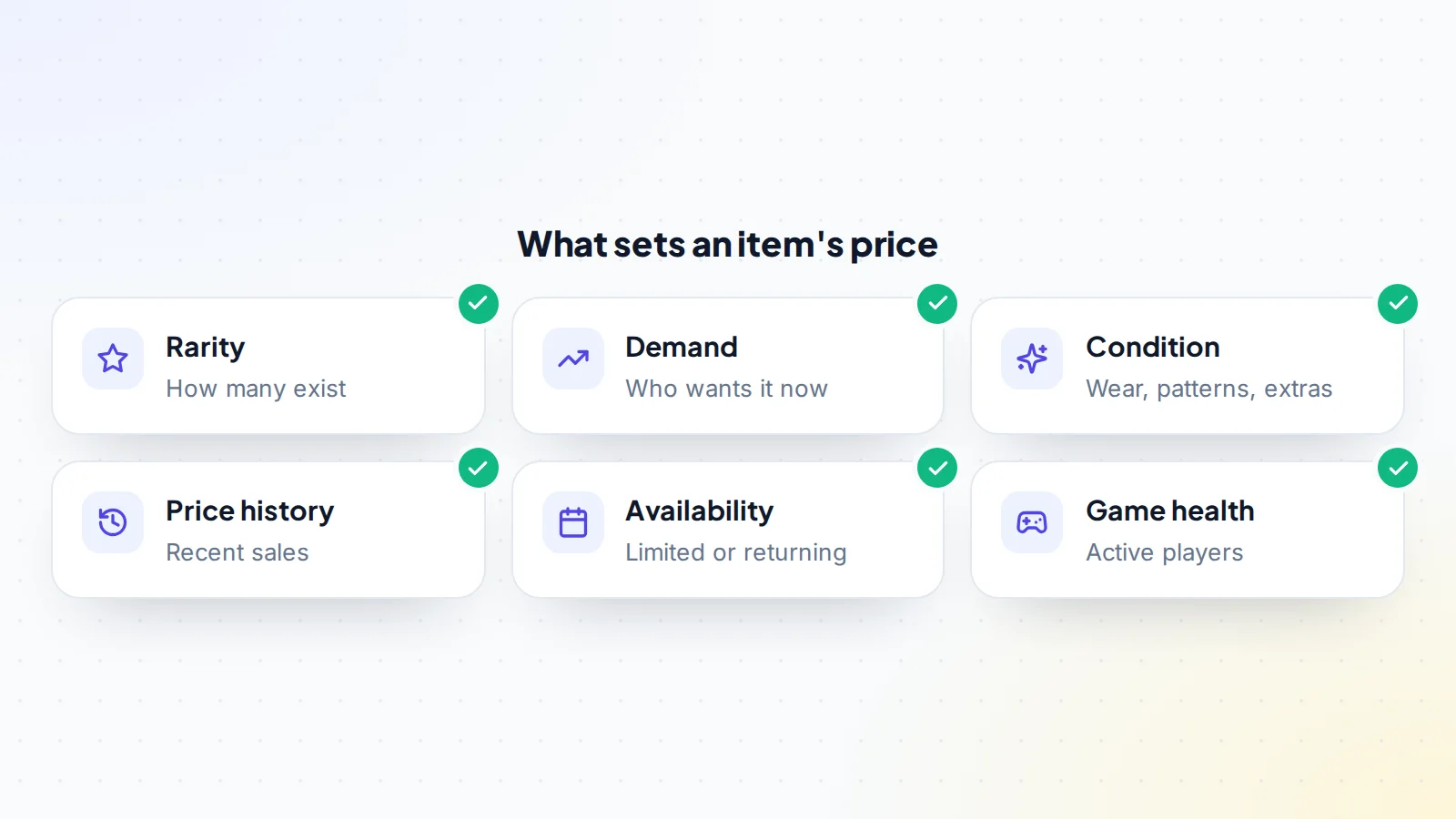
Item prices behave like any collectible market:
- Rarity: fewer copies usually means a higher price.
- Demand: popular skins, characters or weapons sell faster and for more.
- Condition and extras: some games have wear levels, patterns, stickers or other details that change value.
- Price history: recent sales of the same item are the best guide. Official markets often show them.
- Availability: items that may come back in a store or event can lose value; truly limited items tend to hold it.
- Game health: items in games with many active players are easier to sell.
For items without a public price history, look at recent completed sales in reputable marketplaces, not asking prices. If there are only a few sales to go on, price a little below the most recent one to attract buyers, rather than holding out for a record.
How whole accounts are priced
An account sells as a package. Its price reflects the collection, but also things items alone can’t carry: rank and season history, progression, account age, region, linked platforms and, above all, a clean handover with the original email included. Our guide to ranked account value explains how rank and history add to the price, and for Roblox specifically, see Roblox account value.
A simple test: add up what your most valuable items would sell for individually, then compare it with what similar accounts sell for. If the account price is close to or higher than the sum of its best items, selling the account is often simpler. If a few items are worth far more than the rest, selling those items may make more sense.
Selling items well
- Use the official system wherever the game offers one, so the platform records and protects the transfer.
- Price from recent sales, not from the highest asking price you can find.
- List clearly: the exact item, its condition or variant, and screenshots from your inventory.
- Bundle slower items with popular ones, or offer collections, to move them faster.
- Keep your account secure with two-factor authentication while you trade.
Selling the whole account well
- Make a full inventory: the collection, rank, progression, region and linked platforms.
- Include the original email if you can; buyers pay more for a complete handover.
- Show everything live on a screen-share for serious buyers.
- Plan the handover order: email, password, two-factor, linked accounts, then sessions. Our guide to securing a game account describes it from the buyer’s side.
Writing a good item listing
When selling in-game items outside an automated market, a clear listing makes all the difference. Name the exact item and variant, show it in your inventory with a date visible, state its condition or extras, and give the recent sale prices you used to set your price. Say how the transfer will happen: through the game’s own trade system, or as part of an account. Buyers move faster when they can see you know exactly what you’re selling.
Common mistakes to avoid
- Pricing from the highest asking price rather than real sales.
- Sending items first and waiting for payment “after”.
- Moving the conversation to private apps where there’s no record.
- Selling the best items one by one, then struggling to sell the rest of the account.
- Turning off two-factor authentication to make trading quicker.
Keep good records
Keep a simple record of each sale: what you sold, the price, the date, the buyer’s profile and the payment method. Records help if a question comes up later, and they’re useful for your own taxes; ask a local adviser how income from selling digital items is treated where you live.
Doing the deal safely
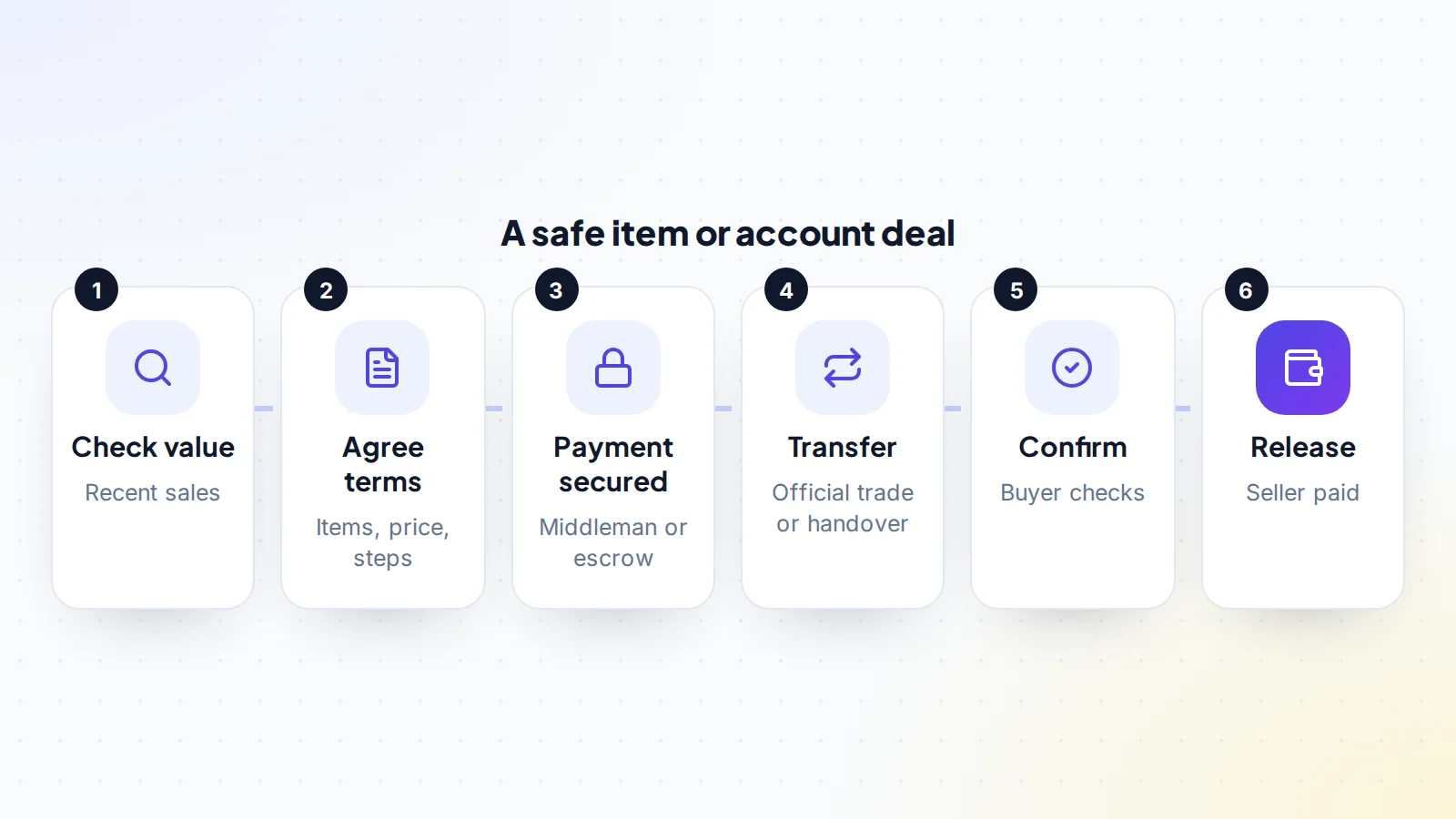
Whatever you sell, the same principles protect you. Agree the items or account, the price and the steps in writing. Secure the payment before anything moves: for account sales and larger item deals, a middleman or escrow holds the money until the buyer confirms. Keep messages on the marketplace. And never send first on trust, or give someone your login “to check” before payment is secured. Our guide to the game account middleman explains how a neutral party handles the exchange.
On digiflippers.com, the ways to pay in a deal are: directly to the seller, through escrow, and the platform never holds the money itself. You can list your account or items and use the free valuation tool to check a price range.
Timing a sale
Item and account prices move with the game. Demand often rises around new seasons, major updates, esports events or when an item’s collection is retired, and it can fall when similar items are added to a store. If you’re not in a hurry, watch recent sales for a few weeks to see the trend before you list. For accounts, sell while the game is active and your rank is current; long breaks can mean decay or reset ranks, which lowers the price.
Don’t try to time the market perfectly. A fair price based on recent sales, with a safe payment, is a better result than waiting months for a peak that may not come.
What buyers look for
Understanding buyers helps you choose. Collectors want specific rare items and will pay for condition and rarity. Players who want to start strong often prefer a whole account with progress, rank and a broad collection, especially in games where cosmetics can’t be traded. Knowing which group is most active in your game tells you which route will sell faster.
A worked example
The details below are made up to show the method.
Sam has played a shooter for five years and owns a large skin collection, including two rare knives. Sam wants to keep playing a different game with friends but is finished with this one. The two knives’ recent sales on the official market add up to a large sum, and the rest of the collection is worth far less individually. Similar accounts with comparable collections and rank sell for a little more than the knives alone.
Sam decides to sell the whole account, since the total is higher and it’s one deal instead of dozens. Sam lists the account with a full inventory, rank history and the original email, shows it live to a buyer, agrees a price and uses a middleman. The handover is done on a call, the buyer confirms, and the middleman releases the payment.
Selling in-game items: the checklist
- Decided: keep playing (sell items) or move on (sell the account).
- Most valuable items priced from recent sales.
- Comparable account prices checked.
- Official trading system or market used for items where available.
- Full inventory prepared for an account sale.
- Terms agreed in writing: items or account, price, steps.
- Payment secured with a middleman or escrow before anything moves.
- Two-factor authentication on throughout.
- Handover done in order, with the buyer confirming before release.
Ready to sell?
List it on digiflippers.com with verified numbers, answer buyers in one place and agree every step in a free Deal Room. 0% success fee up to $10,000, then 5% (max $5,000).
Frequently asked questions
Is it better to sell items or the whole account?
It depends on whether you’ll keep playing and where the value is. A few very valuable items may sell best individually; a large collection with rank and history is often worth more as a whole account.
What’s the safest way to move items?
The game’s own trading system or market, where one exists, because the platform records and protects the transfer.
How do I price an in-game item?
Look at recent completed sales of the same item, adjusted for condition and demand. Official markets often show price histories.
Do I need a subscription to trade on Roblox?
Roblox’s help centre says both players need an active Premium or Plus subscription and trading enabled in their settings.
How do I get paid safely for an account?
Use a middleman or escrow, so the payment is held until the buyer confirms the account is fully theirs.
Should I give a buyer my login to check items?
No. Show items live on a screen-share instead, and only hand over login details once the payment is secured.
Can I sell some items and then sell the account?
You can, but the account’s price will reflect what’s left. If you plan to sell both, decide which items carry the most value on their own before you start.