How a Middleman Makes Game Account Deals Safe
What a middleman does in a game account sale, how the process works step by step, how to choose a trustworthy one and how to spot fake middlemen.
Buying or selling a game account comes down to one question: who goes first? If the buyer pays first, they’re trusting the seller to hand over the account. If the seller hands over first, they’re trusting the buyer to pay. A game account middleman solves that by standing in the middle: the buyer pays the middleman, the seller hands over the account, the buyer confirms, and only then is the seller paid. This guide explains how it works, what a good middleman does, and how to choose one you can trust.
For the full selling process, see our guide to selling a game account. For the buyer’s side, our guide to securing a game account after buying covers the handover.
Key takeaways
- A middleman holds the buyer’s payment until the account is handed over and confirmed.
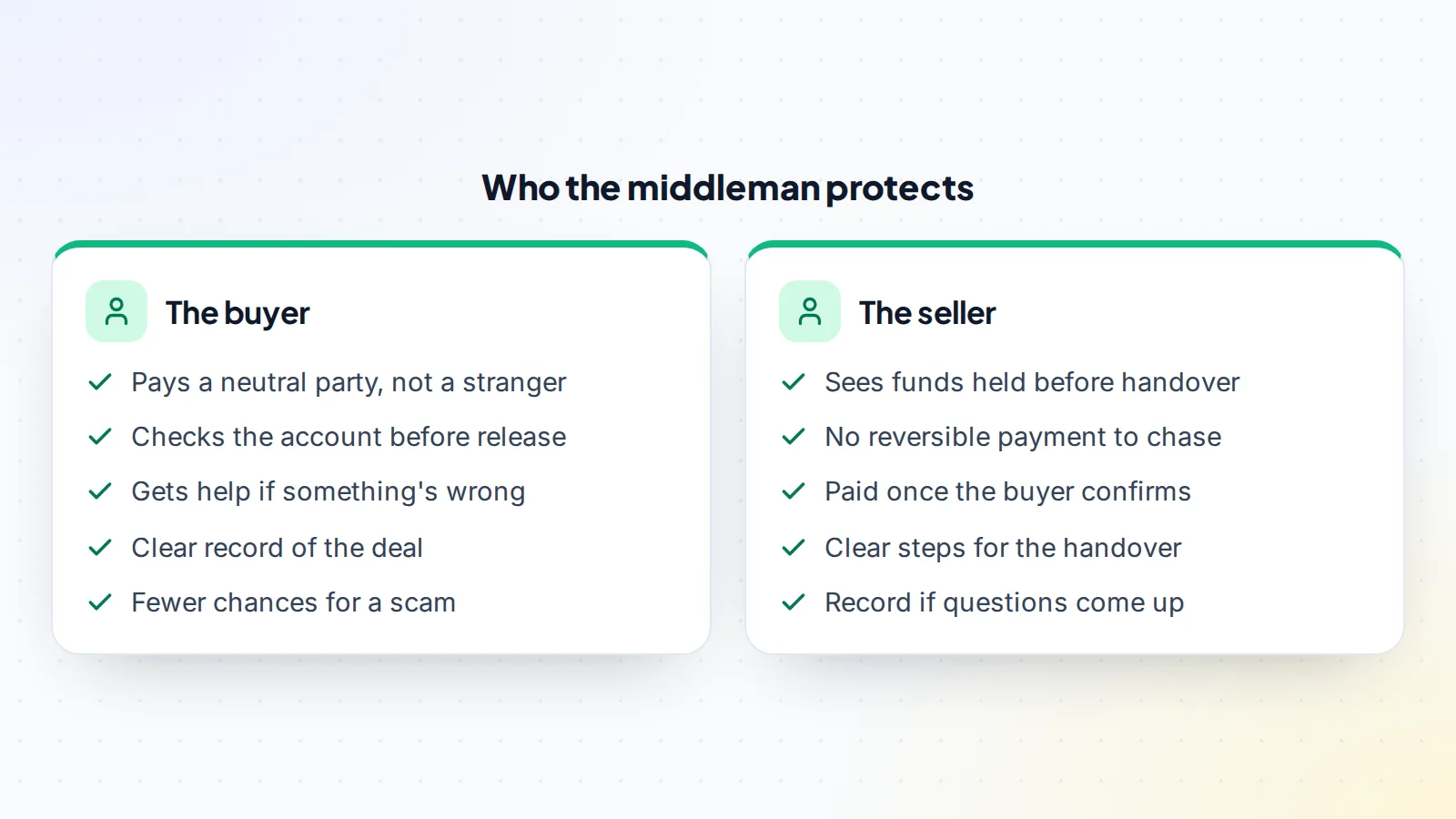
- Both sides are protected: the buyer doesn’t pay a stranger, and the seller sees funds held first.
- The handover follows a set order: email, password, two-factor, then linked accounts.
- Choose a middleman yourself, through the marketplace, never one suggested only by the other side.
- Keep all messages on the platform so there’s a record.
What a middleman does
A middleman is a neutral third party who manages the exchange. In a typical game account deal, they:
- Confirm the terms both sides agreed: the account, what’s included, the price and the steps.
- Receive the buyer’s payment and tell the seller once it’s confirmed.
- Guide the handover, so the email, password, two-factor and linked accounts move in the right order.
- Give the buyer time to check they have full control.
- Release the payment to the seller once the buyer confirms.
- Help resolve problems if the account isn’t as described.
The idea is the same as escrow, used for websites and domains, adapted to the speed and details of game accounts. Our guide to middleman services covers the wider uses.
Why it’s worth using one
Account deals often happen between people who’ve never met, in different countries, over chat. Direct payment leaves one side fully exposed. Card and payment-app transfers can be disputed after the handover, which worries sellers; our guide to chargeback risk explains why. And the FTC lists insistence on payment by wire, gift card or crypto among the classic signs of a scam, which worries buyers. A middleman removes most of those risks by making sure neither side carries the full risk at any point.
A middleman deal, step by step
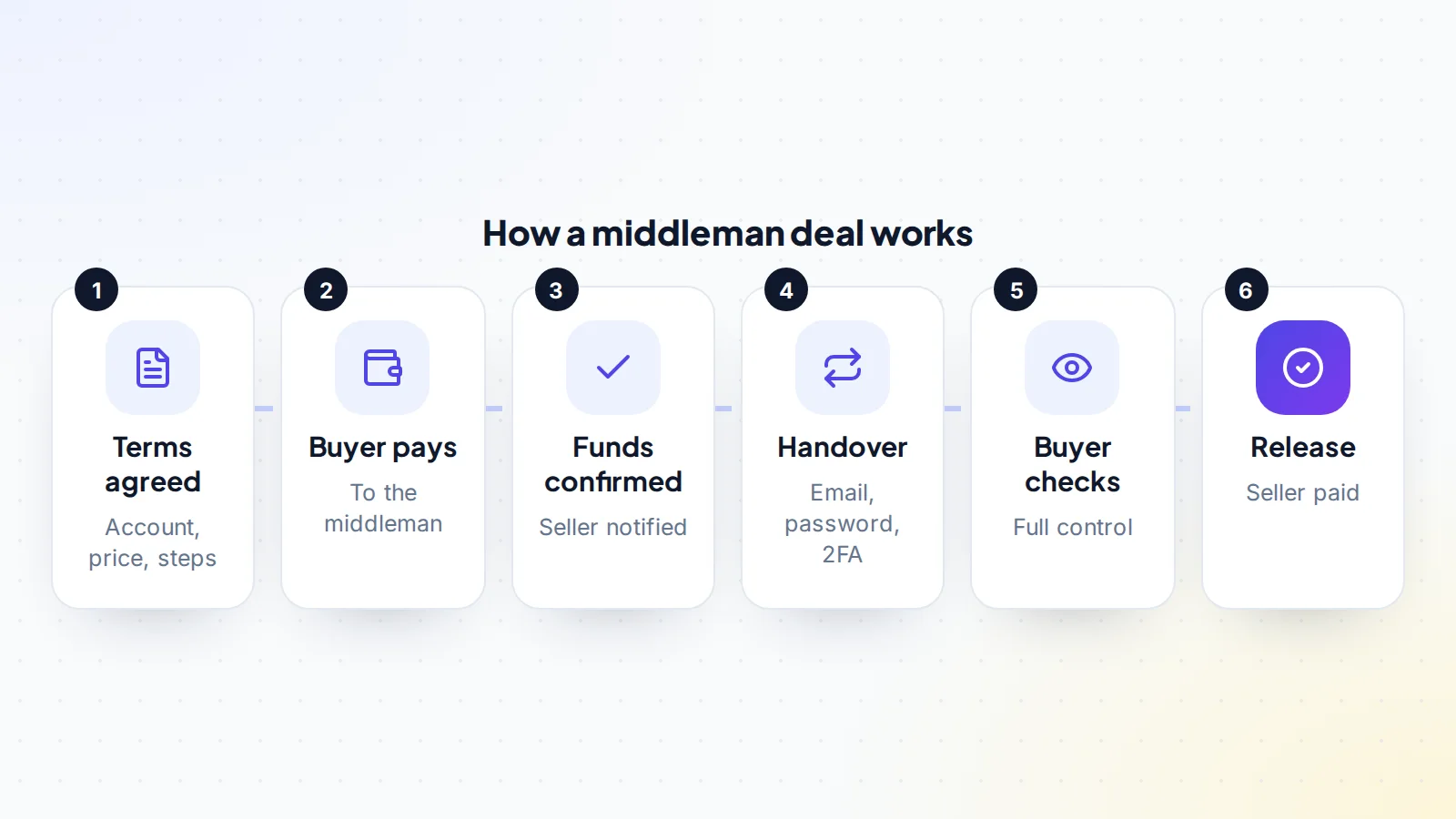
- Agree the terms. List the account, its key details such as rank, skins or level, what’s included, the price, who pays the middleman’s fee and how long the buyer has to check.
- The buyer pays the middleman. Using the payment method the middleman accepts.
- The middleman confirms the funds to the seller, through the platform.
- The handover. The seller changes the account’s email to the buyer’s, then the buyer sets a new password and moves two-factor to their own device. Linked platforms and recovery details follow.
- The buyer checks. They sign in, confirm the account matches the listing, and check that every recovery route is theirs.
- Release. The buyer confirms, and the middleman pays the seller.
Our guide to handing over passwords and 2FA explains the handover order in detail.
Middleman or escrow?
Both put a neutral party between buyer and seller, but they suit different deals. Licensed escrow services are built for larger transactions such as websites and domains, with formal rules, longer inspection periods and regulated handling of funds. Game account middlemen are built for speed and for checking a live handover: they understand how accounts, emails and two-factor work in each game and can help when a step goes wrong. For high-value accounts, some buyers and sellers use both: escrow holds the money, and a middleman guides and checks the handover. Our guide to escrow vs direct payment compares the options.
What a good handover looks like
The handover is where most problems happen, and where a good middleman earns their fee. A clean handover:
- Starts with the account’s email, because it controls password resets and recovery.
- Moves two-factor to the buyer’s own device or app, with new backup codes.
- Removes the seller’s phone number, linked platforms and saved payment methods.
- Signs out every other session and device.
- Ends with the buyer signing in alone and checking that the account matches the listing.
Some games limit how often details can change, so a good middleman checks for recent changes before starting and plans the order accordingly.
Choosing a middleman you can trust
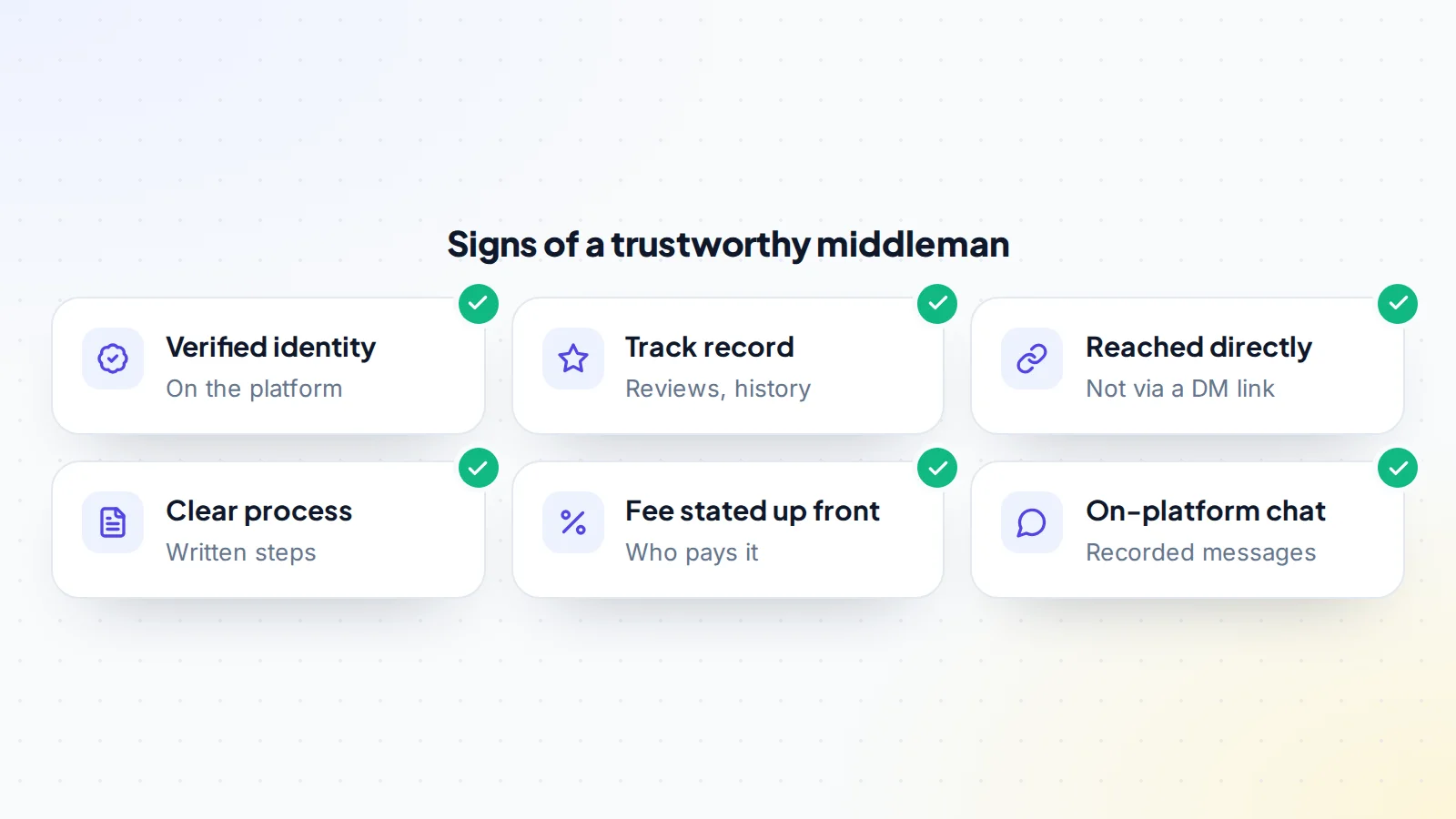
The middleman holds the money, so trust matters most here. Look for:
- A verified identity and a profile on the marketplace you’re using.
- A track record: reviews from completed deals and a history you can see.
- A clear, written process covering payment, handover, checking and release.
- A fee stated up front, and who pays it.
- Communication on the platform, where messages are recorded.
On digiflippers.com, the ways to pay in a deal are: directly to the seller, through escrow, and the platform never holds the money itself. The marketplace’s own middleman service fee: not offered. When the middleman service is used, its fee is paid by the buyer, unless you agree otherwise in the deal.
Spotting a fake middleman
A common scam is the fake middleman: someone who poses as a neutral party, or is suggested by the other side, and takes the payment or the account. Warning signs:
- The other side insists on a specific middleman you can’t verify independently.
- You’re sent a link to a “middleman service” in a private message.
- The “middleman” has a new account, no history or a name very close to a known one.
- You’re asked to move the conversation off the marketplace.
- You’re told funds are held, but can’t see that for yourself.
Choose the middleman yourself, through the marketplace’s own options. The California DFPI gives similar advice for online escrow: check the provider yourself and don’t rely on a link from the other party. Our guide to off-platform payment scams covers the pattern.
When something goes wrong
The value of a middleman shows most when a deal hits a snag. If the account isn’t as described, a code goes to an old phone, or a platform flags the change, the payment stays held while the issue is sorted out. The middleman helps both sides with the platform’s recovery steps, agrees extra time if needed, and, if the deal can’t be completed as agreed, returns the buyer’s payment according to the terms. Without a middleman, the same problem can leave one side out of pocket with no one to turn to.
Questions to ask a middleman
- How do you hold the payment, and how do you confirm it to the seller?
- Which payment methods do you accept?
- What’s your fee, and when is it charged?
- How long does the buyer have to check the account?
- What happens if the handover can’t be completed?
- Can I see reviews from completed deals?
Clear, written answers are a good sign. Vague answers or pressure to move fast are not.
Tips for sellers
- Never hand over the account until the middleman confirms the funds are held.
- Confirm through the platform, not a screenshot or private message.
- Prepare the handover: know which email is linked and how two-factor is set up.
- List everything that comes with the account, so there’s no dispute later.
Tips for buyers
- Check the listing details live on a screen-share before paying.
- Pay only the middleman, using the method they set out on the platform.
- During the handover, change the email first, then the password and two-factor.
- Confirm only when every recovery route is yours.
Write the deal down first
A middleman can only enforce what was agreed, so the terms matter. Before anyone pays, write down in the marketplace’s messages: the game and platform, the account’s key details such as rank, level, skins or characters, whether the original email is included, any linked accounts, the price, who pays the middleman’s fee and how long the buyer has to check. Screenshots of the collection, taken on the day, help both sides. If something is later disputed, this record is what the middleman will look at.
Agreeing a fair price
Middlemen don’t usually set prices, but a fair price makes the whole deal smoother. Sellers should base asking prices on recent sales of similar accounts; buyers should check the account live before agreeing. Our guides to Roblox account value and ranked account value show how different games’ accounts are priced, and the valuation tool on digiflippers.com gives a quick range.
Timing and time zones
Account deals often cross time zones, and a handover needs both sides online at once. Agree a time for the handover call when you agree the terms, and allow extra time for codes, game platform checks and the buyer’s review. Avoid starting a handover late at night or just before a trip, when one side may not be able to respond if something needs attention. A middleman who can coordinate across time zones is worth a lot here, because the payment stays safe even if the handover has to pause until the next day.
Keep your own records
Even with a middleman, keep your own copy of the agreed terms, payment receipts and screenshots of the account before and after the handover. They’re useful if you ever need to show what was agreed, and they make it easy to leave an accurate review.
After the deal
Once the payment is released, both sides should keep the deal’s messages and the middleman’s confirmation. Buyers should finish securing the account: check recovery details again after a day or two, review linked platforms and remove any old payment methods. Sellers should remove the account from their own devices and password manager. Leaving a review for the middleman and the other party helps the next buyer and seller choose with confidence.
A worked example
The details below are made up to show the method.
Theo is selling a shooter account with a large skin collection to a buyer in another country. They agree the price and use a middleman offered through the marketplace. The buyer pays the middleman, who confirms the funds to Theo on the platform. On a call, Theo changes the account’s email to the buyer’s; the buyer sets a new password, moves two-factor to their phone and signs out other sessions. The buyer checks the collection and confirms. The middleman releases the payment to Theo the same day.
Game account middleman: the checklist
- Terms written down: account details, inclusions, price, fee, checking time.
- Middleman chosen through the marketplace, with a verified profile and history.
- Fee and who pays it agreed.
- Buyer pays the middleman only.
- Seller sees funds confirmed on the platform before handing over.
- Handover in order: email, password, two-factor, linked accounts.
- Buyer checks full control before confirming.
- All messages kept on the platform.
Ready to find your next asset?
Browse listings with verified numbers, ask sellers your questions before you offer, and agree every step in a free Deal Room.
Frequently asked questions
What does a game account middleman do?
Holds the buyer’s payment, guides the handover, gives the buyer time to check the account and then releases the payment to the seller.
Who pays the middleman’s fee?
Whoever the buyer and seller agree. On digiflippers.com, when the middleman service is used, its fee is paid by the buyer, unless you agree otherwise in the deal.
How do I know a middleman is real?
Choose one through the marketplace, check their verified profile and history, and never use one suggested only through a private message.
When should the seller hand over the account?
Only after the middleman confirms, through the platform, that the buyer’s payment is held.
What if the account isn’t as described?
Tell the middleman before confirming. The payment stays held while the issue is looked at, which is the main benefit of using one.
Can a middleman be used for items as well as accounts?
Yes. The same process works for valuable items and collections; see our guide to selling in-game items.
How long does a middleman deal take?
Often the same day once payment arrives, depending on the payment method and the game’s rules for changing account details. Plan the handover for a time when both sides can be online.