What a Middleman Does in a Digital Asset Deal
How middlemen protect buyers and sellers of accounts, domains and websites, the difference from escrow, the step-by-step process, and how to pick a real one.
In many digital asset deals, especially for social media accounts, game accounts, communities and domains, buyers and sellers don’t know each other and the handover happens in minutes through logins and settings. A middleman service puts a trusted third person between them, so the payment and the handover happen in the right order and neither side has to take a blind risk.
This guide explains what a middleman does, the two main ways middlemen work, a step-by-step handover, how middlemen compare with escrow, what they cost, how to tell a real middleman from a fake one, and when to use one.
For the bigger picture, read escrow vs direct payment.
Key takeaways
- A middleman is a trusted third party who makes sure payment and handover happen in the right order.
- Some middlemen hold the payment; others oversee the handover while the money moves directly or through escrow.
- Middlemen are especially useful for accounts and assets where the handover itself needs checking.
- Protection depends entirely on the middleman being genuine and trustworthy.
- Never accept a middleman suggested by the other side through a private message. Use one from the marketplace or with a verifiable record.
What a middleman does
A middleman’s job is to remove the “who goes first” problem. In a direct deal, either the buyer pays and hopes the seller delivers, or the seller hands over and hopes the buyer pays. A middleman sits in the middle and checks both sides:
- That the buyer’s payment is real and secured.
- That the seller can actually hand over what’s being sold.
- That the handover is complete: logins, email, two-factor authentication and ownership details all moved to the buyer.
- That both sides confirm before the deal is closed.
The value is in the checking. Escrow services are excellent at holding money; a middleman also looks at the asset itself, which is why middlemen are popular for accounts and communities, where the handover is a series of settings that are easy to get wrong.
Two ways a middleman can work
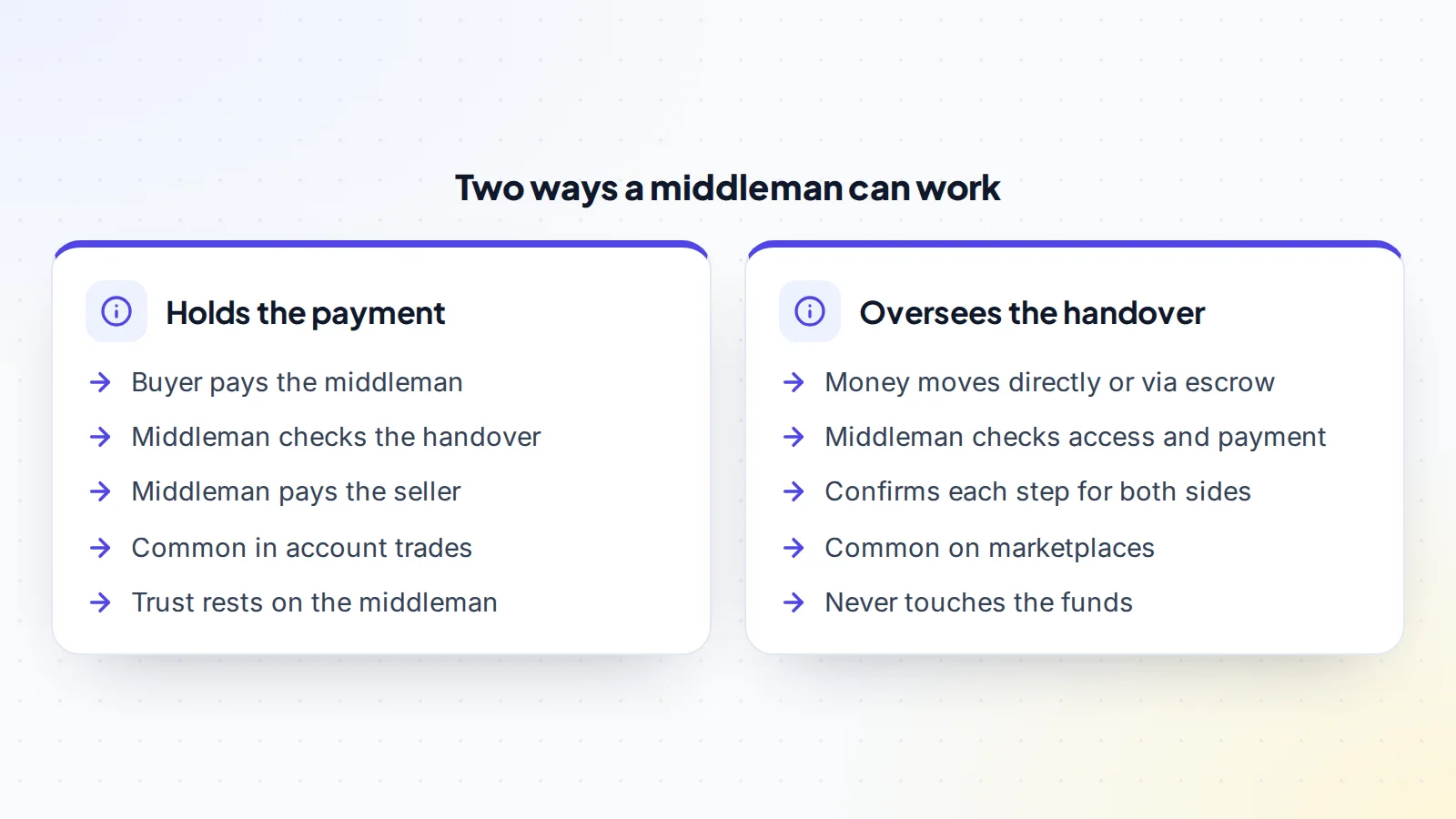
The middleman holds the payment
In this model, common in account trading communities, the buyer pays the middleman, the seller hands over the account, the middleman checks it, and then pays the seller. It’s simple, but it puts a lot of trust in the middleman: they hold the money, and if they’re dishonest or make a mistake, both sides can lose out.
The middleman oversees the handover
In this model, the money moves directly from buyer to seller, or through a licensed escrow service, and the middleman never holds it. Instead, the middleman confirms that payment has been made or secured, guides and checks the handover step by step, and confirms completion. This is common on marketplaces that don’t hold buyer funds. Trust in the middleman still matters, but the money itself isn’t in their hands.
Before you start, ask which model a middleman uses, and where the money will be at each stage.
How a middleman-led handover works
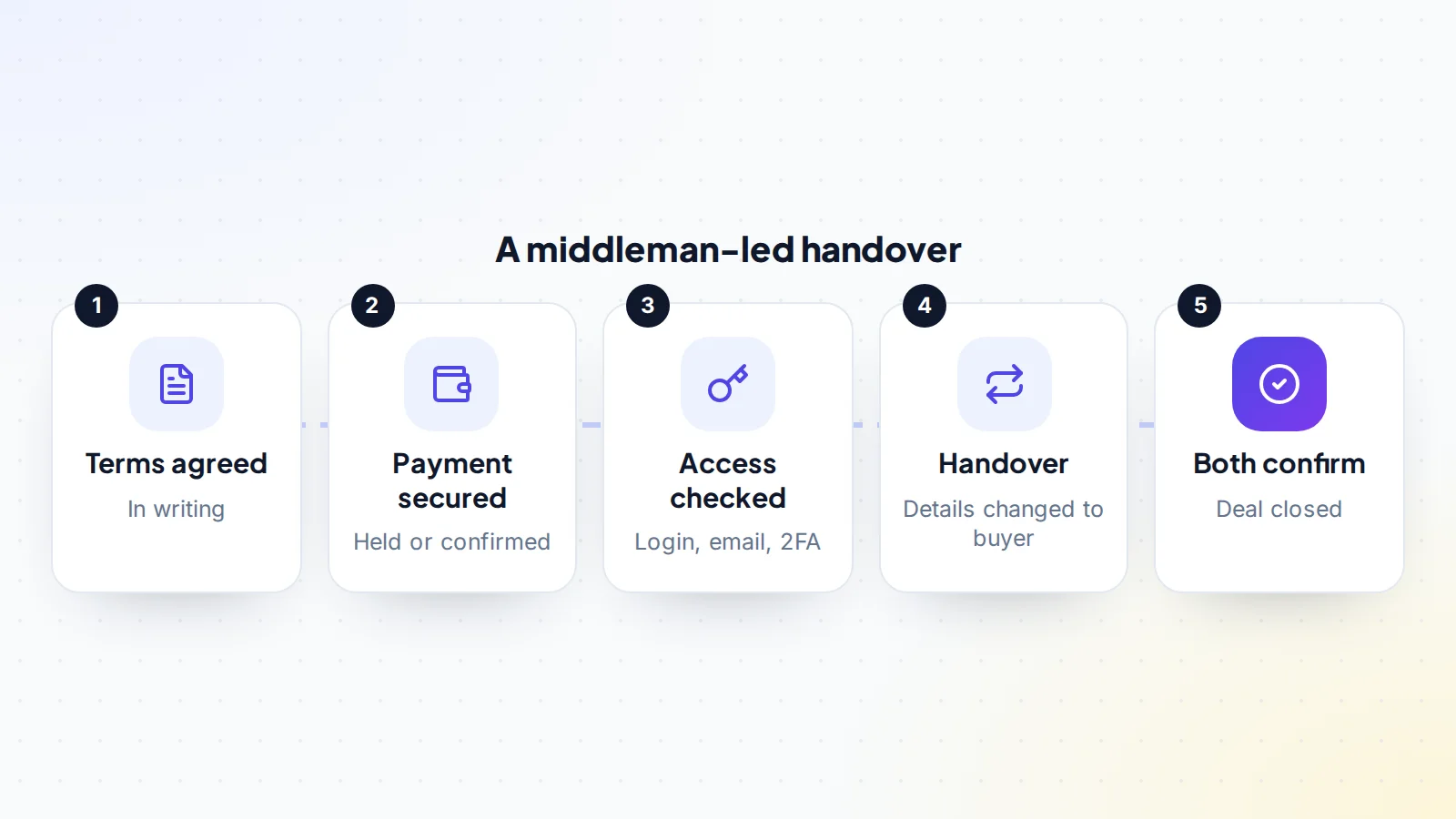
- Terms agreed in writing: price, what’s included (account, email, linked platforms, files), the handover order and the fee.
- Payment secured: either held by the middleman, held by escrow, or confirmed by the middleman as received, depending on the model.
- Access checked: the middleman confirms the seller can sign in, change the email and manage two-factor authentication.
- Handover: email, password, two-factor and recovery details move to the buyer, in the right order. Our guide to transferring accounts with two-factor authentication covers this step.
- Buyer checks: the buyer signs in, confirms everything matches the listing and that the seller no longer has access.
- Both confirm: the middleman closes the deal, and payment is released or the final confirmation recorded.
What a middleman checks for different assets
- Social media accounts: the account email and phone, two-factor authentication, connected business tools and pages, and that the seller’s devices and sessions are removed.
- Game accounts: the email, password, two-factor, linked consoles and platforms, and that the items and ranks described in the listing are there. See securing a game account.
- Domains: that the domain is unlocked, the auth code or push reaches the buyer’s registrar account, and the registry data shows the new registrar. See the domain transfer process.
- Communities: ownership of the server or group transferred, the seller’s admin roles removed, and bots and integrations handed over.
- Newsletters: the platform’s ownership process completed and the sending domain checked.
A good middleman works from a written checklist for each asset type, so nothing important is missed in the moment.
Middleman vs escrow
- Escrow holds money under formal rules and, in some places, under licensing. It’s ideal for websites, businesses and domains, where inspection takes days and the asset is documented.
- A middleman is hands-on. It’s ideal where the handover needs live checking, such as social and game accounts, communities and fast domain pushes.
- Together: some deals use both, with escrow holding the money and a middleman overseeing the handover.
Our guide to escrow for online businesses explains how escrow works in detail.
What a middleman costs
Middlemen charge a fee, usually a percentage of the deal with a minimum, and the parties agree who pays it: the buyer, the seller or both. The fee buys protection and time saved; on anything but small deals between people who already trust each other, it’s usually worth it.
On digiflippers.com:
- The ways to pay in a deal are: directly to the seller, through escrow. The platform never holds the money itself.
- The marketplace’s own middleman service fee: not offered.
- When the middleman service is used, its fee is paid by the buyer.
How to spot a fake middleman
The fake middleman is one of the most common tricks in account and domain trading. The scammer, posing as a buyer or seller, suggests a “trusted middleman” who is really an accomplice, or a second account they control. Warning signs:
- The other side insists on a specific middleman you’ve never heard of.
- The middleman contacts you first, through a private message or a new chat group.
- Their profile is new, or their name is a near-copy of a known middleman’s.
- They ask for payment by an irreversible method, such as gift cards or crypto, to a personal account.
- They ask for your passwords or codes rather than guiding a proper handover.
- They rush you or claim the deal will be cancelled if you don’t act now.
The safest approach: use the marketplace’s own middleman service where one is offered, or find a middleman yourself through an official channel and confirm their identity there. Never use one introduced by the other side in a private message. See digital asset scams and fake escrow scams for related tricks.
A worked example
The details below are made up to show the process.
Kai is selling an established community account on a social platform to a buyer, Mo, for a price both agreed on a marketplace. They choose the marketplace’s middleman service and agree that Mo pays the fee.
Mo pays through the method agreed in the deal, and the middleman confirms the payment is secured. The middleman then joins a call: Kai shows the account settings, changes the email to Mo’s address, Mo sets a new password and moves two-factor authentication to an authenticator app on Mo’s phone, and Kai removes their own recovery phone. The middleman checks with both that every item matches the listing and that Kai no longer has any access. Both confirm, and the deal is closed. The whole handover takes 40 minutes, and neither side ever had to trust the other with money or access.
If something goes wrong mid-handover
Handovers don’t always go smoothly. A platform might ask for a waiting period before a detail can change, a verification code might go to an old phone, or the buyer might find something that doesn’t match the listing. A middleman’s value shows most here:
- Pause, don’t push on. The middleman stops the handover at the step that failed, and the payment stays secured.
- Fix the step together. Most problems, such as an outdated recovery email, can be solved with both sides present.
- Agree a new timeline if a platform rule means waiting, and write it down.
- Follow the dispute process if the asset doesn’t match the listing and the two sides can’t agree.
Because neither side has the full benefit of the deal until every step is complete, both have a reason to cooperate.
When to use a middleman
- Account and community trades, where the handover needs live checking.
- Deals with strangers, especially across countries.
- Fast handovers that happen in a single session.
- Deals where escrow isn’t practical for the asset type or amount.
- Any deal where either side feels unsure about the other.
For larger website or business sales with longer inspections, escrow is usually the better fit, sometimes with a middleman alongside.
Choosing a middleman
- Prefer the marketplace’s own service, where staff are known and accountable.
- Check the record: verified reviews, completed deals and how long they’ve operated.
- Confirm identity through an official channel, not through a link sent by the other side.
- Understand the model: who holds the money and when it moves.
- Agree the fee and who pays it in writing.
- Ask how disputes are handled if something goes wrong mid-handover.
Tips for buyers and sellers
Buyers: prepare your new email and authenticator app before the handover, check every detail before confirming, and never confirm while the seller still has any access. Sellers: check you can change the email and two-factor settings before listing, have the account ready, and never hand over anything before the middleman confirms the payment is secured. Our guides on how to check an online seller and to the Google Workspace transfer cover related steps.
Keeping a record of the deal
Whether or not a middleman is involved, both sides should keep a clear record: the listing, the agreed terms, every message, payment confirmations from the provider itself, and a note of each handover step with the time it was completed. Keep messages inside the marketplace’s deal space rather than moving to private chat apps, where messages can be deleted and where scammers prefer to operate. If a question comes up weeks later, such as a recovery request on an account, the record shows exactly what was agreed and done.
Common mistakes
- Accepting a middleman suggested by the other side.
- Paying a middleman by an irreversible method to a personal account.
- Sharing passwords or codes with the middleman instead of following a proper handover.
- Confirming too early, before every detail has moved.
- Not agreeing the fee in advance.
Middleman service: the checklist
- Middleman chosen through the marketplace or an official channel.
- Model understood: who holds the money, and when.
- Fee and payer agreed in writing.
- Terms written down: what’s included and the handover order.
- Payment confirmed as secured before the handover starts.
- Email, password, two-factor and recovery moved to the buyer.
- Seller’s access removed and checked.
- Both sides confirm before the deal closes.
Ready to find your next asset?
Browse listings with verified numbers, ask sellers your questions before you offer, and agree every step in a free Deal Room.
Frequently asked questions
What is a middleman in a digital asset deal?
A trusted third party who makes sure payment and handover happen in the right order, and checks that the handover is complete before the deal closes.
Does a middleman hold my money?
It depends on the model. Some middlemen hold the payment until the handover is checked; others oversee the handover while the money moves directly or through escrow. Ask before you start.
Is a middleman safer than escrow?
Neither is always safer. Escrow is best at holding money under formal rules; a middleman is best at checking a live handover. Some deals use both.
How do I know a middleman is real?
Use the marketplace’s own service or confirm the middleman’s identity through an official channel. Never trust one introduced by the other side in a private message.
Who pays the middleman fee?
Whoever the parties agree, often the buyer or a split. Agree it in writing before starting.
Can a middleman help with domains and websites too?
Yes, especially for quick domain pushes or when the buyer wants help checking access. For larger website sales with longer inspections, escrow is usually used, sometimes alongside a middleman.