Escrow vs Direct Payment vs Middleman: Which Is Safer?
Three ways to pay in a digital asset deal, compared honestly: escrow, a middleman and paying the seller directly, with a simple way to choose for your deal.
When you buy or sell a website, domain, app or account, the moment money changes hands is the riskiest part of the deal. One side has to go first. The choice between escrow vs direct payment, or a middleman in between, decides who carries that risk, what happens if something goes wrong, and how much it costs to be protected.
This guide compares the three main options in plain terms: how each works, what it protects against, what it costs, and when each makes sense. It applies to both buyers and sellers, because a good payment method protects both sides at once.
Key takeaways
- Escrow holds the buyer’s money with a neutral third party until the handover is confirmed, then releases it to the seller.
- A middleman does a similar job, often checking the transfer itself, which suits accounts and assets that are hard to verify.
- Direct payment is the cheapest and fastest, but the side that goes first carries all the risk.
- Wire transfers, gift cards and crypto are especially hard to reverse; the FTC warns scammers prefer them for that reason.
- Always confirm an escrow service is genuine. A fake escrow site is worse than no protection.
The problem every deal has to solve
In a digital asset deal, the buyer wants the asset before paying, and the seller wants the money before handing over. Someone has to trust the other. With physical goods, there are delivery services, shop counters and card protections built for this. With a website or an account, the handover is a series of logins, ownership changes and file transfers that are hard to undo, and the other side may be a stranger in another country.
Each payment method solves this trust problem differently. Understanding how they work makes the choice straightforward.
How escrow works
An escrow service is a neutral third party that holds the money during the deal:
- Both sides agree the terms on the escrow platform: price, what’s included and the inspection period.
- The buyer pays the escrow service, not the seller.
- The escrow service confirms the funds are held, and the seller can see that.
- The seller hands over the asset.
- The buyer inspects within the agreed period and confirms.
- The escrow service releases the money to the seller.
If the buyer finds a genuine problem, the dispute process in the escrow agreement decides what happens. The seller never hands over an asset without knowing the money exists, and the buyer never pays the seller before receiving the asset.
Escrow is regulated in some places. In California, for example, the Department of Financial Protection and Innovation licenses escrow companies under the state’s Escrow Law, and publishes information about online escrow companies. That’s one reason to choose an established, licensed provider. Our guide to escrow for online businesses covers the process in depth, and escrow fees explains the costs.
How a middleman works
A middleman is a trusted person or service that sits between buyer and seller. The buyer pays the middleman; the middleman checks the handover (often doing parts of it directly, such as confirming account access or changing recovery details), then pays the seller.
The key difference from escrow is involvement. An escrow service holds money and follows agreed instructions. A middleman typically also checks the asset itself, which is useful for things like social media accounts, game accounts or communities, where it can be hard for a buyer to know a handover is complete. The protection depends heavily on the middleman’s reputation, so use one with a public track record, or one provided by the marketplace you’re using. Read what a middleman does for more.
How direct payment works
With direct payment, the buyer pays the seller, usually by bank transfer, payment app or card processor, and the seller hands over the asset, before or after payment depending on what they agree. There’s no third party, so there’s nothing extra to pay and nothing to wait for.
The weakness is obvious: whoever goes first is exposed. If the buyer pays first, they rely on the seller to deliver. If the seller hands over first, they rely on the buyer to pay, and to not reverse the payment later. Some direct methods offer limited buyer protection, such as card chargebacks, but these are designed for goods and services, not for transfers of ownership, and can themselves create risk for sellers; see chargeback risk.
Why reversibility matters
Payment methods differ in how easily money can be recovered. The U.S. Federal Trade Commission warns that wiring money through a transfer service is like sending cash: once it’s sent, you usually can’t get it back, and that scammers often insist on payment by wire transfer, gift card, cryptocurrency or payment app for exactly that reason.
That cuts both ways in a deal:
- For buyers, paying a stranger by an irreversible method before receiving anything means relying entirely on their honesty.
- For sellers, accepting a reversible method (such as some card or app payments) and handing over first can mean losing both the asset and the money if the buyer later disputes the charge.
A neutral third party removes the dilemma: money is held, not sent, until both sides have done their part.
Escrow vs direct payment vs middleman, side by side
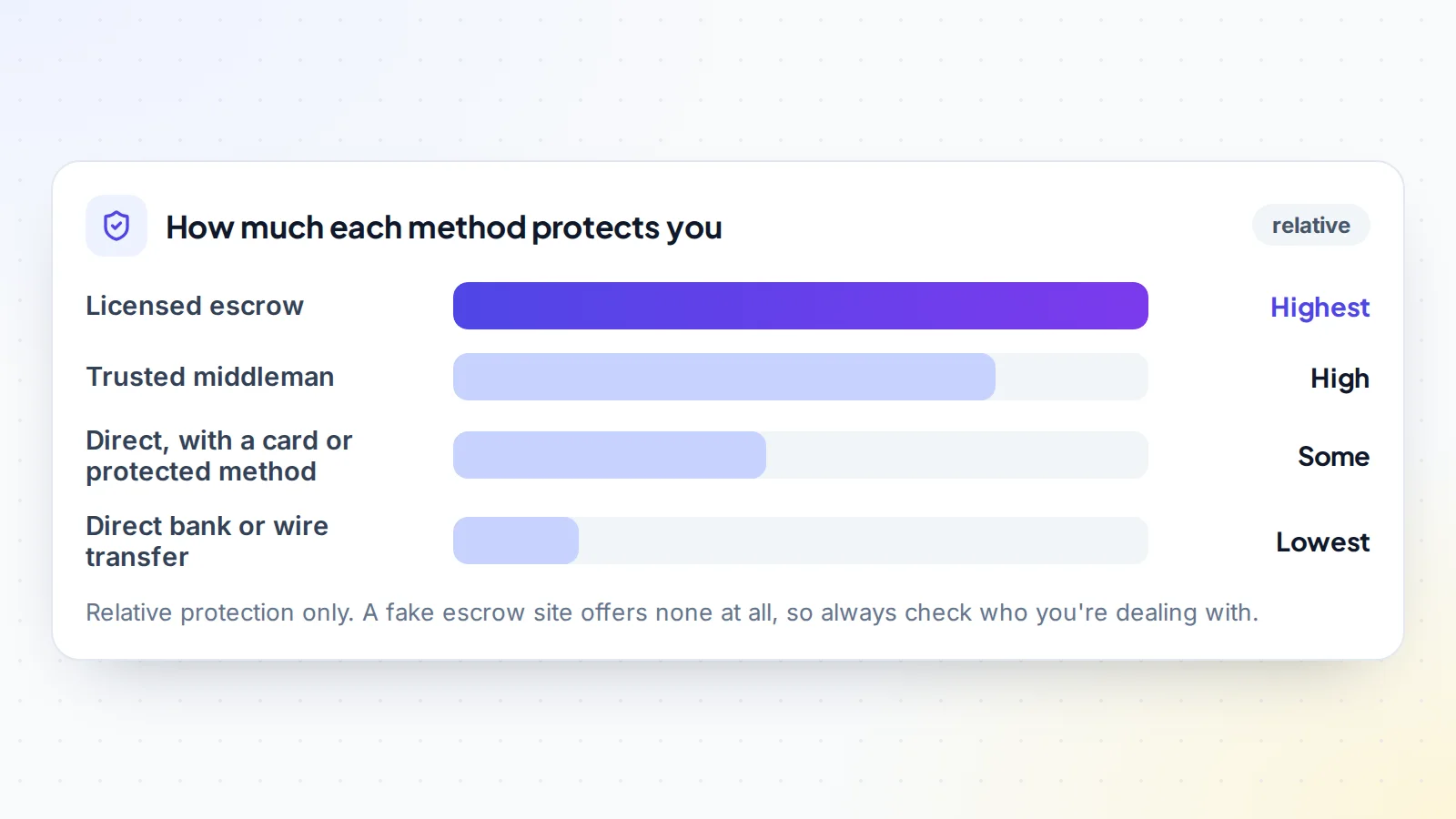
- Protection: escrow gives the strongest, rules-based protection; a reputable middleman gives strong protection plus hands-on checking; direct payment gives the least.
- Cost: escrow and middleman services charge a fee, usually shared or paid by one side as agreed; direct payment usually costs only normal transfer fees.
- Speed: direct is fastest; escrow adds a few days for funding and inspection; a middleman’s speed depends on the handover.
- Best for: escrow suits websites, businesses, domains and larger deals; a middleman suits accounts and assets that need hands-on checking; direct suits small deals between people who already trust each other.
On digiflippers.com, the ways to pay in a deal are: directly to the seller, through escrow, and the platform never holds the money itself. Selling comes with 0% success fee up to $10,000, then 5% (max $5,000), so protection doesn’t come at the price of a large commission. See how payment works.
How to choose for your deal
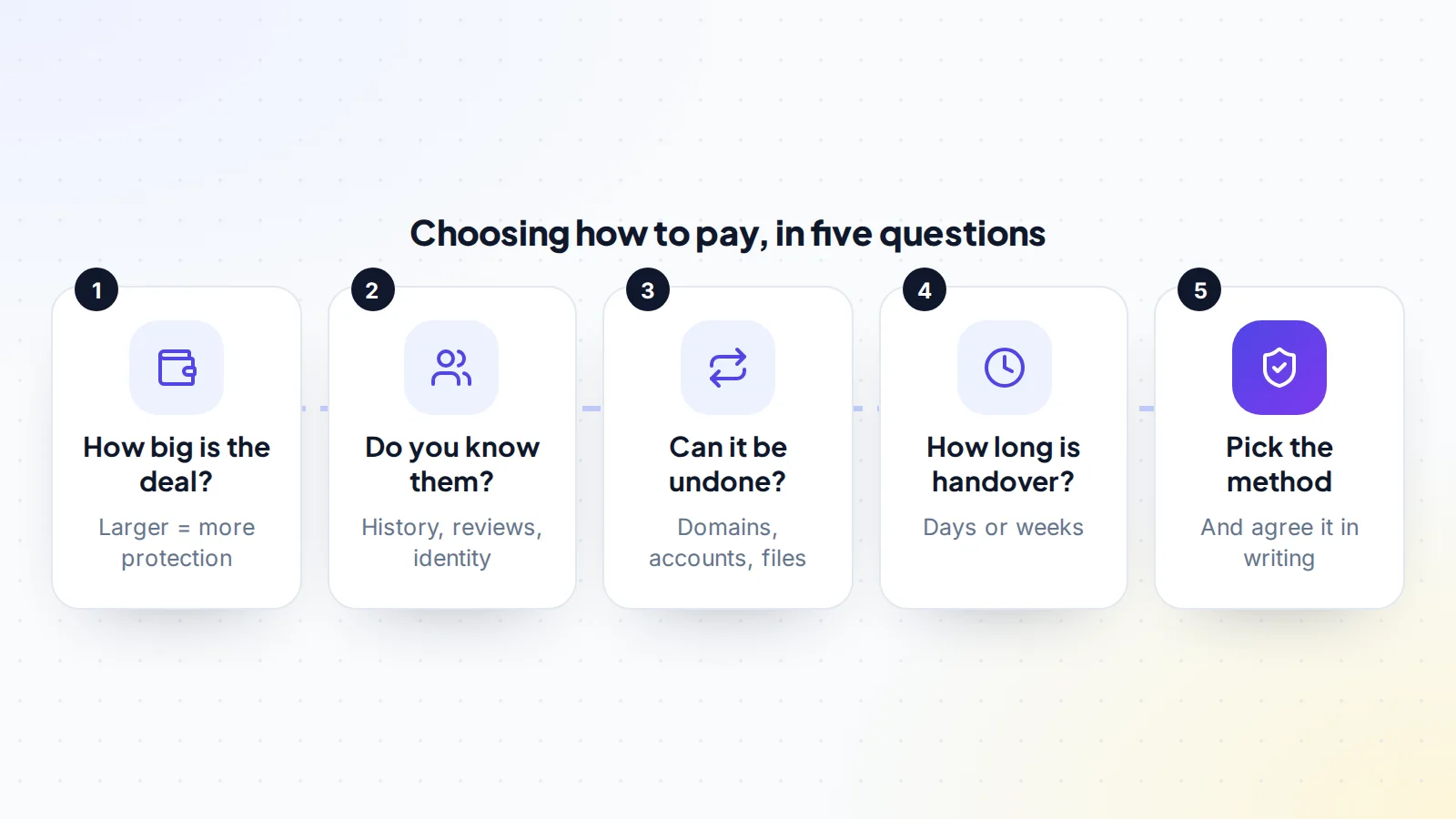
- How big is the deal? The larger the amount, the more a third party’s fee is worth paying.
- Do you know the other side? A long history of trading together is different from a first conversation with a stranger.
- Can the transfer be undone? Domains, accounts and files are hard to take back once handed over.
- How long is the handover? Multi-step handovers, such as a YouTube Brand Account with a 7-day wait, need money held for longer.
- Which method protects both sides? Agree it in writing before any money moves.
A worked example
The details below are made up to show the method.
Leah is buying a small content website for $14,000 from a seller met through a marketplace. The handover involves the domain, hosting, Google Analytics, an email list and two affiliate accounts, and will take about a week.
The seller suggests a bank transfer to save fees. Leah walks through the five questions: the amount is significant; Leah doesn’t know the seller; the domain and accounts can’t easily be taken back; the handover takes days. Leah proposes escrow instead, offering to split the fee. The seller agrees: escrow protects them too, since they won’t hand over the domain until they see the money is held.
The fee costs each of them a modest share of the deal. In exchange, Leah gets a week to check everything, the seller gets certainty of payment, and neither has to trust a stranger with five figures. If the seller had refused any form of protection, that refusal would have been a reason for Leah to walk away.
When direct payment can make sense
Direct payment isn’t always wrong. It can be reasonable when:
- The amount is small enough that both sides could accept the loss.
- Buyer and seller have traded together before, or know each other personally.
- The asset can be handed over and checked instantly, at the same time as payment.
- The deal is split into stages, with a small payment for each step as it’s verified.
Even then, agree the terms in writing and keep every record.
Cross-border deals
Many digital asset deals are between people in different countries, which adds a few things to think about:
- Currency: agree which currency the price is in and who carries the conversion cost.
- Transfer times: international bank transfers can take several days, which affects how long an escrow or middleman holds funds before the handover can start.
- Availability: not every escrow provider serves every country, so check that both sides can use the service you choose before you agree terms.
- Recourse: if something goes wrong with a direct payment to someone abroad, recovering money is even harder than at home. That makes a neutral third party more valuable, not less.
- Tax and records: keep the agreement, invoices and payment confirmations; both sides may need them for their own tax reporting.
For these reasons, the case for escrow vs direct payment is usually even stronger in cross-border deals than in local ones.
The fake escrow trap
Escrow only works if the escrow service is real. One of the most common scams in digital asset deals is a fake escrow site, set up by the “buyer” or “seller” to look like a real service, which takes the money or confirms a payment that never happened. Warning signs include an escrow service you’ve never heard of, a site only recently registered, pressure to use a specific unfamiliar service, and confirmation emails that don’t come from the provider’s real domain. Always go to the escrow provider’s site yourself, never through a link sent by the other side. Read how fake escrow scams work, and if you’re targeted, report it at ReportFraud.ftc.gov or to your local authority.
Put the payment terms in writing
Whichever method you choose, write down: the method and provider, who pays the fee, the inspection period, exactly what “handover complete” means, what happens if something is missing, and any later obligations such as a non-compete or support period. Clear terms are what make escrow and middleman services work smoothly.
Common mistakes
- Saving a small fee on a large deal by paying directly.
- Using an escrow link sent by the other side.
- Handing over before funds are confirmed as held.
- Vague inspection terms, so nobody knows when money should be released.
- Trusting screenshots of payment rather than confirmation from the provider itself; see fake screenshots.
Escrow vs direct payment: the checklist
- Deal size, trust and reversibility considered.
- Payment method agreed in writing before any money moves.
- Escrow or middleman provider checked independently.
- Fee split agreed.
- Inspection period and “handover complete” defined.
- Funds confirmed as held by the provider itself before handover.
- Every message, receipt and confirmation kept.
Ready to find your next asset?
Browse listings with verified numbers, ask sellers your questions before you offer, and agree every step in a free Deal Room.
Frequently asked questions
Is escrow always safer than direct payment?
A genuine escrow service is safer for both sides in most deals between strangers, because the money is held until the handover is confirmed. A fake escrow service offers no protection, so check the provider.
Who pays the escrow fee?
Whoever the two sides agree. It’s common to split it or for the buyer to pay. Agree it in writing before starting.
What’s the difference between escrow and a middleman?
Escrow holds money and releases it according to agreed instructions. A middleman usually also checks the handover itself, which suits accounts and assets that are hard to verify.
Is a bank transfer safe for buying a website?
Bank and wire transfers are hard to reverse, so paying a stranger this way before receiving the asset puts all the risk on you. Use escrow or a middleman for anything you couldn’t afford to lose.
Can a seller be scammed with direct payment too?
Yes. If a seller hands over first and the buyer pays with a reversible method, the payment can be disputed later. Escrow protects sellers as well as buyers.
How long does escrow take?
Usually a few days to fund and confirm, plus the inspection period you agree. Longer handovers mean longer holds.