PayPal and Card Chargebacks: Why Sellers Avoid Them
How card disputes and PayPal claims work, why digital assets are exposed after the handover, and which payment methods and records protect sellers.
Selling a website, domain, account or digital product is different from selling a physical item. Once the buyer has control, there’s nothing to ship back. That’s why the chargeback risk selling online brings deserves careful thought: if the buyer paid with a method that can be reversed weeks later, a seller can end up without the asset and without the money. This guide explains how card disputes and PayPal claims work, why digital assets are exposed, and how to sell with confidence.
It’s written for sellers of digital assets of any size. If you’re choosing how to get paid, our guide to escrow for online businesses is a good companion.
Key takeaways
- Card payments can be disputed after the sale; Stripe says card networks typically allow around 120 days, sometimes more.
- Once a digital asset is transferred, the seller can’t take it back if a payment is reversed.
- PayPal’s Seller Protection mainly covers physical goods; intangible items have extra conditions.
- Escrow or a middleman confirms the money before the handover, removing most of the risk.
- Keep written terms, messages and proof of transfer for every sale.
What a chargeback is
A chargeback happens when a cardholder asks their card issuer to reverse a payment. The issuer takes the money back from the seller’s payment provider while it reviews the case, and the seller can respond with evidence. Disputes exist to protect shoppers from fraud and from sellers who don’t deliver, and they work well for that purpose. The difficulty for digital asset sellers is the timing: a dispute can be opened long after the asset has changed hands.
There are two common reasons a seller faces one. The first is genuine disagreement about what was delivered. The second is fraud: a stolen card, or a buyer who receives the asset and then claims they never authorised the payment or never received what they paid for.
How long a buyer has to dispute
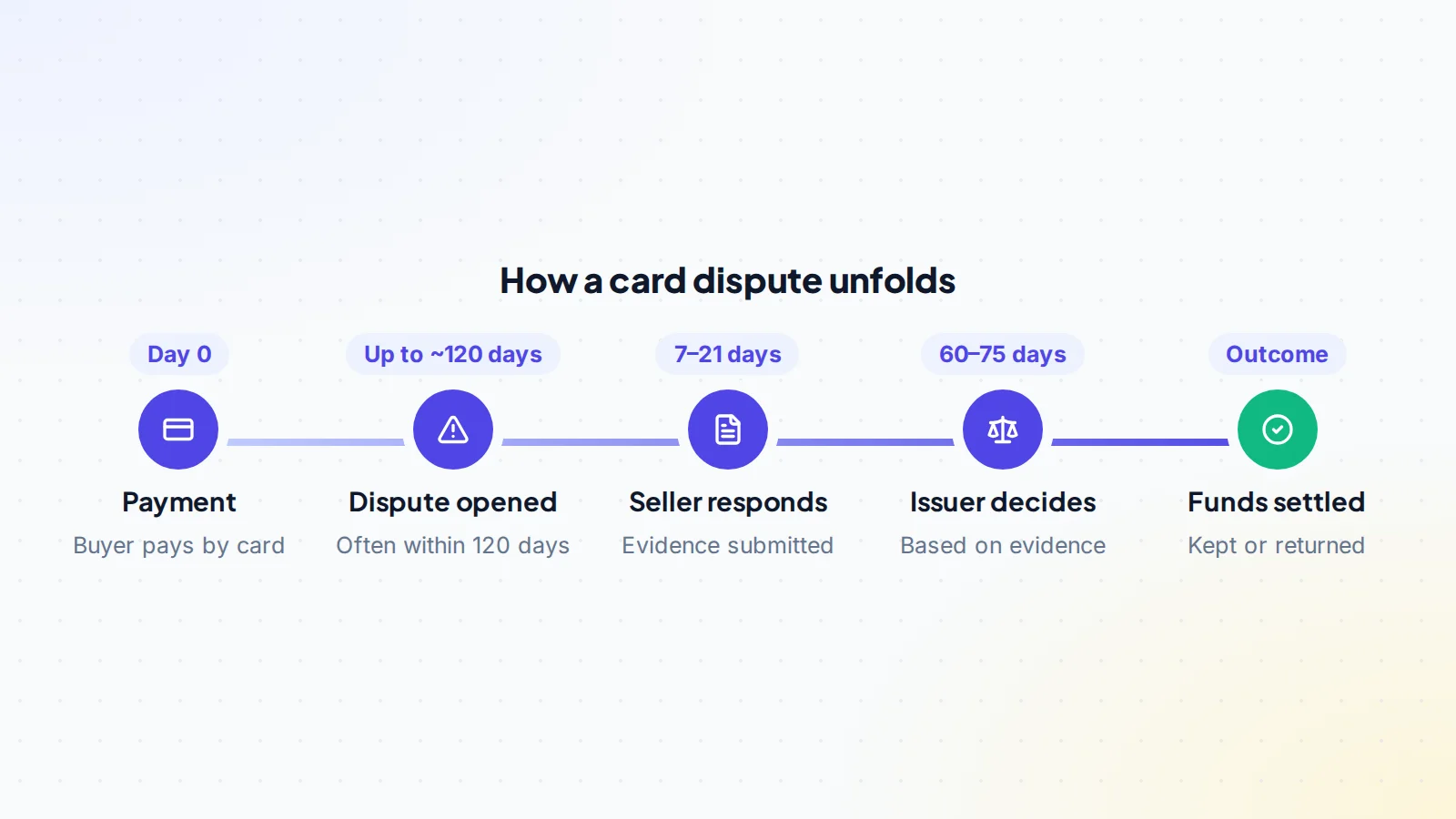
Stripe’s documentation explains that card networks typically allow cardholders to dispute within 120 days of the payment, and their rules allow more time in some situations. After a chargeback is created, the seller usually has 7 to 21 days to respond, depending on the network, and the issuer then usually takes 60 to 75 days to decide.
Put together, a seller who takes a card payment for a website could be waiting months to know whether the money is final, long after the buyer has the website, the domain and the customer list.
PayPal and intangible items
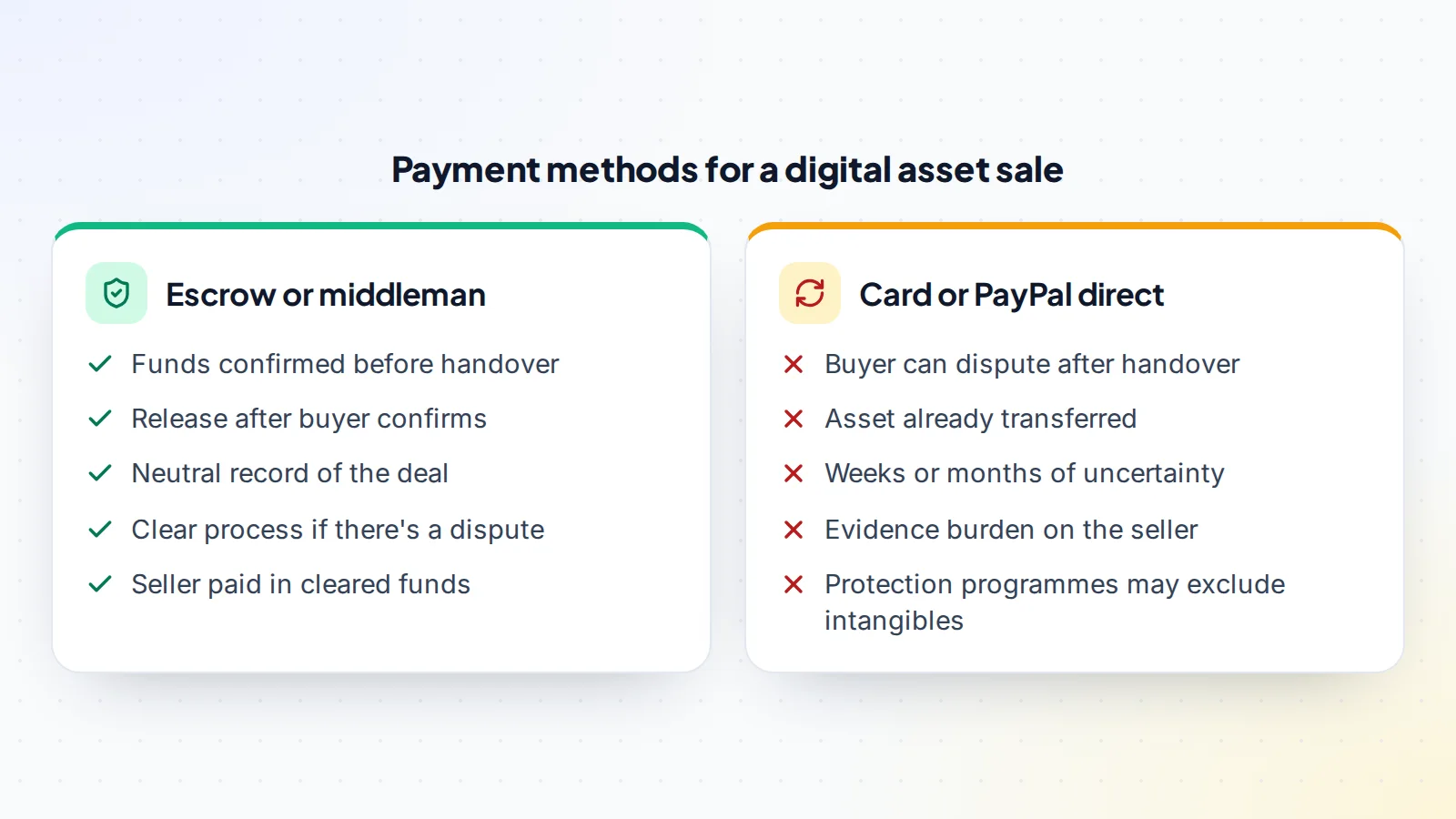
PayPal’s Seller Protection programme helps sellers with certain claims and chargebacks, but its basic requirements are built around physical goods that can be shipped. PayPal’s terms say intangible goods and services have additional requirements before they’re eligible, and in some regions digital goods are excluded. In practice, a seller of a website, domain or account shouldn’t assume Seller Protection will cover a dispute after the handover. Read the current terms for your country before accepting PayPal for a digital asset sale.
Why digital assets are especially exposed
- No return path: a website or account can’t be taken back once the buyer controls the logins and the email.
- Proof is harder: there’s no tracking number. Evidence of delivery has to come from transfer confirmations, logs and messages.
- Higher values: digital asset sales are often larger than typical online purchases, so a single reversal hurts more.
- Fraud targets: assets that can be resold quickly, such as accounts and domains, attract people paying with stolen cards.
Our guide to digital asset scams describes the patterns to watch for.
How escrow and middlemen remove the risk
Most of the chargeback risk selling online carries comes down to the order of payment and transfer, so the cleanest protection is to change the order of events. With escrow or a middleman, the buyer pays first, the money is confirmed as received by a neutral party, the seller transfers the asset, the buyer confirms, and only then is the money released. The seller never hands over an asset against a payment that might be reversed, and the buyer never pays a seller directly for something they haven’t received.
On digiflippers.com, the ways to pay in a deal are: directly to the seller, through escrow, and the platform never holds the money itself. When escrow is used, the escrow fee is normally paid by the seller, and you can agree a different split in the deal. Our guide to choosing a middleman service explains how that option works.
Other payment methods
Bank wire transfers are hard to reverse once sent, which protects sellers, but the FTC warns that the same feature makes them risky for buyers who pay the wrong person. That’s why many buyers won’t wire money directly to a stranger, and why escrow is often the method both sides can agree on. Our guide to wire transfer safety explains the buyer’s side.
Crypto payments are also hard to reverse, with similar concerns for buyers and extra questions about pricing and records. Our guide to paying with crypto for a business covers them.
What happens if a payment is reversed
When a chargeback succeeds, the money goes back to the buyer, and the seller’s payment provider usually adds a dispute fee. The asset, though, stays where it is. Getting a website, domain or account back means persuading the buyer to return it, asking the platform or registrar for help, or taking legal action, all of which take time and may not succeed. For a seller, the safest assumption is that a reversed payment for a transferred digital asset is very hard to recover.
If you receive a dispute
Respond within the deadline your payment provider gives you, and keep it factual. Stripe’s guidance on responding to disputes explains that the evidence should address the reason the cardholder gave. For a digital asset sale, that usually means:
- The agreed terms and the listing the buyer saw.
- Messages showing the buyer asked for and received the asset.
- Proof of each transfer step, with dates and times.
- The buyer’s written acceptance, and evidence that they used the asset afterwards, such as account changes they made.
Report fraud to your payment provider and, where relevant, to the authorities. Then review how the sale was set up, so the next one uses a protected payment method.
Small sales and digital products
Not every sale is a large one. If you sell digital products, templates or small assets directly to customers by card, some disputes are part of normal business. Reduce them with clear product descriptions, a visible refund policy, a recognisable name on card statements, fast support and delivery records. Stripe’s documentation also explains how to respond to disputes with evidence such as delivery confirmation and customer communication.
For larger, one-off sales of businesses, accounts or domains, use escrow or a middleman instead of a direct card or PayPal payment.
Keep evidence from every sale
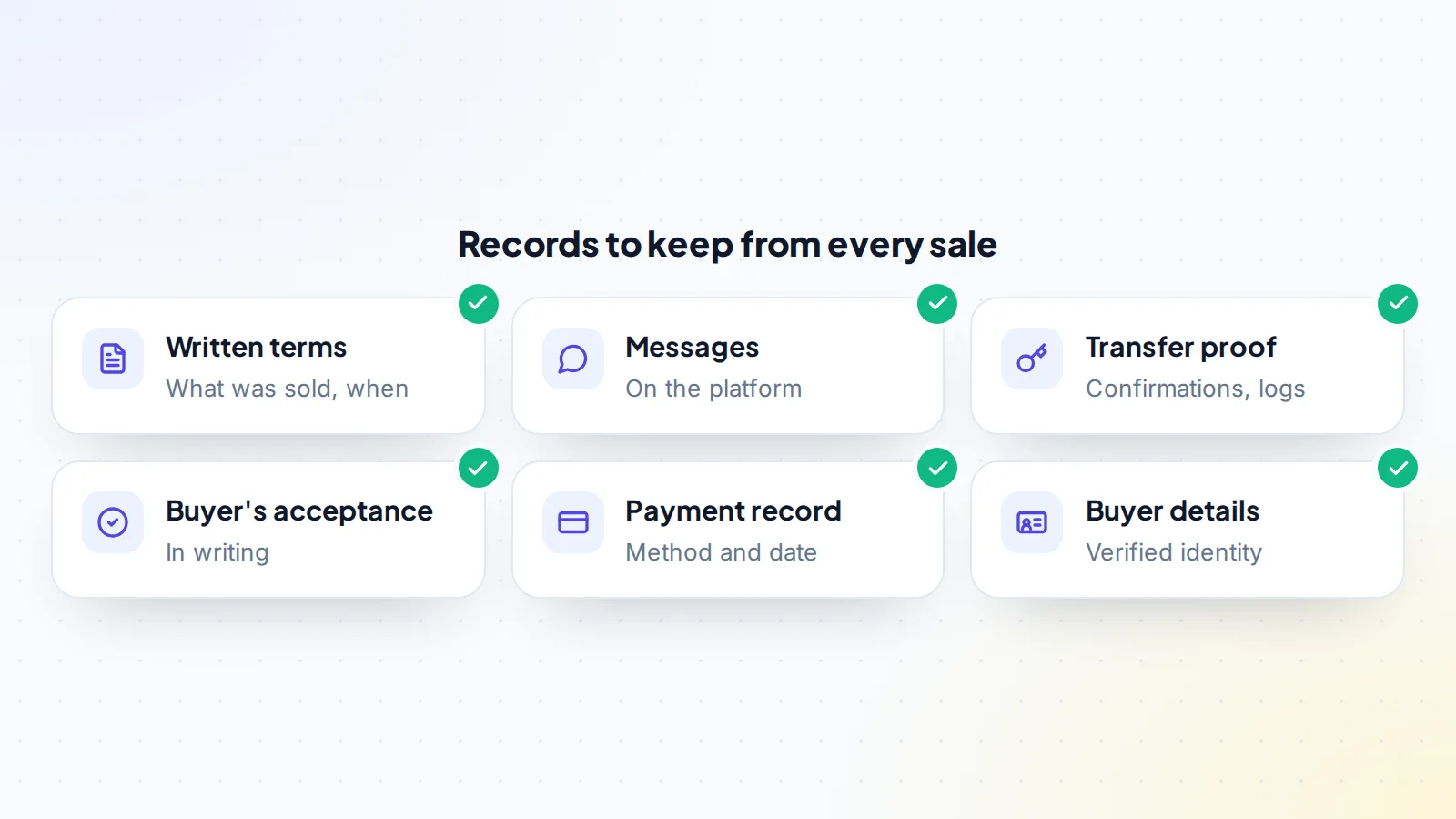
Whatever the payment method, records protect you. Keep:
- The written terms: what was sold, the price, the handover steps and the checking period.
- All messages, ideally on the marketplace rather than private apps.
- Proof of transfer: registrar confirmations, ownership-change emails, platform logs and screenshots with dates.
- The buyer’s written confirmation that they received and accepted the asset.
- Payment records and the buyer’s verified details.
Choosing a payment method by deal size
The right method depends on what’s at stake. As a rough guide:
- Small digital products sold to many customers: card payments through a store are normal. Manage disputes with clear descriptions, refund policies and delivery records.
- One-off sales of accounts, domains or small sites: use escrow or a middleman, even for modest amounts, because the asset can’t come back.
- Businesses and larger assets: use escrow, with written terms, a checking period and a clear list of what transfers.
Whatever the size, agree the method before any work on the handover begins. Changing the plan halfway, especially under time pressure from the buyer, is when mistakes happen.
What to agree with the buyer before payment
- The payment method and who pays any fees.
- When the money must be confirmed, and how the seller will confirm it.
- The handover steps, in order.
- How long the buyer has to check the asset, and how they’ll accept it.
- What happens if something isn’t as described.
Writing these down protects both sides and gives you the evidence you’d need if anything were ever disputed.
A worked example
The details below are made up to show the method.
Lena sells a small content website. A buyer offers to pay the full price immediately by card through a payment link, as long as the site is transferred today. Lena knows a card payment could be disputed for months after the handover, so Lena suggests escrow instead.
The buyer agrees. They fund the escrow, and Lena signs in to the escrow account directly to confirm the funds are held. Lena then transfers the domain, hosting and analytics, and the buyer confirms everything works within the agreed three-day period. The funds are released to Lena in cleared money, with a full record of the deal. Neither side had to trust the other with money or the asset.
Know who you’re dealing with
Many reversed payments start with a stolen card or a fake identity. Knowing who the buyer is cuts that risk before payment is even discussed. On digiflippers.com, members can verify their identity, and a verified badge shows the check has been done. Before a large sale, look at the buyer’s profile, history and reviews, and ask questions that a genuine buyer can answer easily: what they plan to do with the asset, and how they’ve bought before.
Be careful with buyers who refuse every form of verification, who are vague about who will own the asset, or whose payment comes from someone else. A genuine buyer has every reason to be clear, because a clean record protects them too.
Warning signs at the payment stage
- A buyer insists on paying by card or PayPal for a large digital asset and won’t use escrow.
- The buyer pushes to complete the handover before the money is confirmed.
- The buyer’s name doesn’t match the payment details.
- The buyer offers more than the asking price to go faster.
- The buyer wants to move the conversation off the platform.
None of these proves fraud on its own, but each is a reason to slow down and use a protected payment method. A genuine buyer will understand, and most will welcome the extra protection for themselves.
Chargeback risk selling online: the checklist
- Payment method agreed before any transfer.
- Escrow or a middleman used for larger digital asset sales.
- Funds confirmed by signing in to the escrow account yourself.
- Written terms covering the asset, price, steps and checking period.
- All messages kept on the platform.
- Proof of every transfer step saved with dates.
- Buyer’s acceptance recorded in writing.
- Payment provider’s dispute rules read for any card or PayPal sales.
Ready to find your next asset?
Browse listings with verified numbers, ask sellers your questions before you offer, and agree every step in a free Deal Room.
Frequently asked questions
How long can a buyer dispute a card payment?
Stripe says card networks typically allow around 120 days from the payment, with longer windows in some situations.
Does PayPal Seller Protection cover digital asset sales?
Its basic requirements focus on physical goods. Intangible items have additional conditions and are excluded in some regions, so check the current terms for your country.
What’s the safest way to get paid for a website or account?
Escrow or a middleman, so the money is confirmed before the handover and released after the buyer confirms.
Can I win a chargeback for a digital asset?
Sometimes, with strong evidence of delivery and the buyer’s acceptance. But the process can take months, and the asset has already been transferred, so prevention is better.
Is a wire transfer safer for the seller?
It’s hard to reverse once sent, which protects the seller, but buyers face risks paying strangers by wire. Escrow protects both sides.
What evidence should I keep?
Written terms, messages, proof of each transfer step, the buyer’s written acceptance and the payment records.
Does chargeback risk affect buyers too?
Indirectly. Sellers who’ve had payments reversed become cautious, so buyers who offer escrow from the start usually find sellers easier to deal with.