Dropshipping Stores for Sale: Opportunities and Red Flags
What makes a dropshipping store worth buying, the red flags that matter, how to check sales, suppliers, delivery times and ads, and how these stores are priced.
Dropshipping lets a store sell products without holding stock: the store takes the order, and a supplier ships straight to the customer. It’s a low-cost model to run, which is why so many dropshipping stores exist, and why so many come up for sale. Some are real brands with loyal customers and solid margins; others are a single ad campaign with a nice theme. This guide helps you tell them apart when you look at a dropshipping store for sale: the opportunities, the red flags and the checks that protect your money.
For the wider buying process, see our guides on how to buy a website and buying a Shopify store.
Key takeaways
- In dropshipping, the supplier controls the product and delivery, so supplier checks are central.
- Verify sales in the store admin and against payouts, and rebuild profit after ads.
- Watch for sales spikes before listing, ad dependence, long delivery times and high refunds.
- Branded products and owned customers are worth more than generic products sold everywhere.
- Value is usually a multiple of net profit, often lower than for less ad-dependent businesses.
How dropshipping works
A customer finds the store, often through an ad, and places an order. The store forwards the order to a supplier, who ships the product directly to the customer. The store earns the difference between its selling price and the supplier’s price, minus ads, apps, fees and support. The store owns the brand, the website and the customer relationship; the supplier owns the stock, the product quality and the delivery speed.
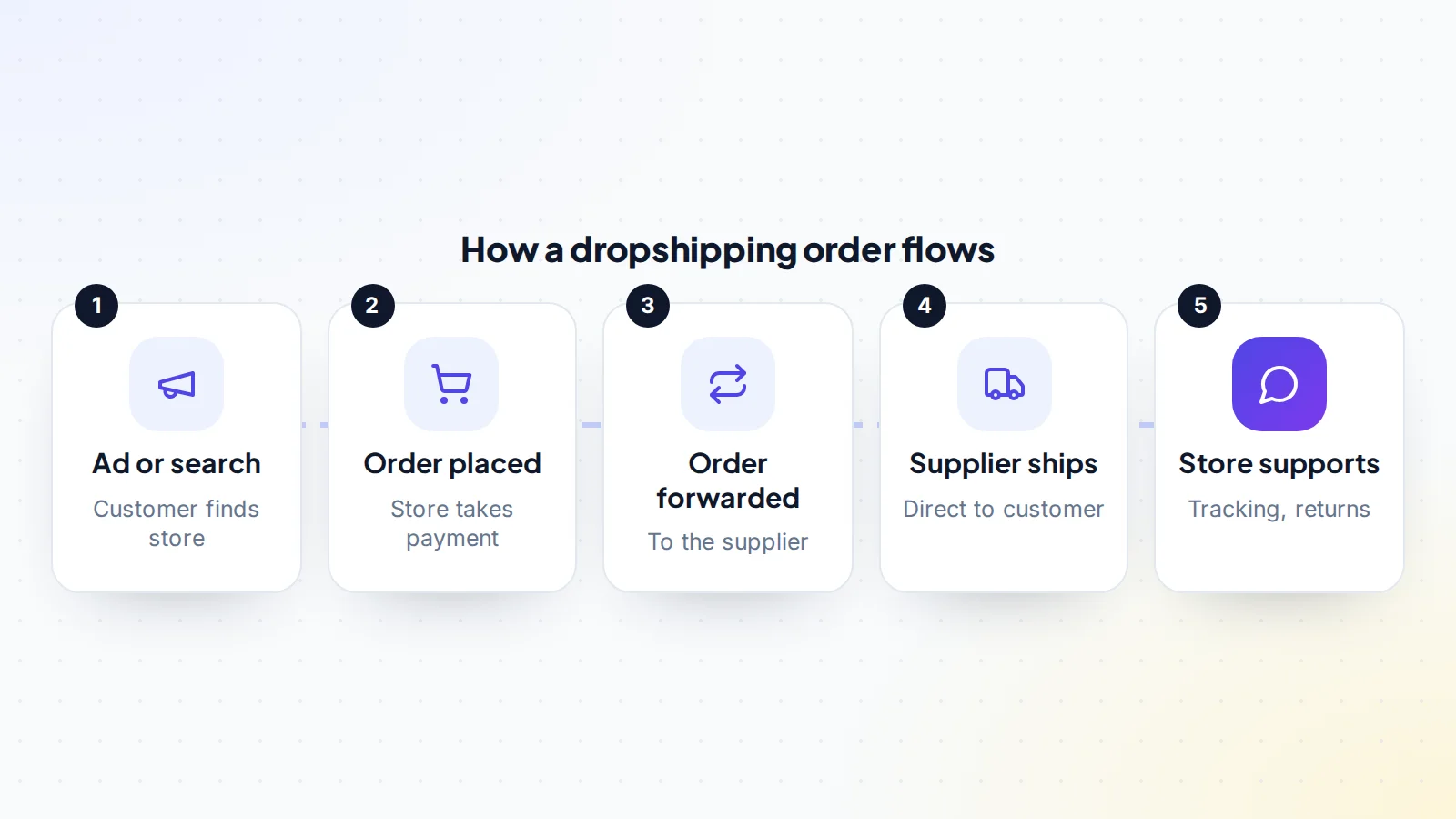
That split is the key to judging any dropshipping store for sale. The buyer inherits the store’s side and has to trust the supplier’s side, so the checks below look at both, with extra weight on the parts the buyer can’t control directly.
The opportunities
- Low running costs: no warehouse to rent and no stock to finance up front.
- Easy to test products: new items can be added without buying inventory.
- Room to build a brand: stores that move from generic products to branded or customised ones can grow margins and loyalty.
- Proven data: an established store comes with ad data, winning products and a customer list.
The red flags
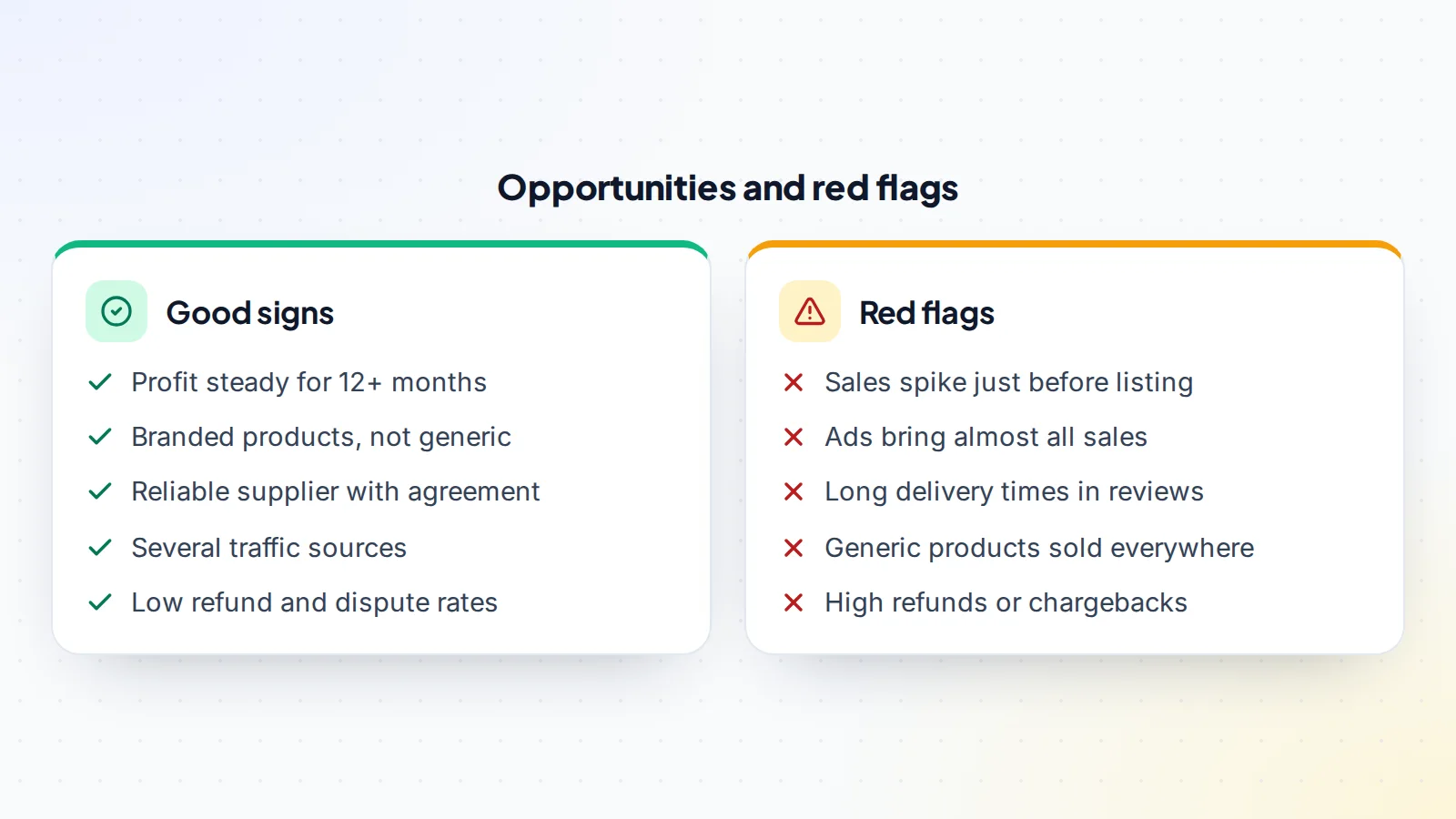
- A sales spike just before listing, often from heavy ad spend that isn’t profitable over time.
- Ad dependence: almost all sales from one ad platform, with little organic, email or returning traffic.
- Long delivery times, visible in reviews, refund reasons and support tickets.
- Generic products that many other stores sell, often at lower prices.
- High refunds and chargebacks, which eat profit and can put payment accounts at risk.
- A short history: a few months of data can’t show whether results last.
None of these rules a store out alone, but each lowers what it’s worth. When you see one, ask the seller for an explanation backed by data, and reflect the answer in your offer, the checking period or the share of the price held until key accounts move.
Check the sales and profit
Ask the seller to share their screen and open the store’s admin, or add you as a staff member with access to reports. Look at sales, orders, refunds and returns month by month for at least 12 months, ideally 24. Then match those figures to payouts from the payment provider and to bank statements. Our guide to verifying website revenue covers the details.
Next, rebuild profit for a typical month: supplier product and shipping costs from supplier invoices, ad spend from the ad accounts, app subscriptions, payment fees and any paid help. In dropshipping, ads are often one of the biggest costs, so profit before ads tells you little.
Check the suppliers
Suppliers decide the product and the delivery, so look at them closely:
- Who they are and how orders reach them: an app, a sourcing agent or direct contact.
- Agreements: pricing, minimums, exclusivity, and whether the relationship can pass to you.
- Delivery times to each main market, from tracking data, not promises.
- Quality: defect rates, return reasons and reviews mentioning the product.
- Backup options for the best-selling products.
Shipping times have rules too. In the US, the FTC’s Mail, Internet, or Telephone Order Merchandise Rule says sellers must have a reasonable basis for the shipping times they advertise, or ship within 30 days if no time is stated, and must ask customers’ consent to delays or offer refunds. A store whose supplier can’t meet its promises carries that risk. Our guide to supplier due diligence has the full checklist.
Product compliance
The store selling a product carries responsibility for it, even if a supplier ships it. Check that products meet the rules of each market sold into. In the US, for example, the Consumer Product Safety Commission requires a Children’s Product Certificate for children’s products, based on testing by an accepted lab, from the manufacturer or importer. Ask for certificates and the evidence behind any claims on product pages.
Check traffic and ads
Find out where buyers come from: paid ads, search, social, email or returning customers. If ads bring most sales, sign in to the ad accounts on a screen-share and review spend, results over time, account history and any warnings. Ad accounts usually belong to a person or business and may not transfer, so plan whether you’ll take them over or rebuild with the seller’s creative and audience data. Stores with a growing share of organic, email and repeat sales are more resilient. Our guide to revenue diversification explains why.
Customers, reviews and the email list
The customer side is what the buyer truly owns in dropshipping, so look at it closely. Check the share of orders from returning customers, the size of the email and SMS lists and how engaged they are, and reviews both on the store and on outside review sites. Read the most recent reviews first; complaints about delivery times or quality from the last few months tell you more than an older average. Confirm that subscribers agreed to receive marketing, and that the email tool account can move to you.
A store with a loyal base of repeat customers is far less exposed to ad costs than one that pays to win every order. It’s one of the clearest differences between a store worth building on and one that only works while ads are cheap.
How much time it takes
Dropshipping is often described as hands-off, but established stores need regular work: managing ads, answering customers, handling refunds, checking supplier stock and testing new products. Ask the seller for a typical week, broken down by task, and who does each one. If you plan to hire help, add the cost to your profit calculation. Our guide to owner hours explains how time affects the price.
Payment accounts, refunds and disputes
Slow deliveries and products that disappoint turn into refunds and card disputes, and those affect both profit and the store’s payment accounts. Stripe’s documentation explains that card networks typically allow customers to dispute payments for around 120 days, so disputes from recent months may still be arriving after you buy. Ask for the dispute and refund history for the last 12 months, check the current rate against the payment provider’s thresholds, and agree in writing who handles disputes on orders placed before the sale.
Seasonality and trends
Many dropshipping stores ride seasons or trends: holiday gifts, summer products or an item that went viral. Look at sales month by month over at least two years. A store whose results rest on one season, or one trending product that has since cooled, is worth less than its best months suggest. Value it on twelve-month averages, and ask how the seller plans to replace products as trends fade.
How dropshipping stores are valued
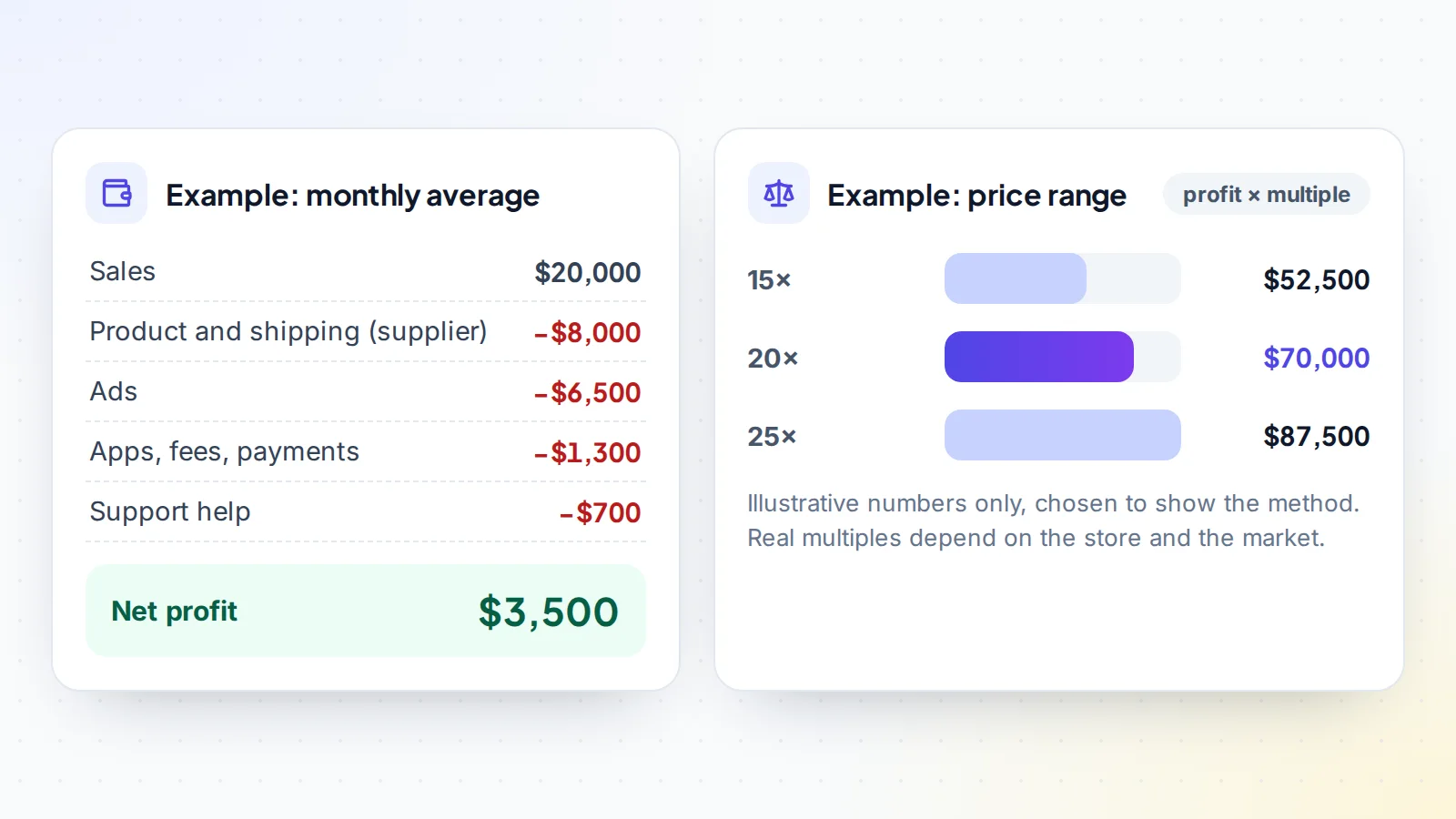
Like most online businesses, dropshipping stores are usually priced as a multiple of average monthly net profit. Because results can depend heavily on ads and suppliers, buyers often apply lower multiples than for businesses with more owned traffic and stock they control. The multiple rises with a longer track record, branded products, a reliable supplier agreement, several traffic sources and low refund rates.
Questions to ask the seller
- How long has the store been profitable, and what changed along the way?
- Which products bring most of the profit, not just the sales?
- Who are the suppliers, and how long have you worked with them?
- What are real delivery times to each main market?
- What share of sales comes from ads, and from which platforms?
- How large is the email list, and how often do you send to it?
- How many hours a week does the store take, and on what?
Growing the store after you buy
Many buyers see a dropshipping store for sale as a starting point rather than a finished business. Common ways to strengthen one:
- Build the brand: custom packaging, branded products or private-label versions of best sellers.
- Improve delivery: a supplier or warehouse closer to your main customers.
- Grow owned channels: email, SMS and content that bring customers back without paying for every visit.
- Reduce ad dependence: search, social and partnerships alongside paid campaigns.
Price the store on what it earns now, and treat these ideas as your own upside rather than something you pay the seller for.
The handover
Write the handover plan into the agreement: the store ownership transfer, the domain, the supplier accounts and apps, the email list, social pages, ad accounts or creative, and how open orders and refunds are handled. Keep the payment held by escrow or a middleman until the store and key accounts are yours and a test order works. On digiflippers.com, the ways to pay in a deal are: directly to the seller, through escrow, and the platform never holds the money itself.
A worked example
The numbers below are made up to show the method.
Rosa looks at a dropshipping store selling home organisation products. The admin shows average monthly sales of $20,000 over 18 months, matching payouts. Supplier invoices put product and shipping at $8,000, ads average $6,500, apps and fees $1,300 and a part-time support assistant $700, leaving $3,500 a month.
Delivery takes about eight days to the main market, reviews are mostly positive, and the supplier has an agreement that can be assigned with consent. But 85% of sales come from one ad platform. Rosa offers at the lower-middle of the range, citing the ad dependence, and they agree a price with 15% held in escrow until the supplier confirms the assignment.
Dropshipping store for sale: the checklist
- Sales, refunds and returns checked live for 12 to 24 months.
- Sales matched to payouts and bank statements.
- Net profit rebuilt after ads, supplier costs, apps and help.
- Suppliers identified, agreements read, delivery times measured.
- Product compliance and claims checked for each market.
- Traffic sources and ad accounts reviewed.
- Red flags noted and reflected in the price.
- Handover plan written into the agreement.
- Payment held until the store, suppliers and accounts are yours.
Ready to find your next asset?
Browse listings with verified numbers, ask sellers your questions before you offer, and agree every step in a free Deal Room.
Frequently asked questions
Is buying a dropshipping store a good idea?
It can be, if the store has steady profit, reliable suppliers, branded products and several traffic sources. Stores built on one ad campaign and generic products carry more risk.
How are dropshipping stores valued?
Usually as a multiple of average monthly net profit after ads and supplier costs, often lower than for businesses with more owned traffic.
What are the biggest red flags?
Sales spikes just before listing, heavy dependence on one ad platform, long delivery times, generic products and high refunds or chargebacks.
Do supplier relationships transfer?
Sometimes. Check any agreements for assignment terms, and speak to the main suppliers before closing.
Do ad accounts come with the store?
Not always. They often belong to a person or business, so agree whether they’ll move or whether you’ll rebuild with the seller’s creative and data.
How do I pay safely?
Use escrow or a middleman so the payment is held until the store and key accounts are yours.
How much history should a store have?
At least 12 months of steady results, ideally 24, so you can see seasons, trends and how the store behaves when ads or products change.