Why You Should Never Pay Outside the Platform
An explainer on off-platform payment scams: why scammers push deals outside a marketplace, the common scripts, the payment methods they prefer, how to respond and what to do if you've already paid.
Marketplaces build protection into the deal: a record of every message, verified profiles, and a payment process where the money is held until the buyer has what they paid for. An off platform payment scam is designed to take you out of all of that. The scammer, posing as a buyer or seller, persuades you to talk and pay somewhere else, where there’s no record, no protection and no way to get the money back. This guide explains how the off platform payment scam works, the lines scammers use, the payment methods they prefer, and how to keep your money safe.
This scam often works together with impersonation; see our guide to marketplace impersonation scams. To understand the protection you’d be giving up, read about escrow for online businesses.
Key takeaways
- The scam moves your conversation and payment outside the platform’s protection.
- Common lines: saving fees, a discount, a “faster” escrow or a different messaging app.
- Scammers prefer payments that are hard to reverse, such as gift cards, crypto and wires.
- Keep messages and payments on the platform, and type escrow addresses yourself.
- If you’ve paid, contact your bank at once, then report it.
How the off platform payment scam works
The scam usually starts normally. A buyer or seller makes contact through a listing, asks sensible questions and seems genuine. Then, at some point, they suggest moving the conversation or the payment elsewhere. The reasons sound helpful: avoiding fees, speeding things up, using a service they trust. Once you’re off the platform, the protections are gone. A fake seller takes the payment and disappears. A fake buyer sends a fake payment confirmation and asks you to hand over the asset. Either way, there’s no record on the platform and nobody to step in.
The key point is that leaving the platform isn’t a side detail. It’s the whole scam.
The lines scammers use
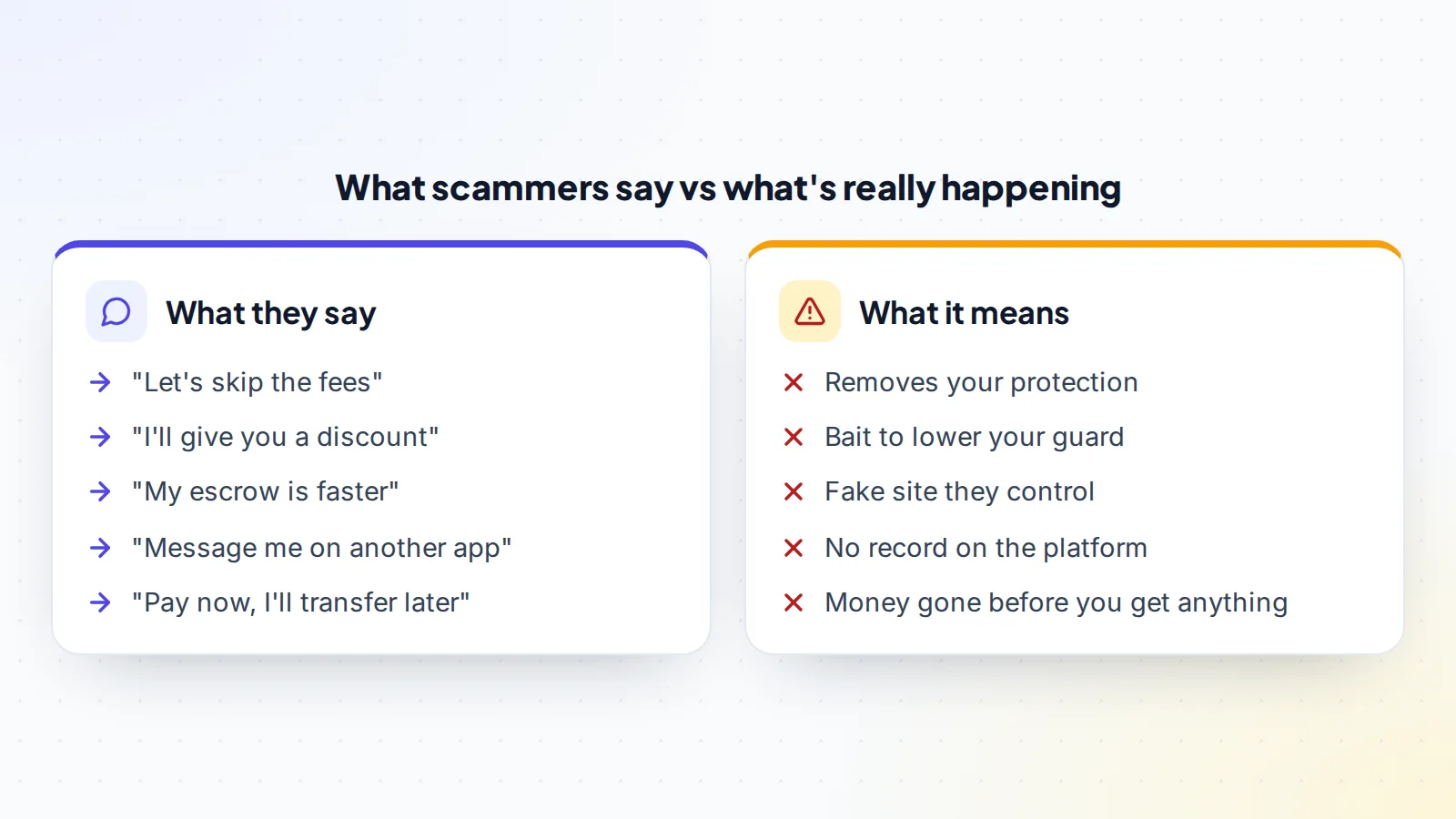
- “Let’s skip the platform fees.” Splitting a saving sounds like a win for both sides. In practice, it removes your protection to save a small amount.
- “I’ll give you a discount if you pay directly.” A lower price is bait to make you ignore the risk.
- “My escrow service is faster.” The link leads to a fake escrow site the scammer controls.
- “Let’s talk on another app, it’s easier.” Moving chat elsewhere removes the record the platform would use to help you.
- “Pay now and I’ll transfer it tonight.” Once the money’s gone, the transfer never comes.
- “The platform’s payment system is down.” A made-up problem to justify a workaround.
Scammers also create urgency: another buyer is waiting, the price goes up tomorrow, the deal must close today. The FTC warns that scammers pressure people to act immediately, so they don’t have time to think or check.
Payment methods scammers prefer
Scammers ask for payment methods that are fast and hard to reverse. The FTC says scammers often insist that people pay in ways that make it hard to get money back, such as wire transfers, gift cards, cryptocurrency and payment apps. It also says that no legitimate business will demand payment with a gift card, and that anyone who insists you pay with cryptocurrency is likely a scammer.
In an online business sale, the safe way to pay is through the deal itself: escrow or a middleman agreed on the platform, so the money is held until the buyer confirms they have what they paid for. On digiflippers.com, the ways to pay in a deal are: directly to the seller, through escrow, and the platform never holds the money itself.
The fake escrow twist
One of the most common versions uses a fake escrow company. The scammer agrees to use escrow, but suggests a service and sends a link. The site looks professional, with logos, a dashboard and email updates. But it’s controlled by the scammer. A buyer who pays into it loses the money; a seller who receives a “payment confirmed” email from it hands over the asset for nothing.
The protection is simple: choose the escrow service yourself, check it’s licensed where it operates, and type its address into your browser rather than following a link. California’s financial regulator, for example, advises checking that an online escrow company is licensed and warns about fake escrow websites. Our guide to buyer protection for digital assets covers how to choose a real one.
How sellers are targeted
Sellers face the mirror image. A fake buyer agrees a price quickly, then moves the conversation off the platform. They send a convincing “payment sent” message, a screenshot of a bank transfer, or an email that appears to come from an escrow company. Then they press for the handover: the domain transfer, the login details, the store ownership.
Sellers should never start a handover on the strength of a screenshot or an email. Confirm the payment is held by signing in to the escrow service or the platform’s deal page yourself. Our guide to non-disclosure agreements explains another way buyers can show they’re serious without asking you to drop your guard.

How to stay protected
- Keep conversations on the platform. A record of messages helps if anything goes wrong.
- Pay only through the deal process. Escrow or a middleman agreed on the platform.
- Type addresses yourself. Don’t follow payment or escrow links from the other party.
- Check the profile. Look for verification and history; be cautious with brand-new accounts.
- Confirm any change. If payment details change, check them using details you already have.
- Take your time. A genuine buyer or seller will wait a day while you check.
On digiflippers.com, profiles show verification and history, and messages stay in your deal. Before you start, you can try the free valuation tool so you know what a fair price looks like; prices far below value are a common lure.
What to say when someone asks
You don’t need to argue. A short, polite reply works: “Thanks, but I only pay and receive payments through the platform’s deal process. Happy to continue here.” Genuine people usually accept this. If the other party keeps pushing, gets angry or invents reasons why the platform can’t be used, treat that as confirmation that something is wrong, stop, and report the account.
If you’ve already paid
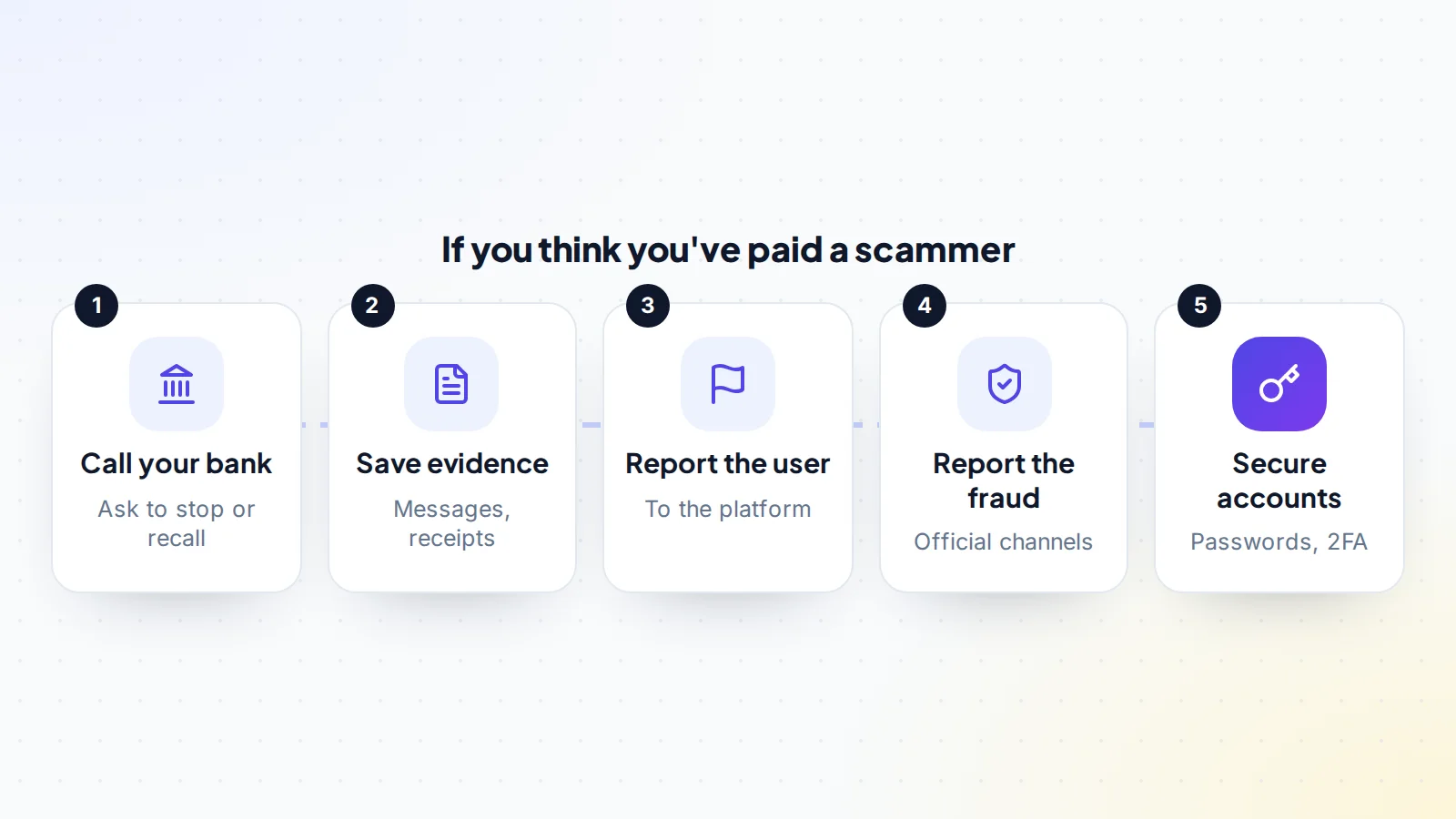
Act fast. The FTC advises contacting the company or bank you used to pay, telling them it was a fraudulent payment and asking them to reverse it. For a wire transfer, ask your bank to recall it. For a gift card, contact the company that issued the card. For a payment app, report the fraudulent transaction to the app and ask for it to be reversed. For cryptocurrency, contact the exchange or wallet you used.
Then save every message, receipt and link, report the user to the platform, and report the fraud. In the US, you can report to the FTC at ReportFraud.ftc.gov and to the FBI’s Internet Crime Complaint Center. Change passwords and turn on two-factor authentication for any account you shared. If you gave access to a business asset, contact the platform that runs it straight away. Our guide to sale disputes explains what to do when a genuine deal goes wrong, as opposed to a scam.
Common variations
The basic pattern appears in several forms, and knowing them makes each easier to spot:
- The overpayment: a fake buyer “accidentally” sends too much and asks for the difference back, before the original payment bounces.
- The fake middleman: someone claims to be a trusted middleman or platform agent and offers to handle the deal outside the normal process.
- The deposit request: a fake seller asks for a small “holding deposit” off the platform to reserve the asset, then asks for more.
- The account takeover: after moving to another app, the scammer sends a link that asks you to sign in, capturing your password.
- The changed details: mid-deal, a message says payment details have changed, sometimes from an account that looks like the real seller’s.
Each one ends the same way: money or access moves outside the protected deal, where it can’t be recovered.
Warning signs, all in one place
- A request to talk or pay outside the platform.
- An escrow service you’ve never heard of, suggested by the other party.
- Payment by gift card, crypto to a personal wallet or a wire to an unrelated name.
- Urgency, threats or a deadline with no clear reason.
- A price far below what similar assets sell for.
- A brand-new profile with no history or verification.
- Payment “confirmations” that arrive only by screenshot or email.
Why this scam works
Off-platform scams work because each step feels small and sensible. Saving fees is reasonable. Using another app is convenient. A discount is welcome. Scammers rely on people focusing on the deal, not the process. They also rely on trust built over several friendly messages, so the request to move feels like a natural next step. Knowing the pattern is the best defence: once you recognise the move off-platform as the scam itself, the rest is easy to spot.
What the platform can and can’t do
Inside the platform, there’s a record of who said what, profiles that show verification and history, and a deal process designed to protect both sides. That’s what makes it possible to investigate problems, act against bad accounts and support a dispute. Outside it, the platform can’t see the conversation or the payment, so it can’t help in the same way. That’s why the safest rule is the simplest one: keep the whole deal, from first message to final payment, where it can be seen.
A worked example
The details below are made up to show the method.
Ali is selling a small e-commerce store. A buyer makes a strong offer within an hour of the listing going live, then suggests moving to a messaging app “to speed things up”. Ali agrees to keep talking but stays on the platform. The buyer then proposes paying through an escrow service and sends a link, offering to cover the fee.
Ali searches for the escrow company independently, finds no licence information, and sees the domain was registered a few weeks earlier. Ali replies that payment must go through the platform’s deal process. The buyer says the platform is “too slow” and adds a deadline. Ali stops, reports the account, and relists. A week later, a verified buyer completes the purchase through escrow on the platform.
Off platform payment scam: the checklist
- All messages kept on the platform.
- Payment only through the platform’s deal process.
- Escrow chosen by you, licensed and typed in yourself.
- Other party’s profile verified, with history.
- No handover until payment is confirmed at the source.
- No gift cards, personal crypto wallets or unrelated wire accounts.
- False deadlines ignored.
- Suspicious accounts reported.
- Bank contacted immediately if money was sent.
Ready to find your next asset?
Browse listings with verified numbers, ask sellers your questions before you offer, and agree every step in a free Deal Room.
Frequently asked questions
What is an off-platform payment scam?
A scam where someone persuades you to talk and pay outside a marketplace’s deal process, removing its record and protection, then takes the money or the asset.
Is it ever safe to pay outside the platform?
It removes the platform’s record and protection. The safest choice is to pay through the deal process with escrow or a middleman agreed on the platform.
How do I spot a fake escrow site?
Choose the escrow service yourself, check its licence, and type its address in. Be wary of any service suggested by the other party with a link.
What payment methods do scammers prefer?
Ones that are hard to reverse, such as gift cards, cryptocurrency, wire transfers and some payment apps.
What should I do if I’ve already paid?
Contact your bank or payment provider immediately to ask them to reverse or recall it, save the evidence, and report it to the platform and the authorities.
As a seller, how do I confirm a payment?
Sign in to the escrow service or the platform’s deal page yourself. Never rely on a screenshot or an emailed confirmation.
Why would a scammer offer to pay the fees?
To make the move off the platform seem generous. The fee saving is bait.