How Much Is a Domain Name Worth? The Factors That Matter
What really decides domain name value: length, extension, meaning, brandability, comparable sales, history and traffic, with examples and a scoring checklist.

“How much is my domain worth?” is one of the most common questions in the digital-asset market, and one of the hardest to answer with a single number. Domain name value isn’t set by a formula; it’s set by what the best-matched buyer is willing to pay. But that doesn’t make it random. A small set of factors predicts how many buyers want a name and how much they’ll pay.
This guide explains those factors one by one: length and clarity, extension, commercial meaning, brandability, comparable sales, history and traffic. You’ll also learn how to use automated appraisals sensibly, how to score names side by side, and what to do with the result whether you’re buying or selling.
It applies to the common generic extensions such as .com, .net and .org, and to country-code domains with some extra caveats we’ll mention.
Key takeaways
- Domain value comes from demand: how many buyers want the name, and how much it’s worth to the best of them.
- Short, clear, meaningful names in strong extensions attract the most buyers.
- Comparable public sales are the best evidence of price; automated appraisals are only a rough guide.
- A clean history matters; a name that copies a trademark is a liability, not an asset.
- For buyers, value also includes what the name saves you: rebranding later, lost type-in visitors, trust.
Why domain value is hard to pin down
Most digital assets can be valued on what they earn. Domains usually can’t, because most domains for sale earn little or nothing on their own. Their value is in what someone could build with them, which is different for every buyer. A short name about insurance might be worth a lot to an insurer and very little to anyone else.
The market is also enormous. Verisign’s Domain Name Industry Brief reported 401.6 million domain name registrations across all extensions at the end of the second quarter of 2026, with the .com base at 166.6 million. With so many names registered, scarcity of good ones is real, but so is the long tail of names nobody wants.
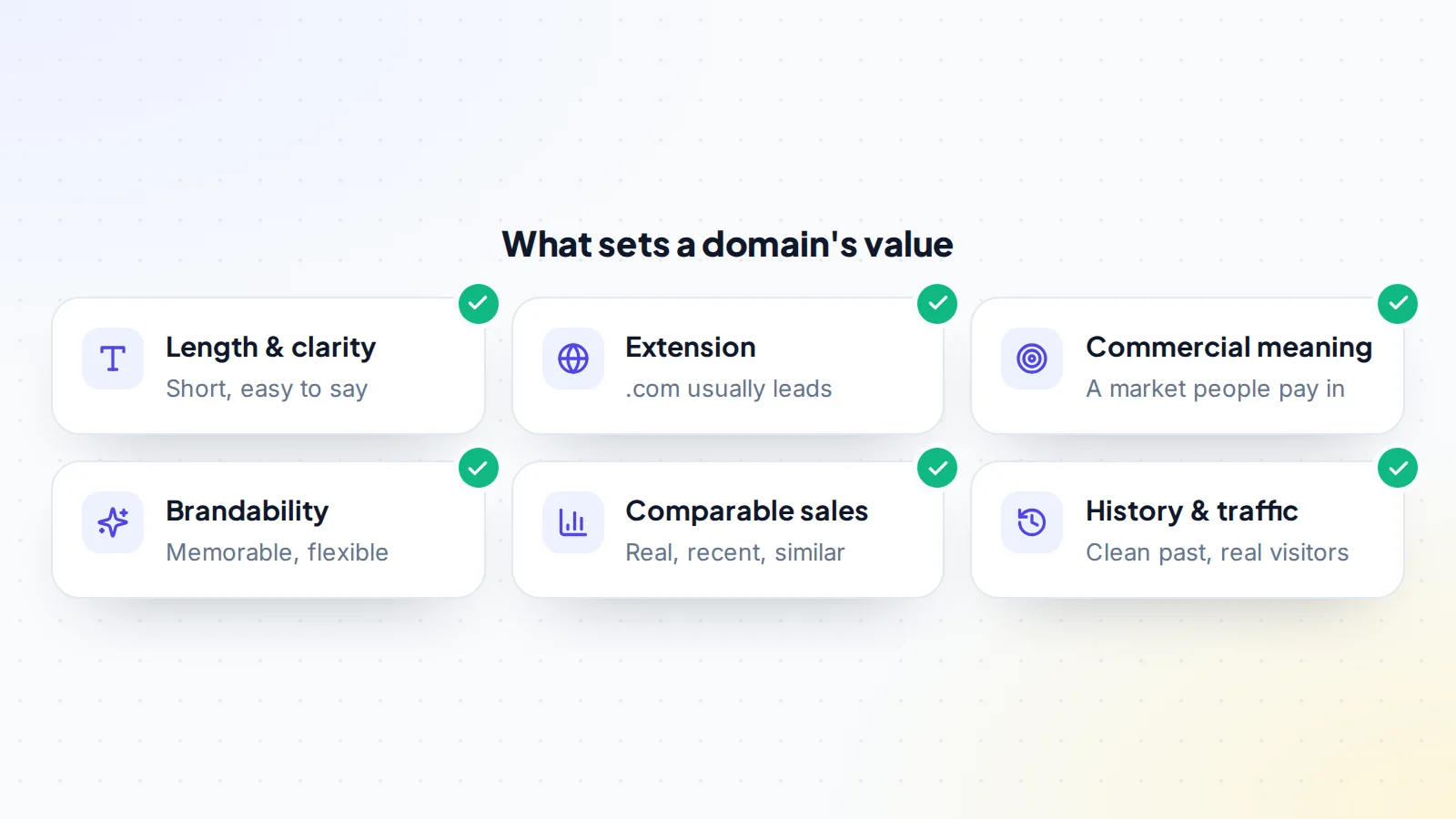
Factor 1: Length and clarity
Shorter names are easier to remember, type and fit on a logo, so more buyers want them. But clarity matters as much as length. A name passes the “radio test” if you can say it out loud and people type it correctly without help. Hyphens, numbers that could be spelled out, unusual spellings and doubled letters all make a name harder to use and lower its value.
Very short names (a few letters) are valuable mainly because they’re scarce. For most buyers, a slightly longer name that’s instantly clear is worth more than a short one that needs explaining.
Factor 2: The extension
The extension (.com, .net, .io, .co.uk and so on) strongly affects value. For businesses with global ambitions, .com remains the default, and the same name in .com typically sells for much more than in other extensions. That’s partly habit: many people assume a business is at the .com, so owning it captures type-in visitors and avoids confusion.
Other extensions can still be valuable when they fit a use: country codes for local businesses, or industry extensions that make sense for a specific audience. Country-code domains also come with their own registry rules, sometimes including residency requirements, which can limit the pool of buyers. Our guide to domain extensions compares the main options.
Factor 3: Commercial meaning
A name that matches a product or service people spend money on has more potential buyers, and those buyers have bigger budgets. Words connected to finance, insurance, health, software, travel and other large markets tend to command more than names in small hobby niches. Exact descriptive names are especially attractive to businesses that want to be seen as “the” place for something.
Factor 4: Brandability
Not every valuable domain is a dictionary word. Invented or blended names, short, pronounceable and easy to trademark, can be very attractive to startups that want a distinctive brand. Their value depends on sounding good, being easy to spell and not resembling an existing brand. See brandable domain names.
Factor 5: Comparable sales
The best evidence of what a domain might sell for is what similar names have actually sold for. Look for public sales of names with similar length, extension, meaning and style, ideally recent ones. Be careful with comparisons: a single famous sale of a one-word .com says little about a three-word .net. Look for patterns across several sales rather than one headline.
Factor 6: History and traffic
Check a domain’s past on the Internet Archive’s Wayback Machine. A name previously used for a respected project is a plus; a name used for spam can carry baggage with email providers and search engines. Our domain history check covers what to look for.
Some domains also receive traffic: type-in visitors or links from old websites. Real, relevant traffic adds value, especially if the domain can be shown to earn from it. Parked pages with ads can provide a small income while you wait for a buyer; see domain parking.
The factor that removes value: trademarks
A domain that copies or closely resembles someone else’s trademark isn’t valuable to anyone except the trademark owner, and they can often take it rather than buy it. ICANN’s Uniform Domain-Name Dispute-Resolution Policy provides a procedure for trademark owners to bring complaints about abusive registrations. Before you value, buy or list a name, search trademark databases in the countries that matter.
Automated appraisals: useful, but limited
Automated appraisal tools estimate a value from patterns in past sales and keyword data. They’re quick and free, and they can be useful for spotting names that are obviously worthless or obviously worth a closer look. But different tools often give very different numbers, and none of them knows how much a specific buyer needs a specific name. Treat appraisals as one input among several. Be especially wary of paid appraisals pushed by a “buyer” who contacts you out of the blue; it’s a well-known scam.
Scoring names side by side
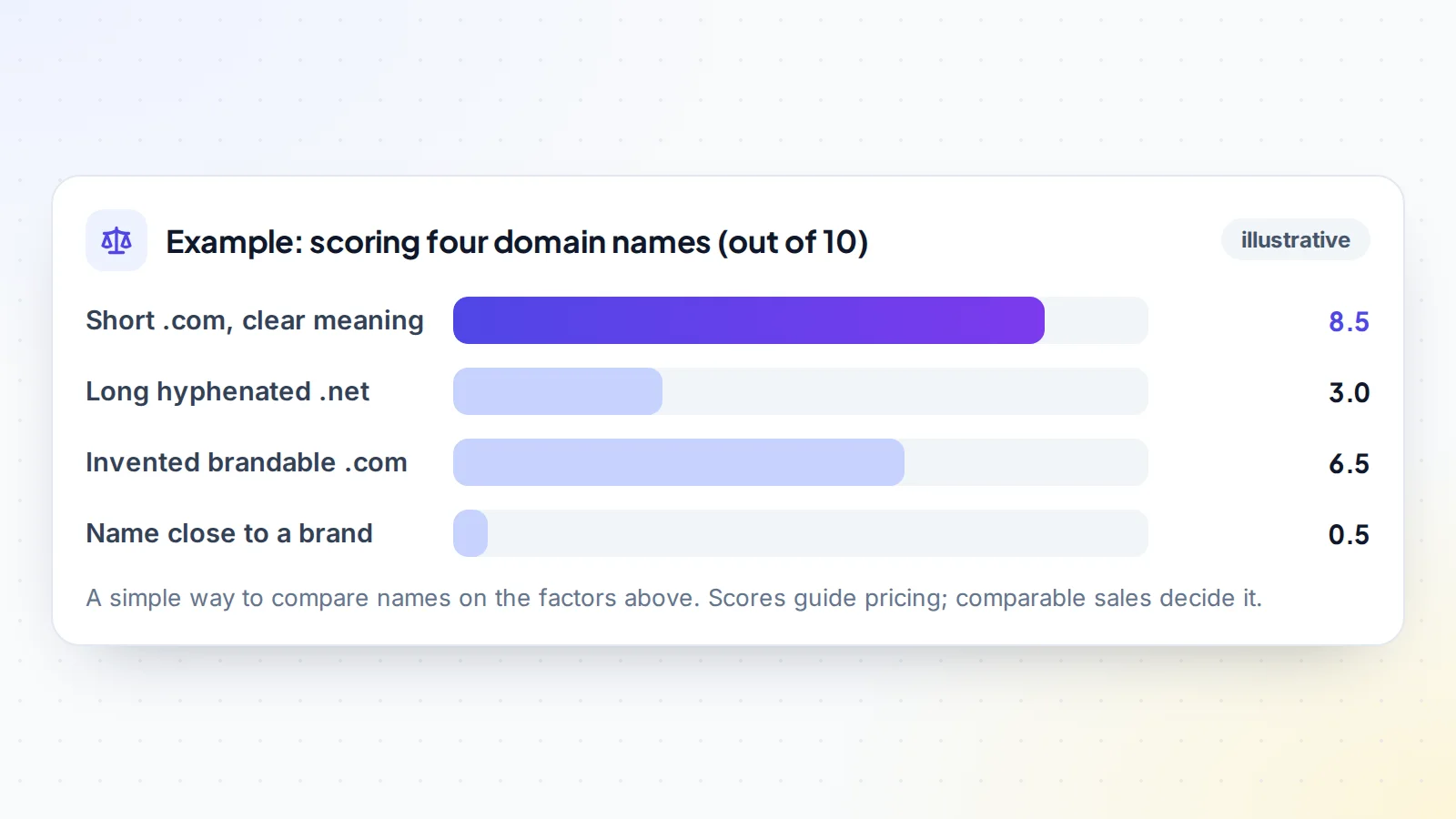
A simple way to compare names is to score each on the factors above (length and clarity, extension, meaning, brandability, history) and note any trademark risk. The total won’t give you a price, but it helps you rank names in a portfolio, spot the ones worth pricing higher and avoid paying too much for a weak name.
For buyers: what a domain is worth to you
As a buyer, the market value of a domain is only half the story. The other half is what it’s worth to your business: the cost of rebranding later if you start with a weaker name, visitors who type the .com and end up somewhere else, and the trust a clear name creates. Those can justify paying more than an appraisal suggests. Decide your walk-away price before you contact an owner; our guide to buying a domain that’s taken covers negotiation, and premium domains explains when high prices make sense.
For sellers: pricing your domain
As a seller, price on evidence: your scores, comparable sales and the pool of likely buyers. A price far above what similar names sell for will be ignored; a fair price with a clear way to buy (a fixed price, or an offer form) sells faster. When a buyer agrees, use escrow or a trusted middleman and follow the domain transfer process. You can list domains for sale on digiflippers.com for free, and get a quick range from the valuation tool.
Who buys domains, and why it matters
The same name is worth different amounts to different buyers, so it helps to know who the likely buyers are. End users (businesses that will build on the name) usually pay the most, because the name is worth more to them than to anyone else; they’re also the hardest to find. Domain investors buy names to resell, so they pay prices that leave room for profit, typically well below what an end user would pay. Startups look for brandable names within a budget and often move fast once they find the right one. When you think about domain name value, ask which of these groups would want the name, and how many of them exist. A name with a large pool of potential end users is worth more than one that appeals only to investors.
Can you increase a domain’s value?
You can’t change a name’s length or meaning, but you can make it easier to sell and more attractive to the right buyer. Point it to a clean “for sale” page with a clear price or offer form, so anyone who types it can reach you. Keep it renewed well ahead of expiry, so buyers aren’t put off by a lapsing name. Check and, if needed, clean up its history: a name that sends spam or redirects somewhere odd puts buyers off. And list it where buyers look, with an honest description of who it suits. These steps don’t change what the name is, but they change how many buyers see it and how confident they feel.
A worked example
Consider three names for a budgeting app. The first is a short, two-word .com that says exactly what the product does. The second is the same words in a less common extension. The third is an invented, five-letter .com with no meaning yet. The first has the most potential buyers: any personal finance company could use it, and comparable sales of similar two-word .com names give a clear range. The second is easier to afford but loses type-in visitors to whoever owns the .com, so it’s worth much less. The third depends entirely on whether a startup loves the sound of it; its value is the most uncertain but can be high for the right buyer. That’s domain name value in practice: same idea, very different prices.
Common valuation mistakes
- Trusting one appraisal. Use several inputs and look for agreement.
- Comparing with outliers. A famous record sale says little about an ordinary name.
- Ignoring renewal costs. Some premium-priced registrations renew at high prices every year, which buyers will factor in.
- Forgetting the buyer pool. A clever name with only one plausible buyer is hard to sell at any price.
Domain name value: the checklist
- Length and clarity checked; the name passes the radio test.
- Extension considered for the likely buyers.
- Commercial meaning and size of the market judged.
- Brandability assessed for invented names.
- Several comparable public sales found.
- History checked on the Wayback Machine.
- Trademark conflicts ruled out.
- Traffic and any parking income verified.
- Automated appraisals used only as a rough guide.
- Price range written down before negotiating.
Ready to find your next asset?
Browse listings with verified numbers, ask sellers your questions before you offer, and agree every step in a free Deal Room.
Frequently asked questions
How do I find out how much my domain is worth?
Score it on length, extension, meaning, brandability and history, look for comparable public sales and check for trademark conflicts. Automated appraisals can give a rough starting point.
Are .com domains always worth more?
Usually, for the same name, because .com remains the default for global businesses. Other extensions can be valuable when they fit a specific use or market.
Are domain appraisals accurate?
They’re rough estimates. Different tools often disagree, and none can see how much a specific buyer needs a specific name.
Does an old domain have more value?
Age alone doesn’t make a domain valuable. A clean history, real traffic and links can add value; a history of spam reduces it.
Can a domain lose value?
Yes: if the market it relates to shrinks, if a trademark conflict appears, or if its reputation is damaged by misuse.
Should I price my domain for investors or end users?
If you can reach end users, price for them, since they usually pay the most. If you want a quick sale, investors are faster buyers but expect lower prices.
How long does it take to sell a valuable domain?
It varies widely. Fairly priced names with clear meaning can sell quickly; very expensive names may wait months or years for the right buyer.
What makes a domain worthless?
Names that are long, confusing, hard to spell, tied to someone else’s trademark or with no clear use for any buyer.