Financial Due Diligence: Bank Statements, P&L and Payouts
How to check an online business's finances before you buy: revenue at the source, payouts, costs, refunds, trends and add-backs, step by step.

Financial due diligence is the part of buying an online business where you confirm that the money is real. It’s not glamorous, but it’s where most bad purchases could have been stopped: revenue that never reached a bank account, costs that weren’t mentioned, a record month presented as normal. Done carefully, it turns the seller’s numbers into numbers you can trust.
This guide walks you through financial due diligence step by step for websites, online stores, SaaS products, newsletters and other digital businesses. You’ll learn what to ask for, how to follow the money from dashboards to bank statements, how to check costs, refunds and trends, how to judge add-backs and how to spot manipulated figures.
It’s one part of a wider process; our pillar guide to online business due diligence covers the rest.
Key takeaways
- Verify revenue at the source: live dashboards or read-only access, never screenshots alone.
- Follow the money from income dashboards to payout reports to bank deposits.
- List every cost and check the larger ones against invoices.
- Look at refunds, chargebacks and the trend, not just the total.
- Accept only add-backs that are real, documented and non-recurring.
What to ask the seller for
Start by asking for these, ideally covering at least the last 12 months and preferably 24:
- A profit and loss statement by month, with revenue by source and costs by category.
- Access to income dashboards: ad networks, affiliate programmes, payment processors, store platforms or billing systems, through read-only access or a live screen share.
- Payout reports from each processor or platform.
- Bank or payment account statements showing the deposits, with unrelated personal transactions hidden if the seller prefers.
- Invoices for significant costs and for any sponsor or client income.
- A list of add-backs with documents.
A seller who has nothing to hide will usually provide these readily. If they hesitate, ask why; there may be a reasonable explanation, or there may not.
Step 1: Verify revenue at the source
Screenshots and spreadsheets are easy to edit. Ask to see each income dashboard live, where you choose the date ranges and the seller clicks where you ask, or ask for read-only access. Look at revenue by month and by source, and note anything unusual: spikes, drops, new sources appearing just before the sale. Our guide to spotting fake revenue screenshots shows what manipulated images often look like.
On digiflippers.com, sellers can connect some accounts with read-only access so their listings show figures verified at the source, marked so you can see they weren’t typed by hand. Read why verified metrics beat screenshots. It’s a strong starting point, but still match the figures to payouts.
Step 2: Follow the money to the bank
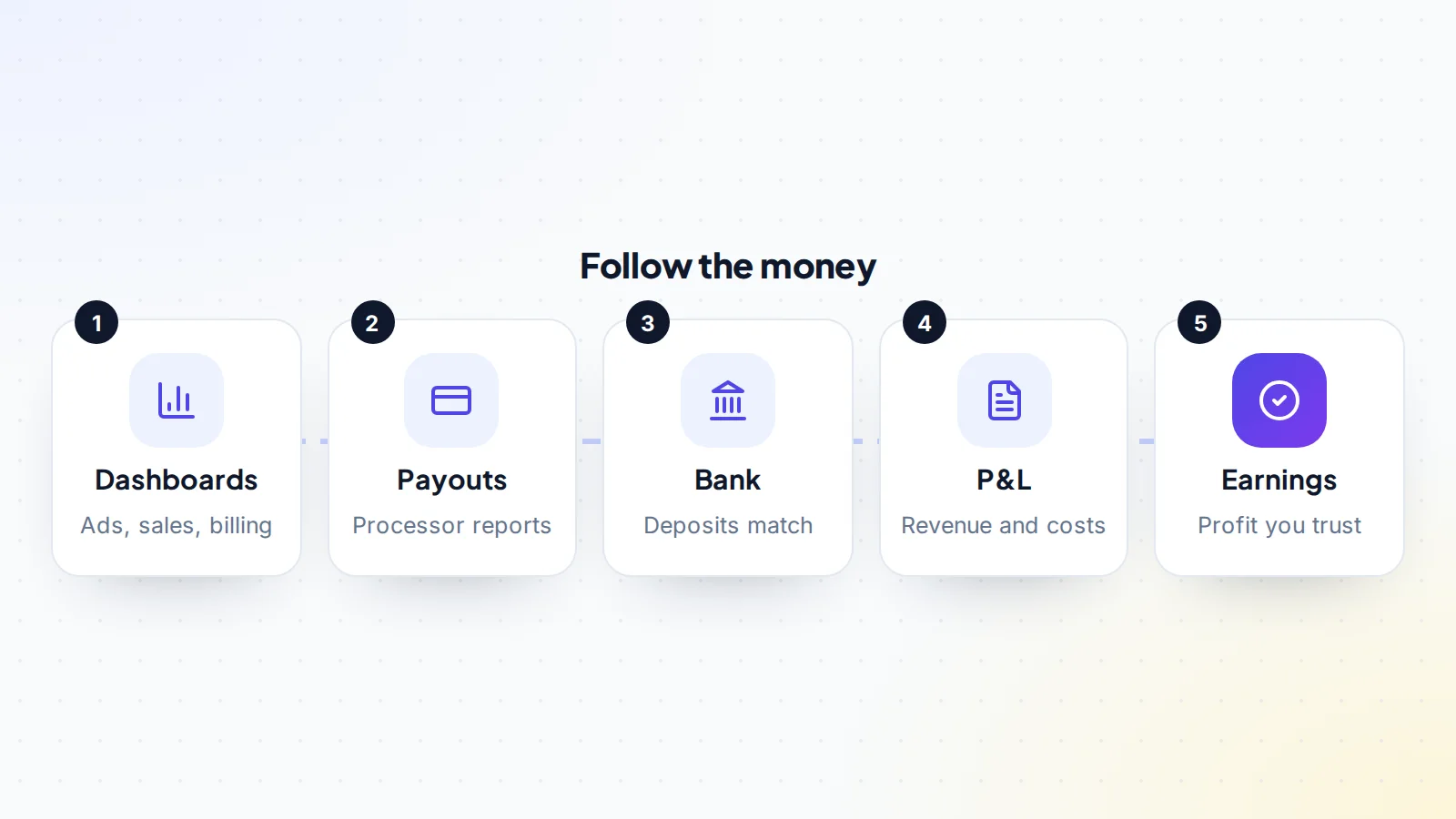
This is the single most reliable check in financial due diligence. Income shown in a dashboard should appear as payouts from that platform, and those payouts should arrive as deposits in the seller’s bank or payment account, allowing for the platform’s payment schedule and fees. Pick several months, including the best and the most recent, and trace them all the way through.
If revenue appears in a dashboard but never reaches a bank, ask why. Common legitimate reasons include platform payment thresholds, currency conversions or a separate business account; common illegitimate ones include fabricated dashboards or revenue that was reversed.
Step 3: Check every cost
Profit is only as reliable as the cost list. Go through the profit and loss statement with the seller and make sure it includes:
- Hosting, domains, software subscriptions and tools.
- Content, design, development and support, whether paid to freelancers, staff or agencies.
- Advertising and marketing.
- Platform, marketplace and payment processing fees.
- Cost of goods, shipping and returns for stores.
- Any contractor who does work the seller didn’t mention.
Then ask what the seller does personally. Work the owner does for free is a cost to any buyer who won’t do it. See seller’s discretionary earnings for how this is handled.
Step 4: Refunds, chargebacks and reversals
Refunds and chargebacks reduce real income and can signal problems with products, marketing or fraud. Ask for them by month and compare with revenue. For affiliate businesses, check reversed commissions too, since programmes often cancel commissions for returned orders. A business with steady, explained refunds is healthier than one where refunds are missing from the numbers entirely.
Step 5: Look at the trend, not the total
A twelve-month total can hide a business that’s shrinking. Plot revenue and profit by month. Compare the last three months with the twelve-month average. Look for seasonality (many businesses have strong and weak months) and for one-off spikes from launches, viral posts or large single sales. A price based on a peak or a temporary spike will disappoint.
Step 6: Test the add-backs
Sellers often adjust profit with add-backs: the owner’s salary, personal expenses and one-off costs. Each one should be documented and genuinely non-recurring. Be wary of costs the business still needs (writers, tools, ads) being added back, and of “one-off” costs that appear every year. Our guide to add-backs explains how to judge them, and revenue vs profit valuation covers why profit is the anchor.
Step 7: Liabilities and obligations
Financial due diligence isn’t only about income. Ask what the business owes or has promised: unpaid invoices to freelancers or suppliers, prepaid annual plans customers have already paid for (you’ll be serving them without receiving that money), sponsor deals paid in advance, affiliate commissions due, outstanding refunds, and any subscriptions or contracts that renew automatically. In an asset sale, many of these stay with the seller, but some (such as serving prepaid customers) effectively pass to you. Agree in writing who covers what, and adjust the price for anything you’ll inherit.
Questions to ask about the numbers
- Which months were unusually good or bad, and why?
- Have prices, products or traffic sources changed in the last year?
- Which costs do you pay personally, outside the business accounts?
- Are any income sources likely to change their terms soon?
- Are there any refunds, disputes or chargebacks still open?
- What would revenue look like if you stopped all advertising for a month?
Good answers come with evidence. Write each answer into your findings and check it against the data.
Checks by type of business
- Content and affiliate sites: ad and affiliate dashboards, reversals, and dependence on one programme.
- Online stores: margins after cost of goods, shipping and returns; stock levels; supplier terms.
- SaaS: MRR, churn, refunds and failed payments from the billing system. See SaaS metrics.
- Newsletters: sponsor invoices matched to payments; paid subscriptions and churn.
- Digital products: sales by product, refunds and platform fees.
Seasonality and one-off events
Many online businesses have strong and weak months. Gift-related stores peak before holidays, education products around the start of school terms, finance content at tax time, travel content before summer. If you only look at the most recent months, you can easily overvalue or undervalue a seasonal business. Compare the same months year on year where you can, and ask the seller to explain every unusual month: a viral post, a launch, a big sponsor, a platform change. One-off events aren’t bad in themselves, but they shouldn’t be treated as the normal level of income.
Simple tools that help
You don’t need special software. A spreadsheet with one row per month and columns for each income source, each cost category, payouts and bank deposits is enough to see whether everything lines up. Add a column for notes, and fill it in as the seller answers your questions. A simple line chart of revenue and profit over 24 months often reveals more in a minute than an hour of reading statements. Keep everything in the same place as your deal conversation so there’s one record of what you checked and what you found.
A worked example
A seller lists a store selling digital planners with $4,000 a month of profit. The store’s sales dashboard matches the listing. Payout reports from the payment processor match the dashboard, minus fees. Bank statements show the payouts arriving each week. So far, so good.
The profit and loss statement, though, shows no advertising cost, while the traffic report shows a large share of paid social visitors. Asked about it, the seller explains that ads are paid from a personal card. Adding those costs in reduces profit to $2,900 a month. Nothing dishonest was intended, but the price based on $4,000 would have been far too high. This is exactly the kind of gap financial due diligence exists to find.
Red flags in the financials
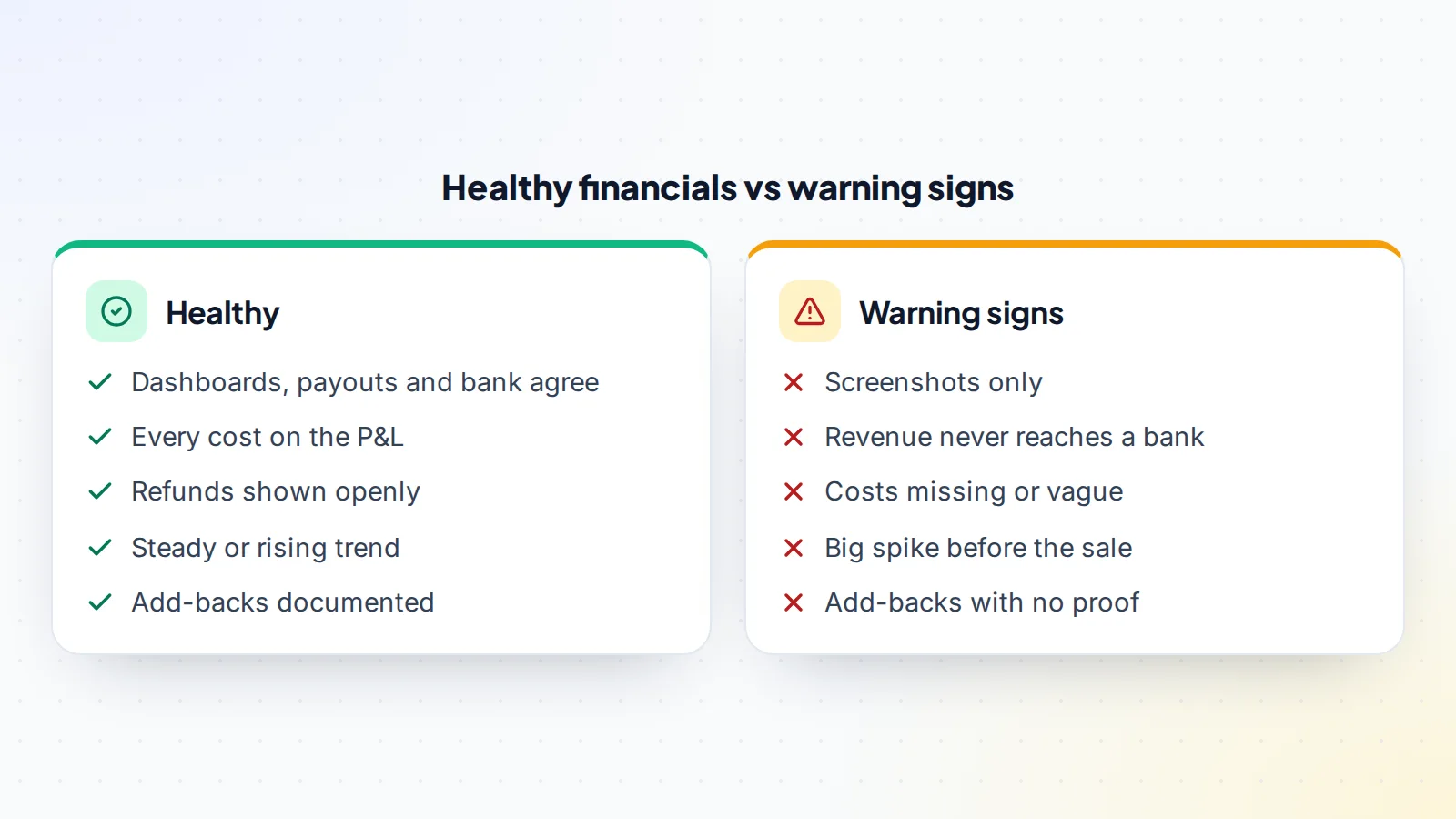
- Revenue that can’t be traced to a bank account. Treat it as unverified until explained.
- Round, unchanging numbers month after month, which real businesses rarely produce.
- A sharp rise in the months before the sale with no clear cause.
- Costs that look too low for the size of the business.
- Several income sources started recently, so there’s little history to judge them on.
- Reluctance to share anything beyond screenshots.
For sellers: making this easy
If you’re selling, you can shorten financial due diligence dramatically by preparing in advance. Keep business and personal money in separate accounts, export a monthly profit and loss statement, save payout reports from every platform, and list each add-back with its invoice. Give buyers read-only access rather than screenshots. Buyers who can verify quickly make faster, firmer offers, and fewer of them walk away halfway through.
When to bring in an accountant
For small, simple deals, many buyers do this work themselves. Bring in an accountant when the business has several entities, staff, inventory, significant tax questions, or when the numbers don’t reconcile easily. The SBA’s guide to buying a business notes that an attorney and an accountant can help evaluate documents such as financial statements and tax returns. Their fee is small compared with a pricing mistake.
After due diligence
Write up your findings: confirmed revenue, confirmed costs, accepted add-backs, the trend and any concerns. Use them to set your offer and explain it to the seller. Then protect the payment: use escrow or a trusted middleman so the money is held until the business is in your hands; see escrow vs direct payment. Agree a timeline with the seller too; our guide to the due diligence timeline shows typical stages.
Financial due diligence: the checklist
- 12–24 months of profit and loss by month.
- Every income dashboard seen live or read-only.
- Several months traced from dashboard to payout to bank deposit.
- Every cost category present; larger costs matched to invoices.
- Owner’s own work identified and costed.
- Refunds, chargebacks and reversals reviewed.
- Trend plotted; spikes and seasonality explained.
- Add-backs documented and tested.
- Type-specific checks done (stores, SaaS, newsletters, content).
- Findings written up and used to set the offer.
Ready to find your next asset?
Browse listings with verified numbers, ask sellers your questions before you offer, and agree every step in a free Deal Room.
Frequently asked questions
What is financial due diligence?
It’s the process of confirming a business’s revenue, costs and profit before you buy, by checking them at the source and matching them to real payments.
What documents do I need?
A monthly profit and loss statement, income dashboards, payout reports, bank statements, cost invoices and documents for any add-backs.
Is a screenshot of revenue enough?
No. Screenshots are easy to edit. Use live screen shares, read-only access and bank statements instead.
How far back should I check?
At least 12 months, and 24 if available, so you can see trends and seasonality.
What if the seller mixes personal and business finances?
It’s common in small businesses. Ask the seller to separate them on the profit and loss statement and document any personal costs added back.
Should I check tax returns?
For larger deals, yes, ideally with an accountant. Tax returns help confirm that reported income matches what the business declared.
Can I rely on a verified badge?
A verified badge means the figures came from the source rather than being typed in. It’s a strong start, but still trace a few months through to bank deposits before you pay.
What if numbers don’t match?
Ask for an explanation and evidence. Small differences from timing and fees are normal; large unexplained gaps are a reason to pause or walk away.
How long does financial due diligence take?
For a small online business, often a few days to a week once the seller provides access and documents.