Escrow Fees Explained: Who Pays and How Much
How escrow fees work for websites, domains and other digital assets: percentages, minimums, payment-method costs, who pays and how to compare.
Escrow is the safest way to pay for a website, domain or other digital asset between people who don’t know each other, but it isn’t free. Escrow fees are usually a small percentage of the deal, and how they’re calculated, who pays them and what extras apply can make a real difference on larger sales. Knowing the details helps you compare providers and agree terms without surprises.
This guide explains how escrow fees work in practice: the common fee structures, minimums, payment-method and currency costs, optional services, who usually pays, how to compare providers and when the fee is clearly worth it. It applies to domains, websites, SaaS, social media accounts and other digital assets.
For the process itself, read how escrow works when you buy an online business.
Key takeaways
- Most escrow companies charge a percentage of the price, usually in tiers that fall as the amount rises, often with a minimum fee.
- Payment method, currency conversion and optional services can add to the cost.
- Who pays is negotiable: the buyer, the seller or a split. Agree it before opening the transaction.
- Use each provider’s own fee calculator for exact figures; rates change.
- Compared with the risk of paying directly, the fee is usually small, especially on larger deals.
How escrow companies charge
Escrow companies are paid for holding funds safely, verifying the payment, managing the release and handling disputes. Their main fee is usually calculated on the purchase price. Many providers use tiers: a higher percentage on smaller transactions and a lower percentage as the amount rises. There’s often a minimum fee, so on very small deals the escrow fee can be a large share of the price.
Providers publish their own fee schedules and calculators. Escrow.com, for example, offers a fee calculator and explains that its fee is calculated on the purchase price, the service level chosen and the currency of the transaction. Always use the provider’s calculator for the exact figure on your deal, because rates and tiers change over time.
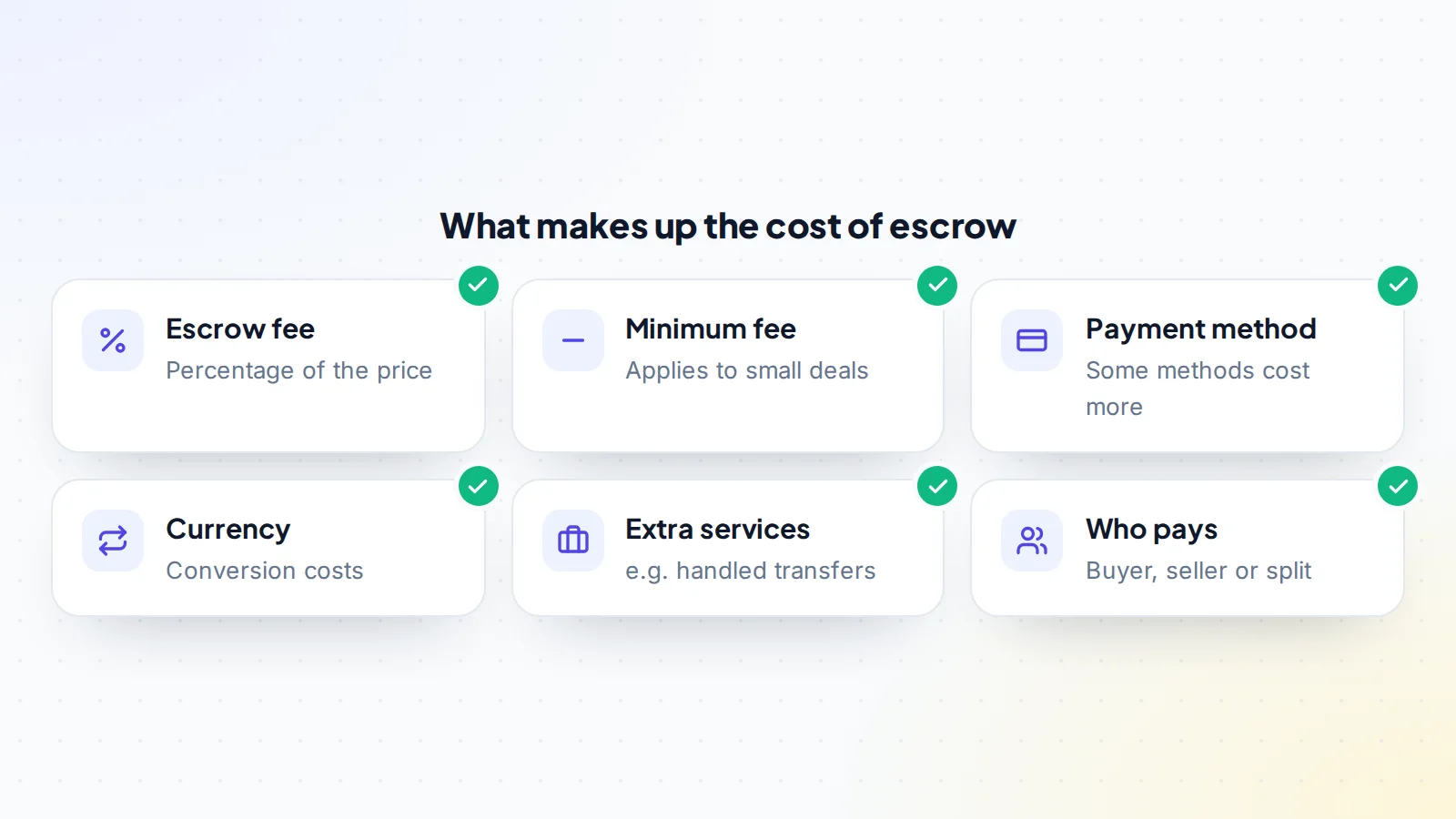
Costs on top of the escrow fee
- Payment method. Bank wires are common for larger amounts; some providers accept cards or other methods for smaller ones, sometimes with extra charges. Banks may also charge for sending or receiving international wires.
- Currency conversion. If the buyer pays in one currency and the seller is paid in another, conversion costs apply.
- Optional services. Some providers offer extras, such as handling a domain transfer on both sides, for an additional fee.
- Returns and cancellations. If a transaction is cancelled after funds arrive, some costs may not be refunded. Read the terms.
Who pays escrow fees?
There’s no fixed rule. Common arrangements are:
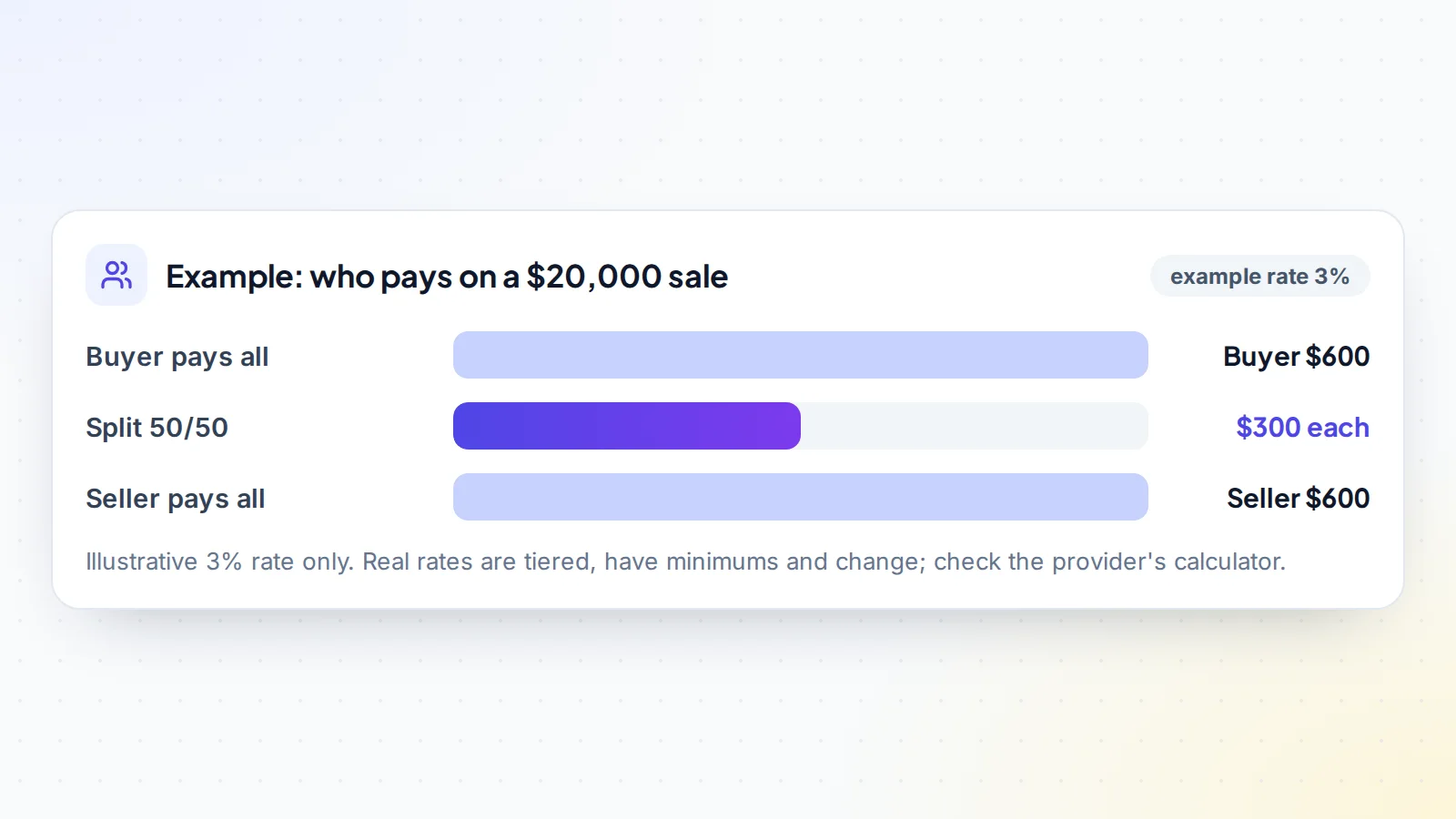
- Split 50/50: often seen as the fairest, because escrow protects both sides.
- Buyer pays: common when the buyer insists on escrow or when the seller’s price is firm.
- Seller pays: sometimes offered by sellers to make their listing more attractive.
On digiflippers.com, our escrow partner is Escrow.com, a licensed escrow company, and the fee is paid by the seller unless you agree otherwise in the Deal Room. Whatever you choose, write it into the deal terms before the transaction opens, so nobody is surprised at checkout.
How to compare escrow providers
- Licensing: is the company licensed and regulated? In California, for example, the DFPI licenses internet escrow agents and publishes a list of licensed online escrow companies.
- Total cost on your actual amount, including payment and currency costs.
- Experience with digital assets: domains and websites need specific processes.
- Inspection periods you can set to match the asset.
- Dispute process and how long it takes.
- Support: real people you can reach by phone or email.
The cheapest option isn’t always the best; a slightly higher fee for a provider with clear processes and good support can save you far more if something goes wrong.
Escrow vs other ways to pay
Escrow isn’t the only option. Direct payment costs nothing extra but leaves one side exposed; it can be reasonable for small amounts between people who trust each other. A middleman service, common for social media and game accounts, holds the payment or the asset during the handover, usually for its own fee. Read escrow vs direct payment and how middleman services work. On digiflippers.com, the ways to pay in a deal are: directly to the seller, through escrow; the middleman service fee is not offered.
When the fee is worth it
Escrow fees are clearly worth paying when:
- You don’t know the other party well.
- The amount is significant relative to what you could afford to lose.
- The asset can’t be returned easily once transferred (domains, accounts, code).
- The handover takes days, with several steps to check.
For a small deal with someone you trust and an asset you can check instantly, the fee may be harder to justify, especially where a minimum fee applies. Even then, keep a clear record of the terms and every message; see why a deal chat record matters.
Ways to reduce escrow costs
- Agree a split rather than one side paying all.
- Choose an efficient payment method for the amount, often a bank transfer for larger deals.
- Avoid currency conversion by agreeing a currency both sides can use.
- Skip optional services you don’t need, if you’re confident handling the transfer yourselves.
- Bundle related assets (a domain and its website) into one transaction where it makes sense.
A worked example
A buyer and seller agree a $20,000 website sale. Using an illustrative 3% rate to keep the arithmetic simple, the escrow fee would be $600. Split equally, each side pays $300. If the buyer pays by international wire, their bank might charge a sending fee too. Compared with the $20,000 at stake, and the risk of either side sending first, $300 each is a modest cost for a neutral party, a clear record and a defined dispute process. For the real figure, the parties would enter the amount into the provider’s fee calculator, which accounts for tiers, minimums and the payment method.
A second example: a small domain sale
Now take a $900 domain sale. Many providers apply a minimum fee, so the escrow fee on a small deal can be a much larger percentage of the price than on a big one. If the minimum were, say, $50, that’s more than 5% of the price before any payment costs. Buyer and seller might still choose escrow if they don’t know each other, because $50 is small compared with losing $900. Or, if the domain can be pushed between accounts at the same registrar within minutes and the buyer has a long, verifiable track record, they might agree a different method. The point is to compare the fee with the risk, not to treat it as a fixed cost of doing business.
Escrow fees by type of asset
The fee itself is usually based on the amount, but the type of asset affects which extras you need and how long the transaction runs. Domains are quick: once the domain is in the buyer’s account, the deal can close. Some providers offer a handled domain transfer for an extra fee. Websites take longer, with files, hosting and accounts to move, and benefit from a longer inspection period. SaaS businesses may need weeks of transition, and sometimes milestone-based releases. Social media and game accounts often use middleman services rather than escrow for smaller amounts. Plan the transaction structure around the asset, then compare the total cost.
Questions to ask an escrow provider
- What is the total fee on our exact amount, with our payment method?
- Are there extra charges for currency conversion or international payments?
- Can we set the inspection period, and what happens if it ends without a response?
- What happens to the fee if the transaction is cancelled?
- How are disputes handled, and how long do they usually take?
- Which licences do you hold, and where can we check them?
Escrow fees in negotiation
Who pays escrow fees can be a useful bargaining point. A seller holding firm on price might offer to pay the full escrow fee to close the gap; a buyer might accept a slightly higher price in exchange for the seller covering it. On larger deals, the fee is usually a small part of the conversation; on smaller deals, it can tip the balance. Either way, settle it early so it doesn’t become a last-minute sticking point.
Common mistakes
- Not agreeing who pays before opening the transaction.
- Forgetting bank and conversion costs on international deals.
- Choosing a provider because it’s cheapest without checking licensing.
- Using an escrow site the other party suggested without verifying it; fake escrow sites are a common scam. See verification and our escrow guide for how to check.
- Setting an inspection period that’s too short to check everything.
How timing affects the cost
Time matters too. Bank transfers can take a few days to arrive and clear, especially across borders, and the clock for the handover usually starts only once funds are confirmed. Long inspection periods keep money tied up for longer. None of this usually changes the provider’s charge, but it affects when the seller gets paid and how long the buyer’s money is committed. Agree realistic dates for payment, transfer and inspection at the start, so neither side feels pressured to rush the checks that the whole arrangement exists to protect.
What you get for the money
It helps to remember what the charge actually buys. A licensed escrow company verifies that the buyer’s payment has really arrived and cleared, so the seller isn’t fooled by a fake confirmation or a payment that’s later reversed. It holds the money in a protected account while the asset moves. It gives both sides a neutral record of the agreed terms, the transfer and the inspection. It runs a defined process if something goes wrong, instead of leaving two strangers to argue. And it releases the money only when the conditions both sides agreed are met. For most digital asset deals, those protections are worth far more than they cost.
Recording the cost
Keep the provider’s receipt with the rest of your deal records. For sellers, the fee is usually a cost of the sale; for buyers, it may form part of the purchase cost. How it’s treated for tax depends on where you live and how you hold the asset, so ask an accountant if the amounts are significant.
Escrow fees: the checklist
- Provider licensed and chosen by you or the marketplace.
- Exact fee checked in the provider’s calculator for your amount.
- Minimum fee, payment method and currency costs considered.
- Optional services chosen deliberately.
- Who pays agreed in writing.
- Inspection period long enough for the asset.
- Dispute and cancellation terms read.
- Escrow site address typed by hand.
Ready to find your next asset?
Browse listings with verified numbers, ask sellers your questions before you offer, and agree every step in a free Deal Room.
Frequently asked questions
How much does escrow cost?
Usually a percentage of the purchase price, often tiered so larger deals pay a lower percentage, with a minimum fee. Payment method, currency and optional services can add to it. Use the provider’s calculator for exact figures.
Who pays the escrow fee, buyer or seller?
Whoever the parties agree. Splitting it equally is common because escrow protects both sides.
Are escrow fees refundable?
It depends on the provider and when the transaction is cancelled. Read the terms before you start.
Is escrow worth it for small deals?
It depends. Minimum fees can make escrow expensive on very small amounts; a trusted middleman or a careful direct payment with a clear record may suit those better.
Do marketplaces charge escrow fees?
Escrow fees are charged by the escrow company. Marketplaces may have their own fees, which are separate. On digiflippers.com, it’s 0% success fee up to $10,000, then 5% (max $5,000), and the escrow fee goes to the escrow partner.
Is a cheaper provider always better?
No. Licensing, clear processes, experience with digital assets and responsive support often matter more than a small difference in price.
Do escrow fees change over time?
Yes. Providers update their fee schedules, so always check the current calculator rather than an old quote or article.
Can the fee be included in the price?
Yes. Some sellers raise the price slightly and pay the fee; some buyers prefer to pay it separately. Agree whichever is clearer for both sides.