Valuation Multiples Explained: Why One Business Sells for More Than Another
Why two businesses with the same profit sell for very different prices: what a multiple measures, how to convert and compare them, and what moves them up or down.

Two websites both make $3,000 a month in profit. One sells for twice the price of the other. The difference is the online business valuation multiple: the number buyers multiply the profit by to reach a price. Understanding what that number really measures is the quickest way to price a business fairly, whether you’re buying or selling.
This guide explains what a multiple is, how monthly and annual multiples relate, what a multiple implies about payback and return, which earnings figure it should be applied to, and the factors that push it up or down. It builds on our full guide to online business valuation.
Key takeaways
- A multiple turns earnings into a price. It reflects how safe, lasting and transferable the buyer thinks those earnings are.
- Always check what a multiple is applied to: monthly or annual, net profit, seller discretionary earnings or revenue.
- A monthly multiple divided by 12 gives the years it takes to earn back the price if profit stays flat.
- Age, stability, diversification, low owner dependence and verified data raise the multiple; concentration and decline lower it.
- Compare multiples only between businesses measured the same way.
What a valuation multiple is
A multiple is a shortcut. Instead of forecasting every future month of income, buyers and sellers agree how many months (or years) of current earnings a business is worth. The price is then:
Price = earnings × multiple
This is a form of what the U.S. Small Business Administration calls an earnings-based approach. Its guide to buying an existing business lists several valuation methods, including capitalised earnings, excess earnings, cash flow, and tangible and intangible asset values. For small online businesses, a multiple of recent earnings is the most common starting point, because most of the value sits in the income rather than in physical assets.
The multiple carries all the judgement. The earnings figure is a fact you can check; the multiple is the buyer’s view of how much of that income will continue, for how long, and how much work and risk it involves.
Monthly vs annual multiples
Small online businesses are often quoted on a monthly multiple: a price of “30×” means 30 times average monthly net profit. Larger companies are usually quoted on an annual multiple: “2.5×” means 2.5 times yearly earnings. They describe the same thing on different scales:
- Monthly multiple ÷ 12 = annual multiple. So 30× monthly is 2.5× annual.
- Annual multiple × 12 = monthly multiple. So 3× annual is 36× monthly.
Mixing the two is one of the most common sources of confusion in listings and negotiations. If someone quotes a multiple, ask “of what, over what period?” before comparing it with anything.
A multiple of what?
The same business can show very different multiples depending on the earnings figure underneath:
- Net profit: revenue minus all costs. The most common base for small online businesses.
- Seller discretionary earnings (SDE): net profit plus the owner’s pay and genuine one-off or personal costs. It is larger than net profit, so the multiple applied to it is usually lower. See seller discretionary earnings.
- Revenue or recurring revenue: used for some software businesses with strong growth, where profit understates value. Stripe defines monthly recurring revenue as the predictable income from subscriptions each month. A revenue multiple and a profit multiple are not comparable.
The earnings period matters too. Most buyers use the average of the last 6 to 12 months, often the trailing twelve months profit, so that one strong or weak month doesn’t distort the price. And any adjustments to profit must be justified; our guide to add-backs explains which ones buyers accept.
The same profit, two prices
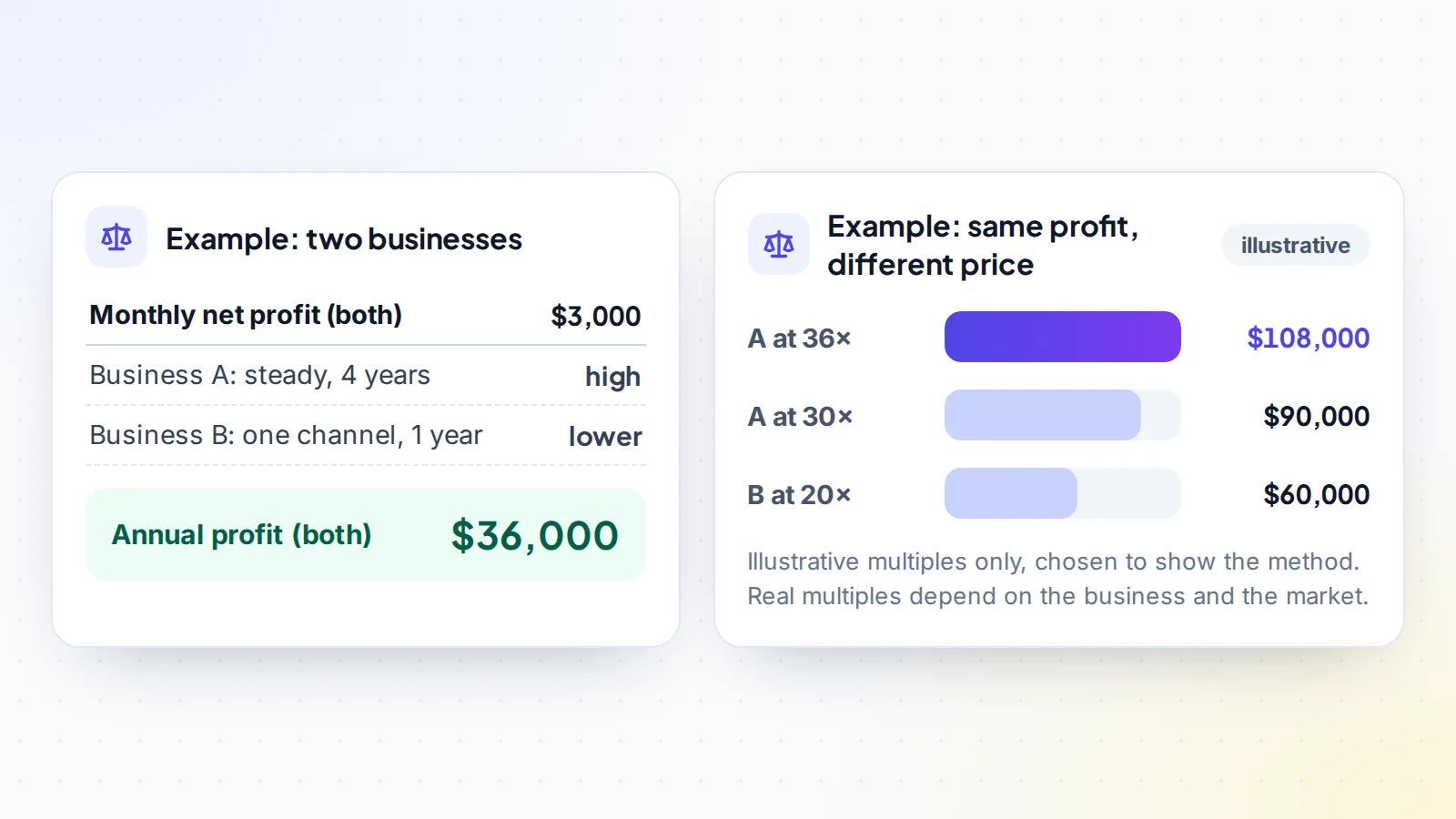
The numbers in this example are made up to show the method, not market data.
Business A is a content site that has earned around $3,000 a month for four years, from search, email and two affiliate programmes plus display ads, with a freelancer writing most articles. Business B also earns $3,000 a month, but it is one year old, gets nearly all its traffic from one social platform and its income from one affiliate programme, and the owner does all the work.
Both have $36,000 of annual profit. A buyer might reasonably offer 30× to 36× monthly profit for A, and around 20× for B. The difference isn’t the income; it’s how confident the buyer can be that the income will still be there in two or three years, and how much work it will take to keep it.
What a multiple implies: payback and return
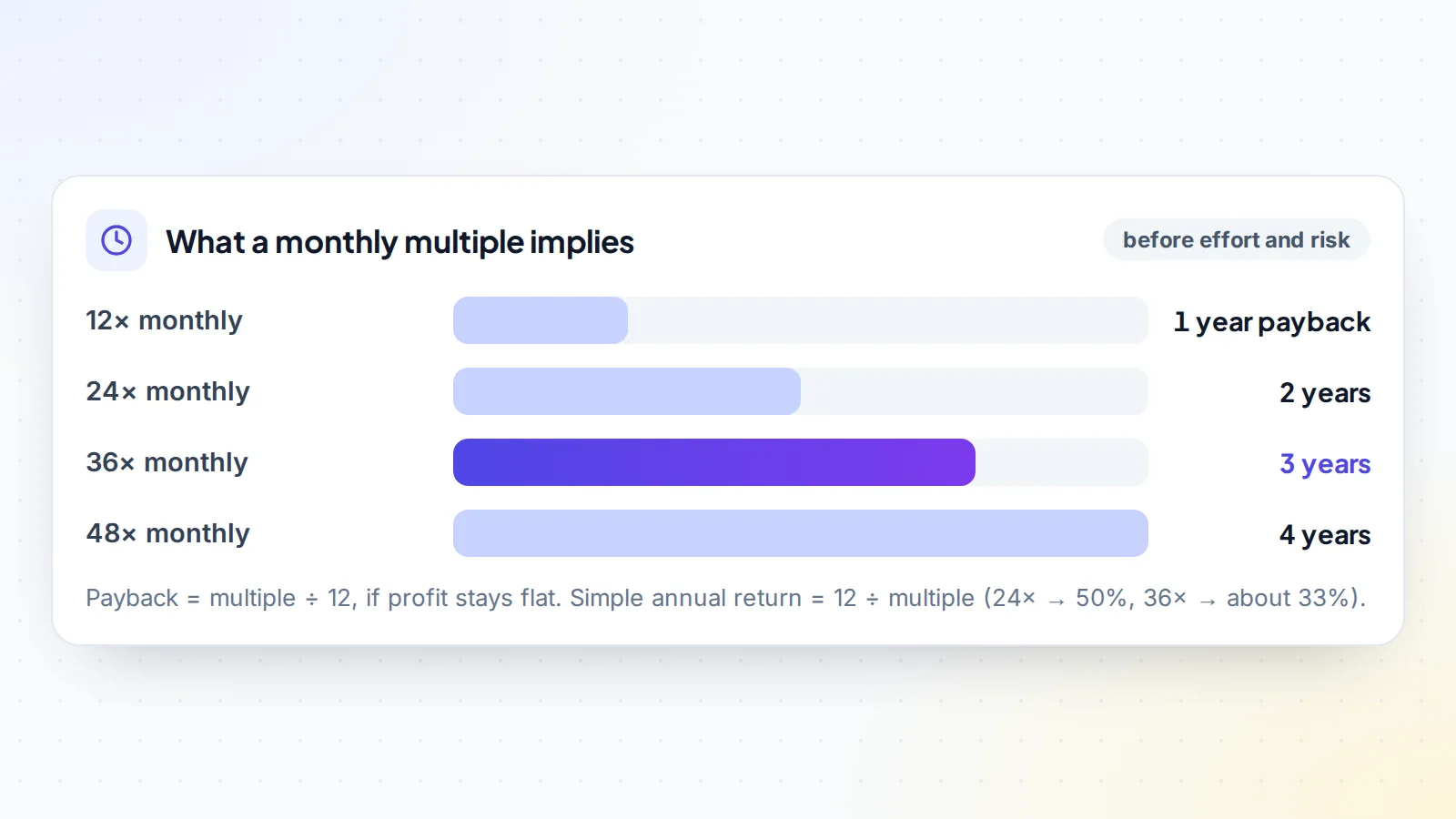
A simple way to read a monthly multiple is as a payback period. If profit stays flat, a business bought at 24× monthly profit earns back its price in 24 months, or two years. At 36×, it takes three years.
Turned around, the multiple implies a simple annual return on the price: 12 ÷ the monthly multiple. At 24×, the profit is 50% of the price each year; at 36×, about 33%. These numbers are before the buyer’s own time, the costs of running the business and the risk that profit falls, which is exactly why lower-risk businesses can command higher multiples: buyers accept a lower return for income they trust.
This also explains why multiples for small online businesses are usually far lower than for listed companies. A small site carries more risk per dollar of profit, and the buyer often has to work in it, so they need a faster payback.
What raises the multiple
- Age and a steady record: several years of stable or growing earnings.
- Diversified traffic across search, email, direct visitors and more than one platform.
- Diversified income across several products, programmes or customers.
- Recurring revenue with low churn, especially in subscription businesses. See MRR vs ARR.
- Low owner dependence: documented processes and contractors or staff who stay.
- Verified data that the buyer can check directly; see verified metrics.
- Growth headroom that a buyer can see and act on.
- A clean transfer: everything owned outright, with clear rights and no restrictions on the handover.
What lowers the multiple
- Recent decline in traffic or income.
- Concentration: one traffic source, one customer, one programme or one product doing most of the work.
- Short history or income that jumped recently.
- Heavy owner dependence, such as a personal brand or skills that aren’t documented.
- Unverified or inconsistent numbers.
- Platform risk, where a single partner’s policy change could cut income.
- Complicated or uncertain transfers.
Multiples across asset types
Different kinds of online business tend to sit in different ranges, because their risks differ. Subscription software with low churn and growing recurring revenue often attracts higher multiples than a young content site, while a business built on one marketplace or social platform often attracts lower ones. Domain names and many social or game accounts with no profit aren’t valued on a multiple at all; they’re priced on comparable sales and demand. Our guides to micro-SaaS for sale and buying an affiliate website cover those businesses in detail.
Published market ranges change with interest rates, buyer demand and the mix of businesses for sale, so treat any range you read as a starting point, check its date and source, and adjust for the specific business in front of you.
Building a multiple step by step
- Fix the earnings base: average monthly net profit (or SDE) over the last 12 months, with verified data and justified adjustments.
- Find comparables: recent sales or listings of businesses of a similar type, size and age, measured on the same base.
- Start from the middle of the comparable range.
- Adjust up for each genuine strength: age, diversification, recurring income, low dependence, verified data.
- Adjust down for each risk: decline, concentration, dependence, platform risk, transfer issues.
- Sense-check payback: would you be comfortable waiting that many months to earn back the price, given the work involved?
The free valuation tool follows the same logic, showing which factors move the range.
Why multiples change over time
An online business valuation multiple isn’t fixed even for the same business. Three things move it:
- The business itself: another year of steady earnings, a new income source or a documented process can all lift it; a drop in traffic can cut it within months.
- The cost of money: when interest rates are high, buyers can earn a safe return elsewhere, so they need a faster payback from a business and offer lower multiples. When rates fall, the opposite tends to happen.
- Buyer demand for the type: when many buyers want a particular kind of business, such as subscription software or newsletters, competition for good listings pushes multiples up.
For sellers, this means timing matters, but the business factors are the ones you control. For buyers, it means a multiple paid a year ago isn’t automatically a fair one today.
Multiples and deal structure
The headline multiple isn’t the whole story. Two offers at the same price can be worth different amounts depending on how the money is paid. A buyer may offer a higher multiple if part of the price is paid later and depends on performance (often called an earn-out), or if the seller stays on to help for a period. A lower multiple paid in full at the handover can be the better deal for a seller who wants certainty. When comparing offers, look at how much is paid up front, what conditions apply to the rest, and how long the seller’s involvement lasts.
For sellers: moving your multiple up
You can’t change the market, but you can change most of the factors buyers score. In the 6 to 12 months before a sale, add a second traffic or income source, document your processes, hand routine work to contractors, fix any rights or transfer issues, and connect your data so it’s verified. Each of these turns a reason for a buyer to discount into a reason to pay more.
For buyers: using multiples in a negotiation
Explain your offer as earnings × multiple, and list the factors behind your multiple. A seller can argue with a number; it’s much harder to argue with “traffic is 85% from one platform, so I’ve adjusted down”. Ask the seller the same question in return: which strengths justify their asking multiple, and where’s the evidence?
Common mistakes with multiples
- Comparing monthly and annual multiples without converting.
- Comparing a revenue multiple with a profit multiple.
- Applying a multiple to a single strong month instead of an average.
- Using an SDE multiple on net profit, or the other way round.
- Treating a published range as a rule rather than a starting point.
- Ignoring the work involved when reading payback.
Online business valuation multiple: the checklist
- Earnings base stated: net profit, SDE or revenue.
- Period stated: monthly or annual, and over how many months.
- Adjustments to profit justified with evidence.
- Comparables measured on the same base.
- Strengths and risks listed, each with its effect on the multiple.
- Payback and simple return sense-checked.
- Final price explained as earnings × multiple.
Ready to find your next asset?
Browse listings with verified numbers, ask sellers your questions before you offer, and agree every step in a free Deal Room.
Frequently asked questions
Is the online business valuation multiple the same as the asking price?
No. The asking price is the seller’s opening position. The multiple is a way of explaining any price, asked or offered, in terms of the earnings behind it, which makes the two easy to compare.
What is a good valuation multiple for an online business?
There’s no single number. It depends on the business type, age, stability, diversification and how much work it needs. Compare with similar businesses measured on the same earnings base, and adjust for the specific strengths and risks.
How do I convert a monthly multiple to an annual one?
Divide by 12. A price of 30 times monthly profit equals 2.5 times annual profit.
Why is an SDE multiple lower than a net profit multiple?
SDE adds the owner’s pay back into earnings, so the base is larger. Applying a lower multiple to a larger base can give a similar price.
Are revenue multiples ever used?
Yes, mainly for growing subscription software businesses where profit doesn’t yet reflect value. They aren’t comparable with profit multiples.
Can a business with no profit have a multiple?
Not a profit multiple. Assets without profit, such as domains or many social and game accounts, are priced on comparable sales, audience and demand instead.
Does a higher multiple always mean a better business?
It usually means lower risk or higher growth. But a buyer paying a higher multiple accepts a longer payback, so the business has to live up to it.