MRR vs ARR: What They Mean When You Buy or Sell SaaS
Monthly and annual recurring revenue in plain English: definitions, formulas, examples, mistakes to avoid and what they mean when you buy or sell SaaS.

If you’re buying or selling a SaaS business, two abbreviations come up in almost every conversation: MRR and ARR. They sound technical, but the idea behind them is simple: how much predictable revenue the business brings in from subscriptions. The MRR vs ARR question is really about which clock you use, and the expensive mistakes come from what gets counted.
This guide explains both in plain English: what each one measures, how to calculate them correctly, when buyers and sellers use one or the other, the common mistakes that inflate them, and how they connect to churn and valuation. You’ll also find a worked example you can follow with your own numbers.
For the bigger picture, see our checklist of SaaS metrics every buyer should check.
Key takeaways
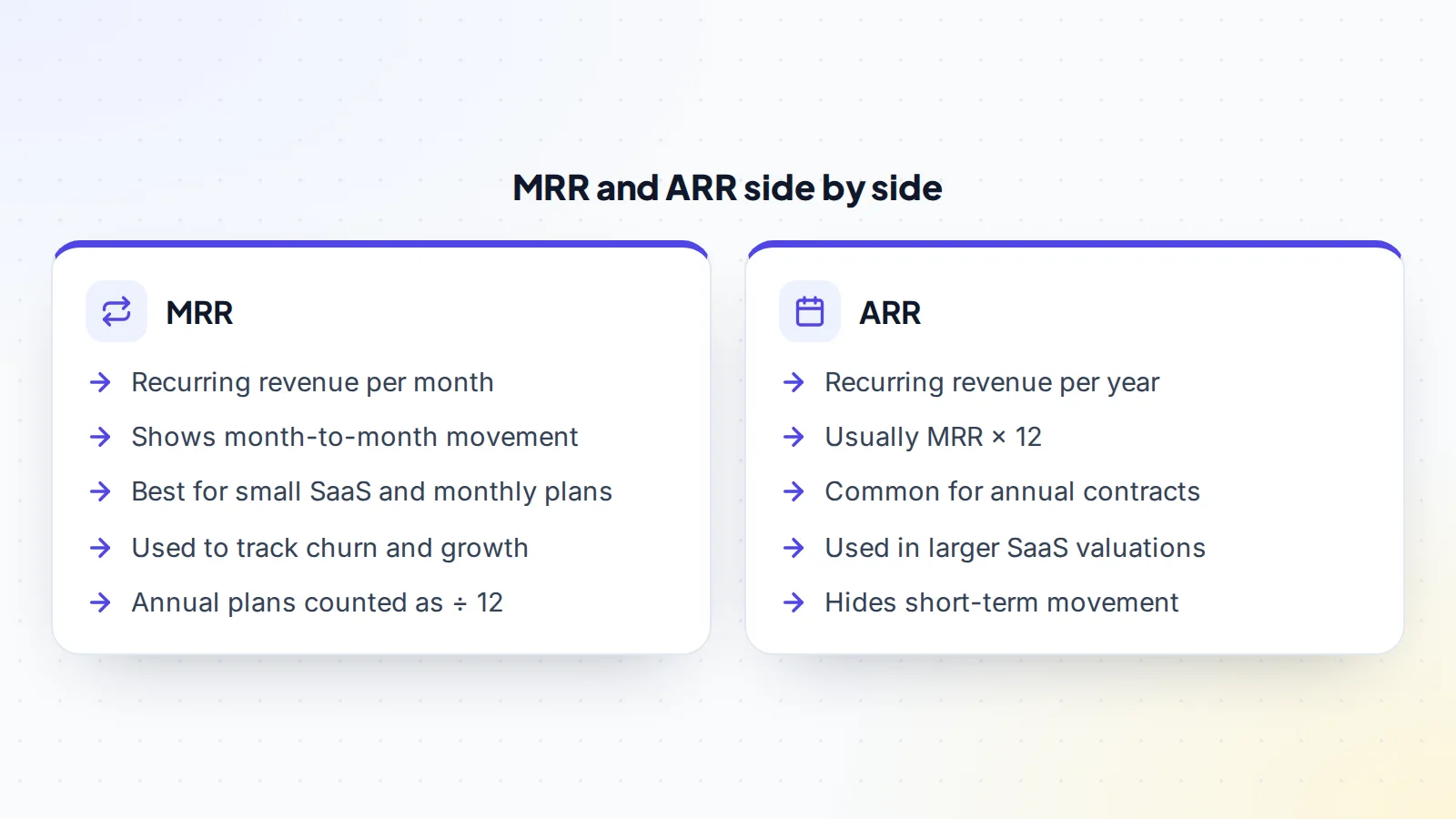
- MRR is monthly recurring revenue; ARR is annual recurring revenue, usually MRR × 12.
- Annual plans count in MRR at one-twelfth of their value each month.
- One-off payments (setup fees, services, lifetime deals) are not recurring revenue.
- Small SaaS businesses are usually discussed in MRR; larger ones and annual-contract businesses often in ARR.
- Neither tells you about profit or churn on its own. Look at both before judging a business.
What is MRR?
Monthly recurring revenue is the predictable revenue a subscription business earns from active subscriptions in a month. Stripe’s guide describes it as recurring income normalised to a monthly amount, and gives a simple way to estimate it: the number of paying customers multiplied by the average revenue per user. For example, 100 customers paying $100 a month is $10,000 of MRR.
MRR is useful because it moves every month. You can see new customers arrive, existing ones upgrade or downgrade, and others cancel. That movement is what buyers study to judge whether a business is healthy.
What is ARR?
Annual recurring revenue is the same idea on a yearly basis. For most small businesses, ARR is simply MRR × 12. Businesses that sell annual or multi-year contracts often talk in ARR because that’s how their customers buy. Larger SaaS companies and investors also tend to quote ARR, partly because it’s a bigger, more familiar number for comparing companies.
How to calculate MRR correctly
- List every active subscription at a point in time (often the last day of the month).
- Convert each to a monthly amount: monthly plans at face value; annual plans divided by 12; quarterly plans divided by 3.
- Use the price actually paid, after discounts and coupons.
- Exclude one-off revenue: setup fees, consulting, one-time purchases and lifetime deals.
- Decide how to treat failed payments and paused subscriptions, and apply the rule consistently.
- Add it up. That’s MRR. Multiply by 12 for ARR.
If the business runs on Stripe Billing, its MRR reports follow a consistent method, which is a helpful starting point for both sides.
A worked example
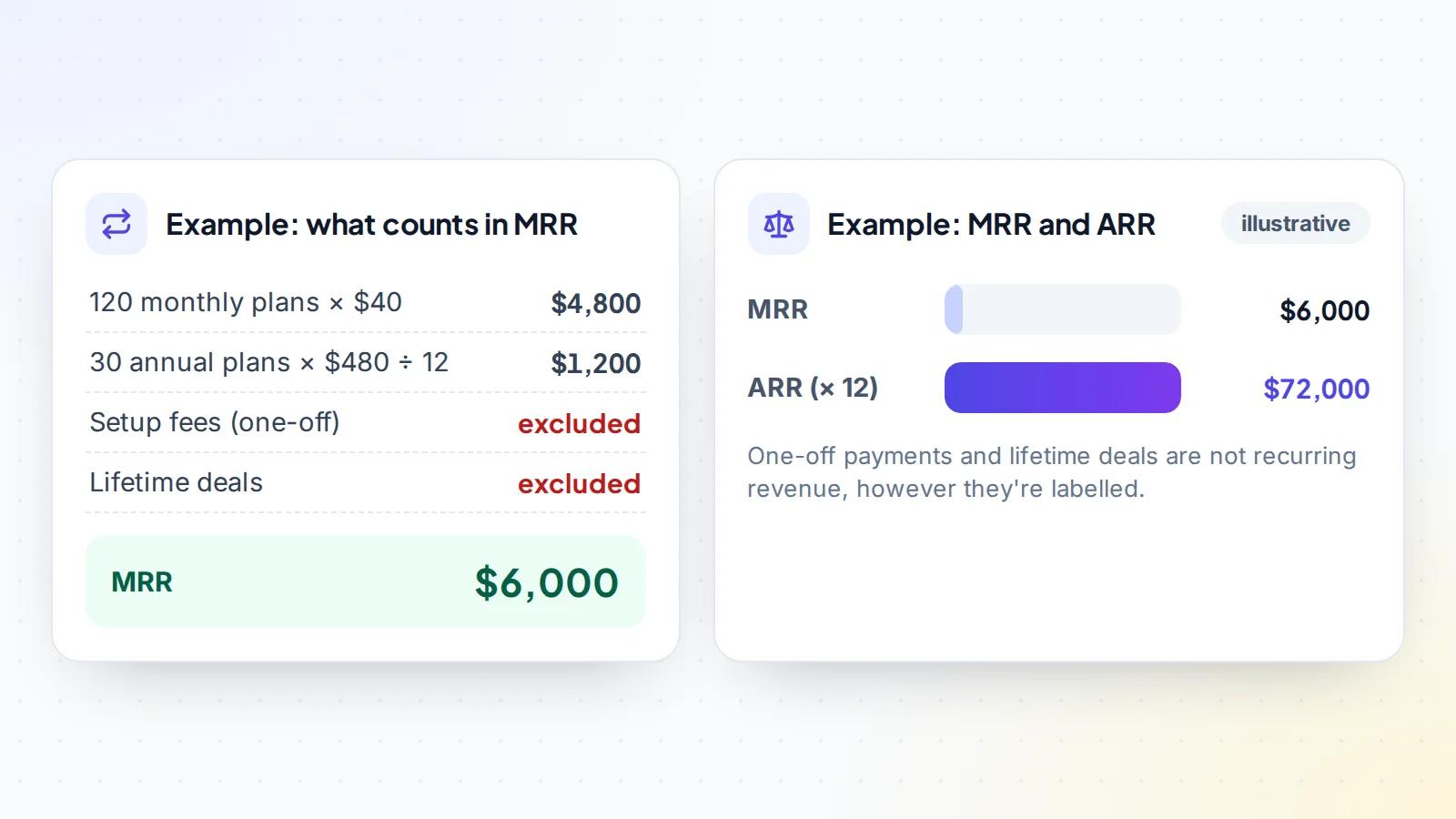
A small SaaS has 120 customers on a $40 monthly plan and 30 customers who paid $480 for an annual plan. It also charged several setup fees last month and sold some lifetime deals a while ago.
Monthly plans contribute 120 × $40 = $4,800. Annual plans contribute 30 × $480 ÷ 12 = $1,200 a month. Setup fees and lifetime deals are excluded because they won’t repeat. MRR is therefore $6,000 and ARR $72,000. If someone reported this business’s MRR as $20,000 because 30 annual plans were paid in one month, they’d be overstating recurring revenue more than threefold for that month and understating it for the next eleven.
The movement inside MRR
The total is only half the story. Each month, MRR changes because of:
- New MRR from new customers.
- Expansion MRR from upgrades and add-ons.
- Churned MRR lost to cancellations.
- Contraction MRR lost to downgrades.
Stripe’s guides describe these components, and they’re what buyers ask for first. A business can show growing MRR while losing customers quickly, if new sales hide the churn. Our guide to SaaS churn rate explains how to measure what leaves.
Net new MRR and growth rate
Two simple figures summarise how MRR is moving. Net new MRR is new plus expansion, minus churned and contraction MRR, for a month. MRR growth rate is net new MRR divided by MRR at the start of the month. A business adding $600 of net new MRR to a $15,000 base grows at 4% a month; the same $600 on a $60,000 base is 1%. Buyers look at both over twelve months or more, because a single strong month says little about the trend.
MRR under different pricing models
Not every SaaS charges a flat monthly fee, and the MRR vs ARR calculation needs care when pricing is more complex:
- Per-seat pricing: MRR changes as customers add or remove users. Count the seats actually billed.
- Tiered plans: straightforward, as long as upgrades and downgrades are recorded as expansion and contraction.
- Usage-based pricing: revenue varies month to month. Many businesses count only the committed minimum as MRR and treat usage above it separately, or use an average over several months. Whatever the method, state it.
- Hybrid models: a subscription plus usage or services. Separate the recurring part from everything else.
A second example: growth that hides churn
Two SaaS products both report $10,000 of MRR and similar growth. The first adds $900 of new MRR a month and loses $300 to churn and downgrades. The second adds $1,800 a month but loses $1,200. Both grow by $600 a month, but the second replaces 12% of its revenue every month just to stand still. If its marketing slows down after the sale, MRR starts falling quickly. Looking at the movement inside MRR, not just the total, is how a buyer tells these two apart.
When to use MRR and when to use ARR
- Use MRR for businesses mainly on monthly plans, for tracking month-to-month changes, and for most small SaaS sales. See micro SaaS for sale for typical examples.
- Use ARR for businesses selling annual or multi-year contracts, for comparing with larger SaaS companies, and when buyers quote revenue multiples.
- Use both when presenting a business for sale: MRR by month shows the trend; ARR gives the headline.
Common mistakes that inflate MRR and ARR
- Counting annual plans in the month they’re paid. Spread them over 12 months.
- Including one-off revenue such as setup fees, services or lifetime deals.
- Using list prices instead of what customers actually pay after discounts.
- Counting trials or customers who haven’t paid yet.
- Keeping failed or cancelled subscriptions in the total for months.
- Annualising a single great month into ARR.
When you’re buying, recalculate MRR yourself from the billing data, month by month, using the same rules for every month.
MRR vs revenue vs profit
MRR isn’t the same as revenue in your accounts, and it’s certainly not profit. Revenue includes one-off sales and is often recorded when earned rather than when paid. Profit is what’s left after every cost. Buyers of small SaaS businesses usually price on profit or trailing twelve months profit, using MRR and churn to judge how reliable that profit is. Larger, fast-growing companies are sometimes priced on ARR instead.
Seeing MRR by cohort
A cohort view groups customers by the month they started and shows how much of their MRR remains over time. It answers a question the headline numbers can’t: do customers who joined last year still pay as much as they did, more, or less? Healthy businesses often see cohorts hold steady or grow as customers upgrade. Businesses with a churn problem see each cohort shrink quickly. If the billing system can export subscriptions with start dates, a simple spreadsheet can build this view in an hour, and it’s one of the most useful things a buyer can look at.
Seasonality and annual renewals
Some businesses sell most of their annual plans in particular months, such as the start of a school year or a big promotion. Because annual plans are spread over 12 months in MRR, the MRR trend stays smooth, but cash arrives in lumps, and renewals cluster a year later. Buyers should ask when annual plans renew. A business that sold many annual plans in a single promotion faces a big renewal month; if many of those customers don’t renew, MRR can drop sharply all at once.
Agreeing definitions
Different tools calculate MRR slightly differently, especially around failed payments, paused subscriptions, taxes and refunds. That’s fine, as long as everyone uses the same method for every month being compared. In a sale, agree the method and the source system at the start of due diligence, so the conversation is about the business rather than about arithmetic.
How MRR and ARR affect valuation
Recurring revenue is attractive because it’s predictable, which is why SaaS businesses often sell for higher multiples than businesses with one-off sales. But predictability depends on churn: MRR from customers who stay for years is worth far more than MRR from customers who leave in a few months. When you see a valuation quoted as a multiple of ARR, check churn, growth and margins before accepting it. For small SaaS, read our guide to selling a SaaS business to see how buyers combine these numbers.
Presenting MRR and ARR when you sell
If you’re selling a SaaS business, a clear MRR table is one of the most persuasive documents you can prepare. Show each month for at least the last year: starting MRR, new, expansion, churned and contraction MRR, ending MRR and active customers. Note any price changes, promotions or lifetime-deal campaigns next to the months they happened. Quote ARR as a headline, but let buyers see the monthly detail behind it. Sellers who present the numbers this way spend far less time answering questions, and buyers trust the totals more.
MRR and ARR in contracts and due diligence
When a sale agreement or an earn-out refers to MRR or ARR, define exactly how it’s calculated: which subscriptions count, how annual plans are treated, how discounts and failed payments are handled and which system is the source of truth. Undefined metrics are a common source of disputes after a sale. Our guide to legal due diligence covers what else to define.
MRR vs ARR: the checklist for buyers and sellers
- MRR calculated from the billing system, not a spreadsheet alone.
- Annual and quarterly plans spread across their months.
- Discounts reflected; trials and unpaid subscriptions excluded.
- One-off revenue and lifetime deals excluded.
- MRR movements (new, expansion, churned, contraction) shown by month.
- ARR calculated as MRR × 12 unless contracts justify otherwise.
- Churn checked alongside both.
- Definitions written into any agreement or earn-out.
Ready to find your next asset?
Browse listings with verified numbers, ask sellers your questions before you offer, and agree every step in a free Deal Room.
Frequently asked questions
What’s the difference between MRR and ARR?
MRR is recurring revenue per month; ARR is recurring revenue per year, usually MRR × 12.
How do annual plans count in MRR?
Divide the annual price by 12 and count that amount each month for the length of the plan.
Are setup fees part of MRR?
No. One-off fees aren’t recurring and should be excluded from MRR and ARR.
Should a small SaaS report MRR or ARR?
Usually MRR, by month, because buyers want to see the trend. ARR can be shown as a headline figure.
Is ARR the same as annual revenue?
No. ARR counts only recurring subscription revenue; annual revenue includes one-off sales too.
Do lifetime deals count as recurring revenue?
No. They’re one-off payments, even if customers keep using the product.
Can MRR go down even when customers grow?
Yes, if customers move to cheaper plans or discounts increase. That’s why MRR is tracked alongside customer counts and average revenue per account.
Should taxes be included in MRR?
No. Sales taxes and VAT that the business collects on behalf of tax authorities aren’t the business’s revenue and are usually excluded.
When does the MRR vs ARR choice matter most?
When comparing businesses or quoting multiples. A multiple of ARR and a multiple of MRR differ by a factor of 12, and both differ from profit multiples, so always check which figure is meant.
Which tools calculate MRR?
Billing platforms such as Stripe Billing show MRR, and many analytics tools connect to billing data. Check how each tool treats annual plans and discounts.