Add-Backs: What Sellers Can and Can’t Include
What sellers can and can't add back to profit when selling an online business, the proof buyers expect, and why every add-back dollar is multiplied in the price.

When an online business is sold, the profit on its books is rarely the profit a new owner would earn. Some costs belong to the current owner personally; some won’t happen again. Add-backs are the adjustments that take those costs out, to show the business’s true earning power. Done honestly, they help sellers get a fair price. Done badly, they’re the fastest way to lose a buyer’s trust.
This guide explains what add-backs are, which ones buyers usually accept and reject, what evidence is needed, how they affect the price, and how to present them. It’s useful for both sides of a deal.
It builds on our guides to online business valuation and seller discretionary earnings.
Key takeaways
- An add-back is a cost in the accounts that a new owner won’t have, added back to profit to show true earnings.
- The test for every add-back: will this cost disappear after the sale? If not, it isn’t one.
- Common accepted add-backs are personal costs, genuine one-off costs and, in some calculations, the owner’s own pay.
- Every add-back needs evidence: invoices, statements and an explanation.
- Because the price is profit times a multiple, each add-back dollar is multiplied, so buyers check them carefully.
What add-backs are
Small business accounts often mix the owner’s personal and business affairs, and they include costs that won’t repeat. An add-back removes one of these costs from the expenses, which increases the profit figure. The result is often called adjusted or normalised profit: what the business would have earned without those items.
The idea is fair. If a seller ran their personal phone through the business, a buyer won’t pay that bill, so the business’s real profit is higher than the accounts show. The problem is that these adjustments are easy to stretch, and every one increases the price.
Why every adjustment matters so much
Most small online businesses are priced as earnings times a multiple. An add-back raises the earnings, so it raises the price by the add-back multiplied by the multiple. At a multiple of 30 times monthly profit (2.5 times annual), adding back $6,000 a year adds $15,000 to the price. That’s why buyers treat these adjustments as one of the most important parts of financial due diligence.
What buyers usually accept
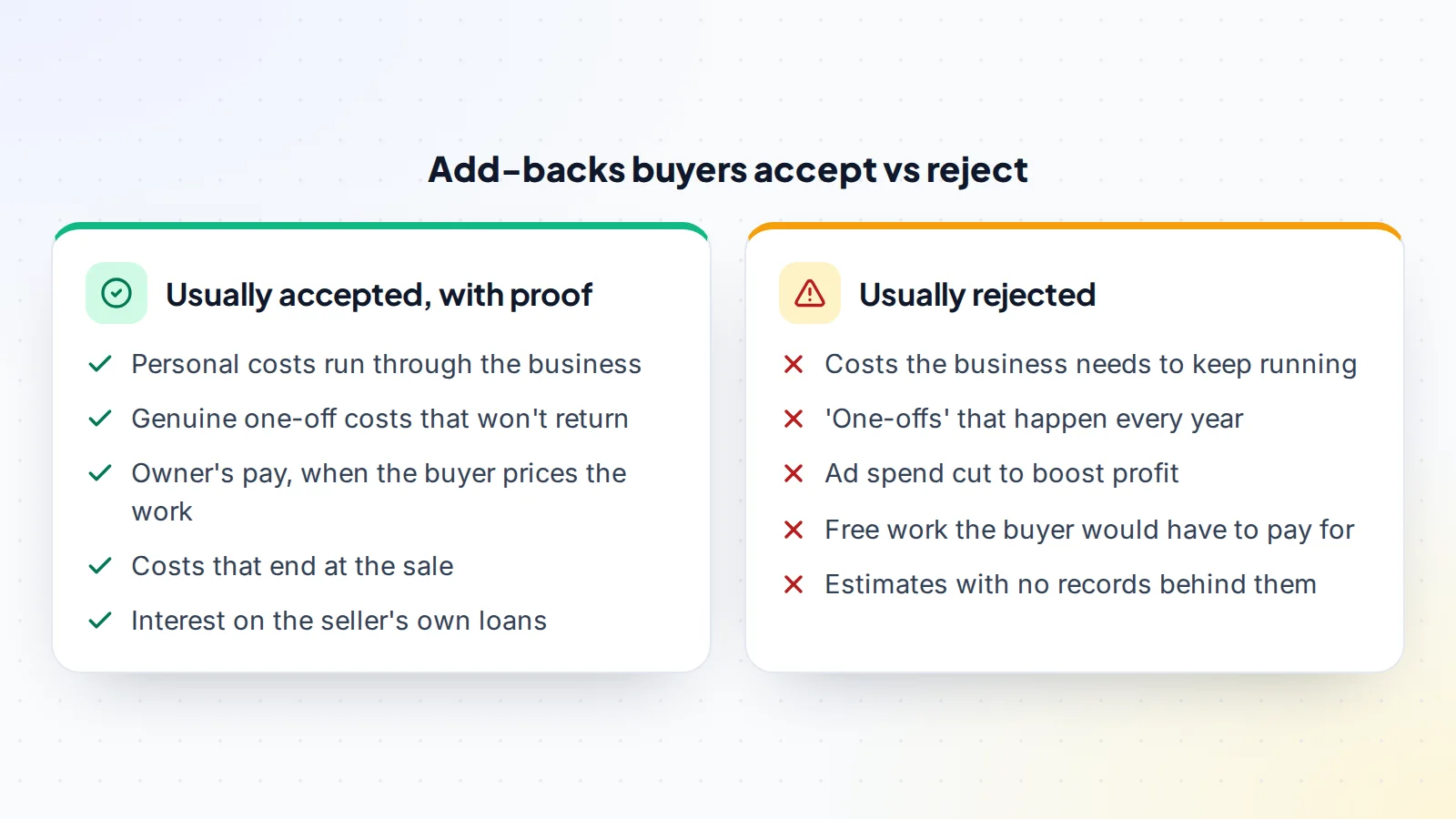
- Personal expenses run through the business: a personal phone, car, travel or subscriptions that aren’t needed to run the business. In the United States, the IRS explains that business expenses must be ordinary and necessary for the business, and that personal, living or family expenses generally aren’t deductible, so well-kept accounts should have few of these to begin with.
- Genuine one-off costs: a site redesign, a legal matter that’s resolved, a one-time migration to new hosting. They must be truly non-recurring.
- Costs that end with the sale: the seller’s accountant fees for their other businesses, or a tool used only for the seller’s other projects.
- Interest and financing costs on the seller’s own loans, which don’t pass to the buyer.
- The owner’s pay, in some calculations. When a business is valued on seller discretionary earnings, the owner’s salary is added back, and the buyer then accounts for the cost of doing that work. When valued on net profit, the work is treated as a cost.
What buyers usually reject
- Costs the business needs: hosting, software, writers, editors and advertising that keep the income coming.
- Recurring “one-offs”: a redesign every year, or “unusual” legal or support costs that appear every few months.
- Cuts that hurt future income: advertising or content spending reduced just before the sale to make profit look higher.
- Unpaid work treated as free: if the seller writes all the content, a buyer who would have to pay a writer won’t accept that cost as zero.
- Undocumented estimates: “about $500 a month was personal” with no records.
The evidence buyers expect
Every add-back should come with:
- The source record: the invoice, receipt or statement line showing the cost.
- An explanation of why it won’t continue after the sale.
- A history showing it hasn’t happened regularly before, for one-off costs.
- Consistency with the rest of the accounts and the business’s tax filings.
A simple add-back schedule, a table listing each item, its amount, its evidence and its reason, makes the buyer’s job easy and shows confidence.
A worked example
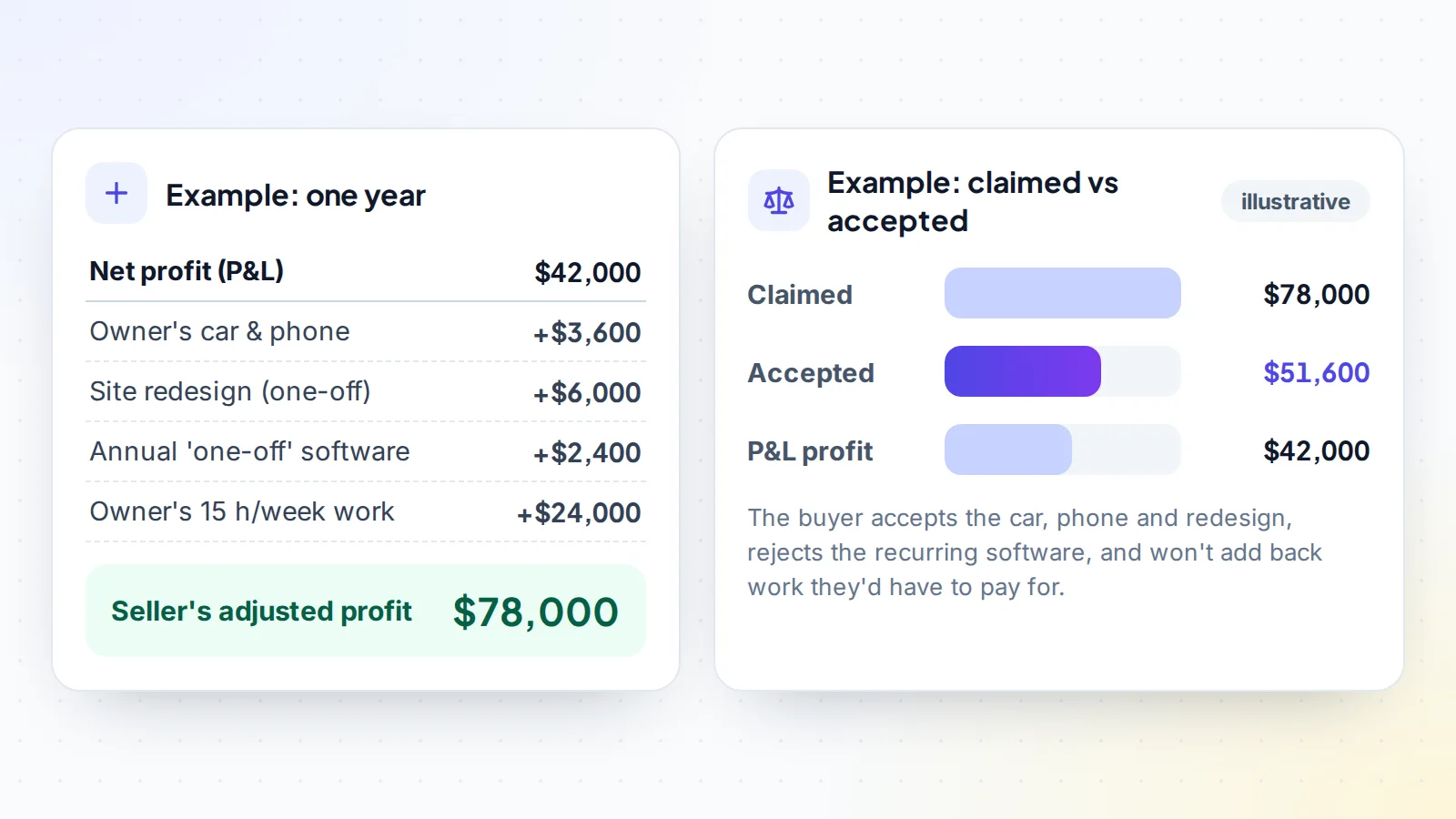
The numbers below are made up to show the method, not market data.
A seller lists a software review site with $42,000 of net profit in the accounts and an “adjusted profit” of $78,000. The adjustments claimed are: $3,600 for the owner’s car and phone, $6,000 for a site redesign, $2,400 for a software subscription described as one-off, and $24,000 for the owner’s 15 hours a week of writing.
The buyer reviews each one:
- Car and phone: statements show they’re personal. Accepted.
- Redesign: invoices show a one-time project; the site hadn’t been redesigned in four years. Accepted.
- Software: billing history shows it renews every year and the site needs it. Rejected.
- Owner’s work: the buyer would have to pay a writer to replace those 15 hours. Because the price is based on net profit, not seller discretionary earnings, the work stays as a cost. Rejected.
Accepted adjusted profit: $42,000 + $3,600 + $6,000 = $51,600. At the same multiple, that’s a very different price from one based on $78,000, and the buyer can explain every dollar of the difference.
Adjustments that lower profit
Normalising profit works in both directions. Buyers also look for costs that are missing or too low, and subtract them:
- Unpaid owner work: if the seller does tasks a buyer would pay for, that cost is added in a net-profit valuation.
- Below-market services: a friend hosting the site for free, a relative writing content at a token rate, or a discounted tool tied to the seller’s other business. The buyer will pay full price, so the true cost goes in.
- Deferred spending: content updates, software maintenance or security work postponed before the sale. The cost hasn’t disappeared; it’s just been delayed.
- Expiring discounts: introductory pricing on hosting or software that will rise after renewal.
A fair adjustment schedule includes these too. Sellers who show both directions earn credibility, because they’re clearly describing the business rather than inflating it.
How to build an adjustment schedule
A simple table is enough. For each item, show:
- Description: what the cost was, such as “owner’s mobile phone contract”.
- Amount in the valuation period.
- Direction: added back or subtracted.
- Reason it won’t continue (or will appear) for a new owner.
- Evidence: the invoice, statement or contract, with a reference.
Add a total at the bottom and the resulting adjusted profit. Keep the table in the same order as the profit and loss statement, so a buyer can follow it line by line. If a single item is large compared with profit, add a short note with more detail.
Accounts, tax returns and bank records
Buyers check adjustments against more than one source. The profit and loss statement shows what was recorded; bank and payment processor statements show what actually moved; tax filings show what was declared. If a seller claims a cost was personal, but it was recorded as a business expense in the accounts and the tax filing, a buyer will ask why. Consistency across the three is what makes an adjustment believable, so sellers should check that their records agree before presenting them.
Add-backs in different online businesses
- Content and affiliate sites: owner’s writing time, one-off redesigns, personal tools.
- SaaS: founder salaries, one-off development projects, legal costs from fundraising. Buyers check carefully whether development is really finished; software usually needs ongoing work. See SaaS due diligence.
- E-commerce and digital products: personal purchases, one-off product launches, discontinued product lines.
- Affiliate sites: one-off link audits or content migrations; see selling an affiliate website.
Tricky cases
- Family members on the payroll: if they do real work, the cost is real. If they don’t, it can be an add-back, with clear evidence.
- Above-market rent or services from the owner’s other companies: the add-back is only the difference between what was paid and a fair market price.
- Advertising tests: a failed campaign may be one-off, but buyers will ask whether advertising is needed to maintain income.
- Currency or payment processor changes: one-off losses may be added back if they won’t recur.
Which period the adjustments apply to
Add-backs should be applied to the same period used for valuation, usually the last 12 months, often called trailing twelve months profit. An add-back from two years ago doesn’t affect today’s profit. And if the business is valued on an average of several periods, each period’s adjustments should be shown separately.
Add-backs and the multiple
Adjustments change the earnings figure, not the risk. If a seller adds back aggressively, buyers often respond by lowering the multiple too, because the business now looks harder to understand. Clean accounts with few, well-documented adjustments usually support a better multiple. Read about the online business valuation multiple for how buyers set it, and revenue vs profit valuation for why profit is the base.
For sellers: presenting add-backs well
- Clean up the accounts before selling: stop running personal costs through the business a year ahead, so fewer adjustments are needed.
- Prepare a schedule with each item, amount, evidence and reason.
- Be conservative: leave out anything you can’t prove. One rejected add-back casts doubt on the rest.
- Be clear about the base: say whether you’re presenting net profit or seller discretionary earnings.
- Explain the owner’s work in hours and tasks, so buyers can price it.
When you’re ready, list your business on digiflippers.com with 0% success fee up to $10,000, then 5% (max $5,000), and use the free valuation tool for a quick range.
For buyers: checking each adjustment
- Ask for the add-back schedule and the evidence for each line.
- Check bank and processor records, not just the profit and loss statement.
- Look back two or three years for “one-off” costs that recur.
- Ask what would happen to income if the cost were removed.
- Make your own adjusted profit figure, and explain your offer from it.
When buyer and seller disagree
Disagreements over adjustments are common, and they’re usually resolved with evidence rather than argument. A few approaches help:
- Go line by line. Agree the items that are clear first, then focus on the few that aren’t.
- Look at history. Two or three years of records usually settle whether a cost really is one-off.
- Split the difference on judgement calls, such as the market rate for the owner’s work, using quotes from freelancers as a guide.
- Use deal structure where a question can’t be settled, for example a small part of the price paid later if profit holds up.
The aim is a profit figure both sides can explain. Once it’s agreed, the rest of the negotiation is about the multiple.
Add-backs: the checklist
- Base stated: net profit or seller discretionary earnings.
- Each add-back listed with amount, evidence and reason.
- One-off costs checked against past years.
- Necessary running costs left in.
- Owner’s work priced, not treated as free.
- Adjustments applied to the same period as the valuation.
- Buyer’s own adjusted profit calculated.
Ready to sell?
List it on digiflippers.com with verified numbers, answer buyers in one place and agree every step in a free Deal Room. 0% success fee up to $10,000, then 5% (max $5,000).
Frequently asked questions
What is an add-back?
A cost in the business’s accounts that a new owner won’t have, added back to profit to show what the business really earns.
Is the owner’s salary an add-back?
In seller discretionary earnings, yes, and the buyer then accounts for the cost of the owner’s work. In a net-profit valuation, the owner’s work is treated as a cost.
How many add-backs are normal?
There’s no fixed number. A few clear, documented adjustments are normal. A long list of large ones is a reason for buyers to look harder.
Can advertising be added back?
Rarely. If advertising drives income, cutting it would lower income, so it’s a necessary cost. A clearly failed one-off test may be an exception, with evidence.
Why do add-backs affect the price so much?
Because the price is earnings times a multiple. Every add-back dollar is multiplied.
Can a buyer adjust profit downwards?
Yes. Buyers subtract costs that are missing or too low, such as unpaid owner work or below-market services, as well as reviewing anything the seller added back.