Buying an AdSense Website: Income, Risks and Checks
A buyer's checklist for AdSense websites: checking earnings live, RPM, traffic sources and seasonality, invalid traffic risks, why ads move to your own AdSense account, ads.txt, valuation and a clean handover.

Websites that earn from display ads are among the most common sites for sale. Their appeal is simple: content attracts visitors, ads earn from those visits, and there’s no product to ship or customers to serve. An AdSense website for sale can be a good first purchase or a solid addition to a portfolio. But ad income depends heavily on traffic, the countries visitors come from and the time of year, and the AdSense account itself stays with the seller. This guide explains what to check, how ad earnings work, how to value the site and how to move the ads to your own account.
For the full buying process, see our guide on how to buy a website. For ad income in general, read about display ad income websites.
Key takeaways
- Check earnings live in AdSense, by month, for at least 12 months.
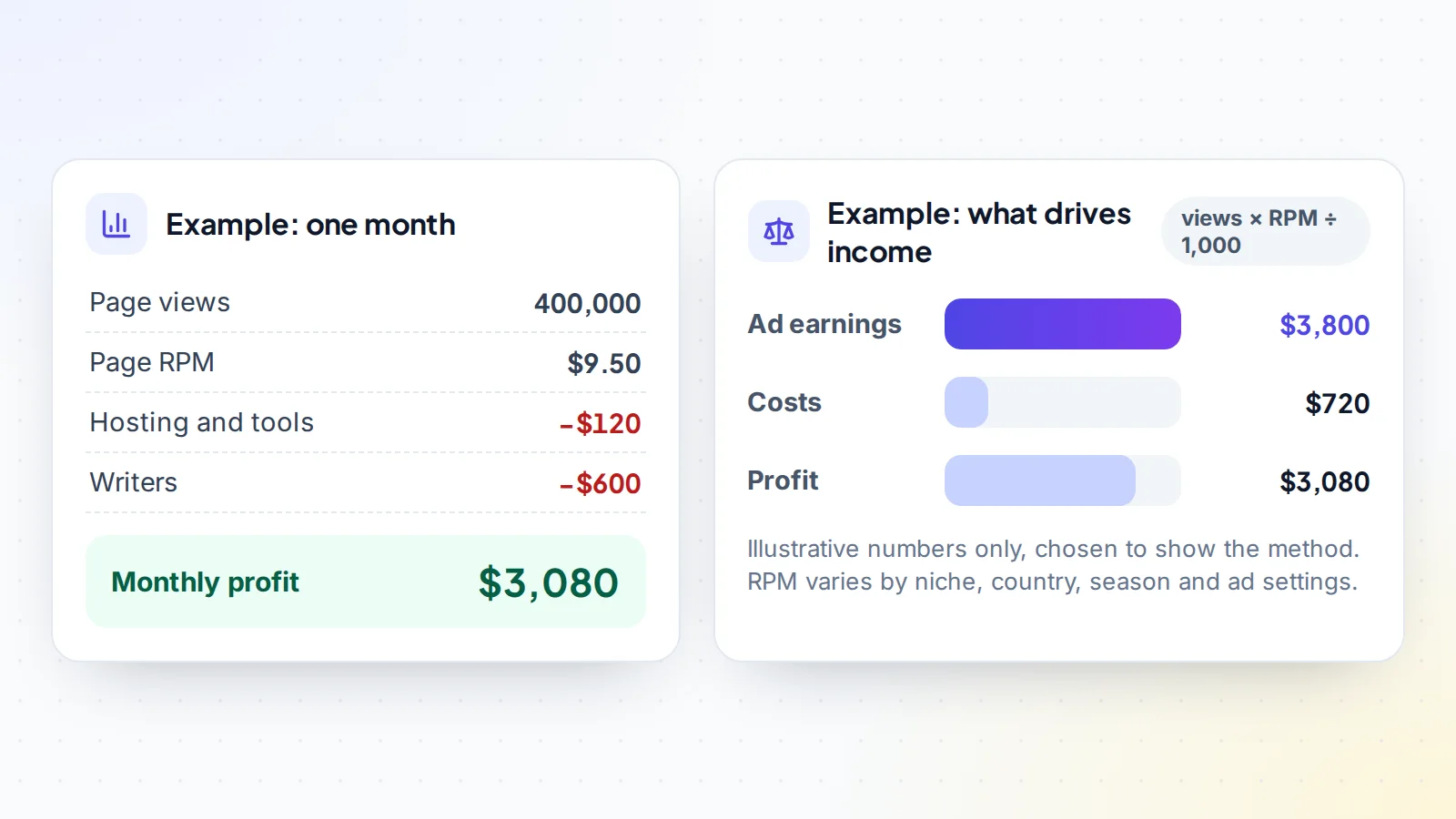
- Income is roughly page views × page RPM ÷ 1,000, so watch both traffic and RPM.
- Visitor countries, seasons and traffic sources all move ad income.
- AdSense accounts are tied to the payee, so you’ll run ads through your own account.
- Update ads.txt with your publisher ID and expect a short review gap.
What is an AdSense website?
An AdSense website earns most of its income by showing ads from Google AdSense. Google places ads on the site’s pages and shares the ad revenue with the publisher. Most AdSense sites are content sites: blogs, guides, recipe sites, tools and reference sites that attract visitors through search, social media or direct visits. Some also earn from affiliate links or sponsorships, which diversifies their income.
Because there’s no product to sell and little customer service, these sites can be relatively simple to run. The main jobs are keeping content useful and up to date, publishing new pages and keeping the site fast and tidy. Many owners run several sites like this, or hand most of the work to freelance writers and an editor.
How ad earnings work
A useful way to think about ad income is page RPM: earnings per 1,000 page views. Monthly ad earnings are roughly page views multiplied by page RPM, divided by 1,000. RPM varies widely depending on the topic, the countries visitors come from, the device they use, the time of year and the site’s ad layout. Topics where advertisers compete for attention, such as finance or software, often have higher RPMs than general entertainment.
That means two sites with the same traffic can earn very different amounts, and the same site can earn very different amounts in different months.
What to check
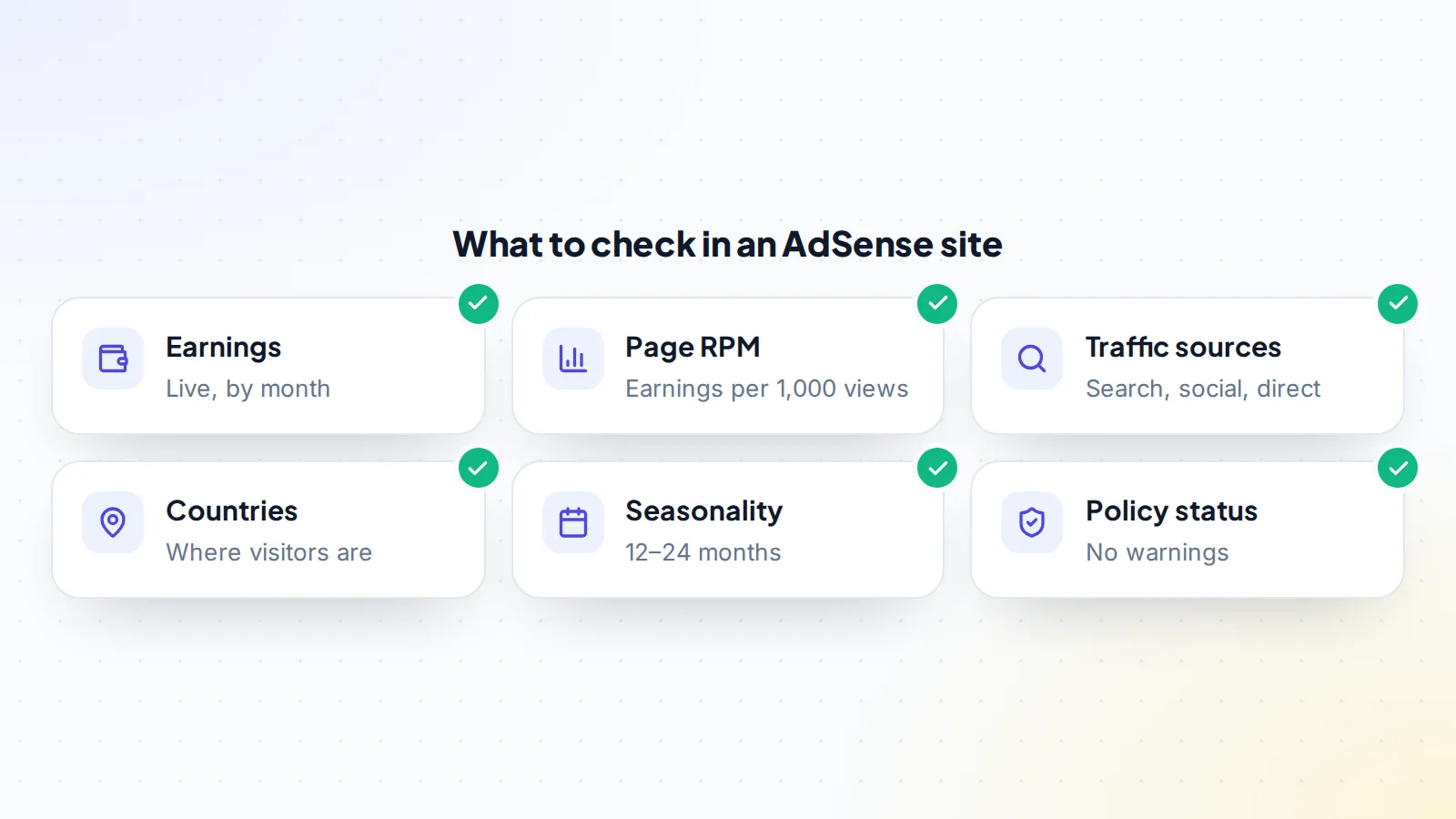
- Earnings: ask the seller to open AdSense on a screen-share and show earnings by month for at least 12 months, ideally 24.
- Page views and RPM: check both move sensibly, and compare page views in AdSense with Google Analytics.
- Payments: match AdSense payments to bank deposits. Our guide to verifying revenue explains how.
- Traffic sources: how much comes from search, social, referrals and direct visits.
- Countries: where visitors are, because it strongly affects RPM.
- Policy status: any policy warnings or ad serving limits shown in the account.
Seasonality
Ad income usually varies through the year. Advertisers often spend more at certain times, such as the end of the year, and less at others, such as the start of the year. Some topics have their own seasons: gardening in spring, tax topics before deadlines, travel before holidays. Look at at least 12 months, ideally 24, to see the pattern, and note which months were strongest and weakest. If a seller lists the site just after its strongest months, base your calculations on the full-year average rather than recent peaks.
Traffic quality and invalid traffic
AdSense pays for genuine visitors. Traffic from bots, click schemes or paid sources designed to inflate ad views can lead to deductions, ad serving limits or account action. Check where traffic comes from. Steady search, social and direct traffic in the site’s natural countries is a good sign. Sudden spikes from unusual countries, very short visits or traffic from paid sources that the seller can’t explain are warning signs. Our guide to verifying website traffic covers what to look for.
Search dependence
Most AdSense sites depend heavily on search traffic, so changes in search rankings show up in income almost immediately. Check Search Console for manual actions and traffic history, review the site’s links, and look at how traffic behaved through past Google updates. Our guides to the backlink audit before buying and Google algorithm update risk explain how.
The AdSense account stays with the seller
AdSense accounts are tied to the account holder’s identity and payments profile. Google’s AdSense help explains that the payments name can’t be changed after identity verification, and that some changes, such as moving to a new country, require closing the account and opening a new one. In practice, that means a buyer runs the site’s ads through their own AdSense account, rather than taking over the seller’s. Plan for this from the start, and agree it in writing.
If you don’t yet have an AdSense account, apply early, ideally during due diligence, so you’re ready when the site moves. If you already have one, you can add the new site to your sites list.
Moving the ads to your account
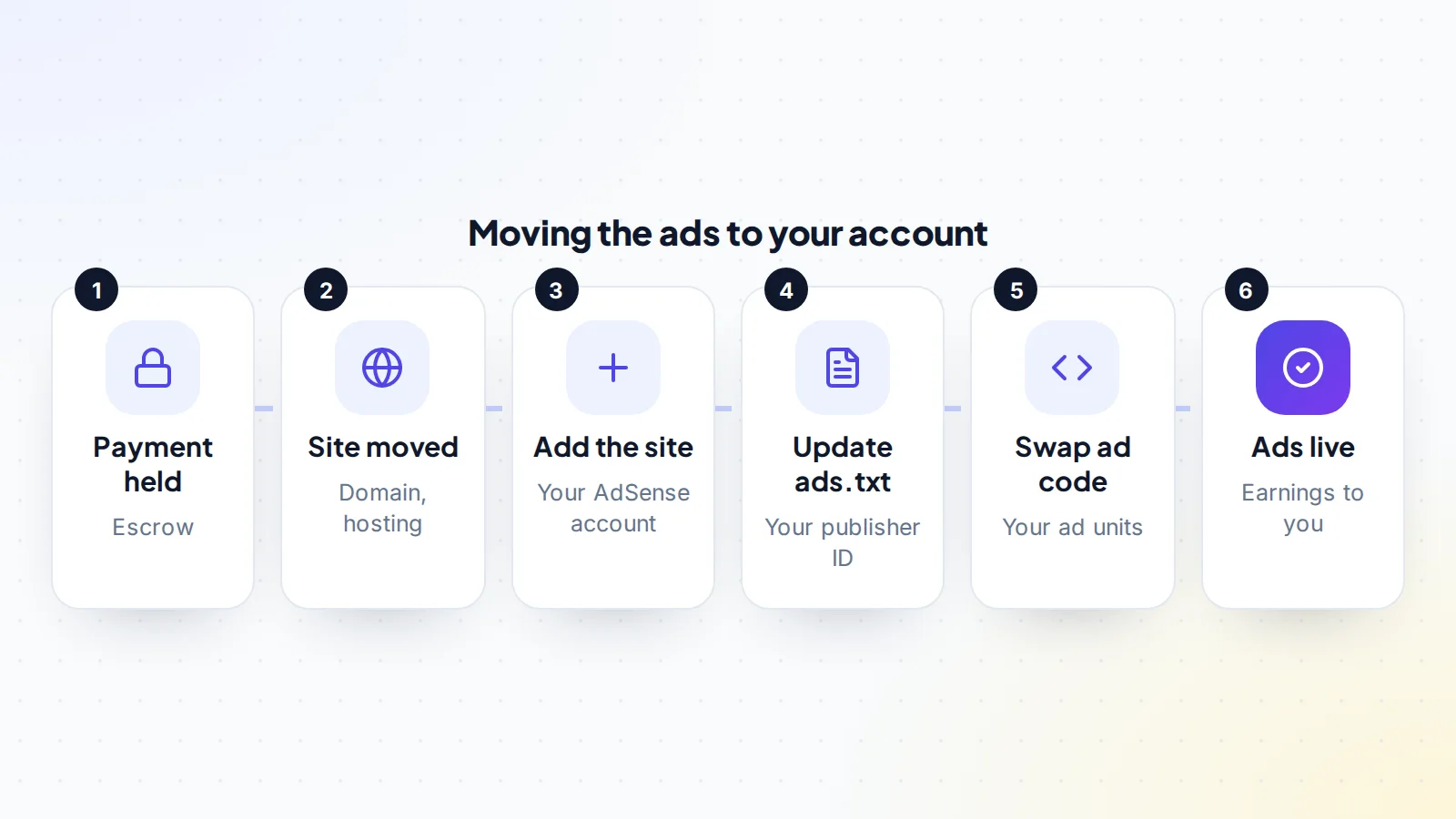
- With the payment held in escrow, move the domain, hosting and site files to your accounts.
- In your AdSense account, add the site to your sites list and request review if needed.
- Update the site’s ads.txt file with your own publisher ID. Google’s ads.txt guide shows the format, with one line for each authorized seller.
- Replace the seller’s ad code or auto ads code with your own.
- Check that ads appear and earnings show in your account, then the payment is released.
Expect a short gap between the seller’s ads stopping and yours starting, while your account reviews the site. Agree with the seller how to handle the timing, and remember that earnings already accrued in the seller’s account belong to the seller.
Questions to ask the seller
- How long has the site earned from AdSense, and has it ever had policy warnings or ad serving limits?
- Has any traffic ever been bought, exchanged or sent from paid sources?
- How is content created, by whom and at what cost?
- Which pages earn the most, and how have they changed over the past year?
- Have you changed ad layouts or settings recently?
- What other income does the site have, such as affiliate links or sponsorships?
Ask for the answers in writing. When you review any AdSense website for sale, compare what the seller says with what the dashboards show.
How AdSense sites are valued
AdSense sites are usually priced as a multiple of average monthly net profit over the last 12 months, after hosting, tools, writers and any other costs. The multiple moves with traffic stability, diversity of traffic and income, how long the site has earned, the quality of its content and links, and how much work it takes. Our guide to valuation multiples explains how buyers choose a number.
Be careful with very young sites. A site that’s only earned for a few months may be riding a short-term ranking or a seasonal peak. Our guide to starter sites explains how to think about early-stage sites.
Content, rights and policies
Check that the site owns or has licences for its content and images, that it has a privacy policy covering ads and cookies, and that it shows a consent message where required. Ad networks and privacy laws in many regions require consent for personalised ads. Our guide to legal due diligence covers the main checks.
Other ad networks
Some sites use other ad networks or management services alongside or instead of AdSense. These often have their own traffic requirements and contracts. Check whether the buyer can join the same network, how long approval takes and whether earnings would be similar. If a network has minimum traffic levels, make sure the site meets them under your ownership.
Growing ad income after buying
Once the site is earning in your account, there are sensible ways to grow it. Publish new, genuinely useful pages on topics the site already ranks for. Update older pages that still get traffic but have become outdated. Improve page speed and layout so visitors stay longer and view more pages, without crowding the content with ads. Add other income, such as relevant affiliate links or an email list, so the site depends less on ad rates. Make one change at a time and measure the effect on both traffic and RPM, because changes that raise short-term earnings can sometimes hurt the visitor experience.
Common mistakes
- Pricing on the best recent months instead of the full-year average.
- Not applying for an AdSense account until after closing.
- Forgetting to update ads.txt with your own publisher ID.
- Ignoring traffic from unusual sources or countries.
- Adding too many ads after buying and hurting the visitor experience.
Buying an AdSense website for sale is often straightforward when these basics are covered.
Running costs to expect
AdSense sites are often cheap to run, but not free. Typical costs include hosting, a content delivery network, a theme or design tools, an SEO tool subscription, image licences and, for most sites that keep growing, writers or editors. Ask the seller for a full list of monthly costs, and check bank and card statements to confirm them. If the seller writes all the content personally and takes no pay for it, add a realistic cost for replacing that work, because you’ll need to pay someone or spend your own time. Profit after these costs is what the price should be based on.
A worked example
The details below are made up to show the method.
Lee is looking at a home-improvement guide site averaging 400,000 page views a month. On a screen-share, AdSense shows earnings by month for two years, with a page RPM averaging about $9.50 and a clear seasonal peak in spring. Payments match bank deposits. Analytics shows most traffic from search in the US, UK and Canada, steady through recent updates. Costs are about $720 a month for hosting, tools and two freelance writers.
Lee bases the price on the 12-month average profit rather than the recent spring peak, and agrees a price with the seller. While the payment is held in escrow, the domain and hosting move to Lee. Lee adds the site to an existing AdSense account, updates ads.txt and swaps in new ad code. After a short review, ads go live in Lee’s account and the escrow funds are released.
AdSense website for sale: the checklist
- 12–24 months of earnings seen live in AdSense.
- Page views and RPM checked against Analytics.
- AdSense payments matched to bank deposits.
- Traffic sources, countries and seasonality reviewed.
- No unexplained traffic spikes or policy warnings.
- Search history and links checked.
- Your own AdSense account ready.
- ads.txt and ad code switch planned.
- Price based on the 12-month average, not peak months.
- Payment held in escrow until ads run in your account.
Browse websites for sale on digiflippers.com, and see how verification works.
Ready to find your next asset?
Browse listings with verified numbers, ask sellers your questions before you offer, and agree every step in a free Deal Room.
Frequently asked questions
Can I take over the seller’s AdSense account?
AdSense accounts are tied to the account holder’s identity and payments profile, so buyers normally run ads through their own account.
How do I verify AdSense earnings?
Ask the seller to show earnings live in AdSense, and match payments to bank deposits.
What is page RPM?
Earnings per 1,000 page views. It varies by topic, country, device, season and ad layout.
Why does ad income change through the year?
Advertiser spending varies by season, and some topics have their own peaks. Look at 12–24 months to see the pattern.
What is ads.txt?
A file that lists who is authorized to sell a site’s ad space. After buying, update it with your own publisher ID.
Will there be a gap in earnings after the sale?
Usually a short one, while your AdSense account reviews the site and your ad code goes live.
How are AdSense sites valued?
As a multiple of average monthly profit, adjusted for traffic stability, diversity, history and content quality.