Buying an Established Website vs Building One From Scratch
Buying vs building a website: what each really costs in money and time, where the risks are, and how to decide which route fits your goals.
Every would-be website owner reaches the same fork in the road: start from a blank domain, or buy an established website that already has traffic and income. Both routes can work brilliantly, and both can go wrong. The difference is in what you spend, what you risk and how quickly you see results.
This guide compares the two honestly. You’ll see what each route really costs in money and time, where the risks hide, which kinds of people each one suits, and how to decide for your own situation. We’ll also walk through a worked example with round numbers, so you can plug in your own.
If you decide to buy, our step-by-step guide to buying a website takes it from there.
Key takeaways
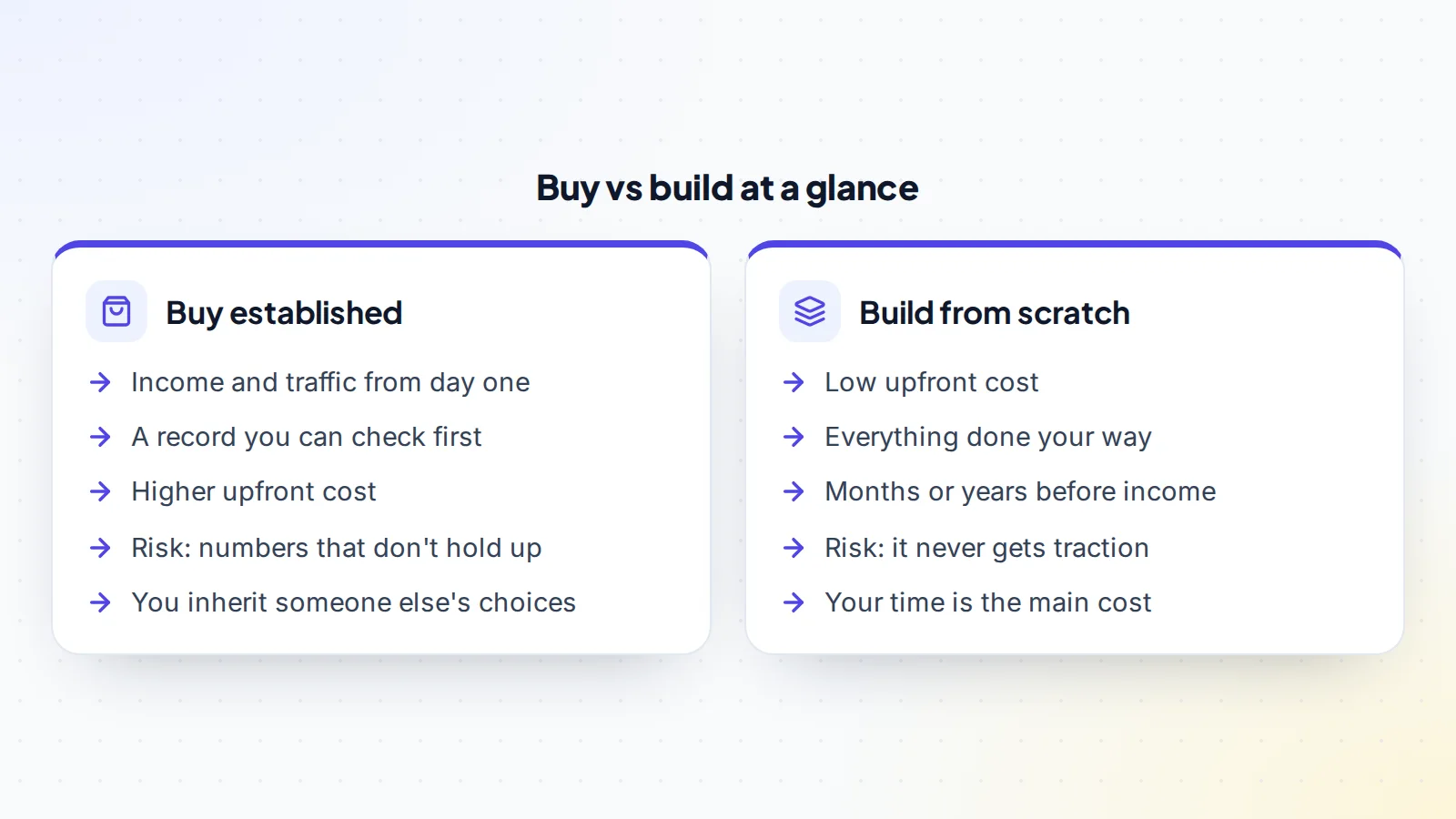
- Buying gives you traffic, income and a record you can verify on day one, for a higher upfront price.
- Building costs less money but much more time, and many new sites never reach meaningful traffic.
- The main risk when buying is overpaying for numbers that don’t hold up; the main risk when building is that it never takes off.
- Your time, skills and appetite for uncertainty matter more than any rule of thumb.
- Many people do both: buy something that works, then build on top of it.
What you actually get when you buy an established website
When you buy an established website, the price covers far more than files and a domain. You’re paying for things that are slow and uncertain to create:
- Search visibility: pages that already rank, which new sites often wait many months for.
- Content: dozens or hundreds of articles, reviews or product pages already written.
- Links and reputation: other sites pointing at it, built up over time.
- Income systems: ad networks, affiliate programmes or a store that already convert visitors into money.
- A track record: months or years of data showing what works and what doesn’t.
That record is the single biggest advantage. You can study it before you commit, which is something no new project can offer.
What building from scratch really takes
Building a site yourself is cheap in cash: a domain, hosting, a theme and some tools cost relatively little. The real cost is time. You’ll choose a niche, plan content, write or commission articles, build links and wait while search engines decide whether to trust a new domain. It’s common for new content sites to take many months before traffic picks up, and plenty never reach the point of earning a meaningful income.
If you enjoy that process and have the time, building can be deeply rewarding, and you’ll own something shaped entirely by your choices. If you’re paying writers and developers to build it for you, the cash cost rises quickly and the uncertainty remains.
Comparing the costs
On the buying side, the main cost is the purchase price, which for established sites is usually a multiple of average monthly profit. Add due diligence, escrow fees, any migration help and money set aside for improvements after the purchase.
On the building side, add up the domain and hosting, content (your time or paid writers), design and development, tools, and the months of your time before income starts. Put a fair hourly value on your time, even if you’re not paying yourself: it’s the cost people most often forget.
A worked example
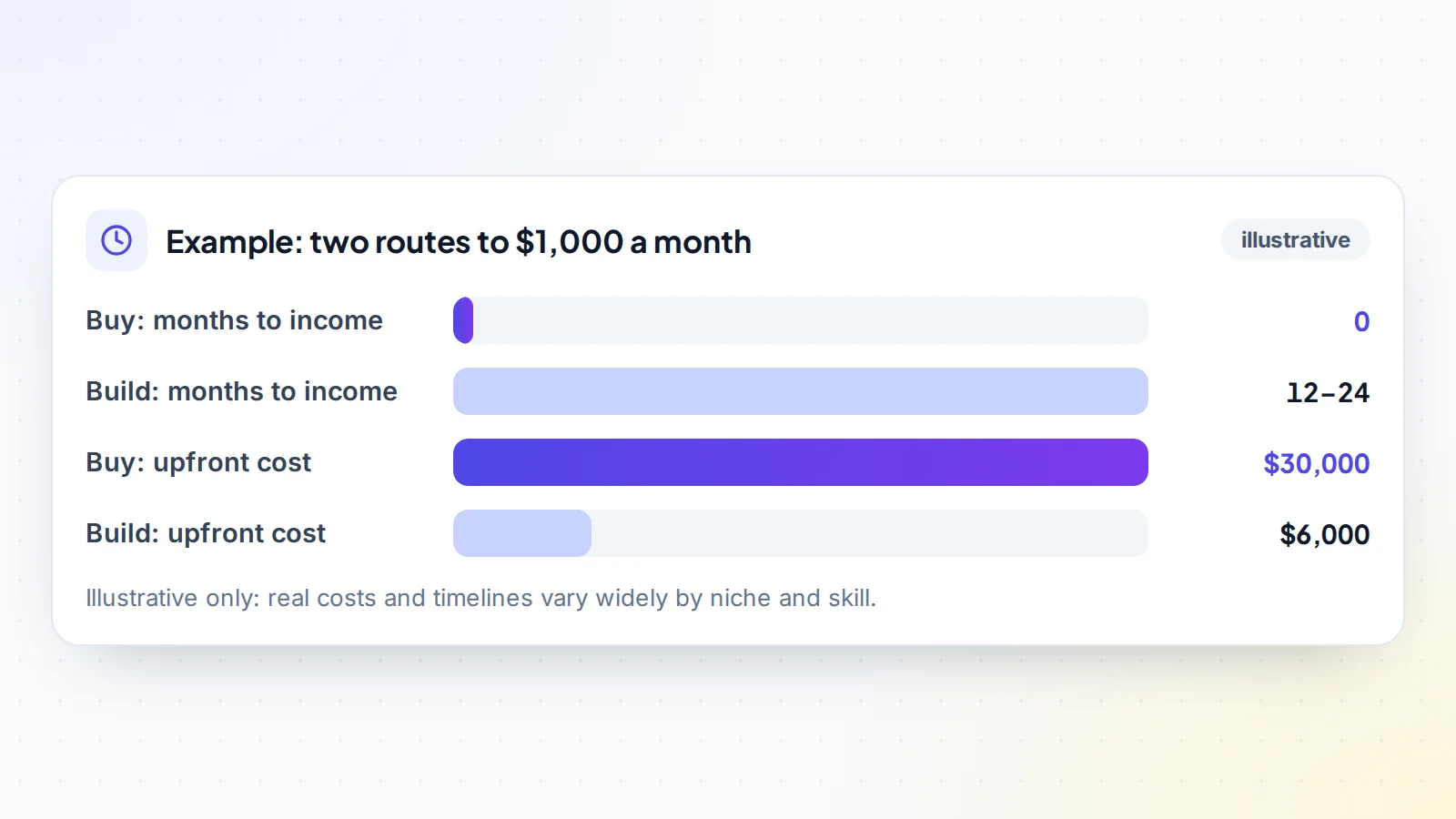
Suppose your goal is a site in a niche you like that earns around $1,000 a month in profit. One option is to buy an established website already earning that. If similar sites sell for, say, around 30 times monthly profit, you’d pay about $30,000 and could start earning from the first month, subject to due diligence confirming the numbers.
The other option is to build. You might spend a few thousand dollars on content, tools and design over the first year, plus many hours of your own time. With good execution and some luck, the site might reach a similar income in a year or two; without them, it might never get there. These numbers are illustrative, not predictions, but they show the trade: buying spends money to remove time and uncertainty; building spends time to save money and keep full control.
The risks on each side
Risks of buying
- Overpaying: paying a multiple of profit that the site’s risks don’t justify.
- Numbers that don’t hold up: traffic or revenue that was inflated, or a recent peak sold as normal. Verification at the source is essential; read about add-backs and how they can inflate profit.
- Hidden problems: a search penalty, a fragile link profile, or income that depends on the seller personally.
- Dishonest sellers: rare, but real. Check who you’re dealing with; see how to check an online seller.
Risks of building
- It never takes off: the most common outcome for new sites.
- Time runs out: life gets busy and the project stalls before it earns.
- The niche turns out to be weak: you only discover it after months of work.
- Search changes affect new sites too, often more harshly than established ones.
Who should buy
Buying usually suits people who:
- Have capital but limited time.
- Value a predictable starting point over a blank page.
- Are comfortable doing careful due diligence, or paying someone to help.
- Want to learn by running a real, working site.
- Already run sites and want to grow a portfolio faster.
Types worth exploring include content websites and affiliate websites, which tend to be the most common first purchases.
Who should build
Building usually suits people who:
- Have more time than money.
- Enjoy creating content, design or code.
- Want full control from the first decision.
- Are happy to treat the first year as learning, with no guarantee of income.
If you build, choose your topic carefully. Our guide to evergreen niches explains how to pick topics that keep earning.
Where the upside is on each route
Risk is only half of the picture. The other half is upside. When you buy, the upside comes from improving something that already works: updating old content, adding income sources the seller never tried, building an email list, fixing slow pages. Small improvements on a working base often show up in the numbers within months, and they can raise the site’s value if you ever sell. When you build, the upside is ownership of every decision and the chance that a site you created for little cash becomes valuable. If it works, your return on money spent can be very high; if it doesn’t, the main loss is time. Neither upside is guaranteed, which is why the honest comparison is always risk and upside together.
The middle path: buy, then build
Many successful owners do both. They buy an established website as a base, then build on top of it: new content, better monetisation, an email list, a product. You get the head start of a site that already works and the satisfaction (and upside) of growing it your way. Some buy starter sites, small sites with little income, as a cheaper middle ground; they cost less, but carry more of the uncertainty of building.
How to decide
Answer four questions honestly:
- What’s your budget? If it’s small, building or a starter site may be the only option. If it’s larger, buying opens up.
- How many hours a week can you give it, for how long?
- How much uncertainty can you live with? Buying replaces “will it work?” with “are these numbers real?”, which you can check.
- What do you enjoy? Running and improving something, or creating from nothing?
If you lean towards buying, browse websites for sale to see what your budget buys, and try the free valuation tool to judge asking prices.
If you buy: how to do it well
Buying an established website rewards patience. Verify traffic and revenue at the source rather than trusting screenshots; check search health in Search Console; list every cost; price on average monthly profit with a multiple that reflects the risks you find; pay through escrow; and take over every account before releasing the money. Our guide to how to buy a website walks through each step. On digiflippers.com, listings can show numbers verified at the source, you can ask sellers questions publicly before you offer, and each deal runs in a free Deal Room.
Questions to ask before you buy an established website
If you lean towards buying, these questions quickly separate strong sites from weak ones. Ask them early, in writing, and compare the answers with what you see in the data:
- How long has the site earned at roughly its current level?
- Which pages bring most of the traffic, and how has that changed over the last year?
- Which income sources does it use, and could any of them change their terms soon?
- How many hours a week do you spend on it, and on what?
- Who writes the content, and will they keep working with the new owner?
- Has the site ever lost traffic suddenly, and what happened?
- What would you do next if you were keeping it?
Good sellers answer clearly and back their answers with data. Vague answers aren’t always a red flag, but they’re a reason to dig deeper before making an offer.
What changes after you buy
The day after the handover, you’re responsible for everything the seller did: publishing, maintenance, renewals, income accounts and answering emails. Most new owners find the first months are about learning the site’s rhythm rather than changing it. Keep publishing in the same style, watch traffic and income weekly, and resist big redesigns or new topics until you understand what drives the numbers. Then improve one thing at a time, so you can see what each change does. Owners who rush often can’t tell whether a drop came from the market or from their own changes.
Common mistakes on both routes
- Buyers pay for a peak month, skip verifying revenue against real payouts, or forget to budget for content after the purchase.
- Builders pick a niche because it sounds profitable rather than because they can create great content in it, then stop after a few months.
- Both underestimate how much time a site needs each week.
Buy an established website or build? The checklist
- Budget written down, including money for after the purchase or launch.
- Weekly hours you can commit, realistically, for the next year.
- Your hourly value counted in the cost of building.
- Comparable sites for sale reviewed to see what your budget buys.
- Risk tolerance considered: verifiable numbers vs uncertain growth.
- Niche chosen with evergreen demand in mind.
- If buying: due diligence plan and escrow ready.
- If building: a content plan for the first six months.
Ready to find your next asset?
Browse listings with verified numbers, ask sellers your questions before you offer, and agree every step in a free Deal Room.
Frequently asked questions
Is it better to buy an established website or build one?
It depends on your budget, time and appetite for uncertainty. Buying gets you income and a verifiable record immediately for a higher price; building costs less money but takes much longer and may never take off.
How much does an established website cost?
Established sites are usually priced as a multiple of average monthly profit, so the price depends on how much the site earns and how risky it is.
Can a bought website lose its traffic?
Yes. Search updates, competition and changes after the sale can all reduce traffic. Careful due diligence, a fair price and keeping things steady after the purchase reduce the risk.
Is building a website cheaper?
In cash, usually yes. Counting your time and the risk that it never earns, not always.
How long does it take to buy an established website?
For a small site, a few weeks from first contact to completed handover is common, including one to three weeks of due diligence.
Do I need technical skills to own one?
Basic skills help, but many owners run sites with help from freelancers for development and content. What matters most is understanding where the traffic and income come from.
Can I sell a site I built later?
Yes. Once a site you built has a steady record of profit, it can be sold like any established website, usually valued on its average monthly profit.
What about starter sites?
Starter sites sit between buying and building: cheaper than established sites, but with little or no income history, so most of the uncertainty of building remains.