Buying Expired Domains: Opportunities and Traps
How domains expire and become available again, why expired names can be good buys, the traps to avoid, and a checklist for buying one with confidence.

Every day, thousands of domain names reach the end of their registration and aren’t renewed. Some are forgotten projects; some are excellent names whose owners simply moved on. Expired domains can be a great way to get a short, memorable name for a new brand at a fair price. They also come with histories, and some of those histories cause problems. This guide explains how the expiry cycle works, where the real opportunities are, the traps to avoid and the checks that let you buy with confidence.
If you’re after a name that’s still registered, see our guide to buying a domain name that’s taken.
Key takeaways
- After expiry, gTLD domains pass through registrar periods, a redemption grace period of up to 30 days and a five-day pending delete before they’re released.
- Many good names are sold at registrar auctions before they ever drop.
- Check history, safety, trademarks, links and email reputation before you bid.
- Google’s spam policies call out “expired domain abuse”: buying old domains mainly to exploit their reputation.
- The best expired names are bought for a genuine project that fits the name.
Why good domains expire
Owners let names lapse for ordinary reasons: a project ends, a business closes or rebrands, a card on file expires, or renewal reminders go to an old email address. Some owners hold many names and drop the ones they no longer plan to use. That’s why expired domains can include genuinely good names, not just leftovers. It’s also why a name’s past matters: you’re inheriting whatever the previous owner did with it.
How domains expire
ICANN’s renewal and expiration FAQs describe what happens to generic top-level domains, such as .com, .net and .org, when the owner doesn’t renew. After the expiry date, there’s usually a period in which the registrar may let the owner renew, though the details vary by registrar. Then comes the redemption grace period, up to 30 days, in which the owner can still restore the name, usually with an extra fee. Finally, a five-day pending delete period runs, during which the name can’t be restored, before it’s released and becomes available to register again.
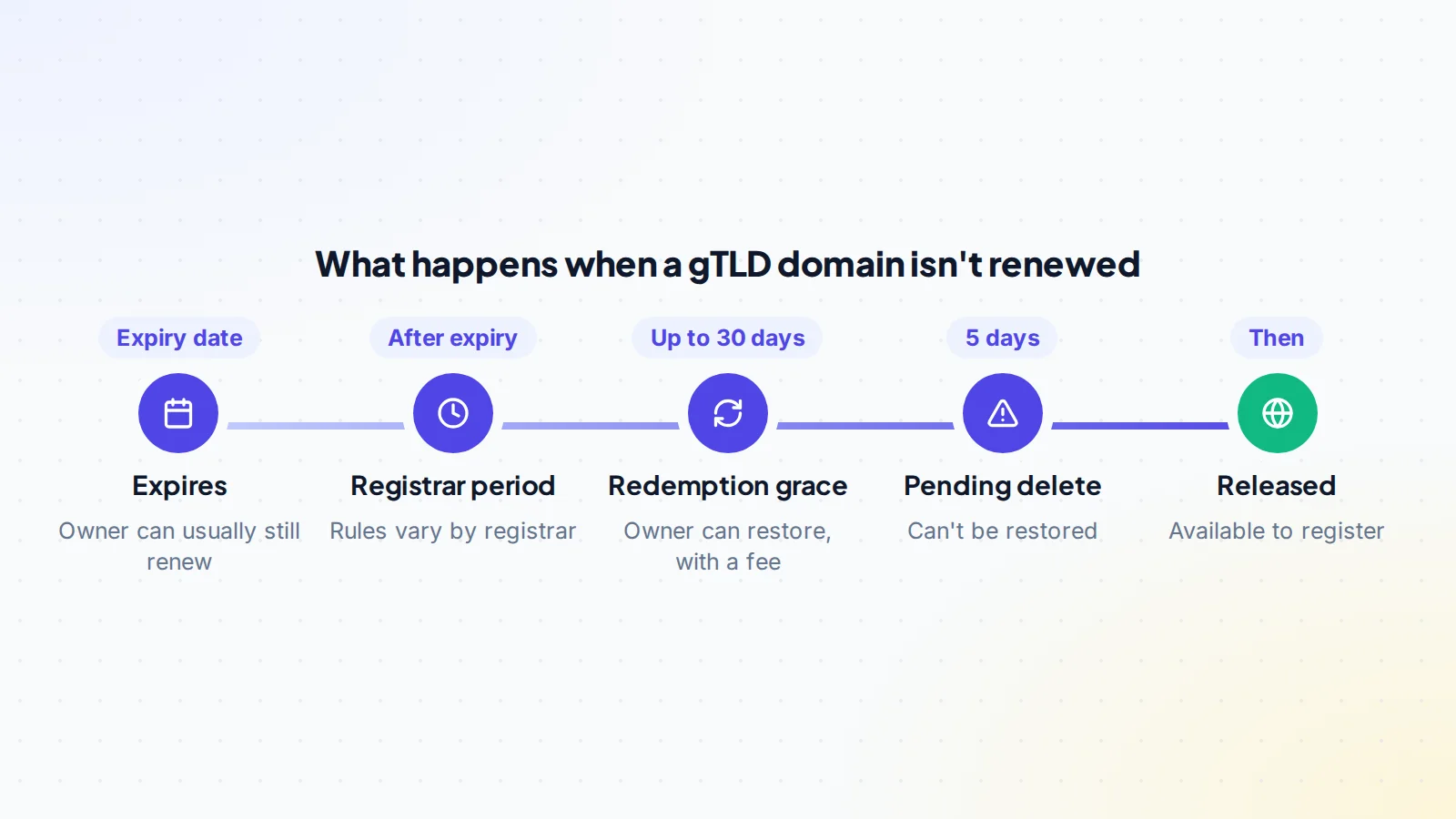
Country-code domains, such as .uk or .de, follow their own registries’ rules, which can be quite different. Check the registry’s policies before planning a purchase, including any rules on who is allowed to register names under that extension.
Where expired names are sold
Expired domains reach buyers in three main ways:
- Registrar auctions: many registrars auction expired names during the period after expiry. If no one bids, the name may continue towards the drop.
- Drop catching: services try to register names the moment they’re released, often running their own auctions when several people want the same name.
- Hand registration: names nobody else wanted can simply be registered at a normal price once they drop.
Read each service’s terms: fees, how auctions end, and whether a name can still be renewed by its original owner during the sale. If the original owner renews during an auction, the sale may be cancelled under the service’s terms, so don’t make firm plans around a name until it’s actually in your account.
Backorders and drop catching
When a name is heading for the drop, you can place a backorder with a drop-catching service, which tries to register it the moment it’s released. If you’re the only person with a backorder and the catch succeeds, you usually pay the service’s price. If several people backordered the same name, many services hold a short private auction among them. Backorders often cost nothing unless the catch succeeds, but read each service’s terms. Placing backorders with several services can raise your chances, but you may end up in more than one auction, so set your limit first.
Expired domains that still get visits
Some expired domains still receive visitors: people following old links, bookmarks or search results that haven’t updated. That can feel like a bonus, but think about who those visitors are and what they expect. If they’re looking for the old business, they won’t find it, and some may be confused or annoyed. If the old site covered a topic close to yours, a thoughtful new site can serve them well. Either way, build your plans on your own content and marketing, and treat any leftover visits as a small extra rather than the reason to buy.
The opportunities
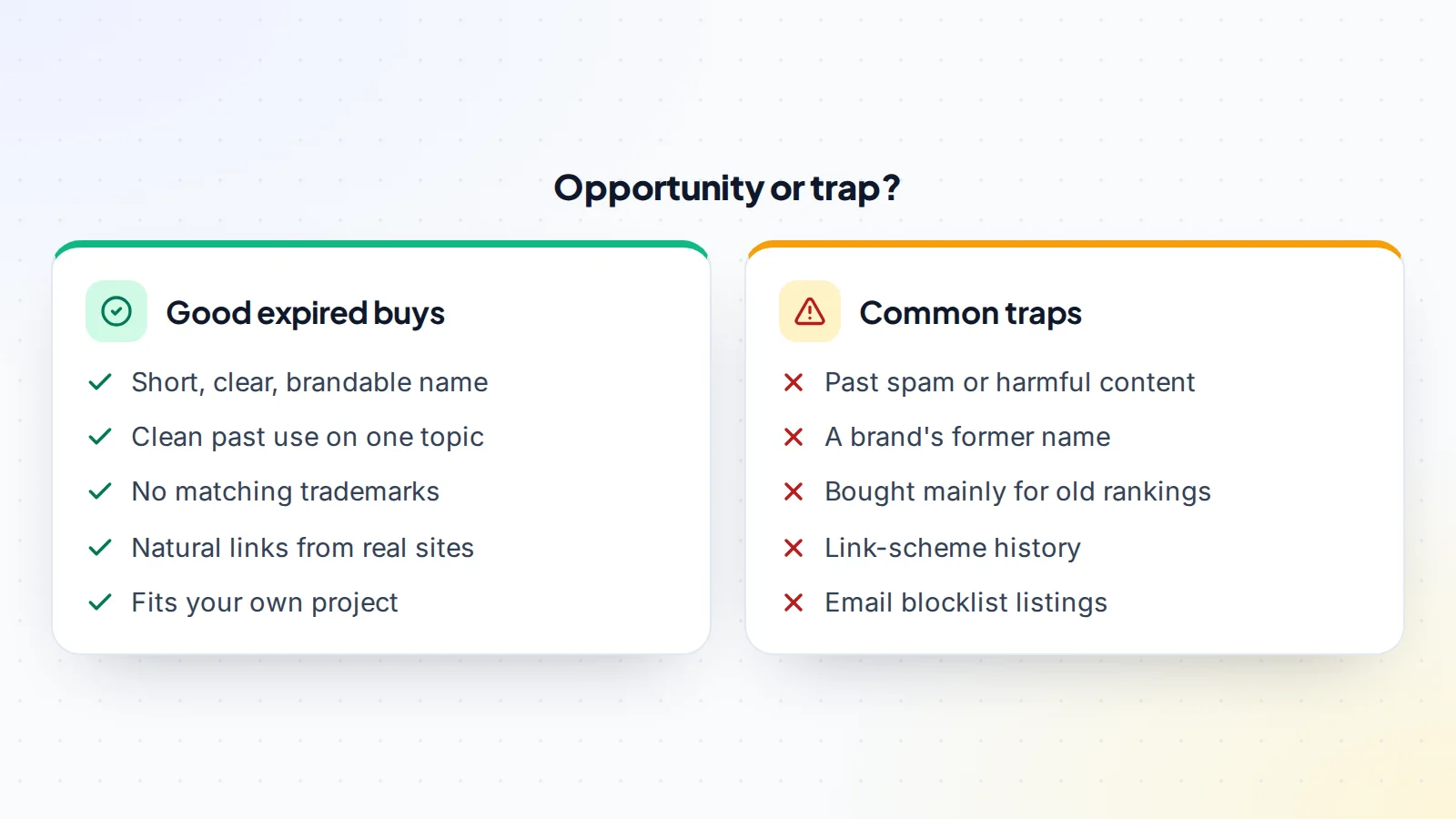
- Better names: short, memorable, brandable names that would be taken otherwise.
- Fair prices: names that were never in high demand can cost little more than a normal registration.
- A clean fit: a name that suits your brand, with a past that’s neutral or relevant to your topic.
The traps
Past spam or harmful content. A name that hosted spam, malware or adult content may carry warnings or a poor reputation with search engines and email providers. Rebuilding trust can take time, and isn’t always possible.
Someone else’s brand. A name that matches a company or product, even a former one, can lead to a trademark dispute. ICANN’s Uniform Domain-Name Dispute-Resolution Policy lets trademark owners challenge domain registrations, and our guide to domain trademarks and UDRP explains how it works.
Buying for old rankings. Google’s spam policies describe “expired domain abuse”: buying an expired domain and using it mainly to host content that offers little value, relying on its past reputation to rank. Google says sites that violate its spam policies may rank lower or not appear in results at all. If your plan for a name depends on its old search rankings rather than your own content, rethink it. Our guide to aged domains and SEO covers this in more depth.
Link-scheme history. Some names were used in networks built to pass links. Large numbers of unrelated, low-quality links are a warning sign.
Checks before you bid
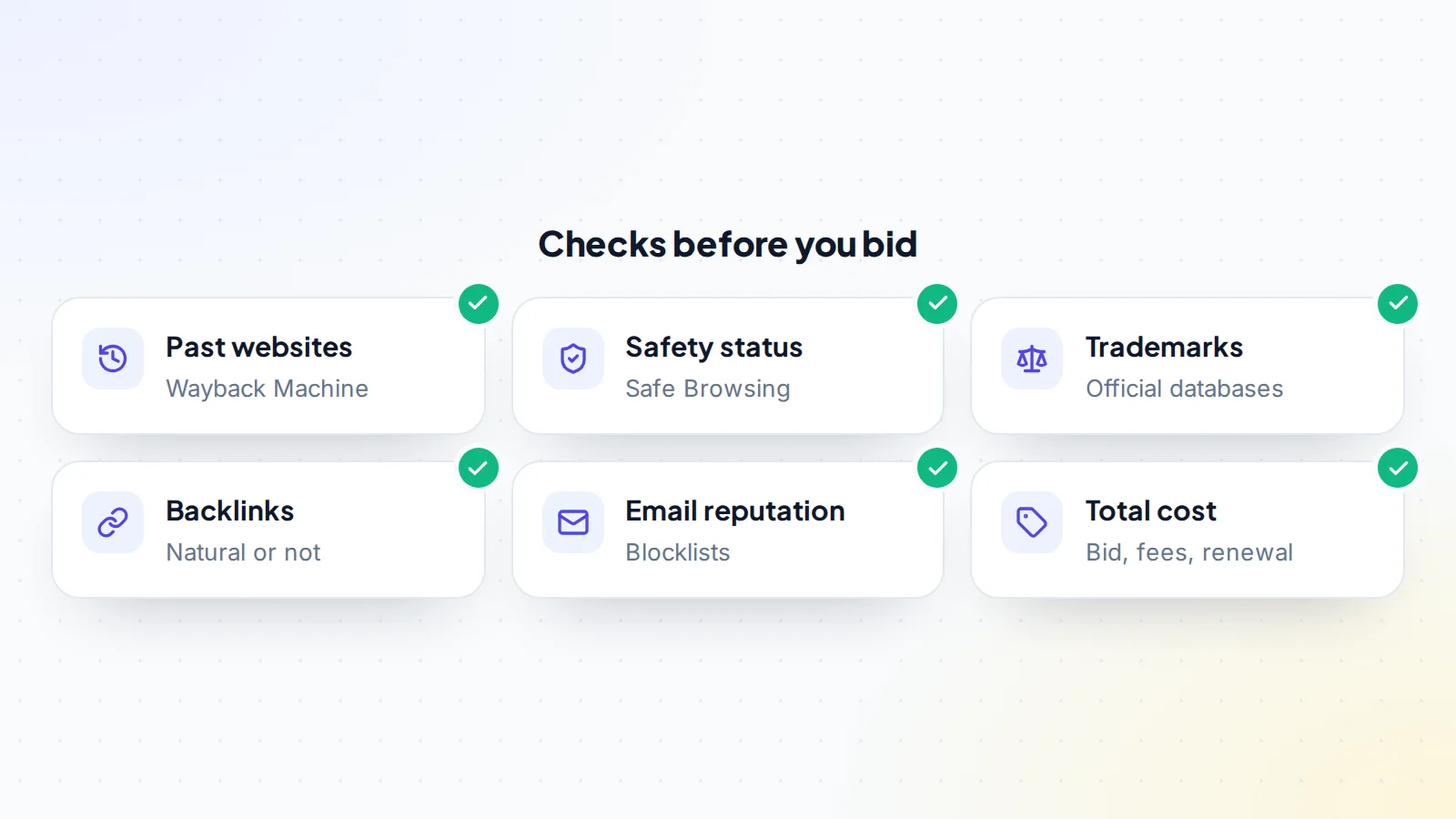
- Past websites: open several years of snapshots in the Internet Archive’s Wayback Machine. A steady past on one topic is reassuring; many topic changes, spam or adult content are not.
- Safety status: check the name in Google’s Safe Browsing site status.
- Trademarks: search the name in the trademark databases for your markets, such as the USPTO’s search, and on the web.
- Backlinks: look at who links to the name. Natural links from real sites in a related topic are fine; sudden spikes and unrelated links are not.
- Email reputation: if you’ll send email from the domain, check common blocklists.
- Total cost: the bid, any service fees and the renewal price, which can differ from the purchase price.
Our step-by-step guide to a domain history check covers each tool in detail.
How much to pay
Decide your maximum before an auction starts, based on the name’s length, words, extension and how well it fits your project. Look at recent sales of similar names. History adjusts the price: a clean, relevant past supports it, while warning signs push it down or rule the name out. Auctions can move quickly, and a firm limit keeps you from overpaying. Our guide to pre-revenue valuation explains how assets without income are priced.
Start with your project, not the list
It’s easy to spend hours scrolling lists of dropping names. A faster route is to start with your own needs: the words that describe your brand, the extension your customers expect and the length you can live with. Make a short list of names that would genuinely suit the project, then set alerts or backorders for those. You’ll spend less time, bid more calmly and end up with a name you’ll be glad to build on for years, rather than one bought because it looked like a bargain.
If the right name isn’t dropping, a registered name bought from its owner or a fresh, well-chosen registration may serve you better than a compromise.
Keep good records
Save the auction or backorder receipt, the registration confirmation and the results of your history checks. They show when and how you acquired the name, which helps if a trademark question or a sale of the domain ever comes up later.
After you buy
Once the name is yours, turn on the registrar lock and two-step sign-in, set auto-renew and update your contact details. Put up your new site or a simple holding page promptly. If old links point to pages that no longer exist, decide whether to redirect the relevant ones to related new pages or let them return “not found”. If you’ll send email, set up SPF, DKIM and DMARC and build up sending gradually. Keep a copy of your history checks with your purchase records.
Common mistakes
- Bidding before checking the name’s history.
- Paying a premium for old metrics or rankings rather than the name itself.
- Forgetting that renewal prices can differ from the first-year price.
- Buying a former brand name in the same field as that brand.
- Starting to send email from the domain without checking blocklists.
Buying a name someone else caught
Many expired domains end up with resellers who caught them at the drop and list them for sale. Ask how and when they acquired the name, and check that the registration record’s created date fits their story. Compare their price with recent sales of similar names. And use escrow, so the money is only released once the domain is in your registrar account.
Buying safely
Expired-name auctions and backorders run through registrars and drop services, which handle payment and the transfer. If you buy an expired name from a person who caught it, the usual rules apply: check their history, keep messages on the marketplace and use escrow so the money is held until the domain is in your account. Be wary of anyone asking you to pay outside the agreed process; our guide to the off-platform payment scam explains the pattern. On digiflippers.com, the ways to pay in a deal are: directly to the seller, through escrow, and the platform never holds the money itself.
A worked example
The details below are made up to show the method.
Noah is launching a coffee subscription and spots a short, two-word .com in a registrar’s expired-domain auction. The Wayback Machine shows it was a small café’s website for six years, then went offline. Safe Browsing shows no warnings, a trademark search finds nothing similar in Noah’s field, and the backlinks are a handful of local listings and food blogs. Noah sets a maximum bid based on similar sales, wins below it and pays the auction fee and first-year renewal. Noah turns on the registrar lock and auto-renew the same day, and the new site goes live within a week.
Expired domains: the checklist
- Expiry stage and sale method understood for the name.
- Wayback Machine history reviewed across several years.
- Safe Browsing status checked.
- Trademark databases and the web searched.
- Backlinks checked for natural patterns.
- Email blocklists checked if you’ll send email.
- Maximum bid set from similar sales and the name’s fit.
- Total cost including fees and renewal confirmed.
- Plan for your own content, not the old rankings.
Ready to find your next asset?
Browse listings with verified numbers, ask sellers your questions before you offer, and agree every step in a free Deal Room.
Frequently asked questions
How long after expiry is a domain released?
For many gTLDs, after any registrar period, a redemption grace period of up to 30 days and a five-day pending delete. The total depends on the registrar and the registry.
Can the old owner get an expired domain back?
During the redemption grace period, the original owner can usually restore it for a fee. Once it’s in pending delete, it can’t be restored.
Are expired domains good for SEO?
A name with a clean, relevant history can be a good start, but Google’s spam policies warn against “expired domain abuse”: using an old domain mainly to exploit its reputation with low-value content.
What should I check before buying an expired domain?
Past websites, safety status, trademarks, backlinks, email reputation and the total cost including renewal.
Where can I buy expired domains?
Registrar expired-domain auctions, drop-catching services, or by registering names that have dropped and weren’t caught.
Do country-code domains expire the same way?
Not necessarily. Each country-code registry sets its own rules, so check the registry’s policies.
Do backorders cost money if they fail?
Many drop-catching services only charge when a catch succeeds, but terms vary. Read each service’s terms before placing a backorder.