What Happens If a Deal Goes Wrong? Disputes Explained
A practical guide to disputes in online business sales: why they happen, how clear terms prevent them, what to do step by step, how escrow dispute processes work, the evidence to keep and when mediation, arbitration or courts come in.

Most online business sales close without trouble. But when something goes wrong, such as a handover that stalls, numbers that don’t match after closing or a disagreement about what was included, both sides want a fair, quick resolution. An online business sale dispute is far easier to resolve when the payment is still held, the terms are written down and the evidence is clear. This guide explains why disputes happen, how to prevent them, what to do step by step if one starts, how escrow dispute processes work and when outside help comes in.
Protection starts before the deal; see our guide to escrow for online businesses. For each side’s view of risk, read about buyer protection and seller protection.
This guide gives general information, not legal advice. For a serious dispute, get advice from a qualified professional in the relevant country.
Key takeaways
- Most disputes come from unclear terms, incomplete handovers or numbers that don’t match.
- Clear written terms, an inspection period and escrow prevent most problems.
- If a dispute starts, keep the funds held, gather evidence and talk in writing.
- Escrow services have their own dispute steps and deadlines; follow them closely.
- Mediation, arbitration or legal action are last resorts, usually after other steps fail.
Why disputes happen
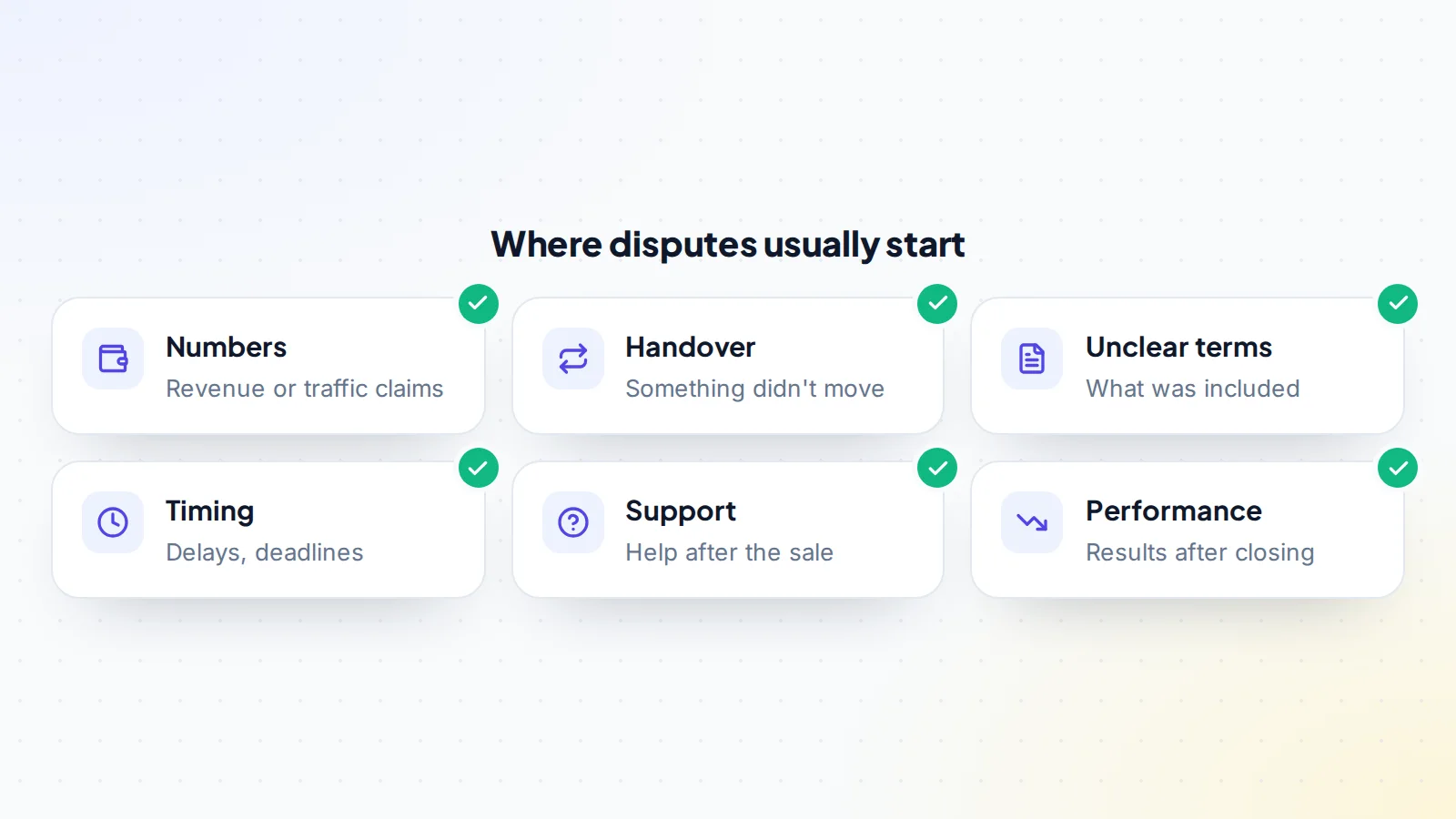
Disputes rarely start with bad intentions. More often, buyer and seller understood something differently: whether a social account was included, how long support would last, whether income would continue at the same level, or exactly when payment would be released. Sometimes the handover simply goes wrong: a domain transfer stalls, an account can’t move, or a key supplier won’t work with the new owner. And occasionally, numbers presented before the sale turn out to be different after closing.
Understanding these causes is the best way to prevent them, and most can be handled with a little more care at the start of a deal.
Preventing disputes before they start
- Write everything down: what’s included, the price, payment terms, the handover plan, support and timelines.
- Use a letter of intent: agree the main terms early; our guide to the letter of intent explains how.
- Verify before paying: check revenue, traffic and ownership at the source.
- Use escrow or a middleman: so money moves only when both sides are satisfied.
- Agree an inspection period: time for the buyer to confirm everything after the handover.
- Keep messages on the platform: a shared record helps resolve misunderstandings fast.
On digiflippers.com, deals keep messages and agreed terms together, and the ways to pay in a deal are: directly to the seller, through escrow. The platform never holds the money itself. Read how it works for the full process.
Terms that prevent the most common disputes
A few clauses do most of the work. A clear list of included assets, item by item, prevents arguments about what was sold. A handover plan with steps and dates prevents arguments about delays. A defined support period, with hours or a number of calls, prevents arguments about help after the sale. Statements from the seller about revenue, traffic and ownership, confirmed as true, give the buyer something concrete to rely on. And a stated dispute method, such as mediation before any legal action, gives both sides a path if they disagree. None of this needs to be complicated; it just needs to be written down before money moves.
If a dispute starts: the first steps
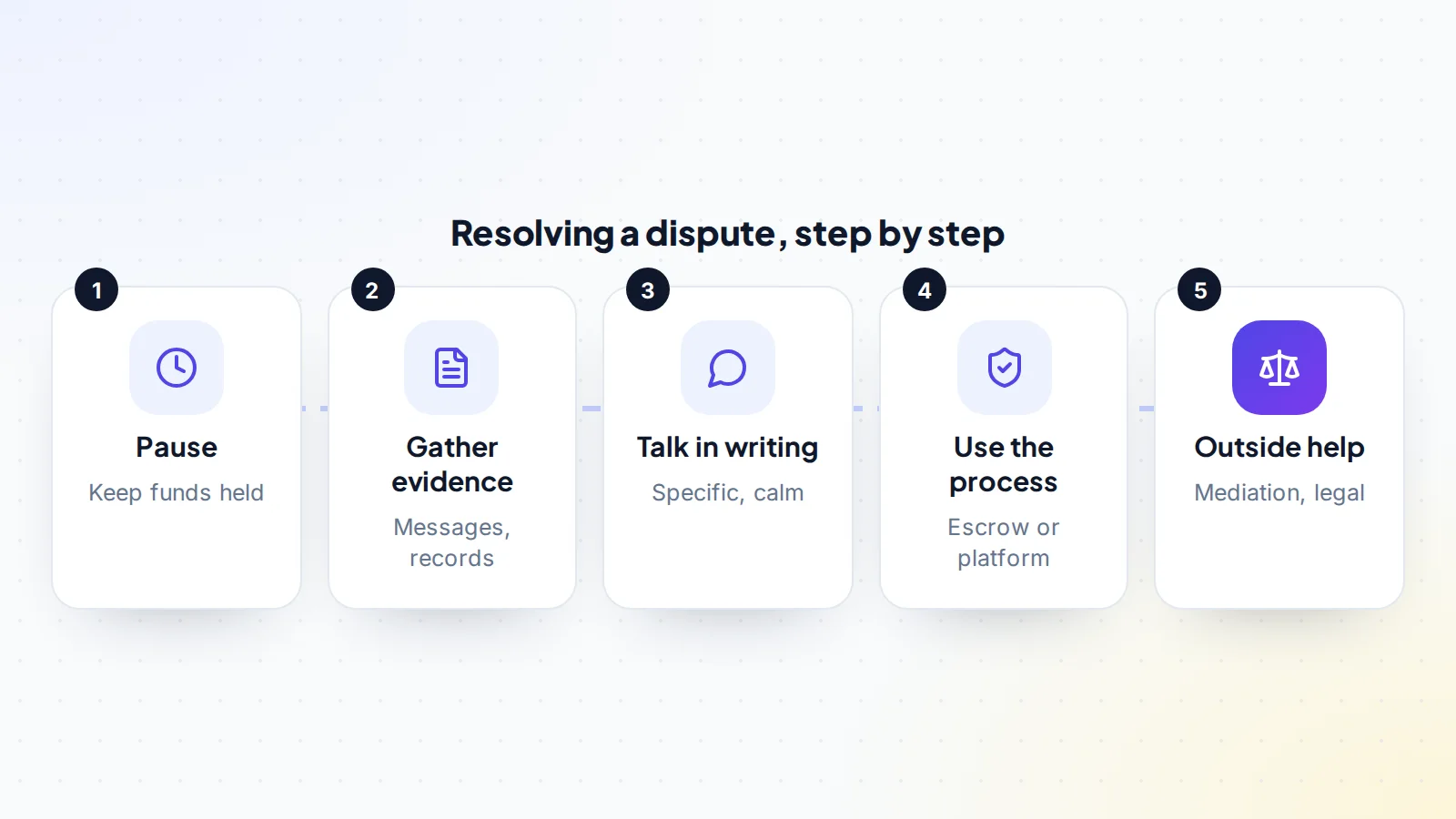
- Pause. Don’t release funds, and don’t make further changes to accounts while the issue is open.
- Gather evidence. Collect the agreement, messages, dashboard records, transfer confirmations and anything else relevant.
- Talk in writing. Describe the problem specifically and calmly, with evidence, and suggest a fair solution.
- Use the formal process. If you can’t agree, use the escrow service’s or platform’s dispute process within its deadlines.
- Seek outside help. If that fails, consider mediation, arbitration or legal advice.
Most disputes end at the third step, once both sides look at the same evidence and realise what happened.
How to communicate during a dispute
Tone matters. Stick to facts: what was agreed, what happened, what the evidence shows and what you’d like to happen. Avoid accusations and threats, which make people defensive. Propose solutions, such as completing a missing transfer, extending support, adjusting the price or returning the asset. Set reasonable deadlines for replies, and acknowledge the other side’s points even when you disagree. Keep everything in writing on the platform, so there’s a clear record if the matter goes further.
How escrow dispute processes work
Escrow services set out their own rules for what happens when buyer and seller disagree. Escrow.com, for example, explains that a buyer who wants to reject what was delivered must do so before the inspection period ends, and is then expected to return it, with 10 calendar days to confirm the return. The seller then has a five-day inspection period for the returned item. If the seller also rejects, the parties enter a dispute process with a 14-day negotiation period to resolve it. Other escrow services work differently, so read the terms of the one you use before the deal starts.
The key lesson is that deadlines matter. A buyer who misses the inspection period may lose the chance to reject. A seller who doesn’t respond in time may lose leverage. Note every date as soon as the deal starts.
The evidence that matters
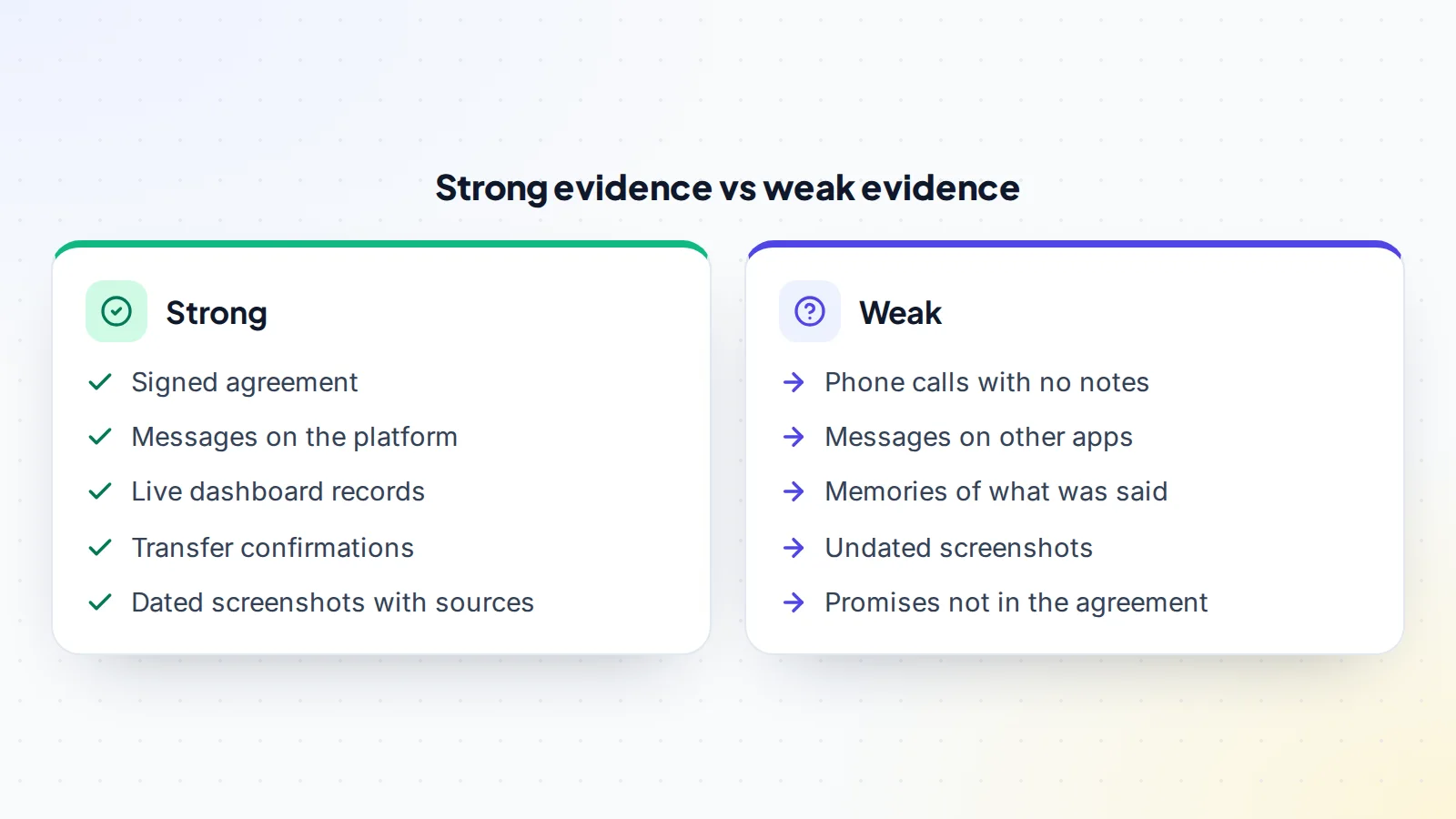
When a dispute is reviewed, by an escrow company, a platform, a mediator or a court, written evidence carries the most weight. The strongest is a signed agreement and messages kept on the platform. Live dashboard records, transfer confirmations and dated screenshots with clear sources also help. Weak evidence includes phone calls with no notes, messages on other apps that can’t be verified, and promises that never made it into the agreement. Our guide to the off-platform payment scam explains another reason to keep everything on the platform.
Common disputes and fair solutions
- An asset didn’t transfer: complete the transfer, or adjust the price if it can’t move.
- Revenue dropped after closing: check whether the drop was foreseeable from the evidence, whether something changed after the handover, and what the agreement says.
- Support not provided: agree the support still owed, with dates.
- Something missing from the sale: check the agreement’s list of included items.
- Seller started a competing business: check whether a non-compete was agreed; our guide to non-competes explains how they work.
Disputes about performance after closing
Some of the hardest disputes are about results: the business earns less after the sale than before. A drop isn’t automatically anyone’s fault. Seasonal patterns, search updates, market changes and the new owner’s own decisions can all affect results. The key questions are whether the seller’s statements were accurate at the time, whether anything the seller controlled caused the drop, and what the agreement says. If part of the price depends on future results, such as an earn-out, the agreed metric and reports should settle most questions. Where it doesn’t, both sides should look at the same data, month by month, before drawing conclusions.
Disputes about timing
Delays are a common source of friction: a domain transfer that takes longer than expected, a platform asking for extra verification, or one side being slow to respond. Many delays have simple causes, such as platform waiting periods or time zones. Agree realistic dates at the start, allow some buffer, and keep each other updated. If a delay threatens an escrow deadline, ask the escrow service whether the period can be extended by agreement, rather than letting it lapse.
When to seek outside help
If direct talks and the escrow or platform process don’t resolve the issue, there are further options. Mediation brings in a neutral person to help both sides reach an agreement; it’s usually faster and cheaper than going to court. Arbitration involves a neutral decision-maker whose decision may be binding, depending on what was agreed. Courts are the final option, and many countries have small claims procedures for lower-value disputes. Check whether your agreement specifies a dispute method or governing law, and get professional advice before starting formal proceedings.
When it’s fraud, not a dispute
Sometimes what looks like a dispute is fraud: a seller who never owned what they sold, a buyer who sent a fake payment confirmation, or someone impersonating an escrow company. In those cases, contact your bank or payment provider immediately, report the account to the platform, and report the fraud to the relevant authorities. In the US, the FTC collects reports at ReportFraud.ftc.gov and the FBI’s Internet Crime Complaint Center handles internet fraud. Our guide to buyer protection covers how to avoid these situations.
The cost of a dispute
Even a dispute that ends fairly has costs: time, stress, delayed payment and sometimes fees for advisers or dispute services. Escrow services may charge for extended processes, and legal help can quickly exceed the amount in question on smaller deals. That’s a good reason to settle sensible disagreements directly, with a fair compromise, rather than pushing every point. Both sides are usually better off with a quick, reasonable resolution than a long fight over a small sum.
After a dispute is resolved
Write down what was agreed, including any changes to the price, the handover or support, and have both sides confirm it. Complete any outstanding steps promptly. Then release or return funds according to the resolution. Both sides can learn from the experience: clearer terms, better records and earlier communication prevent most disputes next time.
For buyers: protecting your position
- Check everything during the inspection period, not after.
- Raise problems quickly, in writing, with evidence.
- Don’t release funds until issues are resolved.
- Keep records of your checks and findings.
For sellers: protecting your position
- Describe the business accurately, including weaknesses.
- Keep copies of everything you showed the buyer.
- Complete each handover step and get confirmation.
- Respond to concerns quickly and calmly.
A worked example
The details below are made up to show the method.
Jordan buys a content site through escrow, with a seven-day inspection period. On day four, Jordan finds that the email list included in the sale hasn’t moved: the seller exported it, but the account on the email platform is still in the seller’s name, along with the automated welcome sequence. Jordan pauses, gathers the agreement listing “email list and automations”, and messages the seller on the platform with the evidence.
The seller replies that they thought exporting the list was enough. They agree that the automations should move too, and the seller transfers the email platform account the next day. Jordan confirms within the inspection period, and the escrow funds are released. The dispute took two days to resolve because the terms were written down and the funds were still held.
Online business sale dispute: the checklist
- Terms, included items and timelines written into the agreement.
- Payment held by escrow or a middleman.
- Inspection period and its dates noted.
- Messages kept on the platform.
- Evidence gathered as soon as a problem appears.
- Calm, specific, written communication.
- Escrow or platform dispute process followed within deadlines.
- Outside help considered only after other steps.
- Resolution written down and confirmed by both sides.
Learn more about trust and safety and escrow on digiflippers.com.
Ready to find your next asset?
Browse listings with verified numbers, ask sellers your questions before you offer, and agree every step in a free Deal Room.
Frequently asked questions
What causes most online business sale disputes?
Unclear terms, incomplete handovers and differences between numbers before and after the sale.
What should I do first if a dispute starts?
Pause, keep the funds held, gather evidence and raise the issue in writing on the platform.
How do escrow dispute processes work?
Each escrow service has its own steps and deadlines. Escrow.com, for example, requires rejection before the inspection period ends and sets a 14-day negotiation period if both sides reject.
What evidence is most useful?
A signed agreement, messages on the platform, dashboard records and transfer confirmations.
When should I involve a lawyer?
When direct talks and the escrow or platform process haven’t worked, or when large sums are involved.
What if it’s fraud?
Contact your bank immediately, report the account to the platform and report the fraud to the authorities.
How can disputes be prevented?
Clear written terms, verification before paying, escrow, an inspection period and keeping everything on the platform.