Buying an Online Course Business: What Really Transfers
What really transfers when you buy an online course business: content, students, platform, brand and the instructor, and how to check each one.

An online course business can be one of the most profitable digital assets you’ll ever own: content made once, sold again and again, with students who often buy the next course too. When you look at an online course business for sale, though, the most important question isn’t how much it earns. It’s what will actually keep earning once the founder steps away.
This guide explains how to judge a course business before you buy. You’ll learn what really transfers (and what may not), how to verify sales, refunds and student numbers, how to check that the content is yours to sell, what the course platform allows, how these businesses are priced and how to manage the handover so students barely notice.
It applies to self-paced courses, memberships and cohort programmes, whether they run on a hosted course platform, a WordPress site or a marketplace.
Key takeaways
- Work out how much of the value depends on the instructor personally. It’s the biggest risk in course businesses.
- Verify sales, refunds and active students in the course platform and payment processor, for at least 12 months.
- Separate evergreen sales from launch spikes; they’re valued very differently.
- Confirm the seller owns every video, workbook and asset, and that music and images are licensed for the business.
- Check how your course platform handles a change of owner and how students keep access.
Why buy an online course business?
Good courses are expensive to make. Planning, scripting, recording, editing and testing a course with real students can take months, and building an audience that buys it takes longer. An established course business gives you:
- Proven content with a sales history and student feedback.
- An audience, usually an email list and sometimes a community, that trusts the brand.
- Systems for selling: landing pages, email sequences, webinars, ads.
- High margins: once content exists, each new sale costs little to deliver.
The best course businesses for a new owner are those built around a topic and a teaching method rather than one charismatic personality, or where the instructor is willing to stay involved for a while.
Types of course businesses
- Self-paced courses sold on demand. Usually the easiest to take over.
- Memberships with recurring payments and regular new content. Recurring revenue is attractive, but someone has to keep producing.
- Cohort programmes with live sessions. High prices, but often tied closely to the instructor.
- Course bundles and libraries covering a broad topic, often sold through marketplaces.
Each type has a different workload and risk profile. Our pillar guide to buying a digital product business covers the shared basics, and template businesses are a related, lower-touch model worth comparing.
The instructor question
Before anything else, work out how much of the business depends on the person who teaches. Watch several lessons and the marketing. Is the founder’s face on every video? Do students buy because of them, or because of the outcome the course promises? Are there testimonials naming the instructor specifically?
If the founder is central, you have three options. Keep them involved for a defined period (as a paid instructor or consultant), gradually re-record or rebrand the content around a new instructor, or accept that some sales will fall and price that in. Many good deals combine a lower upfront price with a paid transition period. Our guide to selling an online course business shows how sellers think about this.
Verify sales, refunds and students
Ask for a live screen share or read-only access to the course platform and payment processor, covering at least 12 months:
- Sales by course and by month, with launch periods marked.
- Refunds and chargebacks. Course businesses often offer refund guarantees; high refund rates are a warning sign about the content or the marketing.
- Active students and completion rates, which show whether students get value.
- Recurring revenue from memberships, with cancellations.
- Payouts matched to the seller’s bank account.
- Costs: platform fees, payment fees, ads, assistants, editors, community moderators, affiliates.
Pay special attention to the split between evergreen sales (steady sales from search, email sequences or ads) and launches (big spikes a few times a year). Evergreen income is more predictable and usually valued higher. Launch income depends heavily on the list, the offer and often the founder’s presence.
Where students come from
Find out how students discover the courses: search, YouTube, social media, podcasts, partnerships, affiliates, paid ads or the email list. If most students come from the founder’s personal social accounts or podcast appearances, that channel may not transfer. A business whose traffic comes from content and an email list the brand owns is much easier to run after the sale. Check search queries in Google Search Console if the business has a website.
Confirm the content is the seller’s to sell
You’re buying the right to keep selling the content, so check who owns it:
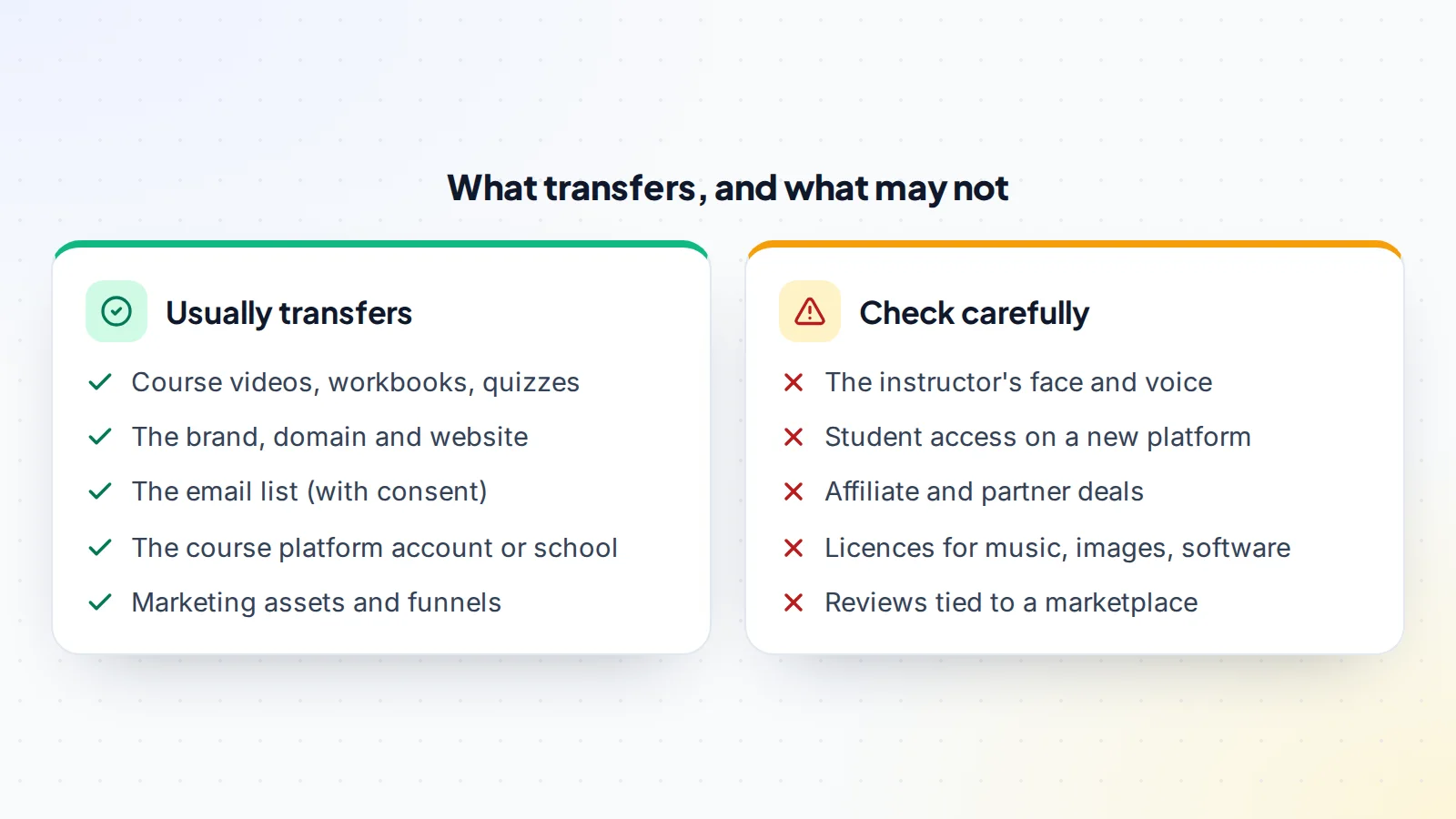
- Videos and materials made by contractors (editors, designers, guest instructors). In the United States, the Copyright Office explains when commissioned work counts as “work made for hire”; otherwise the creator may own it unless there’s a written assignment. Ask for contracts.
- Music, stock footage, images and fonts used in lessons: licences must cover commercial use and continue after a change of owner.
- Software or templates included with the course.
- Trademarks for the brand and course names.
Our guide to intellectual property in digital products covers the documents to ask for.
Check what the course platform allows
Course platforms handle ownership differently, and the answer affects both price and handover. Teachable’s help centre, for example, explains that a school’s primary owner can transfer primary ownership to another owner on the school, with the change confirmed by email. Kajabi’s help centre notes that sites generally can’t be moved between different Kajabi accounts outside its partner transfer process, so check with the platform before you agree a plan. Self-hosted course sites on WordPress move like other websites.
Ask in particular how existing students keep access, whether payment plans and subscriptions continue without students re-entering card details, and whether reviews and ratings move with the course if it’s sold through a marketplace.
How course businesses are valued
Like other digital product businesses, established course businesses are usually priced as a multiple of average monthly net profit over the last 6 to 12 months.
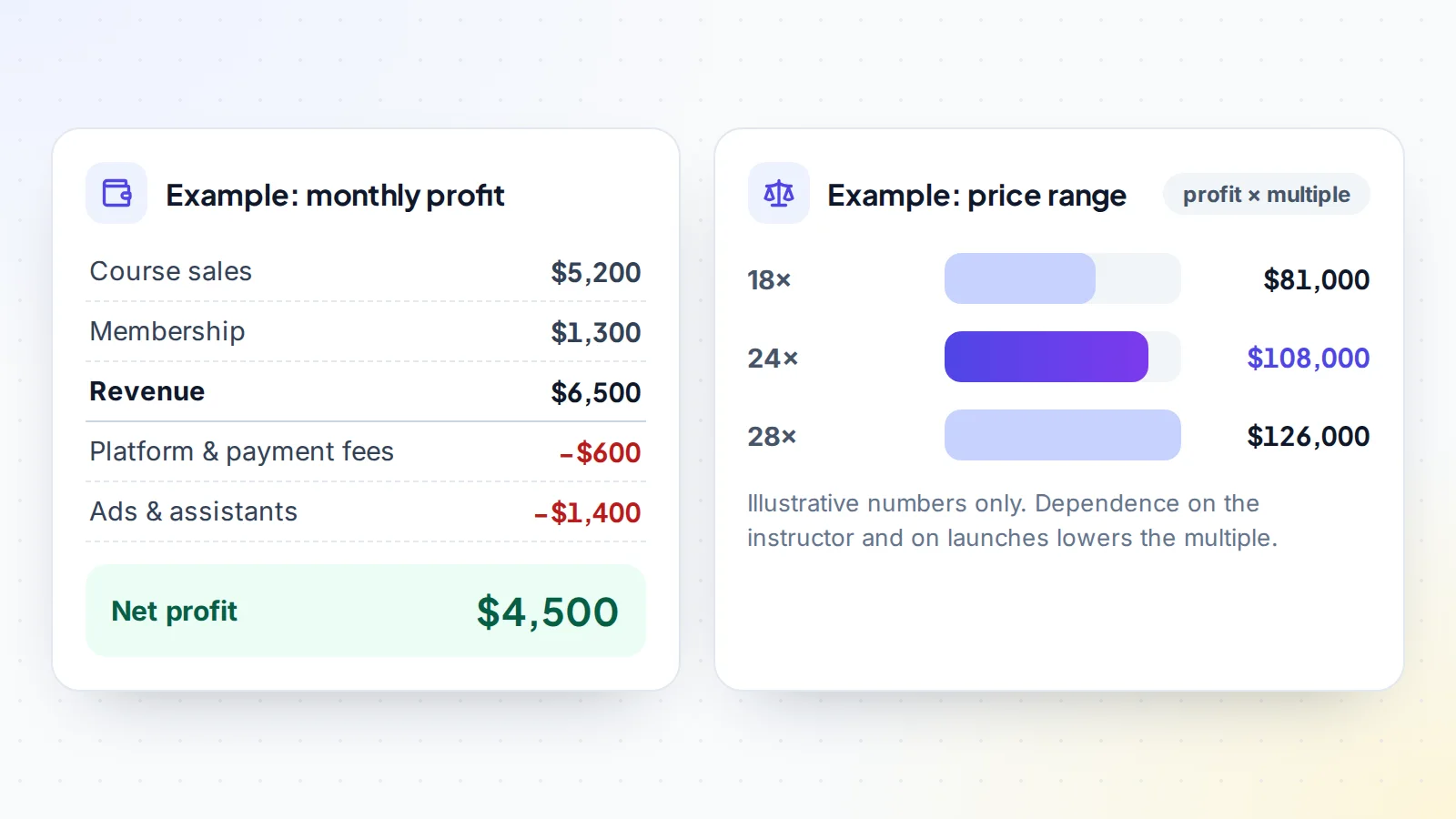
The multiple rises with evergreen sales, low refunds, high completion rates, a strong email list, several traffic channels and content that doesn’t depend on the founder. It falls with launch-driven income, a founder-centred brand, dated content and difficult platform transfers. Read our guide to pricing digital products for what drives course prices, and check the profit figure carefully, especially any add-backs. Try the free valuation tool for a quick range.
A worked example
Suppose you find an online course business for sale teaching spreadsheet skills to office workers: three self-paced courses, a small membership and an email list built over four years. Revenue averages $6,500 a month and profit $4,500. About two-thirds of sales come from an evergreen email sequence and search traffic; the rest from two launches a year. The founder appears on camera in the introduction videos, but most lessons are screen recordings with voice-over.
Due diligence confirms refunds are low and steady, completion rates are healthy and an editor’s work is covered by a signed assignment. The school runs on a platform where the primary owner role can be transferred. The founder agrees to stay on for three months to record a short welcome from the new owner and answer student questions. That combination (evergreen sales, a topic-led brand, a transferable platform and a planned transition) supports a price toward the upper end of the example range. If the same business relied on launches built around the founder’s personal social following, the right offer would be noticeably lower.
What running it involves
Ask the seller exactly how they spend their week. Typical tasks include answering student questions, moderating a community, updating lessons when tools or rules change, running ads or launches, writing emails, managing affiliates and handling refunds. Some course businesses run on a few hours a week; others need a small team. Price the work you’ll need to do or pay for, and plan who will answer students from the first day, because response time is one of the things students notice most after a change of owner.
Red flags
- Revenue shown only as totals, without launch periods marked.
- High refund rates or many recent complaints.
- Content clearly dated (old software versions, outdated rules) with no update plan.
- Course materials that closely resemble someone else’s.
- A founder who won’t commit to any transition support.
- Student access tied to the founder’s personal account on a platform that doesn’t allow transfers.
Before you go further, check who you’re dealing with; see how to check an online seller.
Agree the deal and pay safely
Write down what’s included: every course and its source files (raw video, slides, workbooks), the platform account or school, the domain and website, the email list, community spaces, marketing assets and any affiliate relationships. Agree the transition: how long the founder stays involved, in what role, and whether that’s part of the price or paid separately. Add a non-compete covering similar courses.
Pay through escrow or a trusted middleman so the money is held until the handover is complete. On digiflippers.com, the ways to pay in a deal are: directly to the seller, through escrow, and the platform never holds the money itself.
The handover
- Source files for every course into your own storage.
- Platform ownership transferred using the platform’s process, with student access confirmed.
- Payments moved to your processor account; check active subscriptions continue.
- Email list and community moved, respecting subscribers’ consent.
- Domain, website and marketing tools transferred.
- An announcement to students, agreed with the seller, introducing you and what stays the same.
Our handover checklist covers the remaining steps.
After the purchase
Start by reading every recent student question and review. They’ll tell you what to update first. Refresh outdated lessons, improve onboarding so more students finish (finishers buy again and refer others), and build an evergreen sales system if the business relied on launches. If you’re replacing the instructor, introduce yourself gradually and keep the teaching style consistent.
Checklist: buying an online course business for sale
- Instructor dependence assessed; transition plan agreed.
- 12+ months of sales, refunds, students and payouts verified at the source.
- Evergreen and launch revenue separated.
- Traffic sources understood; the email list is owned by the brand.
- Ownership of all content confirmed; licences checked.
- Platform transfer process and student access confirmed.
- Price based on average monthly profit and the risks found.
- What’s included, transition and non-compete agreed in writing.
- Payment through escrow or a middleman.
- Students informed in a planned, honest message.
Ready to find your next asset?
Browse listings with verified numbers, ask sellers your questions before you offer, and agree every step in a free Deal Room.
Frequently asked questions
Is an online course business for sale a good investment?
It can be, especially when sales are evergreen, refunds are low and the content doesn’t depend heavily on the founder. The main risks are instructor dependence and platform transfer problems.
How are course businesses valued?
Usually as a multiple of average monthly net profit, adjusted for how predictable sales are and how much depends on the founder.
What happens to existing students?
If the platform account or school transfers, students normally keep access. If you move platforms, plan how they’ll keep their courses.
Do I need to re-record the courses?
Not necessarily. Many buyers keep the original content and add updates over time. Re-recording makes sense when the founder’s presence is central or the content is outdated.
Can the seller keep teaching for me?
Often, yes. Many deals include a paid transition period or ongoing consulting. Agree the role, hours and duration in writing.
What if the course content is outdated?
Price in the cost of updating it, and plan the updates for the first months after the purchase. Students notice outdated lessons quickly, and refreshed content often lifts reviews and sales.
Can I move the courses to a different platform?
Usually, by exporting the content and students and importing them elsewhere, but it takes planning. Moving platforms at the same time as changing owners adds risk, so many buyers wait until they’re settled.
Should I check completion rates?
Yes. High completion rates suggest students get value, which supports reviews, referrals and repeat purchases.