Passive Income From Online Businesses: What Is Realistic
An honest guide to passive income online businesses: why no business is fully hands-off, which types need the least time, how to measure owner hours, how buying compares with building, and the earnings claims to be careful with.

The idea of passive income is appealing: a business that earns while you sleep. Online businesses come closer to that than most, because sales can be automated, products don’t run out and customers can buy at any hour. But no business runs itself entirely. A realistic passive income online business is one where the work is small, predictable and can be handed to others, not one with no work at all. This guide explains which businesses need least time, how to measure what they really take, how buying compares with building, and which claims to question.
For the bigger picture of what you can own online, see what is a digital asset. For how owner time affects price, read our guide to owner hours and valuation.
Key takeaways
- No online business is fully passive; the best are low-maintenance and well documented.
- Owner time varies widely by business type and how the work is organised.
- Ask sellers for hours task by task, and check who really does the work.
- Buying an established business can save the hardest, most active early stage.
- Be careful with income claims that promise big earnings for little effort.
What “passive” really means
In practice, passive income from an online business means income that doesn’t depend on you working hours in exchange for each dollar. A digital product sells while you’re away; a content site earns from visitors who arrive through search. But someone still has to update content, answer questions, fix problems, pay bills and keep the business relevant. The more of that work is automated, documented or handled by reliable help, the more passive the income feels.
It’s more accurate to think of a spectrum: from very hands-on businesses, such as services and stores with complex fulfilment, to low-maintenance ones, such as small digital product shops with automated delivery.
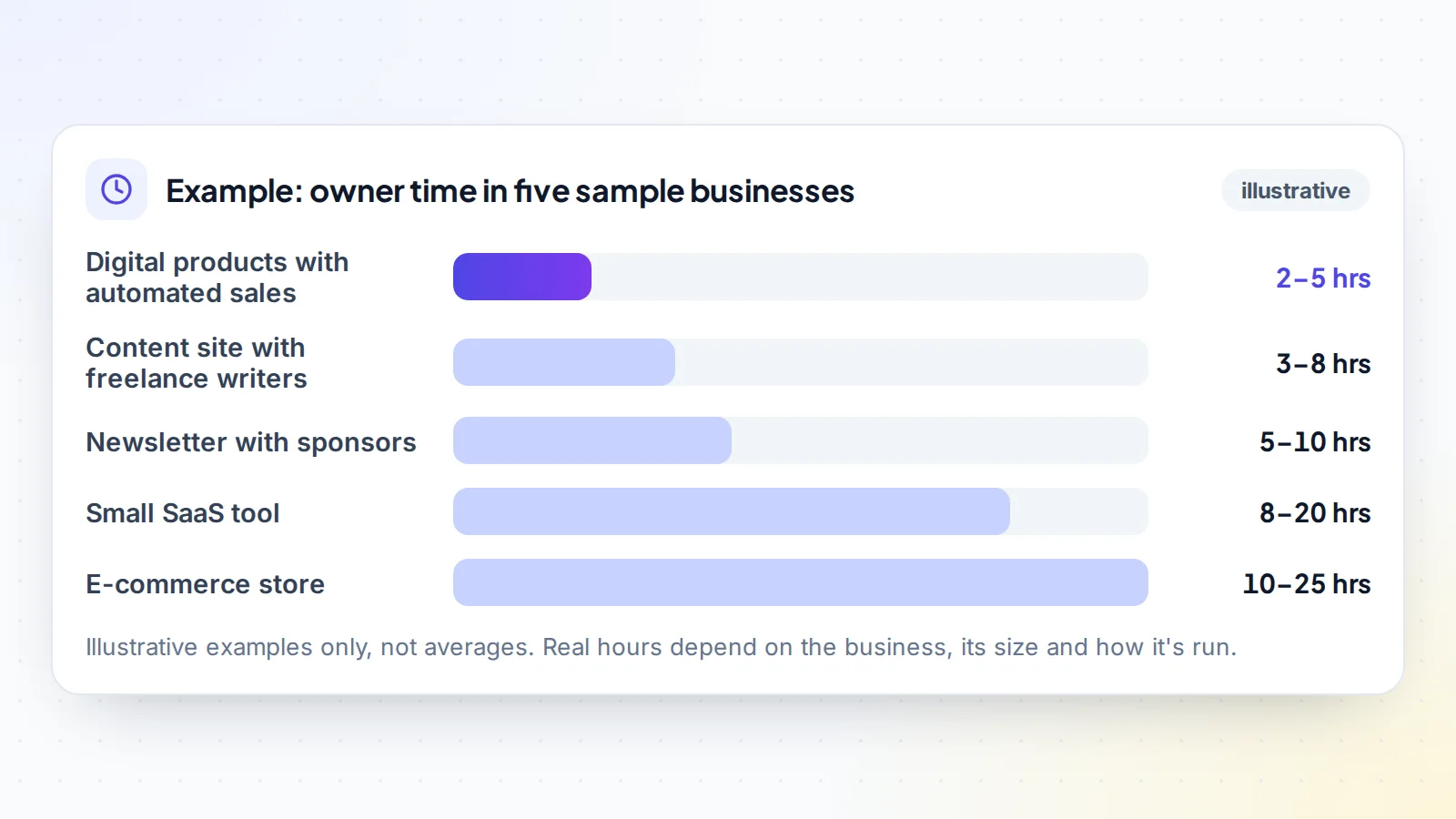
Which businesses tend to need least time
- Digital products: ebooks, templates, courses and presets sold through platforms with automated payment and delivery. Main tasks: support, updates and marketing.
- Content sites: blogs and guides earning from ads or affiliate links. Main tasks: publishing and refreshing content, often through freelance writers.
- Newsletters: earning from sponsors or subscriptions. Main tasks: writing or editing issues and managing sponsors.
- Small SaaS tools and extensions: earning from subscriptions. Main tasks: support, maintenance and occasional updates.
- Dropshipping and e-commerce: usually more active, because of suppliers, customer service and advertising, though some can be streamlined. Our guide to dropshipping stores covers what’s involved.
How to measure owner time
When a seller says a business takes “a few hours a week”, ask for a breakdown: which tasks, how often, how long each takes and who does them. Typical tasks include answering customer emails, publishing content, managing freelancers, checking ads and analytics, updating products, paying bills and handling problems. Ask about busy periods too, such as launches, seasonal peaks or updates to platforms the business depends on.
Then check the claim against reality where you can: support volume in the help desk, content schedules, freelancer invoices and the number of tools in use. Our guide to owner hours and valuation explains how buyers adjust profit for the time a business takes.
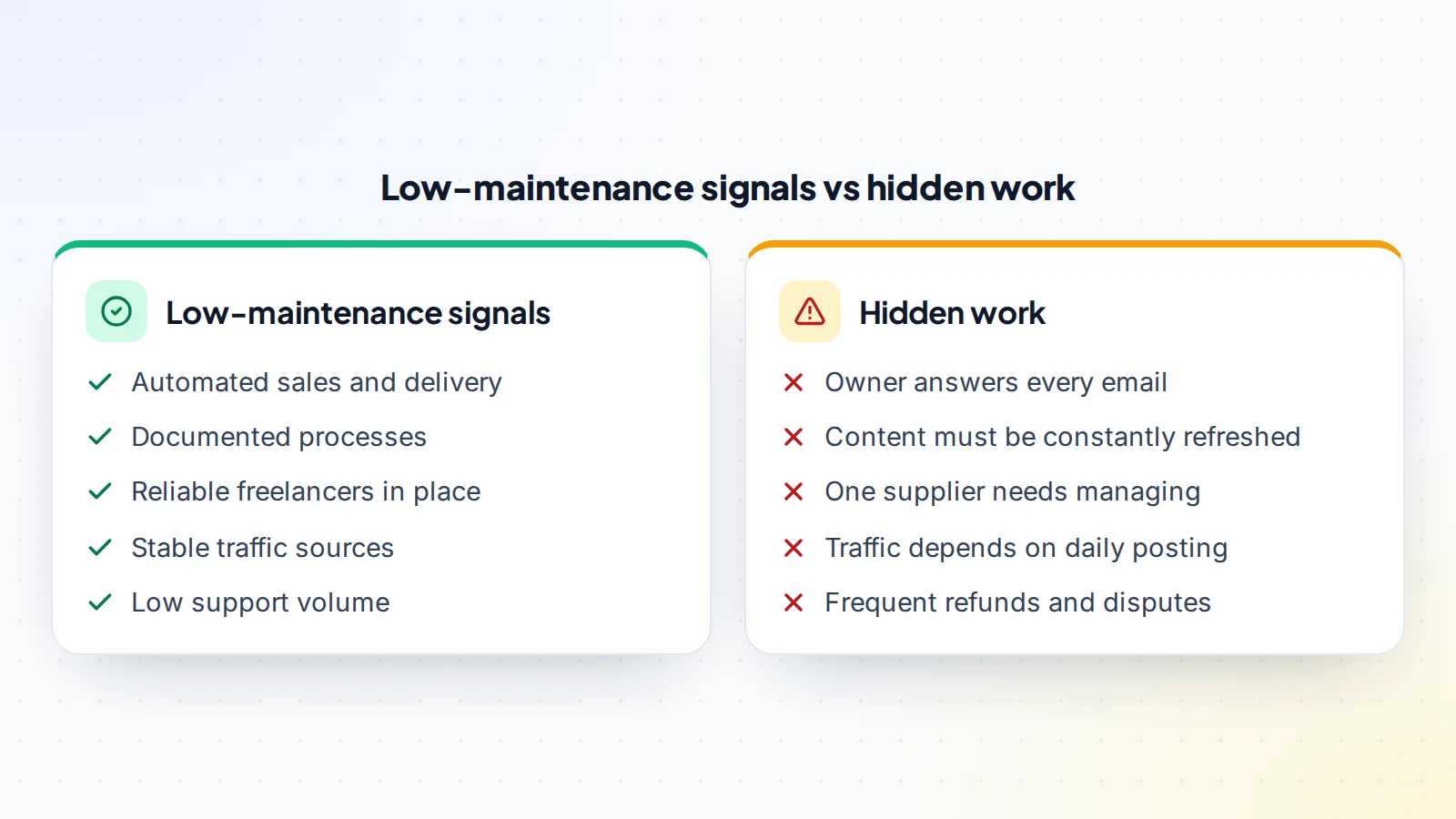
What the weekly work looks like
To make “low-maintenance” concrete, here’s what a week might involve in a well-run passive income online business of each type. A digital product shop: answering a handful of support emails, checking that payments and downloads work, and occasionally adding or updating a product. A content site: reviewing articles from freelance writers, publishing them, and checking traffic and earnings. A newsletter: editing an issue, confirming sponsor placements and replying to readers. A small software tool: answering support tickets, watching for errors and planning small updates. Each involves real work, but work that can be scheduled, repeated and, in part, delegated.
What makes a business low-maintenance
Low-maintenance businesses usually share a few features:
- Automation: payments, delivery, email sequences and reporting run without manual work.
- Documentation: written processes so tasks can be done by anyone.
- Reliable help: freelancers or contractors who already know the business.
- Stable traffic: sources that don’t depend on daily posting or constant advertising.
- Low support: clear products and good help pages, so few customers need to write in.
A business with these features is easier to run, easier to hand over, and usually worth more. If a business has only some of them, the missing ones are often the first improvements a new owner can make.
Buying vs building
Building a passive income business from scratch usually means a very active start: creating content or products, finding an audience and testing what works. Many projects never get past this stage. Buying an established business skips it: the products exist, the traffic arrives, and the processes are in place. The trade-off is the price, which reflects that head start. Our guide to selling a side project shows the seller’s side of this, and why many builders sell once a project is running smoothly.
Choosing a niche
The niche affects how much work a business needs. Topics that change quickly, such as technology or finance, need frequent updates to stay accurate. Evergreen topics, such as hobbies, home skills or reference information, change more slowly. Regulated topics need extra care. Choose a niche where you’re comfortable with the pace of change, and ideally one you understand, so you can spot problems early and judge the quality of freelance work. Our guide to niche research explains how to compare niches.
Claims to be careful with
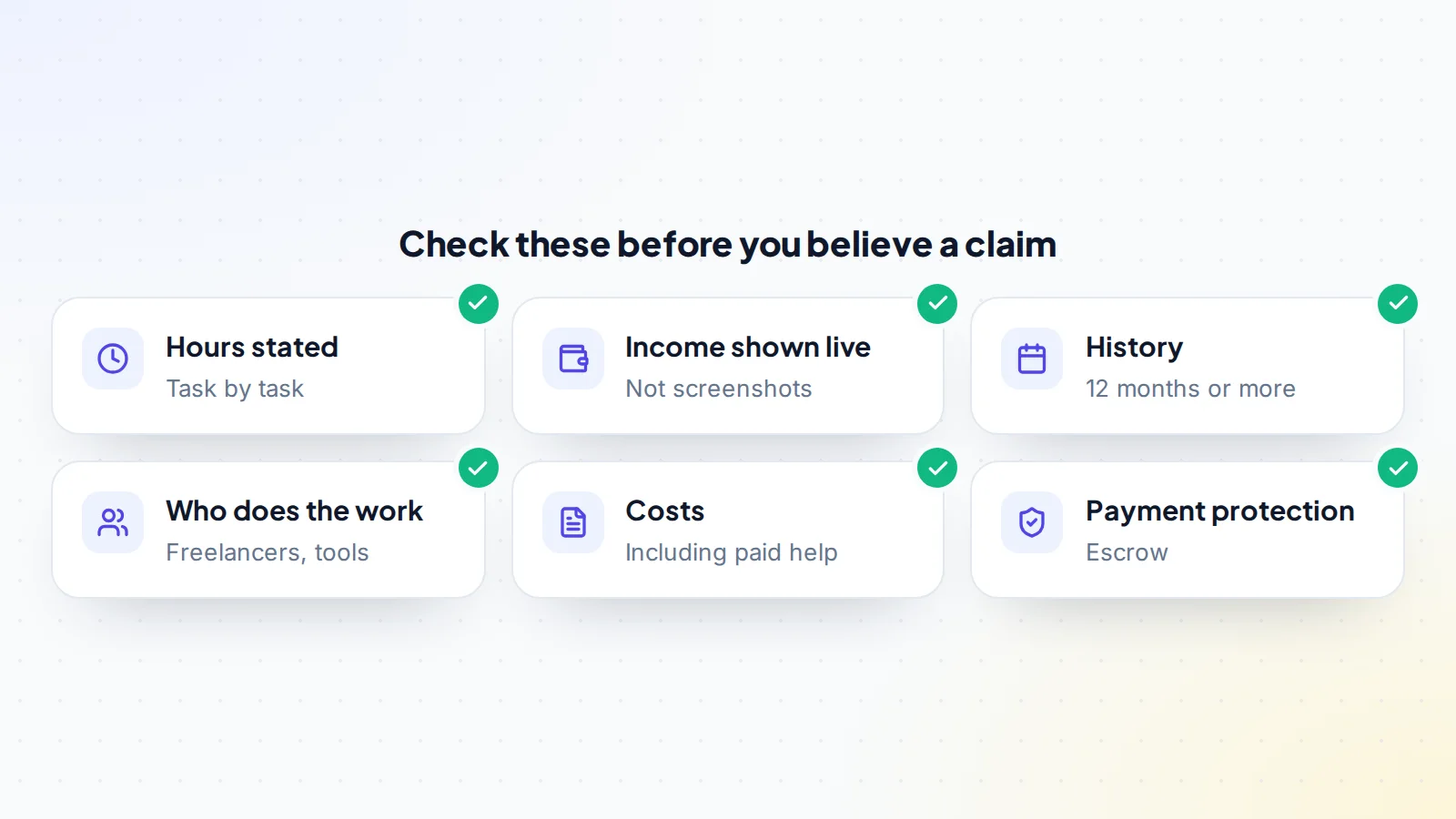
Passive income attracts exaggerated claims. The FTC warns that money-making opportunities often promise high earnings with little effort or experience, and that pressure to act immediately is a common tactic. It has also put businesses on notice that false or unsupported earnings claims can lead to penalties. When a listing or seller promises effortless income, check the evidence carefully: income shown live at the source, at least 12 months of history, a clear breakdown of tasks and all costs, including paid help.
Be especially wary of “done-for-you” passive income packages sold as opportunities rather than businesses with a real track record. Buying an actual business with verified history is very different from paying for a promise.
The hidden costs of “passive”
Low owner time often comes from paying others: writers, editors, virtual assistants, developers or agencies. That’s a sensible way to reduce your hours, but it reduces profit too. When a seller says a business takes two hours a week, check whether freelancers are doing the rest and whether their costs are included in the profit figure. Our guide to add-backs explains how sellers sometimes adjust profit and what to watch for.
Risks that can make income less passive
Some events turn a quiet business into a busy one overnight: a platform changing its rules, a search update cutting traffic, a key freelancer leaving, a supplier failing, or a spike in refunds. Before buying, ask how the business has handled such events in the past, and how much time they took. A business that has weathered a few storms with documented responses is more genuinely low-maintenance than one that has simply been lucky. Keep a cash reserve after buying, so a busy month doesn’t become a financial problem too.
Making the handover passive too
Even a low-maintenance business needs a careful handover. Make sure processes are written down, freelancers have agreed to continue, automation is moved to your accounts and the seller is available for questions for a few weeks. Pay through escrow so the payment is held until everything has moved; on digiflippers.com, read how escrow works. A smooth handover protects the “passive” part of the income from day one.
Your first months as owner
Expect to be more involved at first. Learn the processes, meet the freelancers, watch the numbers weekly and fix small problems before they grow. Once you understand the business, you can reduce your involvement step by step, adding automation or delegating tasks. Many owners find the business becomes more passive in their hands than it was before, simply because they organise it with that goal from the start.
Passive and growing?
There’s a trade-off between low maintenance and growth. A business that runs on two hours a week usually grows slowly, if at all. Growth takes active work: new products, new content, new marketing. Decide which you want. Some owners keep a business steady for income; others invest time early to grow it, then step back. Both are valid; what matters is pricing the business for what it is, not what it might become, and being honest with yourself about how much time you really want to give it.
How passive businesses are priced
Businesses that take little owner time are often priced at a higher multiple of profit, because the buyer gets income without a second job attached. But the price should reflect real hours, including any paid help, and the risks that could make the business busier. Compare listings on profit after all costs, divided by the hours you’d actually spend. A business earning slightly less but taking far fewer hours may be the better fit. For a starting range, try the free valuation tool.
Records and taxes
Passive or not, income from an online business usually needs to be reported for tax, and the rules depend on where you live and how the business is held. Keep clear records of income, costs and payments to freelancers from the first day. An accountant can advise on how a purchase price is treated and what records you’ll need. Good records also make the business easier to sell again later.
Common mistakes
- Believing a business is fully passive.
- Accepting hours claims without a task-by-task breakdown.
- Forgetting that freelancer costs reduce profit.
- Choosing a fast-changing niche and expecting little upkeep.
- Buying “opportunities” instead of businesses with verified history.
A worked example
The details below are made up to show the method.
Dana wants a business that fits around a full-time job. Two options look promising: a planner template shop on a digital product platform, and a small online store selling kitchen gadgets. The template shop’s seller lists about three hours a week: answering a few support emails, adding one new template a month and checking the sales dashboard. Sales and delivery are automated. The store’s seller lists ten hours a week, mostly supplier coordination and customer service.
Dana checks the template shop’s support inbox volume and the past year of uploads, which match the claim, and confirms costs include a freelance designer. Dana buys the template shop through escrow, keeps the designer on, and spends a little more time in the first two months learning the business before settling into a steady routine.
Passive income online business: the checklist
- Owner hours broken down task by task.
- Claims checked against support volume and schedules.
- Freelancer and tool costs included in profit.
- Automation and documentation in place.
- Traffic sources stable and not dependent on daily effort.
- Income verified live with 12+ months of history.
- Handover plan covers processes, people and automation.
- Payment held in escrow until everything moves.
Browse the marketplace on digiflippers.com to compare businesses by type and time needed.
Ready to find your next asset?
Browse listings with verified numbers, ask sellers your questions before you offer, and agree every step in a free Deal Room.
Frequently asked questions
Is any online business truly passive?
No. Every business needs some work. The best are low-maintenance, automated and well documented.
Which online businesses need the least time?
Often digital product shops with automated delivery and content sites run with freelance writers, though it depends on how each is organised.
How do I check a seller’s time claims?
Ask for a task-by-task breakdown and compare it with support volume, content schedules and freelancer invoices.
Do freelancers make a business more passive?
Yes, but they also cost money, so check their costs are included in the profit figure.
Is buying better than building for passive income?
Buying skips the most active early stage, but costs more upfront. It depends on your budget and skills.
What claims should I be careful with?
Promises of high earnings for little effort, especially with pressure to decide quickly. The FTC warns about these.
Can a low-maintenance business still grow?
Slowly, unless you invest time. Decide whether you want steady income or growth.