Why Small Online Businesses Aren’t Valued Like Startups
A plain guide to the difference between startup valuation and small business valuation: profit multiples and seller's discretionary earnings, revenue multiples for fast-growing companies, why headline startup valuations don't apply to most online businesses, where the two overlap, and how to choose and explain the right method when you buy or sell.

News stories about startups being valued at many times their revenue can make small business owners wonder why offers for their profitable website or app look so much lower. The answer is that startup valuation and small business valuation answer different questions for different buyers. Startups are usually valued on what they might become, with investors betting on rapid growth. Small online businesses are usually valued on what they reliably earn today. This guide explains both approaches, why the headline numbers don’t transfer, where the two overlap, and how to choose and explain the right method when you buy or sell.
For the core method, read how online businesses are valued and valuation multiples.
Key takeaways
- Small online businesses are usually valued on profit, often seller’s discretionary earnings, times a multiple.
- Startup valuation focuses on growth potential and is set by investors in funding rounds.
- Headline startup valuations rarely apply to small, steady businesses.
- Fast-growing, recurring-revenue businesses can sometimes attract revenue-based pricing.
- Use the method your likely buyers use, and explain it with evidence.
Two different worlds
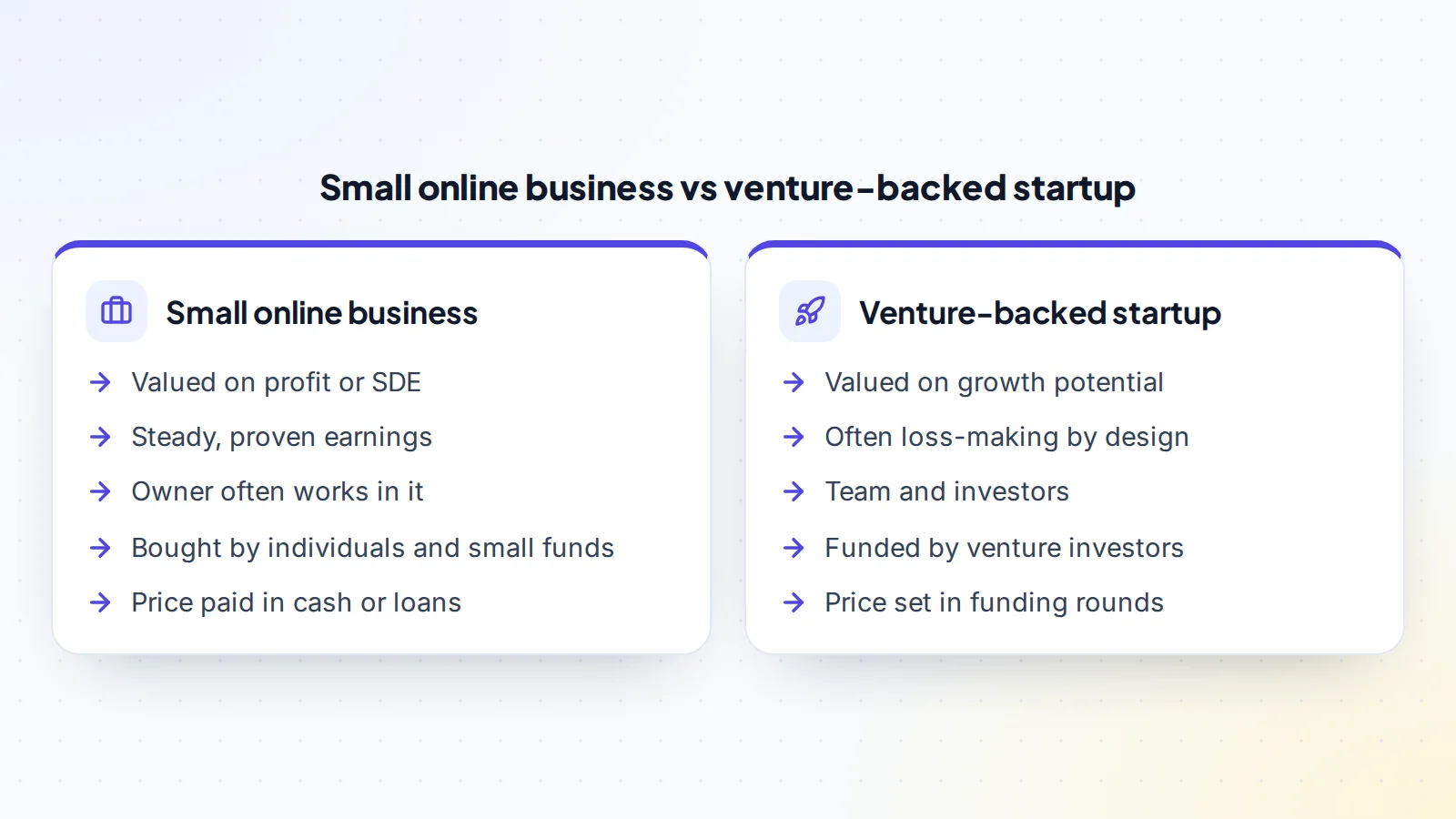
Small online businesses, such as content sites, small shops, newsletters, digital product businesses and small SaaS, are usually bought by individuals, small investment groups or other business owners. They’re paying for income: they want to know how much the business earns, how reliable that is and how long it will take to earn back the price. Startups are funded by venture investors who expect most of their investments to fail and a few to grow enormously. They pay for the chance of that growth, not for today’s profit.
How small businesses are valued
The most common method for small online businesses is a profit multiple. The buyer takes the business’s annual profit, often measured as seller’s discretionary earnings, which adds back the owner’s own pay and personal costs, and multiplies it by a figure that reflects risk, growth and transferability. A steady, well-documented business with little owner time gets a higher multiple; a risky or owner-dependent one gets a lower multiple. Read seller’s discretionary earnings for how the profit figure is built.
How startup valuation works
Startup valuation is less about a formula and more about negotiation. In a funding round, investors and founders agree a valuation based on the team, the product, early traction, market size, growth rate and what similar companies have raised at. Many startups are deliberately loss-making, spending to grow. Later-stage companies with recurring revenue are often compared using revenue multiples, because profits are small or negative. Early-stage valuations can be far higher than any multiple of current income, because investors are pricing a possible future.
Other valuation methods you may hear about
Beyond profit and revenue multiples, a few other methods come up. Discounted cash flow estimates future cash the business will produce and converts it to today’s value; it’s common in corporate finance but sensitive to assumptions, so small changes in expected growth can swing the result widely. Asset-based valuation adds up what the business owns, such as the domain, code, content, stock and audience, and is useful for very young or struggling businesses. Comparable sales look at what similar businesses actually sold for, which is often the most persuasive evidence for small business buyers. Startups add methods built for uncertainty, such as comparing with recent funding rounds or scoring the team, product and market against similar companies.
Why the numbers are so different
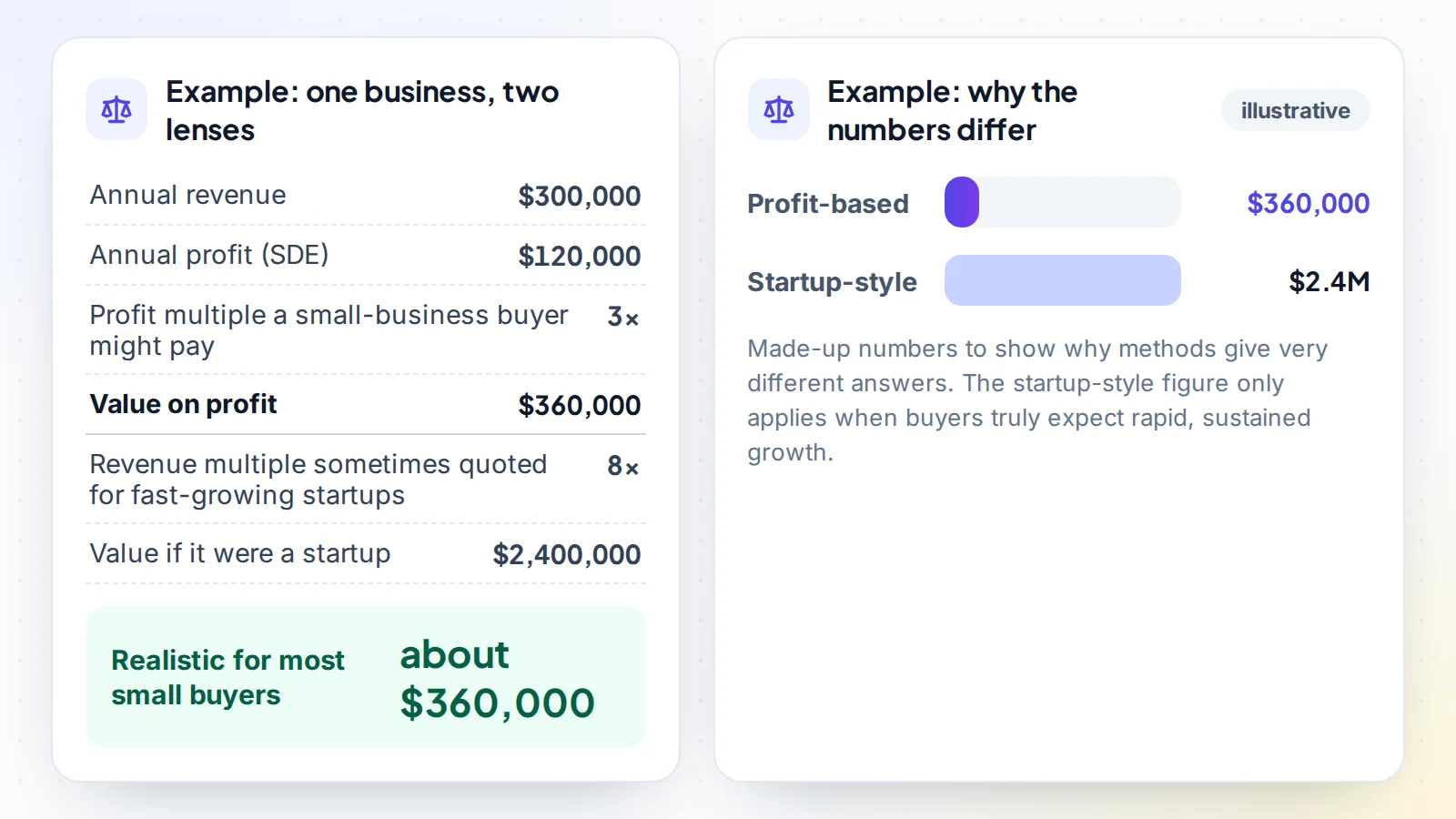
The gap comes from risk and expectations. A small business buyer usually wants their money back within a few years from the business’s own profits, and can’t afford many failures. A venture investor accepts that most investments will lose money, and needs the winners to return many times the amount invested. The two buyers would never agree on a price for the same business, because they’re buying different things: one buys income, the other buys a lottery ticket on rapid growth.
Why headline valuations mislead
Headline startup valuations describe the price of a small slice of a company in a funding round, often with special terms that protect investors. They don’t mean someone would buy the whole company for that amount in cash. They also come from a small number of fast-growing companies that investors expect to become very large. Applying those multiples to a steady small business, even a very good one, leads to asking prices no realistic buyer will pay, and listings that sit unsold.
Where the two overlap
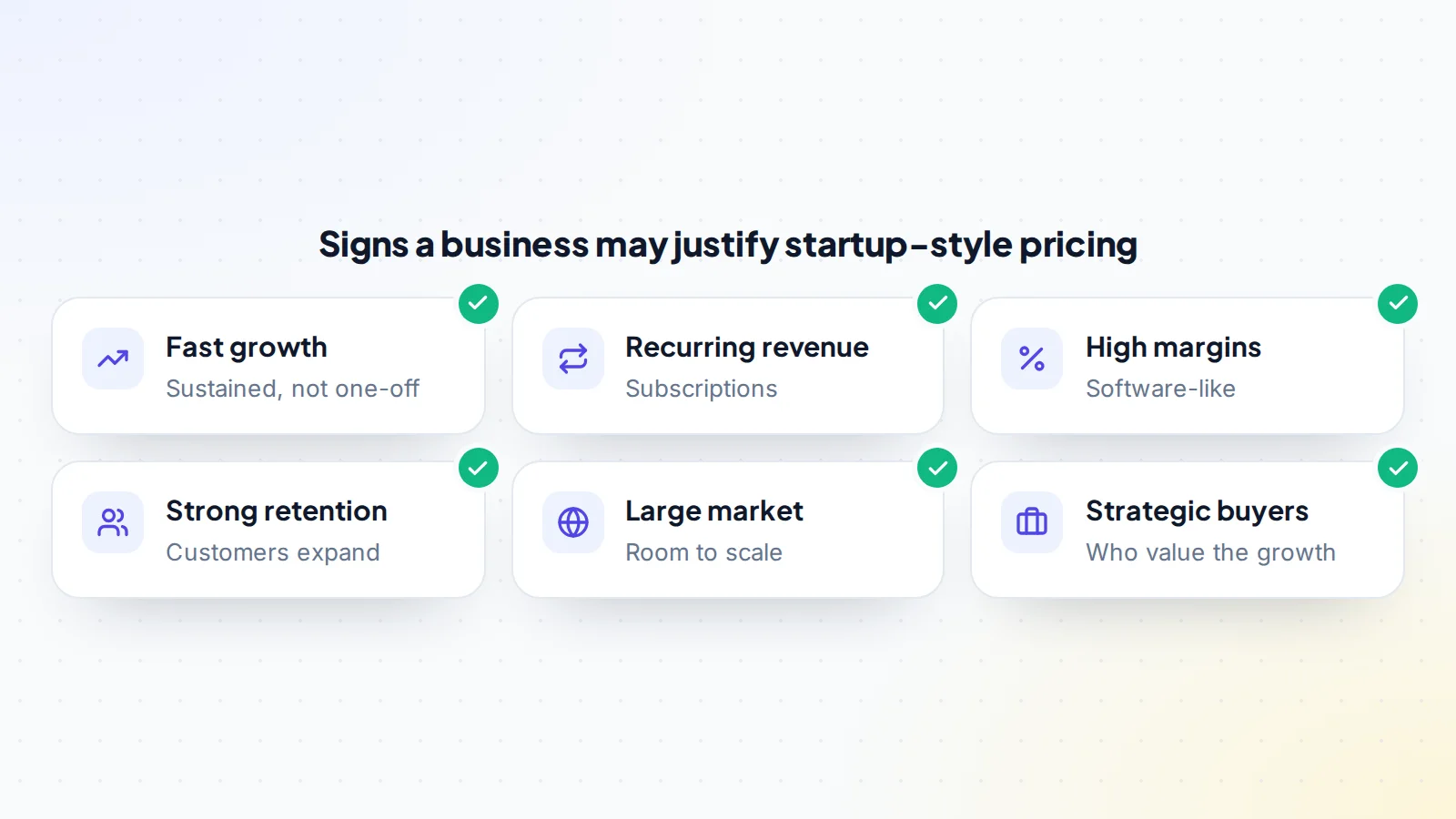
Some online businesses sit between the two worlds. A SaaS business with fast, sustained growth, strong retention and high margins may attract buyers who value it partly on revenue, especially strategic buyers who can grow it faster. Stripe’s guides on monthly recurring revenue and net dollar retention explain the metrics these buyers look at. Even then, most small SaaS businesses are still priced with profit firmly in mind. Read AI SaaS businesses for sale for one area where growth expectations run high.
Pre-revenue and very young businesses
Businesses with little or no profit can’t be valued on a profit multiple. They’re usually priced on assets, traction and the cost of building the same thing from scratch: the domain, code, design, content, audience and early users. That’s closer to a startup’s early stage, but the buyers are usually small, so prices are modest. Read pre-revenue valuation for how these are approached.
Who your buyers are
The right method depends on who’s likely to buy. Individuals and small funds buying content sites or shops will use profit multiples. Strategic buyers, such as companies in your market, may pay more if your business fills a gap for them, but they still need a business case. Venture investors rarely buy small, established businesses outright. Know your likely buyers and use their language. Looking at what similar businesses have recently sold for, and who bought them, is usually the quickest way to find out which group you’re selling to.
For sellers
Base your asking price on the method your buyers use, and support it with evidence: verified profit, a clear list of add-backs, traffic and revenue history, and an honest description of risks. If your business really does have startup-like growth, show the data that proves it: sustained growth rates, retention, margins and a credible plan. Asking for a startup valuation without that evidence usually means long delays and lower final offers. Read what a good valuation report includes.
For buyers
As a buyer, don’t be drawn into paying for growth you’ll have to create yourself. Value the business on what it earns now, then decide how much, if anything, to pay for its potential. If a seller quotes a revenue multiple, ask why it applies: what growth, retention and margins support it? A clear, profit-based valuation protects you from overpaying, and leaves the reward for any growth you create with you.
How business models affect method
Different models tend to fall on different sides. Content sites earning from display ads or affiliates are almost always valued on profit. Online shops are valued on profit, with stock added or adjusted. Newsletters and communities are usually valued on profit, with audience quality affecting the multiple. Small SaaS is mostly valued on profit too, with recurring revenue and growth raising the multiple, and only the fastest-growing businesses moving towards revenue-based pricing.
Growth still matters
None of this means growth doesn’t count for small businesses. Steady growth raises the multiple buyers will pay, because it makes the income more valuable. Decline lowers it. The difference is that growth adjusts a profit-based value rather than replacing it. Read how growth trends affect value.
Bridging a gap in expectations
When a seller believes in strong future growth and a buyer only wants to pay for today’s profit, deal structure can help. An earn-out pays part of the price later if the business hits agreed targets, so the seller is rewarded if the growth happens and the buyer is protected if it doesn’t. Seller financing spreads payments over time. Both need clear terms and good advice, because they leave part of the price at risk after the sale. Read valuation reports for how to document the assumptions behind each side’s view.
Explaining your method in a listing
Buyers trust a price more when they can see how it was reached. In a listing, state the profit figure and how it was calculated, list add-backs with reasons, give the multiple and explain what supports it, such as growth, retention, low owner time or diversified income. If you believe the business deserves more than a typical multiple, show the data that justifies it. A clear explanation turns a negotiation about opinions into a discussion about evidence, and that tends to lead to faster, fairer deals.
Getting help
For larger or more complex businesses, a professional valuation can help, especially if a lender is involved. The SBA’s guidance on selling a business suggests getting a valuation and preparing records before a sale. A valuer who works with online businesses will know which method fits and how buyers are pricing similar businesses now.
A useful way to think about it
A simple question helps cut through the confusion: what is the buyer paying for? If the answer is “the income this business already makes”, a profit-based valuation fits, and the multiple reflects how safe and lasting that income is. If the answer is “the chance this becomes something much bigger, funded by more investment”, startup-style valuation applies, along with its risks and its very different buyers. Most small online businesses are firmly in the first group, and that’s a strength: they earn real money today, can be bought and run by individuals, and don’t depend on the next funding round to survive.
Common mistakes
- Applying headline startup multiples to a small, steady business.
- Quoting revenue multiples without growth and retention to support them.
- Buyers paying for growth they’ll have to create themselves.
- Ignoring add-backs or owner time when calculating profit.
- Assuming venture investors will buy a small established business.
- Forgetting that growth adjusts the multiple rather than replacing the method.
A worked example
The details below are made up to show the method.
Dana runs a scheduling app for small clinics with $300,000 annual revenue and $120,000 in seller’s discretionary earnings. Growth has been steady at around 15% a year. Reading about software startups valued at many times revenue, Dana considers asking $2.4 million, eight times revenue.
After talking to potential buyers, Dana sees that most are individuals and small funds valuing the business on profit, with multiples in a range that would put the value nearer $360,000 to $450,000. One strategic buyer is interested at a higher figure because the app fits its product line. Dana lists at a profit-based price with the strategic angle explained, and agrees a deal within the range, supported by verified data.
Startup valuation vs small business valuation: the checklist
- Likely buyers identified.
- Profit or seller’s discretionary earnings calculated with evidence.
- Multiple chosen with reasons.
- Growth, retention and margins measured.
- Revenue multiples used only where growth supports them.
- Risks described honestly.
- Valuation explained in the listing.
- Professional help considered for larger deals.
Get a quick range from the valuation tool on digiflippers.com, or list your business.
Ready to find your next asset?
Browse listings with verified numbers, ask sellers your questions before you offer, and agree every step in a free Deal Room.
Frequently asked questions
Why are small businesses valued lower than startups?
They’re valued on reliable profit by buyers who want a return; startups are priced on growth potential by investors who accept many failures.
What is startup valuation based on?
Team, product, traction, market size, growth and comparable funding rounds, agreed in negotiation.
Can a small business get a revenue multiple?
Sometimes, if it has fast, sustained growth, recurring revenue, strong retention and high margins.
What’s the usual method for small online businesses?
A multiple of annual profit, often seller’s discretionary earnings.
Do headline startup valuations mean a company could sell for that?
Not necessarily. They usually reflect the price of a small stake in a funding round, often with special terms.
How should I value a business with no profit yet?
On assets, traction and replacement cost; read about pre-revenue valuation.
Does growth matter for small businesses?
Yes. Steady growth raises the multiple; decline lowers it.
Who buys small online businesses?
Mostly individuals, small funds and other business owners, with occasional strategic buyers.