Marketplace vs Broker: The Best Way to Sell an Online Business
Should you list your online business yourself or hire a broker? An honest comparison of costs, control, reach, speed and safety, with a simple way to decide.

Once you’ve decided to sell your online business, the next question is how. You can list it yourself on a marketplace and deal with buyers directly, or hire a broker to run the sale for you. The marketplace vs broker decision affects how much you pay in fees, how long the sale takes, how much control you keep and how much work lands on your desk.
This guide compares the two honestly. You’ll learn what each one does, what they typically cost, where each one shines, the questions to ask before you choose, and a simple way to decide for your own business. It applies to websites, SaaS products, online stores, newsletters, digital product shops, domains and other digital assets.
Key takeaways
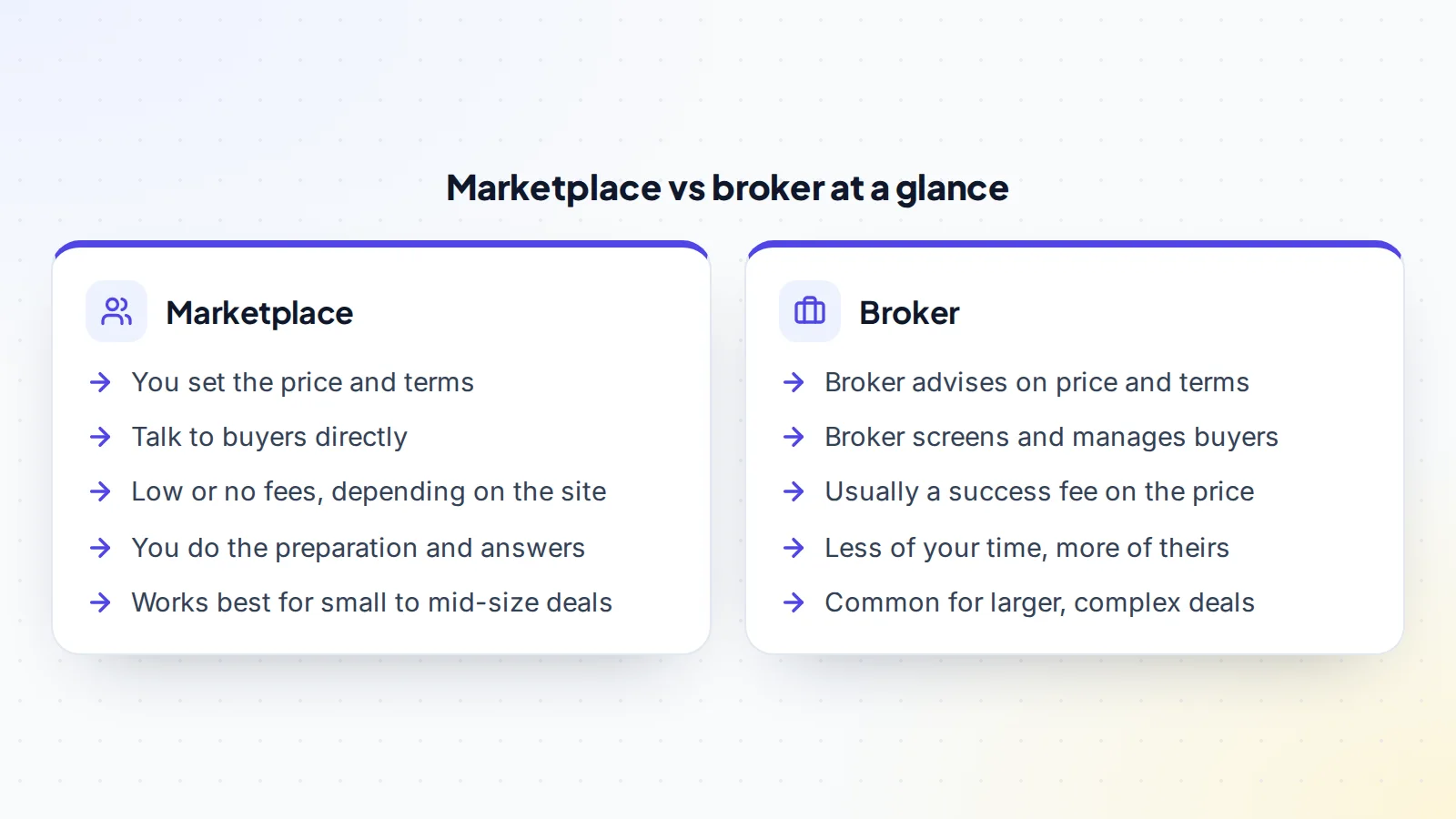
- On a marketplace you list the business, set the price and talk to buyers yourself. Fees are usually lower.
- A broker advises on price, finds and screens buyers and manages the process, usually for a success fee on the sale price.
- Marketplaces suit well-prepared small and mid-size deals; brokers suit larger or complex businesses, or sellers with no time.
- Whichever you choose, the same essentials apply: clean numbers, verified data, written terms and protected payment.
- Ask about every fee, how buyers are screened and how payment is protected before you commit.
How selling on a marketplace works
An online business marketplace is a place where sellers list businesses and digital assets, and buyers browse, ask questions and make offers. You create the listing, set the asking price, answer buyers and negotiate the deal yourself. The marketplace provides the audience of buyers and, depending on the platform, tools such as verified metrics, messaging, deal agreements and protected payment options.
The advantage is control and cost. You decide what to share, with whom, and on what terms. You talk to buyers directly, so nothing is lost in translation. And fees are usually lower than a broker’s: some marketplaces charge listing fees, some charge a success fee on the price, and some charge neither. On digiflippers.com, it’s 0% success fee up to $10,000, then 5% (max $5,000), so you keep 100% of the price on sales up to $10,000. Our guide to online business marketplace fees compares the common fee models.
The trade-off is work. You prepare the numbers, write the listing, answer every question, screen buyers and manage the handover, with the marketplace’s tools to help.
How selling through a broker works
A business broker acts as your representative. A typical broker will review your business, suggest a price, prepare a sales document, market the business to their network of buyers, screen those buyers, manage questions and negotiations, and guide the deal to closing. Some brokers list your business on marketplaces as part of their marketing.
The advantage is time and expertise. A good broker has seen many deals, knows what buyers in your niche will pay, and can keep a complex negotiation moving. The trade-off is cost and some loss of control: brokers usually charge a success fee, a percentage of the sale price, and some charge upfront or listing fees too. Success fees across the market commonly fall in the range of 5–15%. The U.S. Small Business Administration’s guidance on selling a business reminds sellers to note broker fees, along with all other adjustments, in the terms of the sale agreement.
Comparing the costs
Costs are often the deciding factor, so compare them carefully. With a marketplace, look at listing fees, upgrade fees, success fees and payment or escrow fees. With a broker, ask about the success fee, any minimum fee, upfront fees, exclusivity periods (how long you can’t sell elsewhere) and what happens to the fee if a buyer you found yourself ends up buying.
Then compare the totals on your expected sale price. On a larger sale, a success fee is a significant amount of money, so the broker needs to add at least that much value through a higher price, a faster sale or work you couldn’t do yourself. For many small and mid-size deals, a well-prepared seller on a marketplace keeps considerably more. Our explainer on the success fee covers how these fees work.
A worked cost example
Imagine an online business you expect to sell for $120,000. A broker charging a 10% success fee would take $12,000, so you’d receive $108,000 before any other costs. If the broker’s network and negotiation get you a higher price, say $135,000, you’d receive $121,500 after the same fee, which beats selling it yourself at $120,000. If the broker gets you the same $120,000 you’d have reached alone, you’re $12,000 worse off.
That’s the real question in the marketplace vs broker decision: will the broker add more than they cost? For simple, well-prepared businesses, the answer is often no, because buyers can see the value for themselves in verified numbers. For complex businesses with staff, contracts or several moving parts, a good broker can add more than their fee. These figures are illustrative; plug in your own expected price and the fees you’re actually quoted.
What a good broker brings
If you do consider a broker, look for one who specialises in your kind of business, can show recent sales of similar size, prepares a thorough sales document, screens buyers properly (including proof of funds before sensitive information is shared) and explains every fee in writing. Be cautious with brokers who promise a price far above what your numbers support to win your business, or who ask for large upfront fees with no clear deliverables.
Control and communication
On a marketplace you talk to buyers directly. You hear their questions in their own words, judge their seriousness yourself and choose who to sell to. Many sellers find this builds trust quickly: buyers like hearing from the person who built the business.
With a broker, communication usually goes through them. That saves you time and can keep emotions out of a negotiation, but it also means you rely on their judgement about which buyers are serious and which offers to push for. Ask any broker how often you’ll be updated and whether you’ll speak to buyers directly before accepting an offer.
Reaching buyers
Marketplaces bring a large, active audience of buyers who are already looking. Good listings with verified numbers can attract offers quickly. Brokers bring their own networks, which can include investors and companies that don’t browse marketplaces, and that can matter for larger or more specialised businesses.
You can also invite buyers to come to you. On digiflippers.com, buyers post what they’re looking for on the Wanted board, so sellers can find buyers who already want their kind of asset. See how buyer requests work.
Speed
Speed depends far more on preparation and price than on the channel. A well-prepared, sensibly priced business on a marketplace can sell in weeks. A broker can speed things up by preparing documents and screening buyers, but brokers also run structured processes that take time. Read how long it takes to sell a website for typical timelines.
Safety and trust
Both routes need the same protections: verified numbers, written terms and protected payment. On a marketplace, check what the platform provides: identity checks for members, verified metrics, a record of messages and agreed terms, and escrow or middleman options. On digiflippers.com, the ways to pay in a deal are: directly to the seller, through escrow, and the platform never holds the money itself. With a broker, check their track record, references and how client funds are handled. Read how escrow works for the payment side.
Pricing and negotiation
Brokers often add the most value here: they know comparable sales and can defend a price. On a marketplace, you can reach the same position with preparation. Value the business on average profit and risk (see how to value an online business), decide between an auction or a fixed price (auction vs fixed price), and plan your negotiation (negotiating as a seller).
Preparation matters more than the route
Whichever way you sell, buyers ask the same questions, and the same preparation answers them: twelve months or more of profit and loss with matching payouts, read-only access to analytics and income dashboards, documented processes, and clear ownership of content, code and accounts. A broker can help you assemble it, but they can’t invent it. Sellers who prepare well tend to sell faster and closer to their asking price on any channel. Read our guides to selling a website and taxes when selling a website before you start.
How to decide
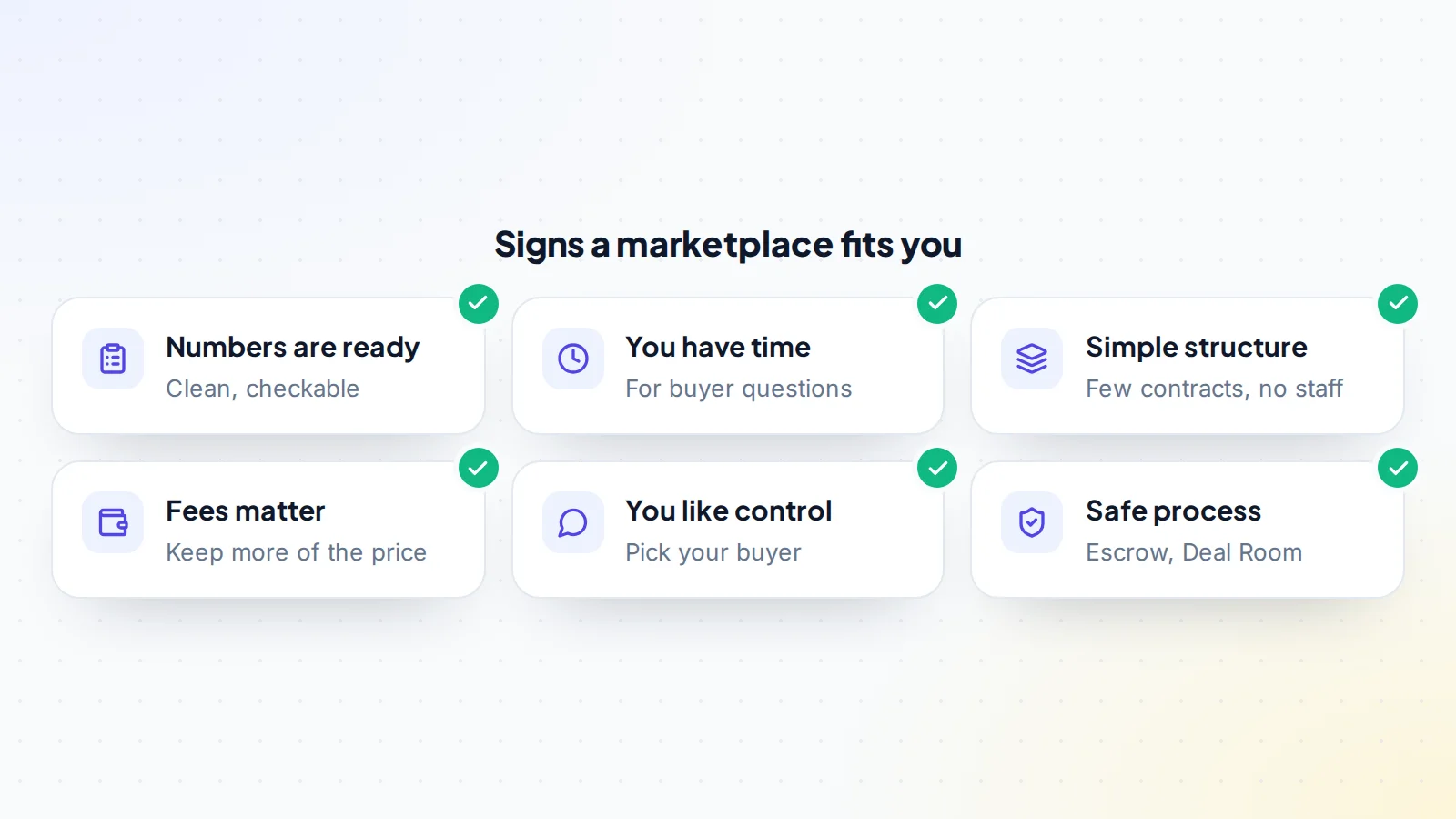
A marketplace usually fits when your numbers are clean and verifiable, the business is relatively simple (few contracts, no staff, one or two platforms), you have time to answer buyers, and keeping more of the price matters to you. A broker usually fits when the business is large or complex, involves staff, many contracts or several entities, you have no time to manage a sale, or you want an experienced negotiator on your side. Many sellers start on a marketplace and only consider a broker if the business needs more specialised handling.
Which route suits which asset?
Asset type changes the picture. Domains sell well on marketplaces and through “for sale” pages, because buyers can judge them quickly. Content sites, newsletters and digital product shops under a few hundred thousand dollars are usually straightforward to sell on a marketplace when the numbers are verified. Social media and game accounts are almost always sold directly on marketplaces with a middleman or escrow protecting the handover. Larger SaaS businesses and online stores with staff, suppliers, contracts or several entities are where brokers most often earn their fee, because the negotiation and paperwork are genuinely complex. If your business sits between these, start by preparing your numbers; how easily buyers understand them will tell you which route fits.
Questions to ask before you choose
- What are all the fees, and when are they due?
- Is there an exclusivity period, and how long is it?
- How are buyers screened before they see sensitive information?
- Can I verify my numbers so buyers trust them?
- How is payment protected, and who holds the money?
- What happens if a deal falls through?
- For brokers: how many similar businesses have you sold recently, and can I speak to past clients?
Other routes
Some sellers sell privately to someone they know, a competitor or a customer. That avoids fees but puts all the work and risk on you, including verification, contracts and payment safety. If you go this way, use the same protections you’d use on a marketplace. Our comparison of marketplace alternatives and the guide to where to buy a website show how different platforms compare.
After you choose
If you go with a marketplace, prepare your numbers, connect your accounts for verification, write an honest listing and set a realistic price. Then answer questions quickly and in writing, and keep every conversation in one place. If you go with a broker, give them everything they ask for promptly, ask to see the sales document before it goes out, stay involved in decisions about which buyers get sensitive information, and insist on protected payment at closing. Either way, the deal isn’t done until the handover is complete and the money is released, so plan that part as carefully as the sale itself.
Marketplace vs broker: the checklist
- Expected sale price estimated from average profit and risk.
- Total cost compared for both routes at that price.
- Exclusivity periods and minimum fees checked.
- Your available time for buyer questions honestly assessed.
- Complexity assessed: staff, contracts, entities, platforms.
- Buyer screening and confidentiality process understood.
- Verified metrics available for your listing.
- Payment protection confirmed: escrow or middleman.
- Broker references checked, if you’re considering one.
- Decision written down with your reasons.
Ready to sell?
List it on digiflippers.com with verified numbers, answer buyers in one place and agree every step in a free Deal Room. 0% success fee up to $10,000, then 5% (max $5,000).
Frequently asked questions
Is it better to sell a website through a broker or a marketplace?
For many small and mid-size websites, a marketplace gives you more control and lower costs. Brokers make more sense for larger or complex businesses, or when you have no time to manage the sale.
How much do business brokers charge?
Most charge a success fee, a percentage of the sale price, and some add upfront or minimum fees. Ask for every fee in writing before you sign.
Can I use a marketplace and a broker at the same time?
Sometimes, but check the broker’s agreement: many require exclusivity for a period.
Do marketplaces check buyers?
It varies. Look for identity checks, a record of messages and protected payment options. On digiflippers.com, buyers and sellers can verify their identity, and every deal runs in a Deal Room.
Will I get a higher price with a broker?
Sometimes, especially for larger businesses where a broker’s network and negotiation add value. Compare the expected difference with the broker’s fee.
Do brokers handle the handover?
Many guide it, but the technical steps (moving the domain, hosting and accounts) are still done by the seller and confirmed by the buyer. Ask what support is included.
Can I switch from a broker to a marketplace later?
Usually, once any exclusivity period in your broker agreement ends. Check the agreement for clauses about buyers the broker introduced, which may still earn them a fee.
What’s the cheapest way to sell an online business?
Listing it yourself on a marketplace with low fees, after preparing clean, verified numbers so buyers trust your asking price.