Seller’s Discretionary Earnings (SDE): How to Calculate It
How to calculate seller's discretionary earnings for an online business, which add-backs are fair, and how buyers use SDE to set a price.

When small businesses change hands, the number buyers and sellers argue about most isn’t revenue or even profit. It’s seller discretionary earnings: the total financial benefit one owner-operator gets from the business in a year. SDE is the starting point for pricing many small online businesses, so understanding it well puts you in a much stronger position on either side of a deal.
This guide explains SDE in plain English: what it includes, how to calculate it step by step from a profit and loss statement, which add-backs are legitimate and which aren’t, how SDE differs from net profit and EBITDA, and how buyers turn it into a price. You’ll also find worked examples and the most common mistakes.
It fits naturally with our pillar guide to valuing an online business, which covers the bigger picture.
Key takeaways
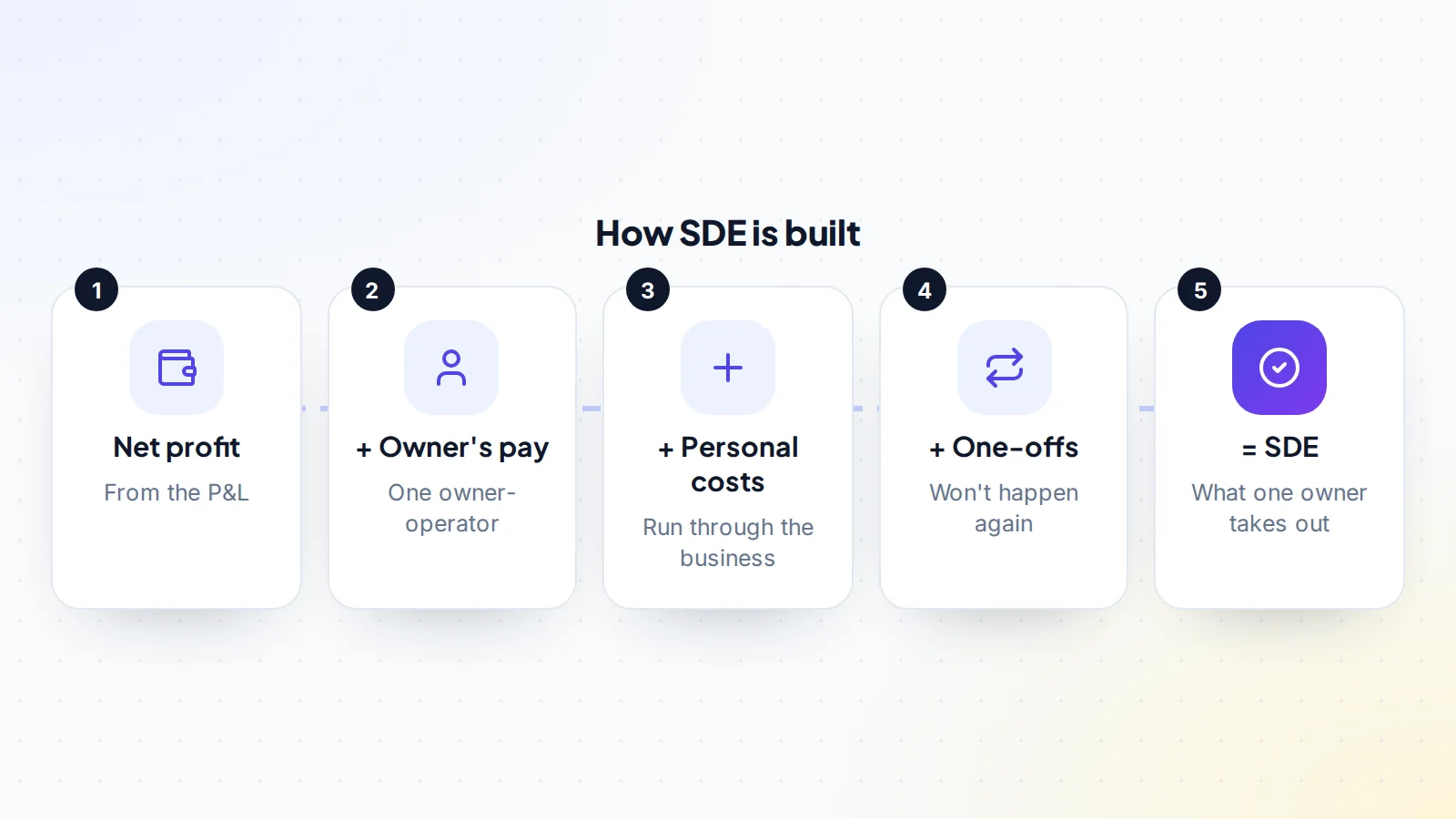
- SDE = net profit + one owner’s pay + personal costs run through the business + genuine one-off costs.
- It shows what a single owner-operator could take out of the business in a year.
- Add-backs must be real, documented and non-recurring; everything else stays in.
- Buyers who won’t do the owner’s work should subtract the cost of replacing it.
- SDE suits owner-run businesses; larger businesses with managers are often valued on EBITDA.
What seller discretionary earnings means
Small business accounts often don’t show what the business really earns for its owner. Owners pay themselves a salary, run some personal expenses through the business and occasionally pay for things that won’t happen again, such as a rebuild or a legal fee. Net profit on paper is therefore lower than the total benefit the owner gets.
SDE adjusts for that. It takes net profit and adds back the owner’s own pay and benefits, personal costs that a new owner wouldn’t have, and genuine one-off costs. The result is the total cash a single owner-operator could expect to take out of the business in a year, before tax and any financing costs.
How to calculate SDE step by step
- Start with net profit from the profit and loss statement for the last 12 months (trailing twelve months). See why trailing twelve months matter.
- Add the owner’s salary and benefits paid by the business, for one owner. If two partners both draw salaries, typically only one is added back, because a buyer will still need someone to do the other’s work.
- Add personal expenses run through the business that a new owner won’t have: a personal phone, a car, family members on the payroll who don’t work in the business.
- Add genuine one-off costs: a site rebuild, a settled legal dispute, a one-time migration.
- Add non-cash and financing items where relevant: depreciation, amortisation and interest are often added back in small business SDE calculations.
- Document every add-back with invoices or statements. Unsupported add-backs won’t survive due diligence.
Legitimate add-backs vs inflated ones
Add-backs are where SDE becomes either useful or misleading. Our full guide to add-backs goes deeper, but the principle is simple: an add-back is fair only if the cost is real, documented and won’t continue under a new owner.
Usually fair
- One owner’s salary and benefits.
- Clearly personal expenses paid by the business.
- A redesign, migration or legal fee that genuinely won’t recur.
Usually not
- “One-off” costs that appear every year in a different form.
- Freelancers or tools the business still needs.
- Advertising spend that drives revenue (“we could just stop ads”).
- Costs with no documents behind them.
A worked example
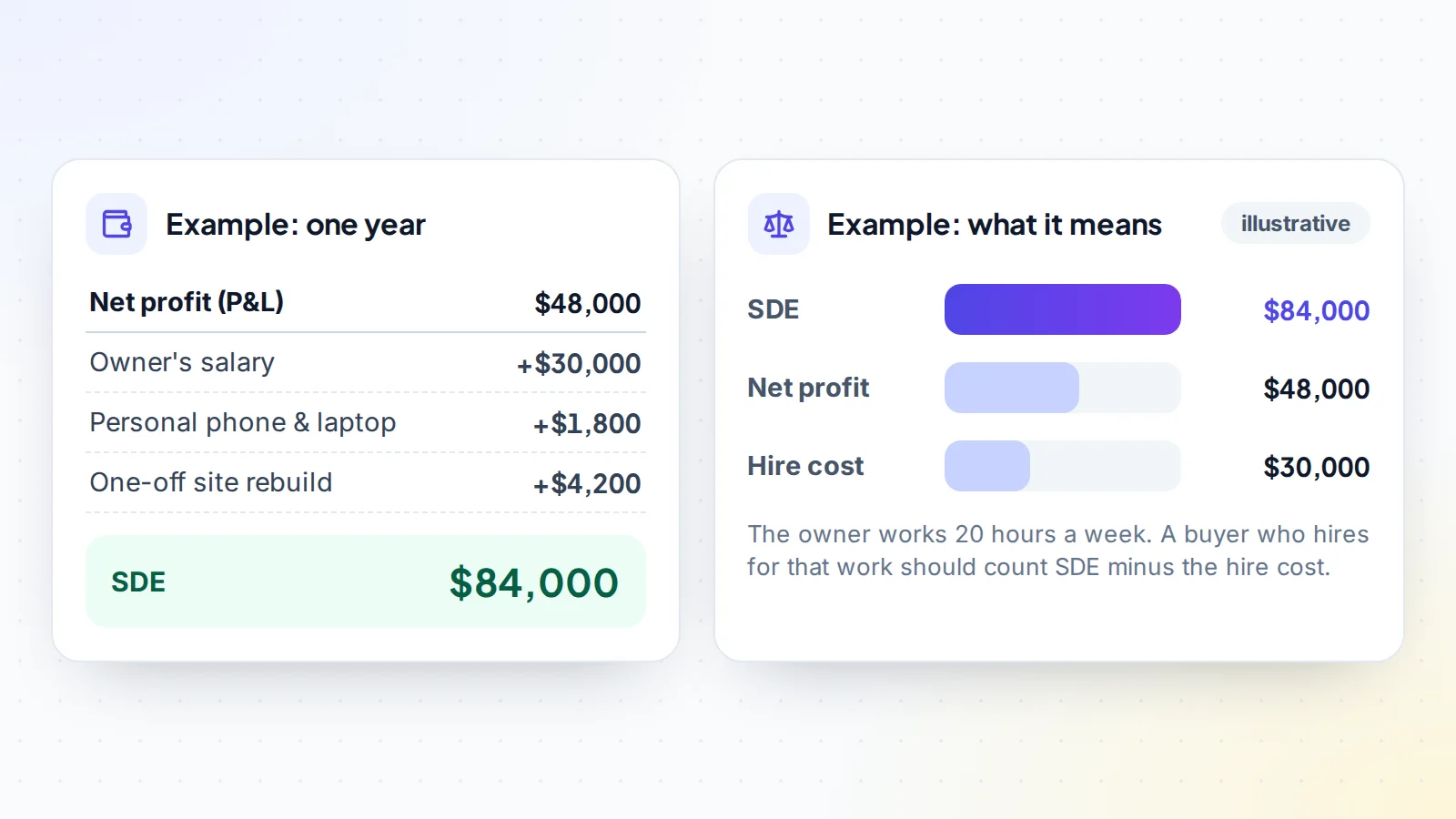
A content and digital-products business shows $48,000 of net profit for the last 12 months. The owner paid themselves $30,000, ran a personal phone and laptop through the business ($1,800), and spent $4,200 on a one-off rebuild of the website. Adding those back gives SDE of $84,000.
That figure is useful, but it describes the business for an owner who will do all the work. The current owner spends about 20 hours a week on content, customer emails and marketing. A buyer who plans to hire someone for that work must subtract what it would cost, perhaps around $30,000 a year in this example, which brings the earnings they’ll actually see closer to $54,000. A buyer who will do the work themselves can use the full SDE. Same business, different buyers, different numbers: that’s why SDE conversations always come back to the owner’s role.
SDE vs net profit vs EBITDA
- Net profit is what’s left after every cost, including the owner’s salary. It’s the right base when the buyer won’t work in the business and will pay others to run it, and it’s common for small online assets like content sites and newsletters valued on monthly profit.
- SDE adds back one owner’s pay and discretionary items. It suits owner-operated businesses, where the buyer will step into the owner’s role.
- EBITDA (earnings before interest, tax, depreciation and amortisation) assumes a market-rate salary for management stays in costs. It’s more common for larger businesses with managers, where the owner doesn’t run day-to-day operations.
The difference matters because multiples apply to a specific earnings figure. A multiple quoted on SDE isn’t comparable to one quoted on EBITDA or monthly net profit. Our guide to valuation multiples explains how they relate, and small business vs startup valuation covers when earnings-based methods don’t apply at all.
From SDE to a price
Buyers typically apply a multiple to annual SDE to reach a price. The multiple reflects the same factors as any valuation: age and stability of earnings, growth, diversity of income, how much work the business needs, how easily it transfers and how verifiable the numbers are. The U.S. Small Business Administration’s guide to buying a business describes this family of approaches (capitalised earnings, cash flow and others) as common ways to determine a fair price.
Two practical rules help. First, apply the multiple only after you’ve checked every add-back. Second, keep the owner’s role in mind: a business with high SDE that depends on 50 hours a week from its owner is a job as much as an investment, and buyers price that in.
SDE in online businesses
Many online businesses are small, owner-run and lean, which makes SDE a natural fit. Typical owner tasks include writing content, managing freelancers, answering customers, running ads and updating products. When you look at a content website for sale or a small SaaS, ask how many hours the owner works and on what, because that determines how much of the SDE a hands-off buyer will actually keep. For SaaS, check churn too: SDE built on a customer base that’s shrinking won’t last; see SaaS churn.
Seller discretionary earnings across online business types
How you calculate seller discretionary earnings is the same everywhere, but what matters in the calculation changes with the type of business. For content sites, the big question is who writes: an owner who writes every article adds back a salary, but a hands-off buyer will pay writers. For online stores, check whether the owner handles customer service, suppliers and stock, and whether family members on the payroll do real work. For SaaS, the owner is often the developer; replacing them can cost far more than their salary, so buyers look hard at that add-back. For newsletters and creator businesses, the owner’s voice may be the product, which makes their role difficult to replace at any price.
A second example: a small SaaS
A small SaaS shows $60,000 of net profit after paying its founder $40,000. The founder also ran a conference trip ($3,000) through the business that a new owner wouldn’t repeat. Seller discretionary earnings are therefore $103,000. But the founder writes all the code and answers support. A buyer who isn’t a developer would need to hire one, likely at a higher cost than the founder’s salary, plus part-time support. Their realistic earnings might be closer to $45,000. Two buyers looking at the same SDE could reasonably offer very different prices, and both would be right for their own situation.
How SDE changes after the sale
SDE describes the past, not a promise. After the sale, the new owner’s earnings depend on what they change: hiring help reduces their SDE, cutting costs or growing revenue increases it. A buyer should model their own version of the year ahead, starting from SDE and adjusting for the work they’ll hand off, the improvements they plan and any costs that will rise, such as new tools or higher ad prices. A price based on that forward view is far safer than one based on last year’s SDE alone.
For sellers: presenting SDE well
- Prepare a clean profit and loss statement for at least 12 months, ideally 24.
- List every add-back on its own line with a short explanation and a document.
- Be conservative. Inflated add-backs are discovered in due diligence and damage trust in everything else.
- State the hours you work and what you do, so buyers can judge the work themselves.
For buyers: checking SDE
- Match net profit to bank statements and payouts first. See financial due diligence.
- Check each add-back against its documents and ask whether it could recur.
- Subtract the cost of any work you won’t do yourself.
- Compare SDE over several periods to see the trend.
SDE in negotiation
Because SDE involves judgement, it’s often where negotiations focus. Sellers want every possible add-back accepted; buyers want only the ones that are certain. The fastest way through is evidence: a line-by-line schedule of add-backs, each with a document and a sentence explaining why it won’t recur. When a particular add-back is genuinely uncertain, the two sides can split the difference, or move part of the price into an earn-out that depends on future results. Arguments about SDE are much shorter when both sides start from the same clean profit and loss statement and agree definitions up front.
Common mistakes
- Adding back two owners’ salaries when a buyer will still need someone to do one of the jobs.
- Treating marketing spend as discretionary when it drives revenue.
- Comparing an SDE multiple with a profit multiple from a different listing.
- Ignoring the owner’s hours, which turns an investment into a job.
- Using a single great year instead of the trend.
Which period to use
Most SDE calculations use the trailing twelve months, but it’s worth looking at two or three years if they’re available. A business whose SDE has grown steadily is more attractive than one where last year was an outlier. If the business is seasonal, make sure the period covers a full cycle, and be wary of SDE based on a partial year scaled up.
Seller discretionary earnings: the checklist
- Net profit for the last 12 months, matched to bank statements.
- One owner’s salary and benefits added back.
- Personal expenses identified and documented.
- One-off costs confirmed as genuinely non-recurring.
- Questionable add-backs removed.
- Owner’s hours and tasks listed.
- Cost of replacing the owner’s work estimated.
- Multiple applied to the right earnings figure.
Ready to find your next asset?
Browse listings with verified numbers, ask sellers your questions before you offer, and agree every step in a free Deal Room.
Frequently asked questions
What is seller’s discretionary earnings?
The total financial benefit one owner-operator gets from a business in a year: net profit plus the owner’s pay, personal expenses run through the business and genuine one-off costs.
How do you calculate SDE?
Start with net profit, add one owner’s salary and benefits, add documented personal and one-off expenses, and add non-cash items like depreciation where relevant.
Is SDE the same as profit?
No. SDE is higher than net profit because it adds back the owner’s pay and discretionary costs.
When should I use SDE instead of EBITDA?
Use SDE for small, owner-run businesses where the buyer will do the owner’s job. EBITDA is more common for larger businesses with managers.
Can SDE be manipulated?
Yes, mainly through inflated add-backs. That’s why every add-back should be documented and checked in due diligence.
Does seller discretionary earnings include taxes?
SDE is usually calculated before income tax on the owner’s earnings. Taxes depend on the buyer’s situation and location, so each buyer applies their own.
Should interest and depreciation be added back?
Often yes in small business SDE, because they depend on how the current owner financed and accounted for the business rather than on how it performs.
Do all online businesses use SDE?
No. Many small online assets are priced on monthly net profit instead. Check which figure a listing uses before comparing multiples.