How to Buy a Content Website That Keeps Earning
How to judge a content website before you buy: content quality, search health, traffic spread, income sources and the work it takes to keep it growing.

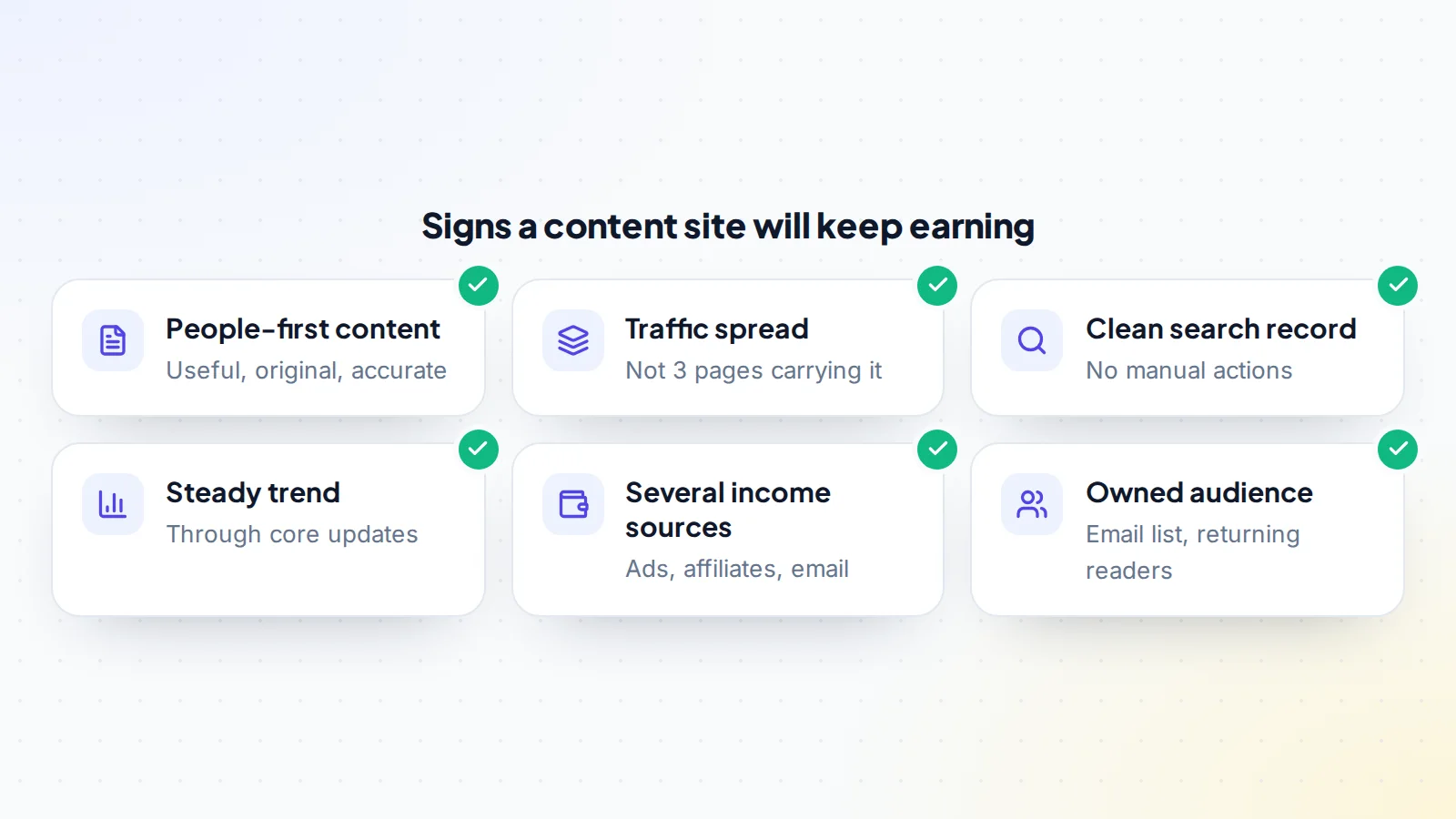
Content websites are the most common first purchase in the online business market, and for good reason. A site full of useful articles can earn from ads and affiliate links while you sleep, needs no stock or customer service, and can grow steadily with more content. But not every content website for sale will keep earning after the handover. The ones that do have something in common: content readers genuinely value, traffic spread across many pages, and income that doesn’t hang on a single thread.
This guide shows you how to tell the difference. You’ll learn what makes a content site durable, how to check content quality and search health, how to read traffic and income, what to watch for after Google updates, how these sites are valued and what to do in the first months after you buy.
It builds on our pillar guide to how to buy a website, which covers the full purchase process.
Key takeaways
- Judge the content first: is it genuinely useful, original and accurate, written for readers rather than search engines?
- Check search health in Search Console: manual actions, security issues and how traffic moved through core updates.
- Look at how traffic is spread. A site carried by a few pages is fragile.
- Verify ad and affiliate income at the source and match it to payouts.
- Budget for content after the purchase; most content sites need fresh articles and updates to keep growing.
What a content website is
A content website publishes articles, guides, reviews or tools on a topic and earns money from the attention they attract. Common income sources are display ads (paid per thousand views), affiliate commissions (paid when readers buy through a link), sponsored content, email newsletters and sometimes the owner’s own products. Many sites combine several. Our guides to affiliate websites and display ad income go deeper into each model.
The appeal is simple: once an article ranks, it can bring visitors for years. The risk is equally simple: if search engines stop sending those visitors, income falls. Everything in this guide is about judging how likely the current traffic and income are to continue.
Why buy a content site rather than build one?
New content sites often take many months before search engines trust them enough to send meaningful traffic, and plenty never get there. An established site has already passed that stage, with articles that rank, links pointing at it and a record of income you can check. We compare the two routes in buying an established website vs building one.
Step 1: Judge the content
Start by reading the site as a reader would. Google’s guidance on core updates says creating helpful, reliable, people-first content is among the practices with the most impact on how content performs in search. Ask yourself:
- Does the content answer real questions better than alternatives?
- Does it show genuine knowledge or experience, or could anyone have written it?
- Is it accurate and up to date?
- Is it written for readers, or stuffed with keywords and padding?
- Are there many thin or near-duplicate pages created mainly to target search terms?
Ask the seller how content is produced: by them, by freelancers, by an agency, or with AI tools, and how it’s edited and fact-checked. Our guide to AI content and website value covers what buyers should look for.
Step 2: Check search health
Ask for access to Google Search Console. Owners can add users under Settings → Users and permissions, and a restricted user can see most data without changing anything. Check:
- Manual actions and security issues. Either needs a full explanation before you go further.
- Performance over at least 16 months (the longest period Search Console shows), looking for sharp drops or rises.
- The dates of those changes compared with Google’s announced core updates. A site that held steady through several updates is more durable than one that rose on a single update.
- The queries that bring visitors: relevant to the topic, or random?
Then review the backlink profile and the domain’s history. Google’s spam policies describe link spam and expired domain abuse; you don’t want to inherit either. See SEO due diligence and auditing backlinks.
Step 3: Read the traffic
Get read-only access to analytics (in Google Analytics, a Viewer role is added under Admin → Access Management) and look at at least 12 months:
- Trend: rising, flat or falling, month by month.
- Sources: search, direct, social (Pinterest, for example), email and referral.
- Spread across pages: how much traffic the top pages bring.
- Countries and devices: they affect ad rates and affiliate conversions.
- Seasonality: many topics have strong and weak months.
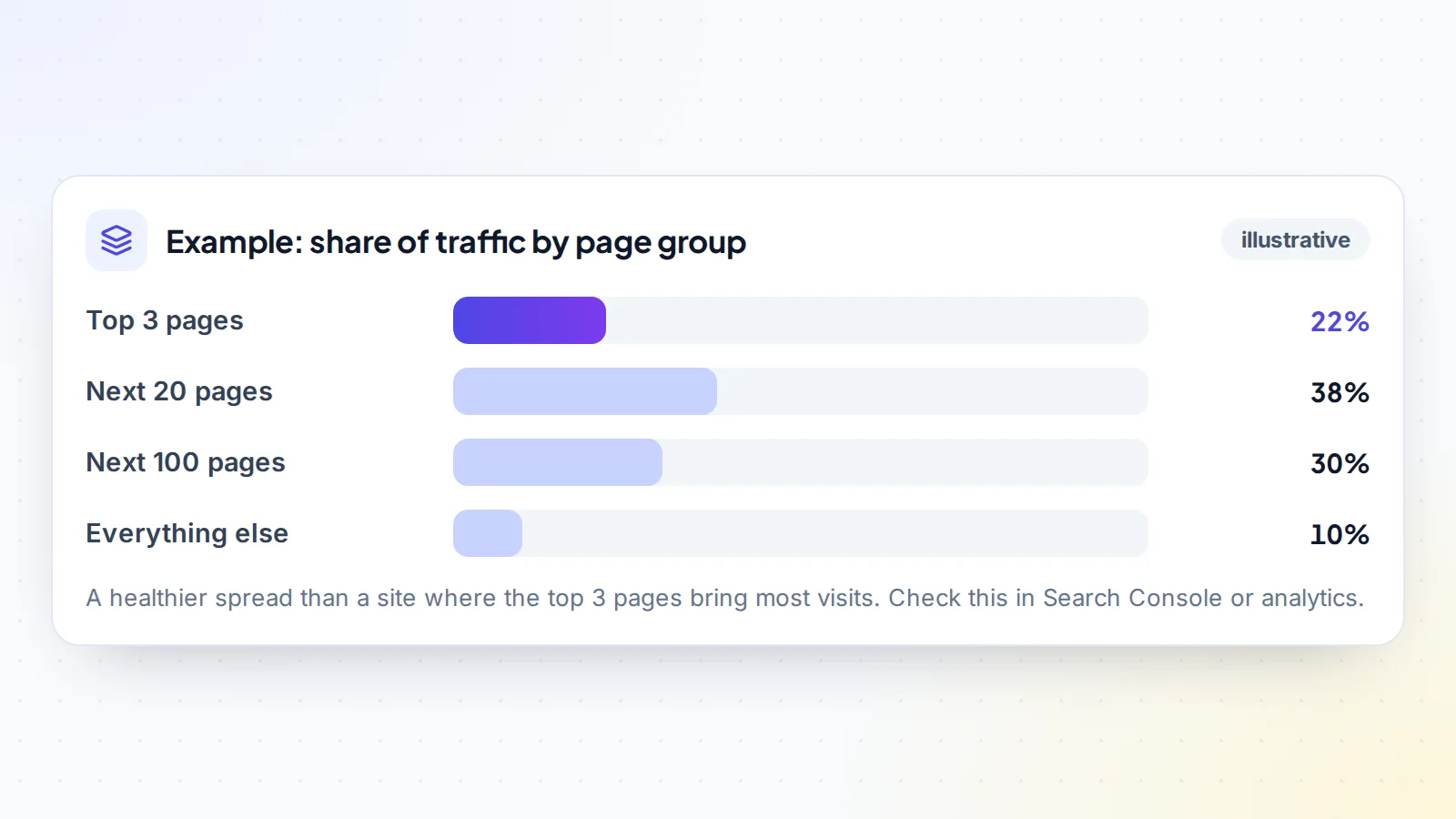
Traffic spread matters a lot. If three articles bring most of the visits, losing one ranking can cut income sharply. A site where traffic is spread across dozens or hundreds of pages is much more resilient. Our guide on traffic concentration risk explains how to measure it.
Step 4: Verify the income
Ask for live screen shares of every income dashboard (ad network, affiliate programmes, sponsors) for 12 months or more, and match them to payouts in the seller’s bank account. Then check:
- Dependence on one programme or network. A change in its rates or rules affects everything.
- Whether income sources transfer. Ad and affiliate accounts are usually tied to a person or company; you’ll apply with your own and replace the codes. Ask whether there are any special rates the seller negotiated personally.
- Reversed commissions and refunds on affiliate income.
- Every cost: writers, editors, hosting, tools, images, link building.
Use trailing twelve months figures to smooth out seasonal swings; see trailing twelve months profit.
Step 5: Understand the work
Content sites look passive, but the good ones aren’t. Ask the seller how many articles they publish a month, how often old articles are updated, who writes and edits, and how much time they spend. If the seller writes everything, decide whether you will, or price in the cost of writers. A site whose income depends on a steady stream of new content will slowly decline if publishing stops.
Step 6: Check rights and legal basics
Confirm the seller owns the content (freelance work should be assigned in writing), that images are licensed for the site, and that any affiliate disclosures and privacy policies are in place. Our guide to legal due diligence covers what to look for.
Think about the niche
The topic shapes everything: how much advertisers pay, which affiliate programmes exist, how fast content dates and how competitive search results are. Evergreen topics such as cooking, gardening, personal finance basics or home improvement keep attracting readers year after year. Fast-moving topics, such as specific software versions or trends, need constant updates. Topics where readers make expensive purchases often earn more per visitor from affiliate links. Choose a content website for sale in a niche you’d enjoy reading about every week; you’ll be making decisions about it for years. Our guide to evergreen niches helps compare topics.
Red flags in content site listings
- Traffic that jumped recently after years of little growth, with no explanation.
- Hundreds of near-identical pages targeting slight variations of the same search.
- A domain with an unrelated past on the Wayback Machine.
- Income from one affiliate programme with no plan if its rates change.
- No Search Console access offered, only screenshots of traffic.
- Bought links from unrelated sites in the backlink profile.
Step 7: Value it fairly
Content sites are usually priced as a multiple of average monthly net profit. The multiple rises with age, steady traffic through updates, wide traffic spread, several income sources, an email list and low effort. It falls with a recent drop, concentration in a few pages, heavy reliance on one programme and content of uncertain quality. Get a quick range from the free valuation tool, then adjust for what you found.
A worked example
Imagine a gardening site with 350 articles, five years old, earning about $2,000 a month in profit from display ads and affiliate links. Search Console shows steady growth with two dips that recovered within a few months. The top three pages bring around a fifth of traffic. A freelance writer publishes eight articles a month from the owner’s briefs. There’s an email list of 9,000 readers.
Compare that with a two-year-old site earning the same profit, where two product-review pages bring most of the traffic and a single affiliate programme pays most of the income. On paper, they earn the same. In practice, the first is far more likely to keep earning, and deserves a noticeably higher multiple.
Questions to ask the seller
- Which articles bring the most traffic and income, and when were they last updated?
- How did the site do during the last few Google core updates?
- Who writes, edits and publishes, and will they keep working with a new owner?
- Which income sources have changed their rates or terms in the last year?
- Have you ever bought links or used private blog networks?
- What would you publish next if you kept the site?
Write the answers into your notes and check each one carefully against the data you’ve already seen. A seller who answers clearly and backs it with evidence is a good sign in itself.
After you buy: the first months
Keep publishing at the same rhythm and quality that readers are used to. Update the articles that bring the most traffic, fix broken links and slow pages, and check that every affiliate link and ad code points to your accounts. Avoid redesigns and big content changes until you’ve seen a few months of data under your ownership. Then grow: new articles in proven topics, better internal links, an email list if there isn’t one. Our guide to growing traffic after a purchase has more ideas.
Checklist: buying a content website for sale
- Content read and judged as genuinely useful and accurate.
- Content production process understood (writers, editing, AI use).
- Search Console checked: no manual actions, steady through core updates.
- Backlinks and domain history reviewed.
- 12+ months of traffic, sources, spread and seasonality analysed.
- Income verified at the source and matched to payouts.
- Every cost listed; seller’s own work costed.
- Content ownership and image licences confirmed.
- Price based on average monthly profit and the risks found.
- Plan and budget for content after the purchase.
Ready to find your next asset?
Browse listings with verified numbers, ask sellers your questions before you offer, and agree every step in a free Deal Room.
Frequently asked questions
Are content websites a good investment?
They can be, when the content is genuinely useful, traffic is spread across many pages and income comes from several sources. The main risk is changes in search traffic.
How much does a content website cost?
Established content sites are usually priced as a multiple of average monthly net profit; the multiple depends on age, stability and risk.
How do Google updates affect content sites?
Core updates can move traffic up or down. Google says they aim to reward helpful, reliable, people-first content, so sites with genuinely useful content tend to be more resilient.
Do I need to keep publishing after I buy?
Usually, yes. Most content sites need new articles and updates to keep growing and to stay competitive.
Can I keep the seller’s affiliate accounts?
Usually not. Affiliate and ad accounts are tied to a person or company. You apply with your own and replace the links and codes.
Where can I find a content website for sale?
On marketplaces where sellers list sites with their numbers, through brokers, or by approaching owners directly. Marketplaces let you compare many sites and ask sellers questions before you offer.
How long does it take to buy a content site?
For a small site, often a few weeks: one to three weeks of due diligence, then a handover of a few days, with an inspection period before the payment is released.
Should I change the design after buying?
Not straight away. Wait until you’ve seen a few months of traffic and income under your ownership, then change one thing at a time so you can measure the effect.
What’s the biggest red flag?
Traffic concentrated in a few pages combined with income from one programme. One change can remove most of the earnings.