Buying an Affiliate Website: What to Check Before You Pay
What to check before paying for an affiliate site: earnings by programme, whether accounts transfer, where traffic comes from, content quality and the handover.

Affiliate websites are among the most popular online businesses to buy: no stock, no customer support, and income that arrives while you sleep. But that income depends on things the seller doesn’t fully control, such as search traffic and the rules of each affiliate programme. Before you buy an affiliate website, you need to know where every dollar comes from and whether it will keep coming after the handover.
This guide is a practical checklist for buyers. It covers how to verify earnings, whether affiliate accounts can transfer, how to judge traffic and content, how to spot concentration risk, and how to plan the handover. For the general process, see how to buy a website.
Key takeaways
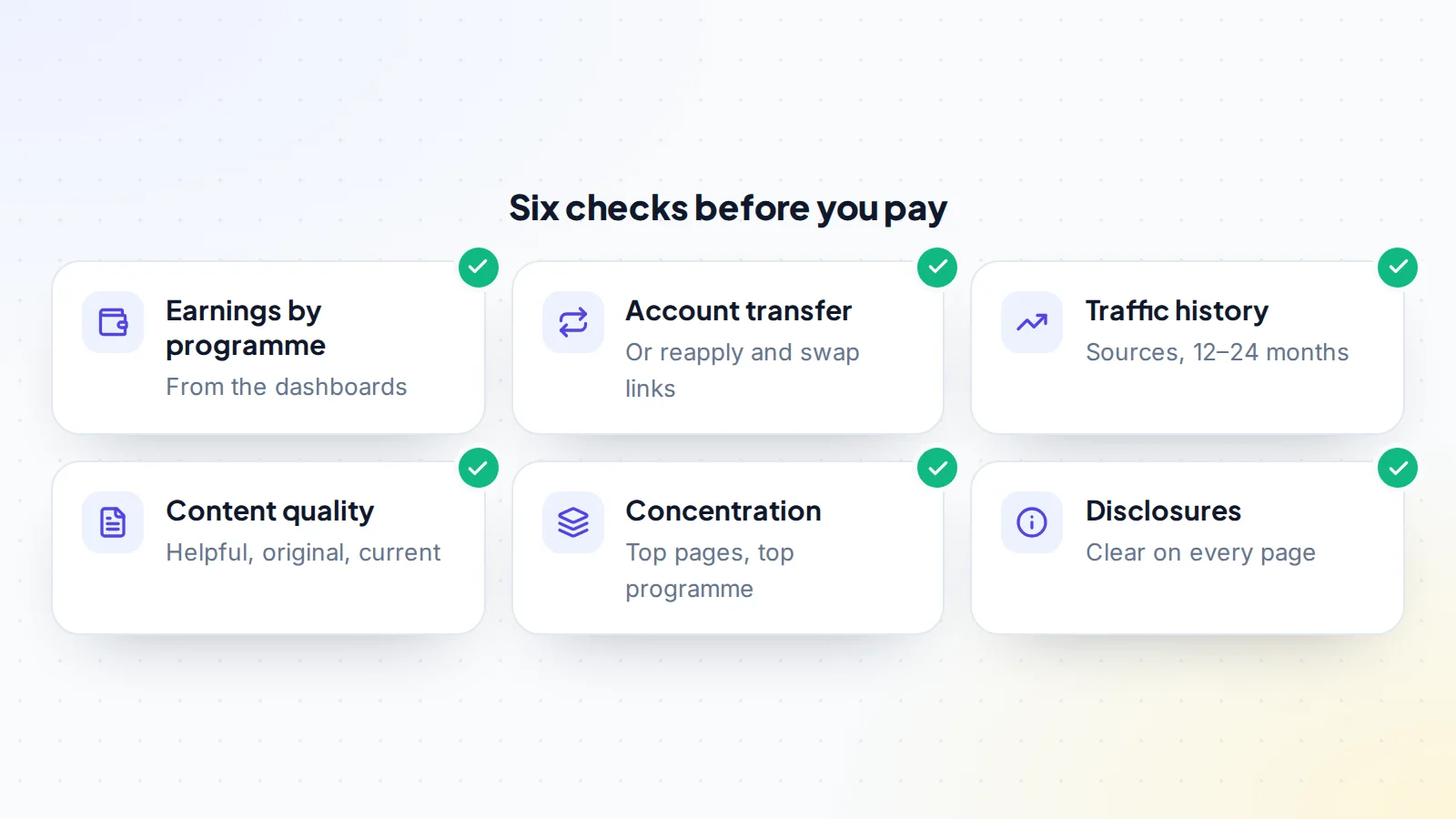
- Verify earnings in each affiliate programme’s own dashboard, for at least 12 months.
- Check whether each affiliate account can transfer. Many can’t; the buyer reapplies and swaps links.
- Study traffic sources over 12 to 24 months, including how the site came through search updates.
- Look at concentration: how much income comes from one programme, a few pages or a few keywords.
- Check that content is genuinely helpful and that affiliate links are clearly disclosed.
How affiliate websites make money
An affiliate website publishes content (reviews, comparisons, buying guides, tutorials) that recommends products. When a reader clicks a link and buys, the site earns a commission from the merchant’s affiliate programme. Many sites also earn from display ads on the same pages. Income depends on three things: how many people visit, how many of them click and buy, and how much each programme pays.
That makes affiliate sites quite different from businesses with their own customers. You don’t own the relationship with the buyer; the merchant does. Your assets are the content, the traffic it attracts and the trust readers place in it. For a comparison with other models, see online business models.
Types of affiliate sites you’ll see for sale
- Niche review sites focused on one product category, such as coffee equipment or hiking gear. Easy to understand, but often reliant on a few retailers.
- Comparison and “best of” sites covering software, finance or services. Commissions per sale can be high, and so can competition.
- Tutorial and how-to sites that earn when readers buy the tools mentioned. Traffic tends to be steady because the questions keep coming.
- Deal and coupon sites, which depend heavily on merchant relationships and timing.
- Video and social-led affiliate businesses, where links sit under videos or in social bios rather than on a website.
Before you buy an affiliate website, decide which type suits your skills. A tutorial site needs someone who can write clear guides; a comparison site needs research and regular updates; a deal site needs fast reactions.
Step 1: Verify earnings by programme
Ask to see each affiliate programme’s own dashboard, in a live screen share where you choose the date ranges, or through read-only access where the programme offers it. For at least 12 months, look at:
- Earnings by month for each programme.
- Clicks, orders and conversion rate, to see whether income comes from steady sales or a few big orders.
- Returns and reversed commissions, which some programmes deduct after the fact.
- Payout records matching the dashboard figures, ideally in bank statements.
Then add display ad earnings and subtract every cost (hosting, writers, editors, tools, link building) to reach net profit. Buyers usually work from trailing twelve months profit, and should check whether the seller’s figures are revenue or profit.
Step 2: Find out whether affiliate accounts transfer
This is the step buyers most often overlook. Affiliate programmes are agreements between the merchant and the account holder, and many don’t allow those agreements to be passed on. Amazon’s Associates Program Operating Agreement, for example, says the agreement may not be assigned without Amazon’s express prior written approval. In practice, the buyer of a site that uses such a programme usually opens their own account (or uses an existing one) and replaces the seller’s tracking links with their own.
For each programme, find out:
- Whether the account can be transferred, and how.
- If not, whether the buyer can be approved for their own account, and how long that takes.
- Whether commission rates are negotiated privately by the seller and might not apply to a new account.
- How pending commissions earned before the handover will be paid and to whom.
Write the answers into the deal terms. A private commission rate that won’t carry over can change the value of the site significantly.
Step 3: Study the traffic
Most affiliate sites depend on search traffic, so look at 12 to 24 months of Google Analytics and Search Console data:
- Sources: search, social, email, direct and referral, by month.
- Trend: growing, stable or declining, and whether there were sudden drops.
- Search updates: Google explains that it makes broad core updates to its ranking systems several times a year, and that recovery after a drop can take months. Compare traffic around those dates.
- Top pages and queries: how much traffic depends on a handful of pages or keywords.
- Countries: commissions often depend on readers being in the merchant’s market.
Our guide to traffic concentration risk explains how to measure dependence on a few pages or sources.
Step 4: Judge the content and links
Read the top 20 pages yourself. Ask:
- Is it genuinely helpful? Does it show real experience with the products, original photos or testing, and clear recommendations?
- Is it current? Product reviews go out of date quickly.
- Is it original? Check samples for copied or thinly rewritten text.
- How was it promoted? Google’s spam policies describe link schemes (such as buying links to manipulate rankings) as spam. Ask about past link building and look at the site’s backlinks.
Content that exists only to rank and push links is fragile. Content that helps readers make decisions tends to last.
Step 5: Check affiliate disclosures
In the United States, the FTC’s Endorsement Guides say readers should be told clearly when a site earns from its recommendations, close to the links, in plain words such as “I get commissions for purchases made through links in this post”. Many affiliate programmes require disclosures too. Check that every page with affiliate links has a clear disclosure. If it doesn’t, you’ll need to fix it after the purchase, so count the work.
Step 6: Measure concentration
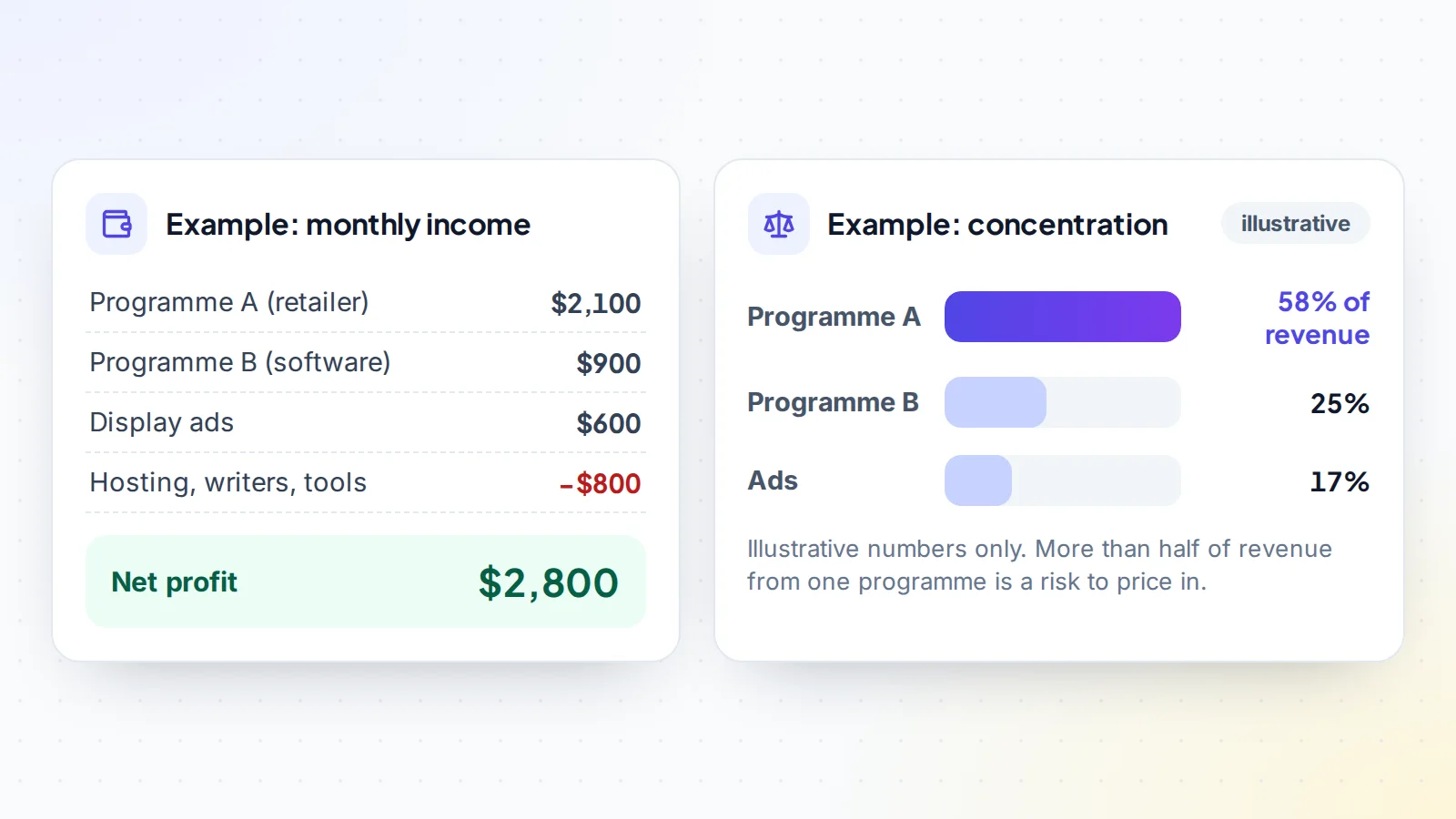
Concentration is the biggest risk in most affiliate sites. Look at:
- Programme concentration: the share of revenue from the largest programme.
- Page concentration: the share of revenue from the top five pages.
- Source concentration: the share of traffic from one search engine or platform.
- Product concentration: income tied to one product that could be discontinued.
Concentration doesn’t mean you shouldn’t buy, but it should be reflected in the price. A site earning evenly from several programmes and hundreds of pages is worth more than one with the same profit from a single programme and three pages.
Step 7: Agree a fair price
Affiliate sites are usually priced as a multiple of average monthly net profit. The multiple rises with a long, stable traffic record, diversified programmes, helpful content and transferable accounts. It falls with recent drops, concentration, unclear link-building history and programmes that won’t transfer. Read about the online business valuation multiple and try the free valuation tool.
A worked example
The numbers below are made up to show the method, not market data.
Jamie is looking at a home-office equipment review site with net profit of $2,800 a month. Dashboards confirm $2,100 a month from a large retailer’s programme, $900 from a software company’s programme and $600 from display ads, with $800 of monthly costs.
Three findings shape the offer. First, the retailer programme can’t be assigned, so Jamie will apply for an account and swap links on handover day; there’ll be a short gap while tracking switches over. Second, the software programme pays the seller a negotiated rate higher than its public rate; the seller agrees to introduce Jamie to the programme manager, but there’s no guarantee the rate will carry over. Third, 58% of revenue comes from the retailer, and four pages bring half the traffic.
Jamie values the site on the profit expected under Jamie’s own accounts at public rates, applies a multiple adjusted down for concentration, and agrees with the seller that a small part of the price will depend on the software programme approving the same rate. Both sides understand exactly what’s being paid for.
Step 8: Plan the handover
- Payment held by escrow or a trusted middleman. On digiflippers.com, the ways to pay in a deal are: directly to the seller, through escrow, and the platform never holds the money itself.
- Domain and hosting transferred.
- Affiliate accounts transferred where allowed; otherwise your own accounts approved in advance and links replaced on the day.
- Analytics and Search Console ownership added for you.
- Email list, social accounts and writers handed over as agreed.
- Tracking checked: test clicks and early orders recorded under your accounts.
Our handover checklist covers the remaining steps.
Questions to ask the seller
- Which affiliate programmes do you use, and which accounts can transfer?
- Do you have any private commission rates or special terms?
- How was the content written, and who wrote it? Will the writers stay?
- Have you bought links or used any link-building services?
- How did traffic change during the last few search updates?
- What would you do next if you were keeping the site?
- Why are you selling?
Good sellers answer these quickly and with evidence. Vague answers to the link-building and programme questions are the ones to take most seriously when you decide whether to buy an affiliate website or walk away.
Red flags
- Earnings shown only in screenshots, with no live access to dashboards.
- A sharp traffic rise in the last few months with no clear reason.
- Large amounts of bought or low-quality backlinks.
- Content copied from other sites or thinly rewritten.
- A seller who won’t explain which programmes transfer.
- Missing disclosures throughout the site.
Before going further, check who you’re dealing with; see how to check an online seller.
After you buy
The first months are about protecting what you bought: keep publishing at the usual pace, update the top pages, check every affiliate link works and tracks correctly, and watch traffic closely. Then look for growth: new programmes, an email list, or your own product to reduce dependence on commissions.
Checklist: buying an affiliate website
- 12 months of earnings verified in each programme’s dashboard.
- Net profit calculated with every cost included.
- Transfer rules confirmed for each affiliate programme.
- Your own accounts approved where transfer isn’t possible.
- 12–24 months of traffic studied, including around search updates.
- Top pages read for quality, originality and freshness.
- Backlinks and link-building history reviewed.
- Disclosures present and clear.
- Concentration measured and reflected in the price.
- Payment held by escrow or a middleman before the handover.
Ready to find your next asset?
Browse listings with verified numbers, ask sellers your questions before you offer, and agree every step in a free Deal Room.
Frequently asked questions
Can I take over the seller’s Amazon Associates account?
Amazon’s operating agreement says it can’t be assigned without Amazon’s express written approval. Most buyers use their own account and replace the links during the handover.
How much is an affiliate website worth?
Usually a multiple of average monthly net profit, adjusted for traffic stability, concentration, content quality and whether programmes transfer.
What happens to commissions earned before the sale?
They’re normally paid to the seller’s account. Agree in writing how pending commissions are handled, and when the cut-off is.
Are affiliate sites risky?
They carry specific risks, mainly search traffic changes and programme changes. Diversified sites with helpful content and several programmes are much less risky than concentrated ones.
Do I need to keep the site’s disclosures?
Yes. In the United States, the FTC expects clear disclosure of affiliate relationships, and many programmes require it too.
How long does the handover take?
Usually one to two weeks, depending on domain transfer times and how quickly your own affiliate accounts are approved.
Is it better to buy an affiliate website or build one?
Buying gives you income and traffic from day one; building costs less money but usually takes many months before meaningful search traffic arrives. See buying vs starting an online business.