.com vs New Domain Extensions: What Buyers Should Consider
A buyer's guide to domain extensions: generic, country-code and new endings, what Google says about each for search, how extensions affect price and resale, renewal costs, rules and restrictions, and how to choose.
The ending of a domain name, its extension or top-level domain, says a lot before anyone visits the site. .com feels familiar everywhere, a country code signals a local business, and newer endings like .app or .shop describe what a site does. Choosing between domain extensions affects how memorable your name is, how much it costs, how easily you could sell it later and, in some cases, how search engines understand your audience. This guide explains the main types, what Google says about each, how prices differ and how to choose.
If the name you want is taken, see our guide to buying a domain name that is taken. For the investment side, read about domain investing.
Key takeaways
- Extensions are generic (like .com), country codes (like .de) or newer generic endings (like .app).
- Google says country codes are a strong signal for a country; new endings are treated as generic.
- Google has said keywords in an extension give no ranking advantage or disadvantage.
- .com names usually cost more to buy and resell for more, because more buyers want them.
- Check renewal prices, eligibility rules and who owns other versions before buying.
What is a domain extension?
A domain extension, or top-level domain (TLD), is the last part of a domain name, after the final dot. In example.com, it’s .com. Each extension is run by a registry, and the full list of extensions is published by IANA in its root zone database. You register domain names through registrars, which sell names in many extensions.
There are hundreds of extensions, from long-established ones like .com, .org and .net to country codes and hundreds of newer endings introduced through ICANN’s new gTLD programme.
The main types
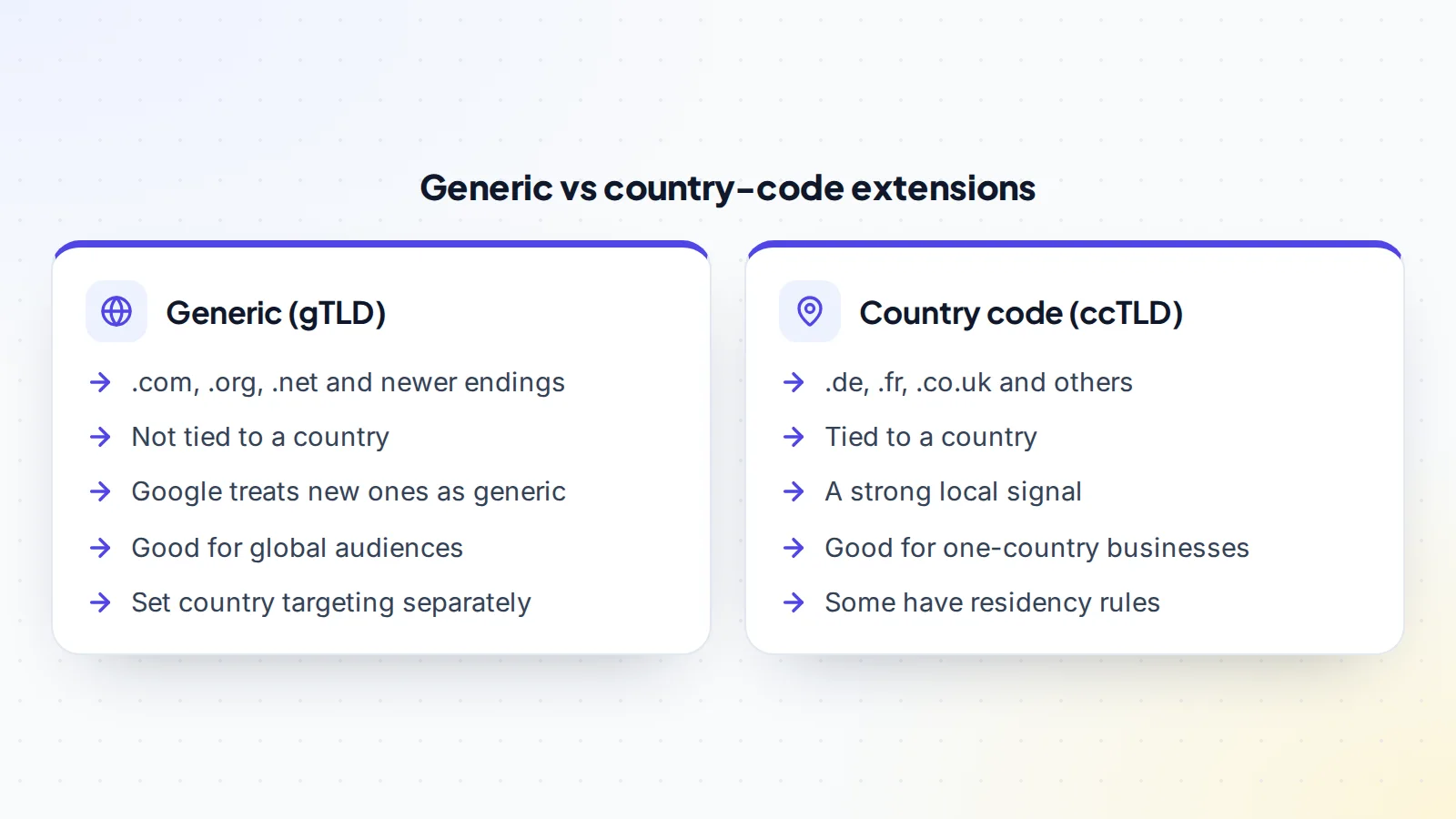
- Generic (gTLDs): .com, .net, .org and others not tied to a place.
- Country codes (ccTLDs): two-letter endings for countries and territories, such as .de, .fr, .ca and .co.uk.
- New generic endings: words like .app, .shop and .blog, plus city and regional names, introduced in recent years.
- Restricted or sponsored endings: extensions limited to certain groups, such as .gov or .edu in the US.
What Google says about extensions
Google’s guidance on multi-regional sites says country-code domains are tied to a specific country and provide a strong signal to users and search engines that a site is intended for that country. Generic domains aren’t associated with a location; if a site on a generic domain wants to target a particular country, it can signal that in other ways.
Google has also explained how it handles newer endings: it treats new gTLDs like other generic domains, treats regional endings such as city names as generic too, and treats some country codes that are widely used generically, such as .tv and .me, as generic. In the same post, Google said keywords in an extension don’t give any advantage or disadvantage in search. In short, choose an extension for your audience and brand, not for ranking.
Why .com is still popular
.com is the default many people type, especially when they hear a name rather than see it. That familiarity makes .com names easy to remember and share, and it’s why short, brandable .com names are scarce and expensive. Many businesses using another extension also try to own the .com of their name, so customers and email don’t go astray.
Habits also show up in links and email: people who hear a name in a podcast or conversation often assume it ends in .com, so a different ending needs to be said clearly and repeated in your marketing.
That doesn’t mean .com is always best. A business focused on one country may be better served by that country’s code, and a well-chosen newer ending can make a short, memorable name possible when the .com isn’t available.
Country codes
Country-code domains suit businesses that serve one country. They signal local presence to customers and, as Google says, to search engines. Each country’s registry sets its own rules: some require residency or a local business presence, some allow anyone to register. Check the registry’s rules before buying, especially for a name that’s being transferred to you from another owner, because some registries need extra documents.
Newer generic endings
Newer endings let you register short, descriptive or creative names that would be impossible on .com. A word ending can also make a name clearer: a shop on .shop or a blog on .blog. Some endings have special technical requirements; for example, certain endings require websites to use secure HTTPS connections. The trade-offs are that some people still type .com by habit, some newer endings have higher renewal prices, and resale demand for many of them is smaller.
Extensions by type of business
- Local services and shops: the country code where customers are often builds trust and signals that you serve them.
- Global software and apps: .com is the safe default; a relevant newer ending can work well when the .com is out of reach.
- Online stores: .com or a country code usually feels most familiar at checkout, where trust matters most.
- Blogs and content sites: readers tend to arrive through search and links, so memorability matters a little less than for brands people type in.
- Non-profits and communities: .org remains widely recognised.
These are tendencies, not rules. Plenty of successful businesses break them with a memorable name on an unexpected ending.
How extensions affect price
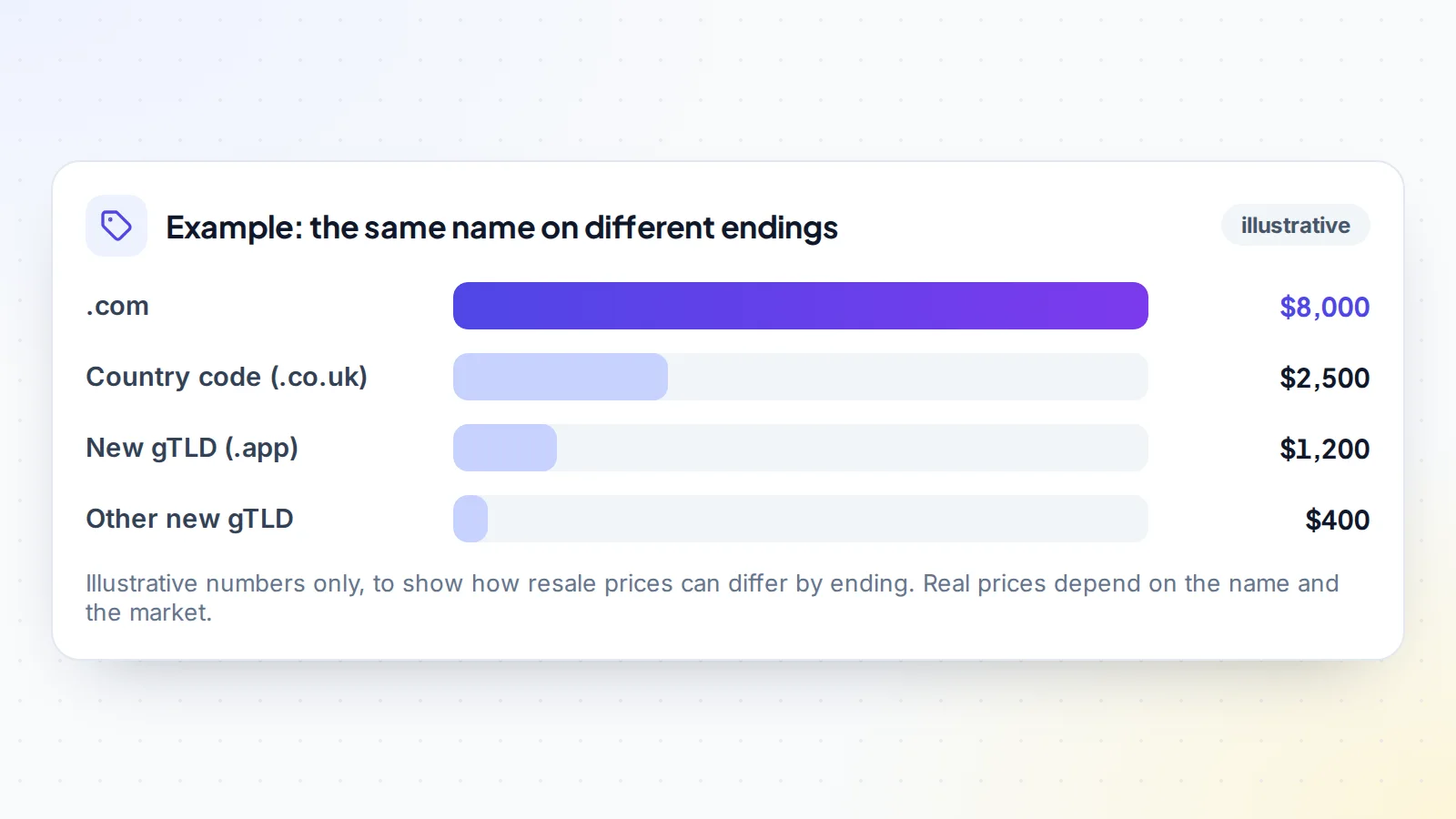
Prices for registered names depend on the name and the extension. The same word usually sells for much more on .com than on most other endings, because more buyers want .com. Country codes can be valuable within their country, especially for short, common words. Newer endings vary widely: a few are popular in particular industries, many have limited resale markets.
Also check renewal costs. Registration prices are set by registries and registrars, and some extensions, and some premium names within them, renew at much higher prices than standard ones. A cheap first year doesn’t guarantee a cheap tenth year, so compare the cost over the whole period you expect to keep the name. Our guide to valuation multiples covers how domains fit into the value of a wider business.
Premium names
Many registries set aside “premium” names, often short words or popular terms, sold at higher prices than standard registrations, and sometimes renewed at higher prices too. When you buy a domain from another owner, ask whether it’s a premium name with a higher renewal fee. That ongoing cost can change whether the purchase makes sense.
How to choose
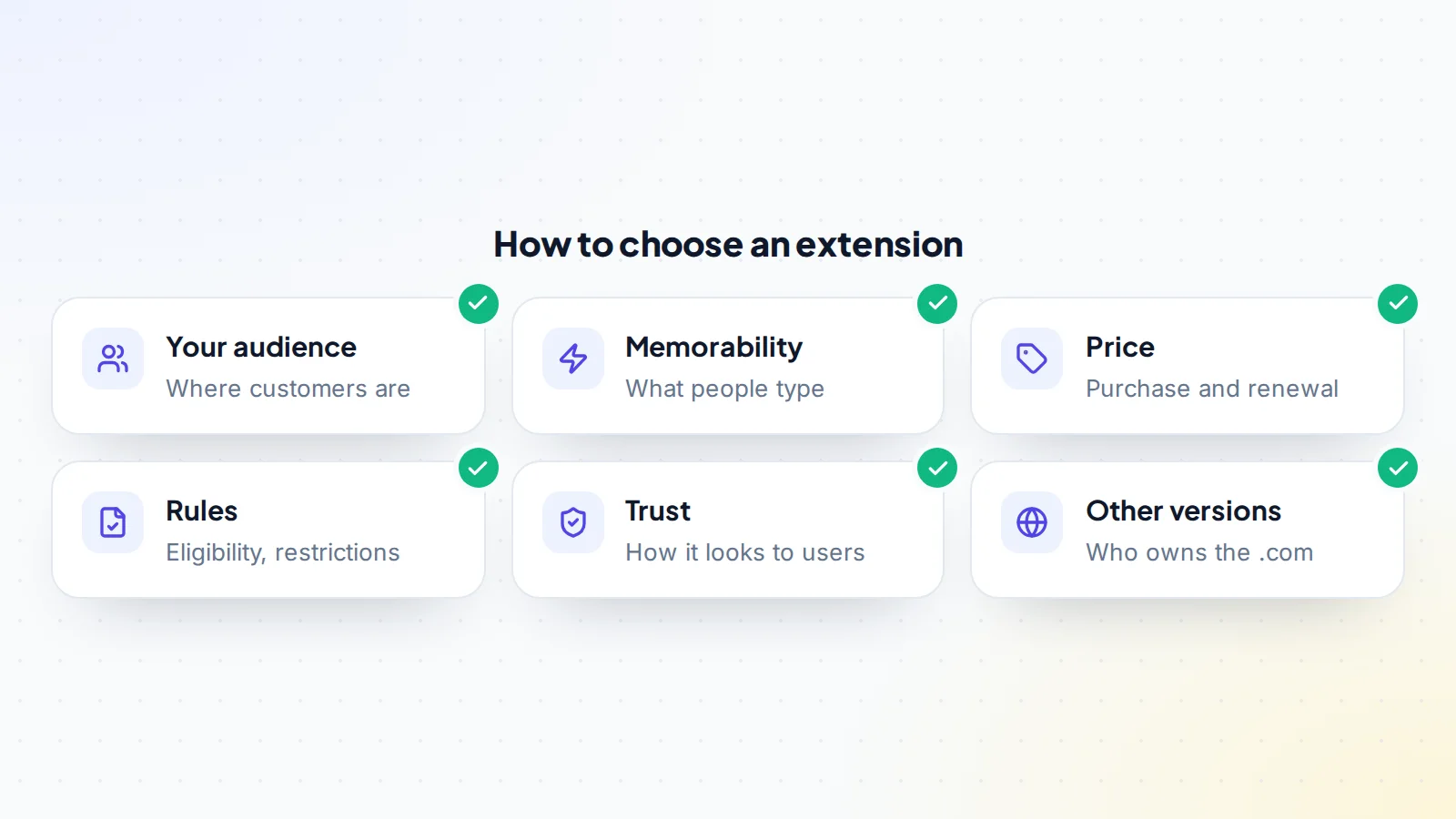
- Start with your audience. One country, or many? A country code suits the first; a generic ending suits the second.
- Say it out loud. Will people remember and type it correctly after hearing it once?
- Check the total cost. Purchase price plus renewals over several years.
- Read the rules. Residency, eligibility and any technical requirements.
- Look at other versions. Who owns the .com and the main country codes for your name?
- Think about resale. If you might sell the domain or the business later, more popular endings are easier to sell.
Buying an existing domain
If you’re buying a name from another owner, the extension affects the transfer too. Generic domains follow ICANN’s transfer rules, including possible restrictions after a recent registration or change of registrant. Country codes follow their own registry’s rules, which can differ. Our guide to the 60-day domain transfer lock explains the most common restriction. To reach the owner of a registered name, read how to find a domain owner.
Pay through escrow so the money is held until the domain is in your account. Our guide to escrow fees explains the cost. On digiflippers.com, sellers can verify ownership, and you can browse domains for sale or read how escrow works.
Extensions and email
Your domain is also your email address, which customers see on every message. A short, familiar ending is easier to say on the phone and less likely to be mistyped. If customers often type .com by habit, owning the .com of your name, even just to forward email and redirect visitors, prevents lost messages. Whatever ending you choose, set up email authentication properly so your messages reach inboxes.
Using several extensions together
Many businesses own their name on several endings and redirect the extras to one main site. That’s sensible: it catches visitors who type a different ending and protects the brand. For search, use permanent redirects from the extra domains to the main one, and keep the main domain consistent in links and marketing. Running separate sites with the same content on different endings usually creates confusion rather than benefit, unless they genuinely serve different countries or languages.
Protecting your brand across extensions
You don’t need every extension of your name, but it’s worth owning the ones customers are most likely to type: usually the .com and the country codes where you trade. Some businesses also register common misspellings, especially if their name has a word that is often spelled two ways. Redirect extra domains to your main site so visitors arrive in the right place, and keep all of them on auto-renewal with the registrar lock and two-factor authentication turned on.
Security and trust
Visitors judge a site partly by its address. A familiar ending, a clean name and a secure connection all help people feel confident before they share details or pay. Whatever extension you choose, use HTTPS across the whole site, keep the domain on auto-renewal so it never lapses, and turn on the registrar lock and two-factor authentication at your registrar. Losing a domain to an expired renewal or a hijacked registrar account is far more damaging than choosing a less popular ending.
Common mistakes
- Choosing an ending for a ranking boost that doesn’t exist.
- Ignoring high renewal prices on premium names or some newer endings.
- Buying a country code without checking residency rules.
- Forgetting to check who owns the .com of your name.
- Assuming a newer ending will resell as easily as .com.
A worked example
The details below are made up to show the method.
Mina is naming a meal-planning app. The ideal short .com is owned by an investor asking a high price. The .app version is available from another owner at a fraction of the cost, and the country code for the UK, where most of Mina’s first users are, is also available.
Mina checks the renewal prices for both, confirms the .app ending’s HTTPS requirement suits the app’s website, and notes that Google treats .app as a generic ending, so the site can still reach users in other countries. Mina buys the .app name through escrow as the main brand, registers the UK country code to redirect, and sets a reminder to ask about the .com again in a year, when the business can afford it.
Domain extensions: the checklist
- Audience: one country or many.
- Name tested for memorability with the chosen ending.
- Purchase and renewal prices compared over several years.
- Premium status and renewal fee confirmed.
- Registry rules and any technical requirements checked.
- Ownership of the .com and key country codes checked.
- Transfer rules for the extension understood.
- Payment through escrow; auto-renewal and lock turned on.
Ready to find your next asset?
Browse listings with verified numbers, ask sellers your questions before you offer, and agree every step in a free Deal Room.
Frequently asked questions
What are domain extensions?
The endings of domain names, such as .com, .de or .app, also called top-level domains.
Does the extension affect search rankings?
Google says country codes are a strong signal for a country, new gTLDs are treated as generic, and keywords in an extension give no advantage or disadvantage.
Is .com always the best choice?
Not always. It’s the most familiar, but a country code suits one-country businesses, and a newer ending can make a short name possible.
Why are .com names more expensive?
More buyers want them, so short, brandable .com names are scarce and resell for more.
Do some extensions have rules?
Yes. Some country codes require residency or a local presence, some endings are restricted to certain groups, and some have technical requirements.
What is a premium domain name?
A name a registry prices above standard registrations, sometimes with higher renewal fees too.
Should I register other extensions of my name?
Usually the .com and the country codes where you trade, redirected to your main site.