Starting a Domain Portfolio: A Realistic Beginner’s Guide
An honest introduction to domain investing: how buying and selling names works, why renewals decide profit, what makes a good name, trademark and UDRP risk, where to buy, how to price and sell, and how to track a portfolio.

Domain investing means buying domain names you expect someone else to want, and selling them for more than they cost you to hold. It sounds simple, and some people make steady money from it. But most names never sell, every name costs money to renew each year, and the names worth the most are rarely cheap to get. This guide explains how a portfolio really works, how to choose names, the legal risks, pricing and selling, and how to keep the numbers on your side.
If you’re buying a single name for your own business rather than to resell, read how to choose a domain name and how to buy a domain that’s taken instead.
Key takeaways
- A domain portfolio makes money only when sales beat purchases plus yearly renewals.
- Most names sell rarely or never, so each sale has to cover many names.
- Good names are short, clear, in popular extensions and fit real businesses.
- Names that use someone’s trademark can be lost in a dispute.
- Track every cost, price every name, and drop the weakest each year.
How domain investing works
An investor registers new names or buys existing ones, holds them, and lists them for sale. Buyers are usually businesses: a start-up that wants a better name, a company rebranding, or someone launching a product. When one of them wants a name you hold, you agree a price, the buyer pays, and the name moves to their account.
The hard part is that you can’t know which names will sell or when. A portfolio is a bet that, across many names, enough will sell at good prices to cover the cost of holding all of them.
The maths: renewals decide profit
Every domain must be renewed, usually every year, to stay registered. ICANN’s domain name renewal and expiration FAQs explain how renewal and expiry work. A name that costs a small amount a year seems cheap, but a hundred of them add up, and that bill comes every year whether anything sells or not.
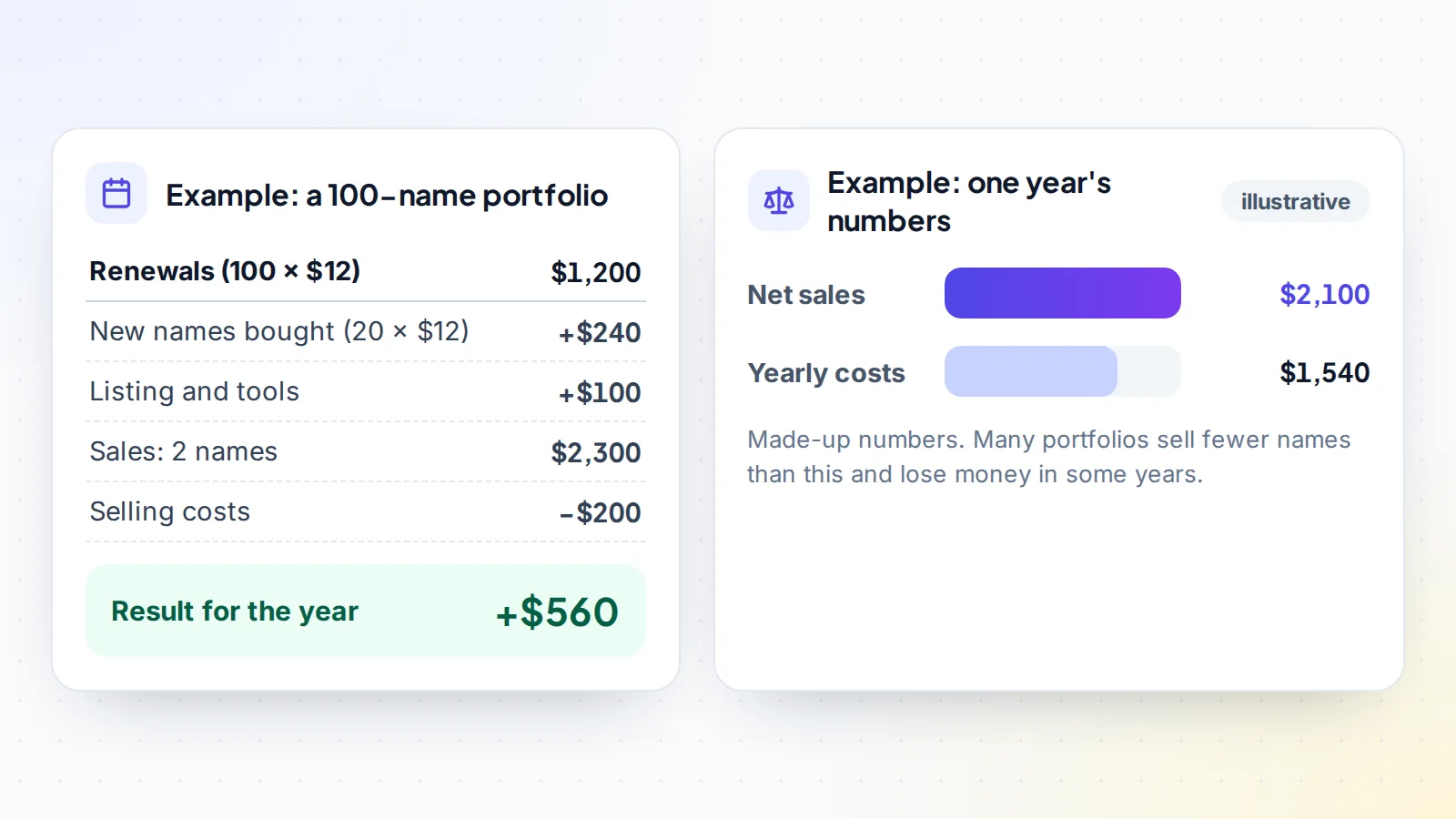
This is the core of domain investing: your sales must pay for every name you hold, not just the ones that sold. A portfolio full of names that never sell is a steady cost. That’s why careful investors buy fewer, better names, and drop names that aren’t working.
What makes a name valuable
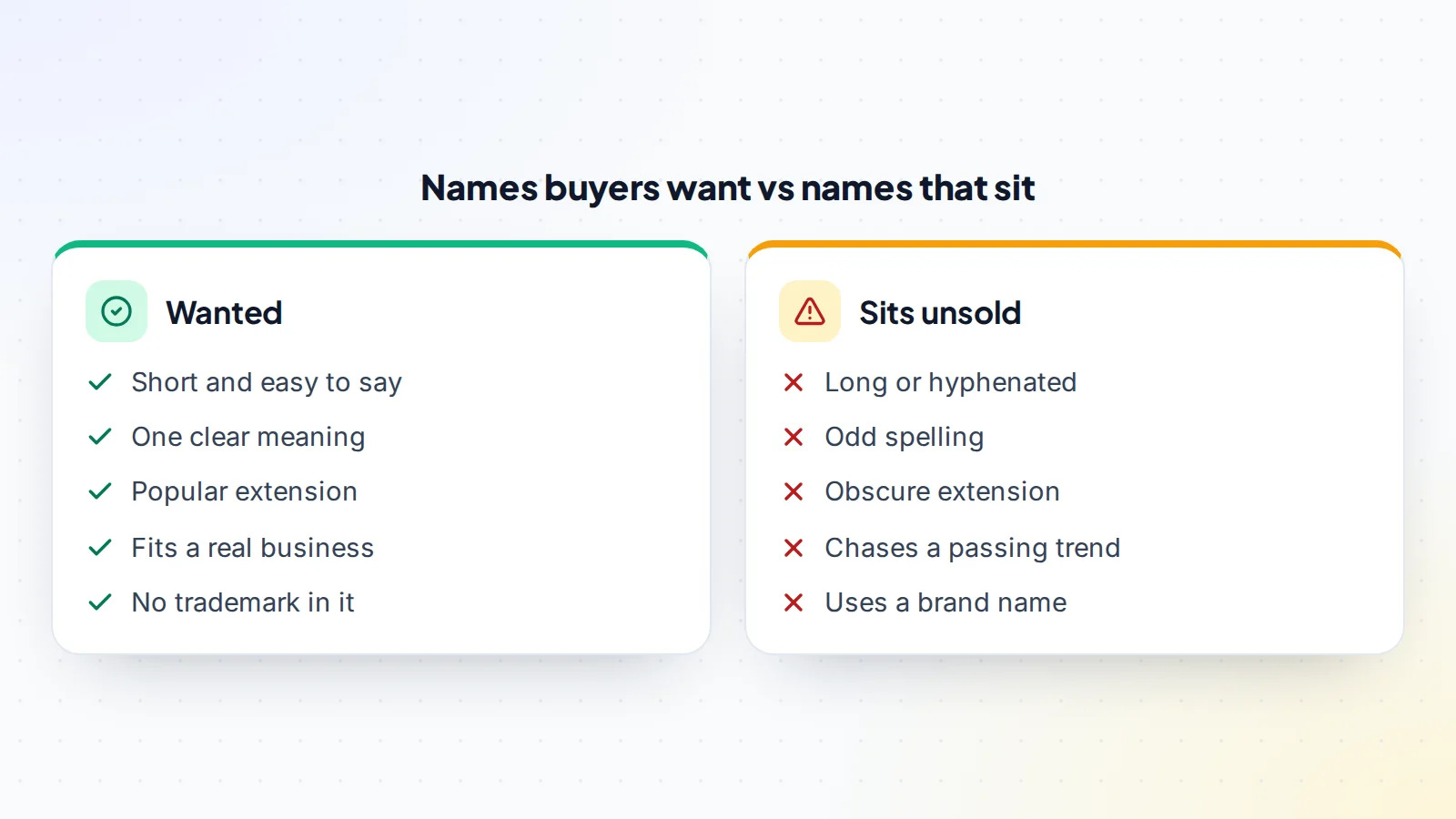
Buyers pay for names that make their business easier: easy to say, spell and remember, with a clear meaning and a trusted extension. Short dictionary words, clear two-word phrases and brandable made-up words that sound natural tend to do best. Long names, hyphens, numbers and odd spellings tend to sit unsold.
Read what makes a domain name valuable and brandable domain names for more detail, and domain extensions for how the ending affects value.
The trademark risk
The biggest legal risk is buying a name that includes someone else’s trademark, or is confusingly similar to one. Trademark owners can bring a complaint under ICANN’s Uniform Domain-Name Dispute-Resolution Policy (UDRP), often filed with the WIPO Arbitration and Mediation Center. If the panel finds the name was registered and used in bad faith, it can be transferred to the trademark owner. Offering a brand’s name back to the brand for sale can itself be used as evidence of bad faith.
Before every purchase, search trademark databases in your main markets and search the web for businesses using the name. Generic words used in their ordinary meaning are much safer than names built around a brand. Read domain trademarks and UDRP.
Where investors get names
- New registrations. Cheapest, but most good names are already taken, so it takes creativity.
- Expiring and expired names. Names whose owners didn’t renew, bought through drop-catching services or auctions. Read expired domains.
- From other owners. Buying from investors or businesses, through marketplaces or direct offers. Prices are higher, but quality can be too.
Whatever the source, check the name’s history in a web archive and its standing before buying. Read how to check a domain’s history.
Common approaches
Domain investors tend to follow one of a few approaches, and many mix them:
- Quality over quantity. A small number of strong names bought at higher prices, held for years, sold rarely but for larger amounts.
- Volume. Many lower-cost names, priced to sell, relying on a steady trickle of sales to cover a large renewal bill.
- Brandables. Made-up or creative names aimed at start-ups, often sold at fixed prices through specialist marketplaces.
- Niche or local. Names for a specific industry or place, sold to businesses in that field.
Each needs a different budget and different skills. Beginners often find a small quality-first portfolio teaches them more with less risk than a large volume portfolio.
Watch for premium renewals
Some extensions charge more than the standard fee for names they class as premium, and in some cases that higher price applies at every renewal, not just the first year. Check the renewal price, not only the purchase price, before buying any name in a newer extension. A name with a high yearly renewal needs to sell at a much higher price to be worth holding.
Setting a budget
Decide a total budget for the first year that covers both buying and renewing, and money you can afford to lose. Many beginners spend it all on many cheap names, then face a large renewal bill a year later with no sales. Starting with a small number of names you’d be proud to own, then adding more only after you’ve sold some, is the safer path.
Pricing your names
Every name in your portfolio should have a price, even if you’re open to offers. Many buyers prefer to buy instantly at a clear price rather than start a negotiation. Price based on what a business would reasonably pay given the name’s quality and comparable sales, not on what you hope to get. Read how to negotiate a domain purchase to understand the buyer’s side of the table.
Review prices once a year. A name that has had no interest for years at one price may need a lower one, or may be one to drop.
Selling a name
List names where buyers look: domain marketplaces, a simple “for sale” page on the domain itself with a price or contact form, and general marketplaces for digital assets. Answer enquiries quickly. When you agree a sale, use escrow or a trusted platform so payment and transfer happen together; read escrow vs direct payment and domain escrow.
Know the transfer rules before you sell. Registrars apply ICANN’s transfer policy, which includes a lock after some changes. Read the 60-day domain transfer lock and the domain transfer process so you can tell buyers exactly what to expect.
Handling offers
Enquiries range from serious buyers to people testing whether you’ll take very little. Reply politely and quickly, with your price or a counter-offer. Ask what the buyer plans to use the name for; a business with a real launch date is more likely to close. Don’t be offended by low offers, and don’t feel pushed to accept one. If a buyer can’t meet your price, leave the door open; some come back months later.
Be careful with buyers who want to pay outside a trusted platform, ask you to transfer the name before payment arrives, or send you to an unfamiliar escrow site. Those are common signs of a scam. Read fake escrow scams.
Contacting possible buyers
Some investors reach out to businesses that might want a name. Done carefully, this can work: a short, polite message to a company whose name or product clearly matches, with a fair price. Done badly, it annoys people and can look like pressure. Never contact a brand offering it a name that contains its trademark; that’s exactly the kind of evidence used in disputes.
Pruning the portfolio
Each year, before renewals, review every name. Has it had any interest? Would you buy it again today at its renewal cost? Is the trend it was bought for still alive? Drop names that fail those tests, or list them at a low price to recover something. Pruning keeps your yearly costs in line with what the portfolio can earn.
Keeping records
Track every name in a spreadsheet: purchase date and price, registrar, renewal date and cost, asking price, enquiries and offers. Track total spending and total sales by year. This tells you which kinds of names sell for you, and it’s what an accountant will need. Sales of domains are usually taxable; rules depend on where you live and how often you sell.
Protecting your portfolio
Your names are only as safe as your registrar accounts. Use strong, unique passwords and two-step verification, keep names locked against transfers when you’re not selling, and keep account contact emails current so renewal notices reach you. Be wary of messages claiming to be from your registrar or a buyer that ask you to sign in through a link. Read digital asset scams.
Learning the market
Before spending much, spend time watching. Follow public reports of domain sales, note which kinds of names sell and at what prices, and look at what similar names are listed for. Domain investing rewards people who understand what businesses actually need, so read start-up news and notice what kinds of names new companies choose.
Trends and timing
New technologies and buzzwords tempt investors to register many names at once. A few early buyers do well; many end up renewing names that nobody wants once the trend fades. If you buy around a trend, keep the number small, choose names that would still make sense if the trend cooled, and be ready to drop them.
Common mistakes
- Buying many cheap names and forgetting the renewal bill.
- Registering names that contain someone else’s trademark.
- Pricing every name very high and never selling.
- Chasing trends with dozens of similar names.
- Not tracking costs, so you don’t know if you’re making money.
- Selling without escrow or a trusted platform.
A worked example
The details below are made up to show the method.
Quinn sets a first-year budget of $1,500 and buys thirty names: a few short two-word names in .com and some brandable names, all checked against trademark databases. Each gets a buy-now price on a marketplace and a simple landing page. By the end of the year, two names have had enquiries and one sells for $900 through escrow.
Before renewals, Quinn reviews the list. Ten names have had no interest and look weaker than the rest; Quinn drops them. The remaining twenty are renewed, and Quinn adds five new names, choosing patterns similar to the ones that drew interest. The spreadsheet shows a small loss for the year, but a clear picture of what sells, which Quinn uses to buy more carefully in year two.
Domain investing: the checklist
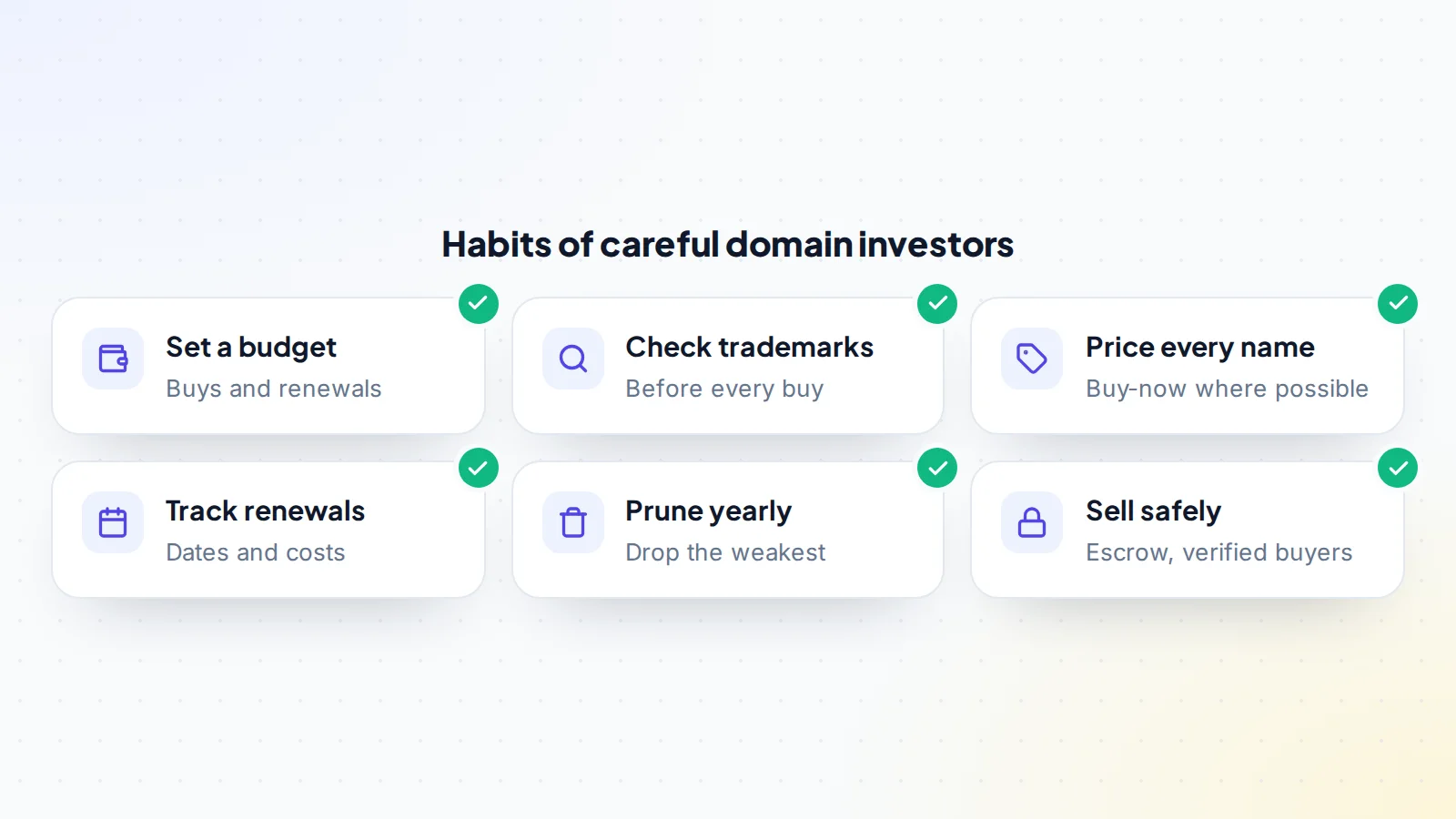
- Yearly budget set for buying and renewals.
- Trademarks and web use checked before each purchase.
- Name history checked in a web archive.
- Every name priced, with buy-now prices where possible.
- Renewal dates and costs tracked in one place.
- Weakest names dropped before renewals each year.
- Registrar accounts secured with two-step verification.
- Sales completed through escrow or a trusted platform.
Browse domains for sale, or list your domains with 0% success fee up to $10,000, then 5% (max $5,000). Read how verification works on digiflippers.com.
Ready to find your next asset?
Browse listings with verified numbers, ask sellers your questions before you offer, and agree every step in a free Deal Room.
Frequently asked questions
Is domain investing profitable?
For some people. Many portfolios lose money, mainly because renewals add up while most names don’t sell.
How many names should a beginner buy?
Few, and good ones. Add more only once you’ve learned what sells.
What happens if a name contains a trademark?
The trademark owner can bring a dispute, and the name may be transferred to them.
Where do domain investors sell names?
Domain marketplaces, landing pages on the names themselves, and digital asset marketplaces.
How should I price a domain?
On what a business would reasonably pay, based on quality and comparable sales. Review prices yearly.
How long does it take to sell a name?
It varies widely. Some sell in weeks, many take years, and many never sell.
Do I pay tax on domain sales?
Usually. The rules depend on where you live; speak to an accountant.
What’s the safest way to sell?
Through escrow or a trusted platform, so payment and transfer happen together.