Fake Escrow Websites: How to Spot Them
Fake escrow sites look real and confirm payments that never happened. How the scam works, the warning signs, and how to check an escrow company before you trust it.

Escrow is one of the best protections in a digital asset deal, which is exactly why scammers imitate it. A fake escrow scam uses a website that looks like a real escrow company, sends convincing “funds received” emails, and waits for the seller to hand over a domain, account or files. By the time anyone checks, the site and the “buyer” are gone. Knowing how the scam works, and how to verify a real escrow company, makes you very hard to fool.
This guide explains the scam step by step, the warning signs of a fake escrow site, how to check an escrow company before you trust it, and what to do if you’re targeted. It’s useful for sellers (the usual targets) and buyers alike. For how genuine escrow works, see escrow for online businesses.
Key takeaways
- In a fake escrow scam, the “buyer” suggests an unfamiliar escrow site that falsely confirms payment, so the seller hands over the asset.
- Always go to the escrow company’s website yourself, never through a link sent by the other side.
- Check the company’s licence with its regulator; California’s DFPI warns that fake sites copy real licence numbers.
- Real escrow companies don’t ask you to pay an individual or use person-to-person money transfer services.
- Confirm funds are held by signing in to the real escrow account yourself, not by trusting an email.
How the scam works
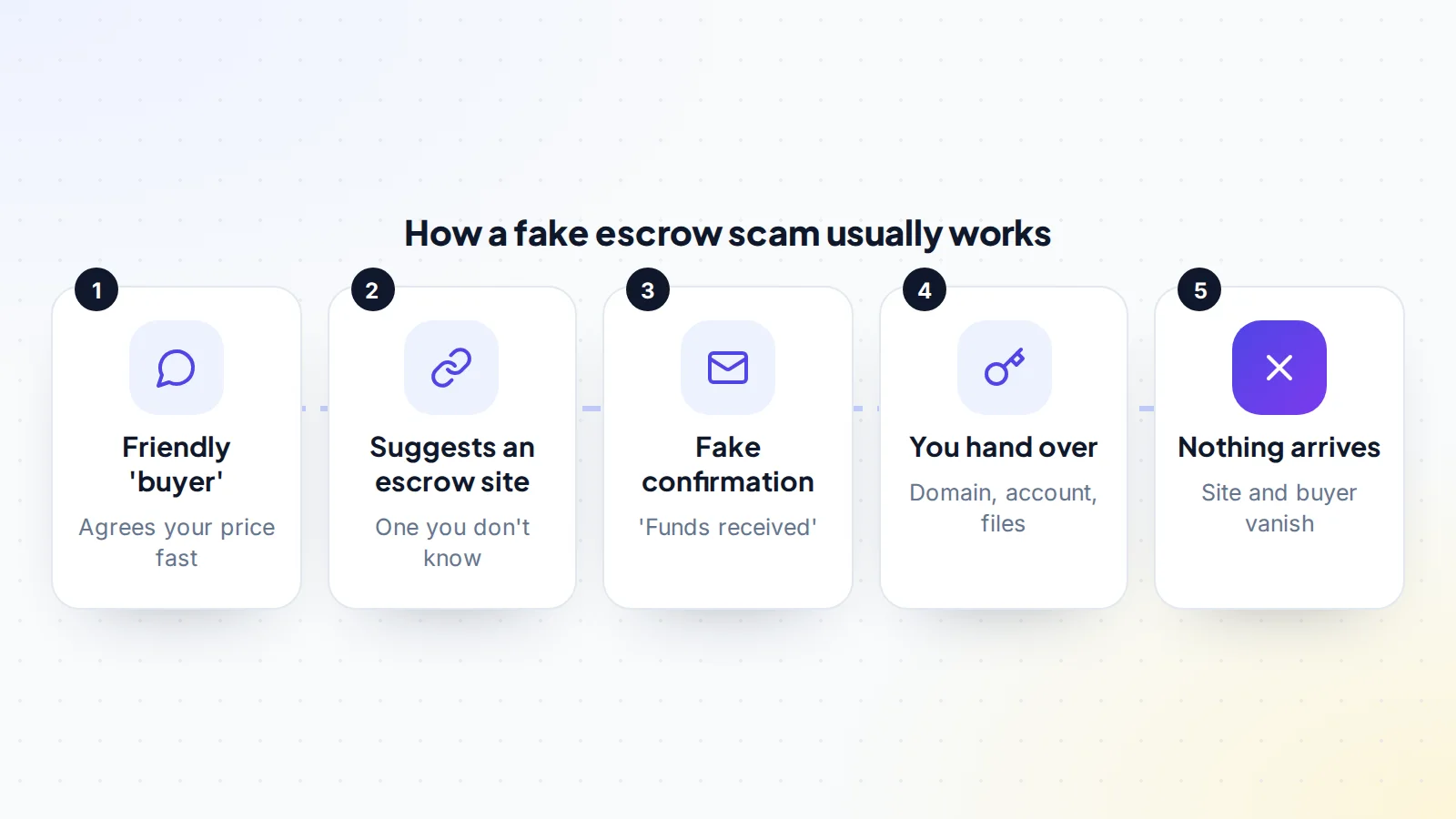
- A “buyer” makes contact, often agreeing your price quickly or offering a little more, to make the deal feel easy.
- They suggest an escrow service you haven’t used before, with a reassuring name and a professional-looking website. Sometimes they say it’s the only one they use, or that it’s required in their country.
- You’re asked to register on the site, which may ask for personal or bank details.
- A confirmation arrives saying the buyer’s funds have been received and that you can now hand over the asset.
- You hand over the domain, account or files, believing the money is safe.
- No money is ever released. The site stops responding, and the buyer disappears with the asset.
Escrow.com describes the same pattern in its fraud guidance: a buyer recommends a fraudulent escrow site, the site indicates funds have been received, the seller delivers, and the seller is never paid. The scam also runs in reverse against buyers, with a fake “seller” asking for payment into a fake escrow account.
Why the scam works
Fake escrow scams succeed because they turn a good habit into a weakness. Sellers have learned that escrow is safe, so when a buyer suggests it, they relax. The scam adds a few more pressures: a buyer who agrees quickly feels like a lucky break, a polished website looks trustworthy, and a deadline makes checking feel like a risk to the deal. None of these is evidence. The defence is to separate the idea of escrow (good) from any particular escrow website (which must be verified).
Warning signs of a fake escrow site
- The other side insists on a specific escrow site you’ve never heard of.
- The site’s domain is very new. Escrow.com suggests checking when a domain was registered; fake sites often claim years of history on domains registered weeks ago. ICANN’s lookup tool shows the registration date.
- Licence claims you can’t verify. California’s Department of Financial Protection and Innovation (DFPI) has warned about fake escrow sites that claim to be licensed, display fictitious licence numbers or copy the details of real licensees.
- Payment to an individual, or through a person-to-person money transfer service. The DFPI says legitimate escrow companies don’t do this.
- Emails from look-alike addresses, with small spelling changes from a real company’s domain.
- No working phone number, or support that only answers through chat apps.
- Sloppy details: spelling mistakes, broken links, copied text and inconsistent company information.
- Urgency: pressure to hand over quickly “before the transaction expires”.
How to verify an escrow company
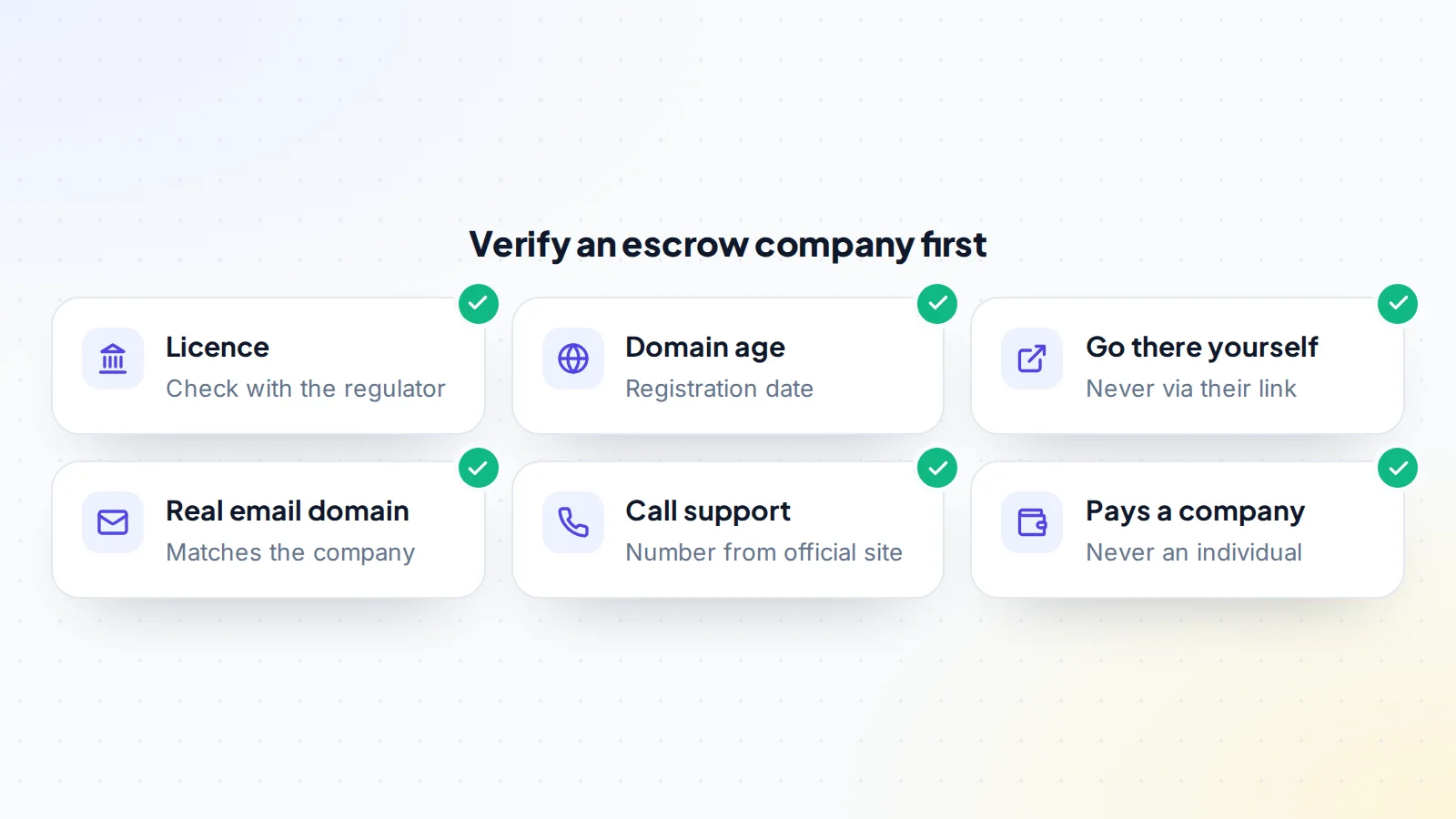
- Find the company yourself. Search for it independently or use the one your marketplace provides. Never use a link sent by the other side.
- Check the licence with the regulator. For California-licensed escrow companies, the DFPI explains how to verify a licence on its official website. Other places have their own regulators.
- Check the domain’s age with ICANN’s registration data lookup.
- Call support on a number from the official website, and ask them to confirm the transaction exists.
- Check the payment details: money should go to the escrow company itself, not an individual.
- Sign in yourself to confirm the funds are held, by typing the company’s address into your browser.
The DFPI’s own tips on avoiding online escrow fraud make the same core point: verify the company is properly licensed before sharing financial or personal information.
Never trust an email alone
The fake confirmation email is the heart of the scam. Even with a genuine escrow company, scammers sometimes send fake emails that imitate it. The rule is simple: don’t act on any “funds received” email until you’ve signed in to your escrow account yourself, through the company’s real website, and seen the transaction marked as funded. If you can’t do that, nothing has been confirmed.
A worked example
The details below are made up to show how the scam unfolds and how it’s stopped.
Dana lists a domain for sale. Within an hour, a buyer offers the full asking price and says they’ll pay through “SecureTrade Escrow”, the service their company always uses, and sends a link. The site looks polished, with a licence number and trust badges.
Dana checks. The domain was registered three weeks earlier. The licence number, searched on the regulator’s website, belongs to a different company. The site’s only contact is a chat window. Dana replies that the deal must use the marketplace’s own payment options or a well-known escrow company, reached directly. The buyer stops responding.
Had Dana trusted the link, the next message would have been a “funds received” email, followed by a request for the domain’s auth code. Five minutes of checking saved the domain.
Domains and accounts are prime targets
Digital assets are especially attractive to escrow scammers because they move instantly and are hard to recover. A domain auth code, an account email change or a file download takes seconds, while a bank transfer that never happened can take days to discover. In a domain sale, the moment of risk is sending the auth code; in an account sale, it’s changing the email or two-factor settings. Never take that step until you’ve confirmed the funds yourself. See the domain auth code guide for the safe order in domain deals.
Questions to ask any escrow provider
- Which regulator licenses you, and what’s your licence number?
- Can I confirm this transaction by phone on your official number?
- Where exactly will the buyer’s money be paid, and in whose name is the account?
- How do I see the status of the transaction in my own account?
- What happens if the buyer disputes the handover?
A real escrow company answers these easily and consistently. A fake one avoids them, changes the subject, or gives answers you can’t verify with anyone independent, such as the regulator.
Using escrow safely
- Use the marketplace’s payment options or an established escrow company you reach directly. On digiflippers.com, the ways to pay in a deal are: directly to the seller, through escrow, and the platform never holds the money itself.
- Agree the escrow provider before negotiating details, so a sudden switch stands out.
- Keep conversations on the marketplace, where there’s a record and staff can help.
- Hand over only after confirming funds yourself in the real escrow account.
- Keep every message and email in case you need to report something.
Our guides to escrow vs direct payment and the middleman service explain the safe options.
How the scam targets buyers
Buyers can be targeted too. A fake “seller” lists an attractive asset, then asks the buyer to pay into a fake escrow account. The same protections apply: choose the escrow company yourself, verify it independently, and never pay an individual or use a money transfer service because the other side insists. Our guide on how to check an online seller covers the other warning signs.
Protecting a team or business
If several people in your business handle sales, make the rules explicit so nobody is caught out under pressure:
- Keep a short list of approved escrow providers and payment methods, and use nothing else.
- Require a second person to confirm that funds are held before any asset is handed over.
- Bookmark the real escrow sites, so nobody types or clicks their way to a look-alike.
- Use two-factor authentication on escrow, registrar and email accounts.
- Share examples of scam messages you receive, so everyone learns to recognise them.
Simple rules like these stop a fake escrow scam even when a message looks convincing and a deal feels urgent.
Related tricks
- Fake middlemen: an accomplice posing as a “trusted middleman”. See middleman service.
- Fake payment screenshots: an edited screenshot of a bank transfer; see fake screenshots.
- Impersonated staff: messages claiming to be from the marketplace or escrow company, sent privately.
- Chargebacks: a buyer paying with a reversible method, then disputing it after the handover; see chargeback risk.
Our overview of digital asset scams covers these and more.
If you’ve been targeted
- Stop the handover immediately if you haven’t completed it.
- Don’t send more information or money.
- Secure the asset: change passwords, re-lock domains, and reset two-factor authentication if codes were shared.
- Report it to the marketplace, to the real escrow company if it was impersonated, and, in the United States, at ReportFraud.ftc.gov. The DFPI also takes complaints about online escrow fraud involving California licences.
- Contact your bank or payment provider straight away if you sent money.
- If a domain was transferred, contact your registrar at once.
Keep evidence
If anything about a deal feels wrong, save everything before it disappears: the listing, every message, the escrow site’s address, screenshots of its pages and any emails with their full headers. Fake sites are often taken down quickly, and evidence helps the marketplace, your bank, registrars and authorities act. Keeping records costs nothing and makes every report far more useful.
Common mistakes
- Clicking the escrow link the other side sent.
- Trusting licence numbers or badges without checking them with the regulator.
- Acting on a confirmation email without signing in yourself.
- Letting urgency override checks.
- Moving off the marketplace to “make things easier”.
Fake escrow scam: the checklist
- Escrow company chosen by you or provided by the marketplace.
- Website reached by typing the address yourself.
- Licence verified with the regulator.
- Domain registration date checked.
- Support reached on the official phone number.
- Payment going to a company, not an individual.
- Funds confirmed by signing in yourself before any handover.
Ready to find your next asset?
Browse listings with verified numbers, ask sellers your questions before you offer, and agree every step in a free Deal Room.
Frequently asked questions
What is a fake escrow scam?
A scam where a fake escrow website falsely confirms that payment is held, so the victim hands over an asset or sends money that’s never recovered.
How can I tell if an escrow site is real?
Find it yourself, check its licence with the regulator, check its domain age, call its official number and confirm funds by signing in yourself.
Can scammers copy real licence numbers?
Yes. California’s DFPI has warned about fake sites displaying fictitious licence numbers or the details of real licensees, so always check with the regulator directly.
Is it suspicious if a buyer insists on a particular escrow service?
It’s a common warning sign, especially when the service is unfamiliar. Agree on a well-known service or the marketplace’s own options, reached directly by typing the address yourself.
What should I do if I’ve already handed over the asset?
Contact the marketplace, your registrar or platform and your bank immediately, report the fraud, and secure any accounts involved.
Do fake escrow sites ever look exactly like real ones?
Some copy real designs closely. That’s why the address you type yourself, the regulator’s records and signing in to your own account matter more than how a site looks.